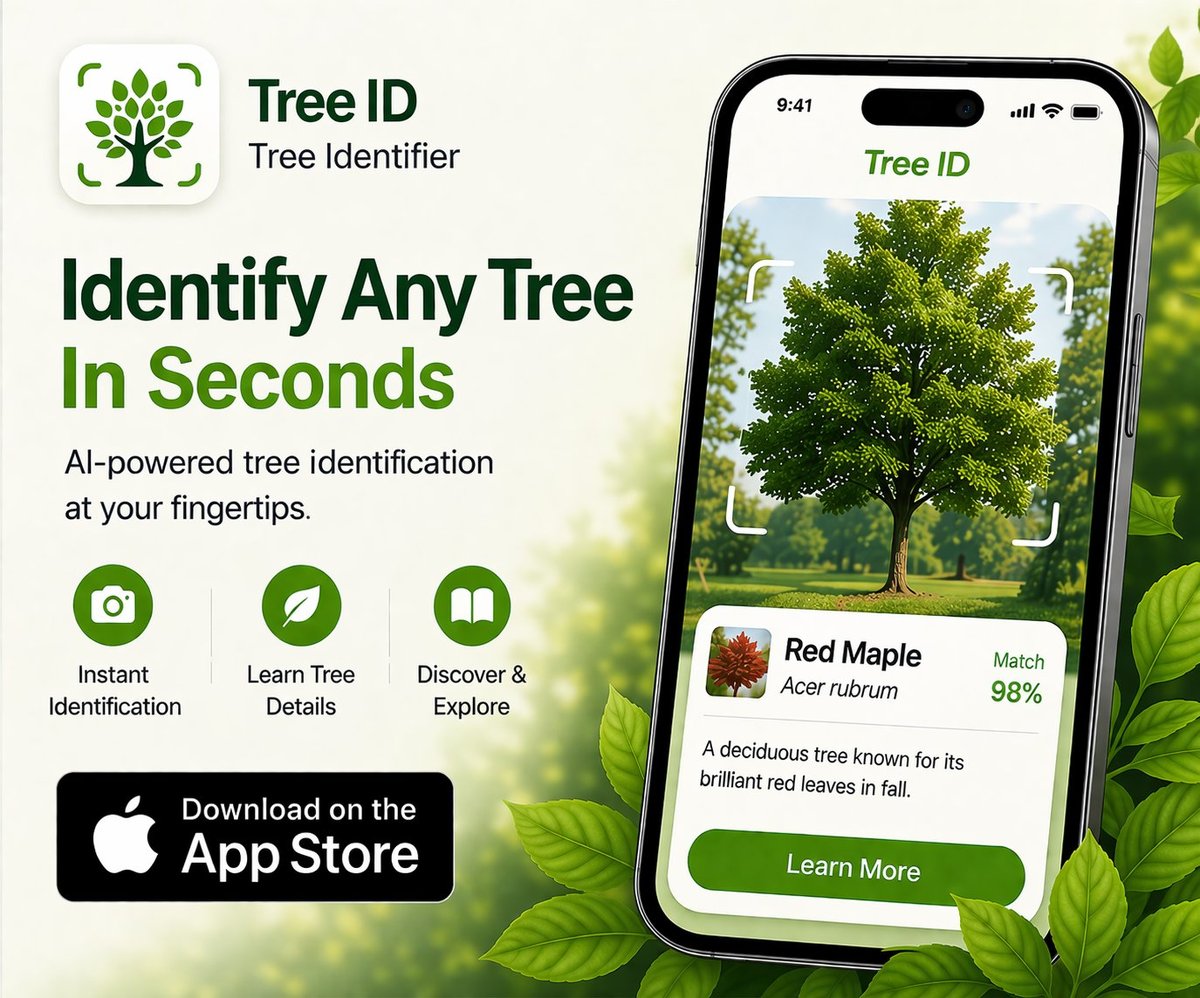
TL;DR: A "free tree identification app" usually means free to download, not free to use unlimited. Most apps give you 3-10 free identifications before requiring a subscription. Genuinely free, no-strings options exist — PlantNet and iNaturalist are fully free. Commercial apps gate features like history, PDF export, unlimited scans, and detail-rich species pages behind paid tiers. Knowing what's actually free before you download saves a surprising amount of frustration.
📌 If you want unlimited free tree ID with no ads and no upsell: PlantNet (research-backed, European-strong) or iNaturalist (community-driven, slower but more accurate).
What "free" actually means in tree ID apps
"Free" is the most overloaded word on the App Store. It can mean any of these things, and they're not the same:
- Free to download, paid to use. The app installs without payment, but identifications require a subscription from the first scan.
- Free trial, then paid. Typically a 3-7 day window of full access that auto-converts to a recurring subscription.
- Freemium with limits. A small number of free identifications per day or week, with paid tiers unlocking more.
- Free with ads. Unlimited identifications, but every scan shows a video or banner ad.
- Fully free. No subscription, no ads, no limits — usually because the app is funded by research grants, donations, or a non-profit.
The App Store label "Offers In-App Purchases" appears on all but the last category. That label is the first signal to check. Even better: scroll down on the App Store page and tap "In-App Purchases" to see the actual price list before downloading.
What you should expect to get for free
A baseline free tier in 2026 should include:
- At least 3-5 identifications per day (or 10-20 per week) — enough to evaluate accuracy before committing
- Common name and scientific name in the result
- A short species description
- The ability to use leaf, bark, and whole-tree photo inputs
- Basic photo cropping in the app
- The most recent few identifications saved in history
If a "free" app gives you less than this — for example, locking you out after one identification or refusing to display the species name without payment — it's free in name only. The free tier should be enough to genuinely evaluate whether the app's identifications are accurate for the trees you care about.
What's typically behind the paywall
Premium tiers across the major apps gate roughly the same set of features:
- Unlimited identifications. The single biggest paywall lever.
- Full species detail. Family, size, native range, uses, similar species, identification tips.
- Identification history. Past scans saved permanently, searchable, exportable.
- PDF report export. For nature journals, school assignments, property surveys.
- Ad removal. Where the free tier shows ads.
- Plant care reminders. Watering, pruning, fertilizing schedules (more common in plant apps than tree-specific apps).
- Disease and pest diagnosis. A separate AI feature that identifies what's wrong with the tree.
- Multi-photo identifications. Submit several photos for higher confidence.
For occasional users, the free tier is enough. For frequent users — hikers identifying many trees on a single trail, biology teachers preparing class material, landscape designers cataloging properties — a subscription pays for itself quickly. The question isn't "free vs paid" but "do I use this often enough to pay?"
Avoiding subscription traps
The most common complaints across the App Store reviews of tree identification apps come from accidental subscriptions. Here's what to watch for:
- Free trials that auto-convert. A 3-day free trial that becomes a $9.99 weekly subscription is the most common pattern. The trial is legitimate, but most users forget to cancel. Set a calendar reminder for one day before the trial ends.
- Weekly subscriptions framed as "low cost." $5.99 per week sounds cheap; it's $311 per year. Yearly subscriptions are almost always better value if you'll keep using the app.
- Pre-checked auto-renew. Some apps default to auto-renewing even after explicit cancellation — you have to disable it separately in iOS Settings → Apple ID → Subscriptions.
- "Limited time" pricing that isn't limited. The "50% off, expires in 24 hours" countdown resets when you reopen the app.
- Hidden subscription requirements after onboarding. Some apps let you start onboarding for free, then require a subscription on the very first identification attempt. Read App Store reviews to spot this.
The safest pattern: download an app, immediately go to iOS Settings → Apple ID → Subscriptions and check what's been added. If a subscription was created during onboarding, you can cancel it right then while still using the free tier or trial.
Truly free options worth knowing
PlantNet. Funded by a consortium of French research institutions. Genuinely free, no ads, no subscriptions. Strong European tree coverage; weaker but workable for North America. Best for users who want zero friction and don't need polished UI.
iNaturalist. Non-profit, jointly run by the California Academy of Sciences and National Geographic. Completely free, no ads. Identifications come from the community of botanists rather than AI alone, so they're slower (minutes to hours) but generally more accurate. The Seek companion app offers instant AI identification powered by the same backend, also free.
USDA PLANTS database (web, not an app). Free reference for North American species. Useful for confirming an app's identification with authoritative data.
Local extension service websites. Most US state universities run free tree identification keys for their state's native species — slower than apps but extremely accurate and tied to your specific region.
How Tree Identifier handles this
Tree Identifier is free to download with basic AI-powered identifications available without a subscription. Identification history is saved locally, and the species name plus core details are shown free. Premium unlocks unlimited identifications, full species detail pages, PDF report export, and history search — features mostly useful for frequent users (hikers, students, designers). The app offers a $19.99 lifetime option in addition to weekly and monthly subscriptions, which is unusual in the category — most competitors only offer recurring billing.
The bigger picture: in iOS Settings → Apple ID → Subscriptions you can review and cancel any subscription with two taps. iOS makes this clearer than most platforms, which is why subscription complaints are usually about users not knowing to look there. Always check after downloading any new app.
The honest math on free vs paid
If you identify 1-2 trees per month — a tree at the cabin, a neighbor's odd-looking shrub — you're fine on free tiers across all major apps. If you identify 10+ trees per month, paid tiers start to make sense. A few comparisons:
| Use case | Recommended tier |
|---|---|
| Occasional curiosity (1-2 trees/month) | Free tier of any app, or PlantNet |
| Regular weekend hiker (5-15 trees/month) | Free tier + iNaturalist for confirmation |
| Biology teacher / nature journaler | Annual or lifetime subscription |
| Landscape designer / arborist apprentice | Lifetime where available; multi-app workflow |
| Citizen scientist contributing data | iNaturalist exclusively (free) |
Frequently asked questions
Is there a completely free tree identification app with no ads?
Yes. PlantNet is fully free, ad-free, and funded by research grants. iNaturalist is also free and ad-free, funded as a non-profit. Both are legitimate, well-maintained options with no hidden subscription requirements.
Why do "free" apps ask me to subscribe immediately?
Because their business model requires it. Running AI image models on cloud GPUs costs real money per scan, and the developer needs to cover those costs. Truly free apps offset this with research funding or donations. Commercial apps offer a free trial or limited free tier as a sample, then ask for payment for sustained use.
Can I cancel a subscription I signed up for accidentally?
Yes. Go to iOS Settings → Apple ID → Subscriptions, find the app, and tap Cancel. The subscription continues until the end of the current billing period (no refund for unused time, but no further charges). For free trials, cancelling before the trial ends prevents any charge.
Are free tree identification apps less accurate?
Not necessarily. The AI accuracy is the same regardless of whether you've paid — what changes is how many identifications you're allowed per day and how much detail you see about the result. PlantNet, despite being free, uses research-grade models comparable to commercial apps for European species.
What's the catch with PlantNet?
No catch — but the UI is more functional than polished, North American coverage is uneven compared to Europe, and bark-specific identification is weaker than commercial alternatives. Your observations are optionally contributed to a biodiversity research database. If you're OK with those trade-offs, it's the best fully-free option.
Why are weekly subscriptions so expensive in the long run?
Weekly pricing is designed for users who underestimate annual cost. $4.99 per week is $260 per year. Most apps offering weekly subscriptions also offer monthly or annual plans at much better effective rates — typically 60-80% less per month — but the weekly option is often the most prominent on the upgrade screen because it converts highest at signup.
Is the App Store privacy label reliable?
It's self-reported by the developer but Apple audits it. Most labels are accurate, though they describe categories of data collection rather than specifics. Cross-reference with the app's privacy policy and recent reviews if you want certainty. For tree ID apps specifically, look for "Data Linked to You" — apps marked "Data Not Linked to You" or "Data Not Collected" have stronger privacy practices.
Try Tree Identifier — free on iPhone
AI-powered tree ID from a single photo. Free tier with no signup required.
Download on the App Store