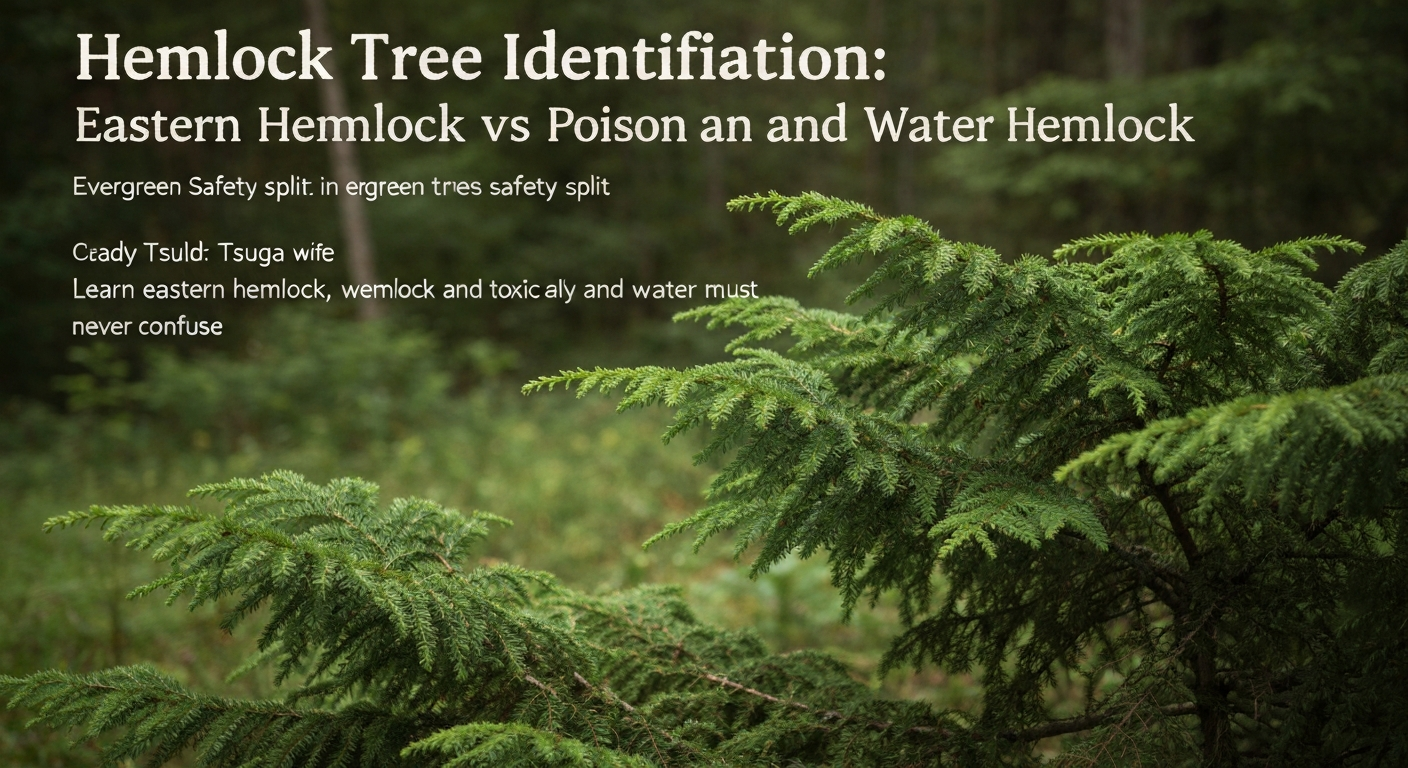
TL;DR: Hemlock identification requires separating two completely different plant groups that share one name. Hemlock trees (Tsuga) are evergreen conifers with flat, soft needles, drooping branch tips, and small woody cones in cool forests. Poison hemlock (Conium maculatum) and water hemlock (Cicuta) are herbaceous carrot-family plants with divided leaves and white umbrella-shaped flower clusters — both are deadly if ingested. Eastern hemlock identification (Tsuga canadensis) uses flat needle sprays with two white lines beneath each needle. If the plant is woody with needles, it is a tree — not the toxic hemlock of history. Photograph needles and cones safely, then confirm with the Tree Identifier app.
⚠️ Hemlock identification safety rule: Woody evergreen with flat needles and cones = Tsuga tree (eastern or western hemlock). Herbaceous plant with purple-blotched hollow stem and white umbel flowers = poison hemlock — do not touch or taste. Wetland umbellifer with chambered root = water hemlock — the most lethal plant in North America.
Why hemlock identification confuses everyone
The word hemlock applies to an entire genus of graceful conifer trees and to some of the deadliest flowering plants on the continent. Search volume for hemlock identification is high because hikers, gardeners, and foragers encounter both meanings — often in the same region.
Eastern hemlock (Tsuga canadensis) shades Appalachian coves and northern ravines. Poison hemlock (Conium maculatum) lines sunny roadsides and vacant lots. Water hemlock (Cicuta maculata and related species) hides in wet meadows where streams slow. Hemlock tree identification and water hemlock identification share almost no botanical characters beyond the name.
Before any field work, decide which growth form you are facing:
- Tree or tall shrub, evergreen, needles year-round: Tsuga — eastern hemlock, western hemlock, or mountain hemlock.
- Herbaceous, dies back in winter, fern-like divided leaves, white flat flower clusters: Poison hemlock or water hemlock — Apiaceae family, not conifers.
Identifying hemlock correctly can be a life-or-death distinction for foragers. For tree lovers, eastern hemlock identification is about recognizing a keystone forest species now threatened by hemlock woolly adelgid.
Eastern hemlock identification (Tsuga canadensis)
Eastern hemlock is the hemlock tree of eastern North America — a long-lived conifer that can exceed 150 feet in virgin stands, though most mature trees today are smaller due to adelgid damage and logging history.
Needles: Flat, soft, flexible, about ¼ to ½ inch long. Each needle attaches individually to the twig — never in bundles of two, three, or five like pine. Pull a twig gently; eastern hemlock needles feel feathery, not prickly. The underside shows two broad whitish stomatal bands — the fastest eastern hemlock identification character in the field.
Needle arrangement: Needles lie mostly in one flat plane along the twig, like a fan or comb — similar to fir but with shorter needles and a notched or rounded tip rather than a sharp point.
Branch form: Leaders and branch tips droop downward — a graceful weeping habit visible from a distance in the forest understory or ravine edge.
Cones: Small, oval, papery, about ½ to 1 inch long, hanging from branch tips. Scales are thin and rounded. Cones persist after opening. Eastern hemlock cones are much smaller than spruce cones and lack the rigid barrel shape of fir cones.
Bark: Young bark smooth and gray-brown. Old trunks develop thick, furrowed, reddish-brown plates — hemlock tree bark identification on large stems is distinctive in winter surveys.
Habitat: Cool, moist sites — north-facing slopes, stream gorges, ravines, hemlock-hardwood forests. Eastern hemlock tolerates deep shade as a seedling and often forms dense evergreen canopy over trout streams.
Range: Nova Scotia to Minnesota, south along the Appalachians to northern Alabama and Georgia. The core of eastern hemlock tree identification territory is Pennsylvania, New York, New England, and the southern Appalachian coves.
Western hemlock and mountain hemlock
Western hemlock (Tsuga heterophylla) dominates Pacific Northwest coastal forests from Alaska to northern California and east into the northern Rockies. If you are identifying hemlock west of the Cascades, western hemlock is the default Tsuga.
Needles: Longer than eastern hemlock — often ½ to 1 inch — blunt-tipped, flat, with less conspicuous white bands beneath. Western hemlock often shows needles of two sizes on the same twig (heterophylly — the species name means different leaves).
Form: Extremely drooping top and branch tips — even more pendulous than eastern hemlock. Mature trees are tall, narrow-crowned giants in coastal fog belts.
Cones: Similar small ovals to eastern hemlock, hanging from tips.
Bark: Darker, thinner, deeply furrowed on old trunks — brown to blackish gray.
Mountain hemlock (Tsuga mertensiana) occupies subalpine zones in the West — shorter, often wind-shaped trees with bluish-green needles and larger cones relative to branch size. Western hemlock tree identification and mountain hemlock identification overlap at elevation transitions; cone size and alpine habitat help split them.
Tsuga vs fir vs spruce — conifer lookalikes
Hemlock tree identification among conifers focuses on needle attachment and texture:
- Pine: Needles in bundles of two, three, or five — never single flat sprays.
- Spruce: Needles four-sided, sharp, stiff, rolling easily between fingers; cones hang down but are larger and woody-scaled.
- Fir (Abies): Flat needles like hemlock, but cones stand upright on branches and disintegrate on the tree — hemlock cones hang and persist.
- Yew (Taxus): Flat dark-green needles without pale stomatal bands beneath; red cup-shaped arils instead of woody cones — toxic seeds.
Photograph a twig showing needles attached singly plus a hanging cone if present. See Best Photo for Tree ID for conifer close-up tips.
Poison hemlock identification (Conium maculatum)
Poison hemlock is not a tree. It is a biennial herb in the carrot family (Apiaceae), native to Europe and invasive across North America. Every part is toxic — the alkaloids coniine and gamma-coniceine disrupt the nervous system. Historical accounts of Socrates refer to this plant, not Tsuga.
Life cycle: First year rosette of deeply divided, fern-like leaves close to the ground. Second year bolts a tall hollow stem — often 6 to 10 feet — topped with broad umbrella-shaped white flower clusters (compound umbels).
Stem: The signature poison hemlock identification mark — smooth, hollow, green to purple-spotted or streaked with reddish-purple blotches, especially on lower internodes. Stems are hairless and waxy. Cut stem may smell musty or mouse-like — do not rely on smell alone.
Leaves: Fine, lacy, pinnately compound — resemble parsley, carrot tops, or wild chervil. Leaflets are narrow and deeply cut.
Flowers: White, small, in flat umbels 2 to 4 inches wide, blooming late spring through summer. Seeds are ribbed, paired, and split in two.
Habitat: Disturbed sunny ground — roadsides, fence rows, ditches, vacant lots, trail edges, stream banks in full sun. Poison hemlock spreads aggressively along highways.
Critical split from Tsuga: No wood, no needles, no cones. Dies to the ground after seed set. If you can wrap your hand around a purple-blotched hollow stem with carrot-family flowers, you are not looking at eastern hemlock identification material — you are looking at a plant that can kill you.
Water hemlock identification (Cicuta)
Water hemlock identification matters for anyone gathering wild plants near wetlands. Cicuta maculata (spotted water hemlock) and western species contain cicutoxin — a violent convulsant that can kill within hours. Roots and base of stems concentrate the toxin.
Habitat: Wet meadows, marshes, pond margins, slow streams, irrigation ditches — always in or near saturated soil. Water hemlock identification starts with where your feet are standing.
Leaves: Pinnately compound, divided like poison hemlock but often coarser leaflets with pointed teeth. Veins sometimes end in notches between teeth — a technical character botanists use.
Stems: Hollow, smooth, green to purplish, chambered at the base — internal partitions visible if cut. Height 3 to 7 feet when flowering.
Flowers: White compound umbels like poison hemlock — Apiaceae family resemblance is why water hemlock identification is difficult for beginners.
Root: Thick, fleshy, often clustered tuberous roots at the base — the deadliest part. Never pull or taste wetland umbellifers.
Split from poison hemlock: Water hemlock prefers wet feet; poison hemlock tolerates dry roadsides. Both are herbaceous; neither is a conifer. Split from Tsuga: trees vs waist-high flowering herbs.
If foraging wild carrots or parsnips, read Tree Identification for Hikers for safety habits — positive ID before any harvest, multiple characters, expert confirmation for umbellifers.
Side-by-side hemlock identification summary
Use this table mentally in the field:
- Eastern hemlock (Tsuga): Woody tree, evergreen flat needles, white bands beneath, small hanging cones, moist forest, drooping branches.
- Western hemlock (Tsuga): Same genus, longer needles, Pacific Northwest coastal forest, strongly drooping crown.
- Poison hemlock (Conium): Herbaceous biennial, purple-blotched hollow stem, fern-like leaves, white umbels, roadsides and sunny waste ground.
- Water hemlock (Cicuta): Herbaceous perennial, wetlands, white umbels, chambered hollow stems, deadly tuberous root base.
Hemlock tree identification never involves tasting stems. Toxic hemlock identification never involves confusing a rosette with a conifer — unless you are not looking at the plant at all, only the name in a search result. Always verify growth form first.
Hemlock woolly adelgid and forest context
Eastern hemlock faces decline from hemlock woolly adelgid (Adelges tsugae), an invasive insect that feeds on branch bases. White woolly ovisacs at the base of needles on undersides of twigs signal infestation. Gray-green fading foliage and thin crowns follow.
Knowing eastern hemlock identification helps citizen scientists report remaining healthy stands and supports conservation plantings. Western hemlock is less affected by this pest but faces logging pressure and climate stress at southern range edges.
Winter hemlock tree bark identification
When needles are out of reach, bark and silhouette still support hemlock tree identification:
Silhouette: Conical to narrow crown, fine-textured branching, drooping terminal shoot — especially on eastern hemlock in ravines.
Persistent cones: Small oval cones may remain on branches beneath live foliage.
Bark plates: Reddish-brown scaly bark on large eastern hemlock trunks distinguishes them from smooth-barked beech or tight-scaled spruce at a distance.
For bark photography methods, see Tree Bark Identification App Guide.
Using Tree Identifier for hemlock
Tree Identifier recognizes eastern and western hemlock from needle close-ups and cone photos across native ranges.
Best photos: One twig filling the frame — flat needle spray, pale lines visible on needle undersides. Add a hanging cone photo when available. Include drooping branch tip context if shooting from below.
Limits: Apps identify Tsuga trees — not herbaceous poison or water hemlock. If the plant lacks woody structure, use stem color, habitat, and flower form; do not depend on a tree ID app for Apiaceae safety.
Confusion: Fir and hemlock overlap in flat needles — cone position (hang vs upright on fir) settles most cases. Spruce and pine are easier splits by needle bundle and stiffness.
Hemlock identification rewards careful observers — a shade-casting conifer icon of eastern forests on one hand, and a sobering reminder to never trust common names alone on the other.
Frequently asked questions
How do you identify eastern hemlock?
Eastern hemlock (Tsuga canadensis) is an evergreen conifer with flat, soft needles about half an inch long, each with two pale white lines on the underside. Needles attach singly to the twig in a flat spray — not in bundles like pine. Branch tips droop gracefully. Cones are small, oval, and hang from branch tips. Bark on mature trees is reddish-brown with broad scaly plates. Eastern hemlock grows in cool, moist forests and ravines across the eastern US and Canada — a tall shade tree, not a roadside weed.
What is the difference between hemlock tree and poison hemlock?
They are completely unrelated plants that share a common name. Hemlock trees (Tsuga) are woody evergreen conifers with needles and small woody cones. Poison hemlock (Conium maculatum) is a herbaceous biennial in the carrot family with fern-like divided leaves, hollow purple-blotched stems, and umbrella-shaped white flower clusters. Poison hemlock grows in sunny disturbed sites — roadsides, ditches, fields — and is deadly if ingested. If the plant has needles and cones, it is a tree, not poison hemlock.
How do you identify water hemlock?
Water hemlock (Cicuta species) is the most violently toxic plant in North America. It grows in wet meadows, stream margins, and marshes with divided carrot-family leaves and umbrella-like white flower clusters. Stems are hollow and often chambered at the base — the root is the deadliest part. Water hemlock identification requires wetland habitat plus careful comparison with edible umbellifers. Never taste or handle roots. Unlike Tsuga hemlock trees, water hemlock is herbaceous, dies back in winter, and has no needles or cones.
Is eastern hemlock poisonous?
Eastern hemlock trees (Tsuga canadensis) are not poisonous in the way poison hemlock or water hemlock are. The name collision causes dangerous confusion, but Tsuga is a conifer — needles, cones, woody bark — not a toxic herb. Do not eat hemlock needles casually, but the tree itself is not the deadly plant of Socrates fame. Hemlock identification safety rule: woody evergreen with flat needles = Tsuga tree; purple-streaked hollow stem with white umbel flowers = poison hemlock.
How do you tell eastern hemlock from western hemlock?
Eastern hemlock (Tsuga canadensis) has shorter needles, usually under half an inch, with a rounded or notched tip and prominent white stomatal bands beneath. Western hemlock (Tsuga heterophylla) has longer needles, often up to an inch, with blunt tips and less conspicuous underside marking. Western hemlock branch tips droop more dramatically and it dominates Pacific Northwest coastal forests. Eastern hemlock is the Tsuga of Appalachian and northeastern ravines. Range maps do not overlap much — location is a strong clue.
What does hemlock tree bark look like?
Eastern hemlock bark on mature trees is thick, furrowed, and reddish-brown to gray with broad scaly plates — somewhat like large-cork oak but on a conifer trunk. Young stems have smooth gray-brown bark. Western hemlock bark is thinner, darker gray-brown, and deeply furrowed on old trees. Hemlock tree bark identification helps in winter when needles are harder to reach — look for the conifer form, drooping leaders, and persistent small cones beneath branches.
Can tree ID apps identify hemlock?
Yes, Tree Identifier and similar apps recognize eastern and western hemlock from clear needle close-ups showing the flat spray and pale underside lines, plus cone photos. Apps may confuse Tsuga with fir or spruce from distance — photograph needles attached singly to the twig, not in bundles. Never use an app alone to rule out poison hemlock or water hemlock on herbaceous plants — verify stem color, habitat, and flower structure before any contact.
Try Tree Identifier — free on iPhone
Photograph hemlock needles or cones and get a Tsuga species match in seconds.
Download on the App Store