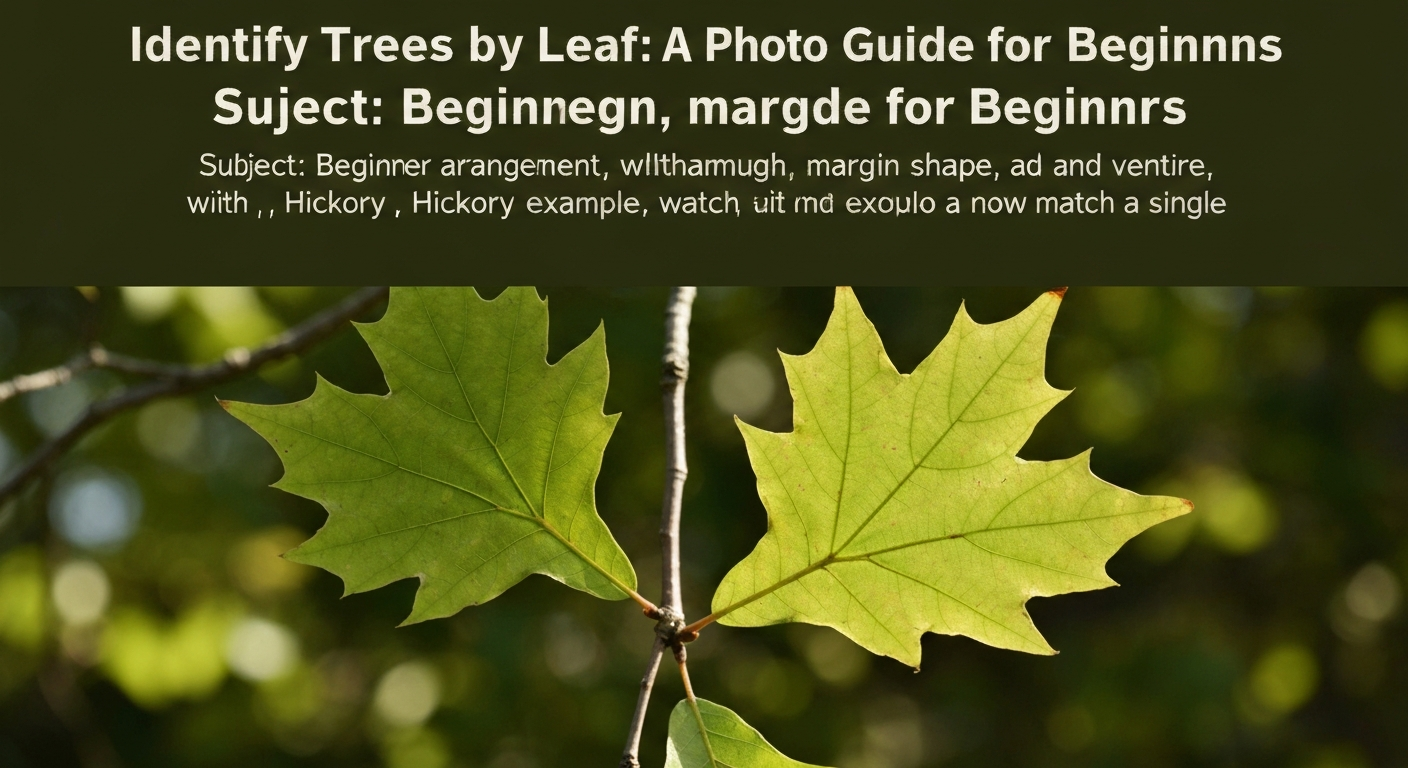
TL;DR: To identify this tree leaf from a photo, work through four traits in order: leaf arrangement (opposite vs alternate), simple vs compound structure, margin shape (smooth, toothed, or lobed), and venation pattern. Oaks (Quercus) have alternate, simple, lobed leaves. Maples (Acer) have opposite, simple, often lobed leaves. Hickories and walnuts have alternate compound leaves — nut tree identification by leaf starts with counting leaflets. Photograph the full blade against sky or your palm, then confirm with the Tree Identifier app or cross-check bark and fruit.
🍃 Tree identity by leaf gets easy once you memorize one rule: opposite leaves mean maple, ash, or dogwood; alternate leaves mean oak, birch, elm, or most everything else. That single observation narrows a mystery leaf from hundreds of species to a short list.
Why leaf photos work for tree identification
Leaves are the most photographed tree feature for good reason. They stay within reach, show species-specific shape at maturity, and carry enough detail — arrangement, margin, venation, texture — to separate major groups without climbing the trunk. When someone searches identify this tree leaf, they usually hold a single blade and want a name in minutes, not a forestry degree.
Leaf-based ID has limits. Hybrid oaks, young saplings, and stressed trees can produce atypical foliage. Fall color masks green-season traits. Ornamental cultivars may have leaves that differ from wild-type field guides. Treat a leaf ID as a strong hypothesis, then confirm with bark, fruit, or location. Apps accelerate the first step; your eyes handle context.
If botanical terms like petiole, sinus, and rachis are unfamiliar, bookmark the Tree Anatomy Glossary — it defines every trait this guide references.
Step 1: Leaf arrangement on the twig
Before you study the blade, look at how leaves attach to the branch. This is the highest-leverage trait in tree identity by leaf.
Alternate arrangement: One leaf per node, staggered left-right up the twig. Common on oak, birch, elm, poplar, cherry, hickory, walnut, and most North American forest trees. Hold the twig at arm's length and trace upward — if leaves swap sides at each point, you have alternate.
Opposite arrangement: Two leaves at each node, directly across from each other. Classic on maple, ash, dogwood, buckeye, and viburnum. Opposite arrangement is so consistent that finding it strongly points to one of a small set of families.
Whorled arrangement: Three or more leaves radiating from one node — rare, seen on catalpa and some understory species. Most beginners can ignore whorled until they encounter it deliberately.
Photograph a short twig section with two or three nodes visible. Apps read arrangement from twig photos almost as well as human eyes do, and the photo prevents the common mistake of identifying a maple leaf while forgetting the tree is an alternate-leaved birch nearby.
Step 2: Simple vs compound leaves
A simple leaf is one continuous blade on one petiole — oak, maple, beech, magnolia. A compound leaf has multiple leaflets sharing one stalk (the rachis) before a single attachment to the twig — hickory, walnut, ash, locust, sumac.
The trick that trips beginners: count attachments to the twig, not leaflet tips. A hickory may show five or seven leaflet blades, but they all connect to one rachis that connects once to the twig — that is one compound leaf, not seven simple leaves.
Compound leaves divide into:
- Pinnately compound: Leaflets in a row along the rachis — walnut, pecan, ash, locust.
- Palmately compound: Leaflets radiating from one point — Ohio buckeye, horse chestnut.
Nut tree identification by leaf relies heavily on this step. Hickories and walnuts are alternate and pinnately compound. If you see that combination plus serrated leaflet edges, you are in the walnut family (Juglandaceae) or nearby lookalikes — not in oak or maple territory.
Step 3: Leaf margin — edge shape
The margin is the leaf edge. Botanists classify it into a handful of patterns that map cleanly to photos:
- Entire (smooth): No teeth or lobes — magnolia, some holly, redbud on mature leaves.
- Serrate (toothed): Fine, forward-pointing teeth like a saw — birch, elm, chestnut, cherry, many hickory leaflets.
- Doubly serrate: Teeth on teeth — ironwood, hornbeam, some birches.
- Lobed: Deep or shallow indentations (sinuses) between projecting sections (lobes) — oak, maple, sycamore, sweetgum.
Margin matters because it separates lookalikes within the same arrangement group. Alternate + simple + lobed strongly suggests oak or sweetgum, not birch. Opposite + simple + lobed points to maple. Opposite + compound leaflets with serrate edges suggests ash.
When you photograph a leaf to identify this tree leaf, fill the frame with the margin in focus. Side lighting at an angle reveals teeth that flat midday sun washes out.
Step 4: Venation — how veins run
Venation is the vein pattern inside the blade. Two patterns dominate temperate tree ID:
Pinnate venation: One central midrib with secondary veins branching toward the margin — oak, birch, elm, beech, cherry. The midrib is straight and obvious.
Palmate venation: Several major veins radiating from the petiole attachment like fingers — maple, sycamore, poplar, sweetgum. Maple leaves show palmate venation even when the blade is lobed; follow the main veins from the stem outward.
Less common patterns include parallel venation (ginkgo, some monocots) and arcuate veins (dogwood — veins curve toward the leaf tip). Venation is easiest to see when the leaf is backlit — hold it toward the sky and shoot through the blade.
Combining margin and venation resolves many confusions. A lobed, alternate leaf with pinnate venation and rounded lobe tips is classic Quercus — quercus leaf identification at the genus level often ends there unless you count lobe number and sinus depth for species.
Oak leaves (Quercus)
Oaks are the archetypal alternate, simple, lobed tree in North America. Quercus leaf identification starts with two broad groups:
White oak group: Rounded lobe tips, no bristle tips at lobe ends. Sinuses are often U-shaped or shallow. Examples: white oak (Q. alba), bur oak (Q. macrocarpa), post oak (Q. stellata). Leaves feel slightly leathery; some species keep dried leaves on branches through winter (marcescence).
Red oak group: Pointed lobes, often with bristle tips at lobe ends. Sinuses tend to be deeper and more angular. Examples: northern red oak (Q. rubra), pin oak (Q. palustris), black oak (Q. velutina). Fall color often brilliant red.
Live oaks and evergreen oaks: In the South and West, some oaks hold narrow, unlobed or spiny-toothed leaves year-round — coast live oak, interior live oak. Do not expect every oak to look like a textbook white oak leaf.
Oak confusions: young pin oak and red maple both have pointed lobes, but maple is opposite and palmate; oak is alternate and pinnately veined with bristle tips in the red oak group. Sweetgum has star-shaped leaves with more lobes (usually five to seven) and often smells resinous when crushed.
Maple leaves (Acer)
Maples are opposite, simple, and usually palmately lobed or veined — the flag of Canada is a stylized sugar maple. Acer leaf identification leans on lobe count, sinus depth, and leaf size.
Sugar maple (A. saccharum): Five lobes, smooth margins between lobes (no teeth), U-shaped sinuses, dark green summer color, brilliant orange-red fall. The yard tree people mean when they say "hard maple."
Red maple (A. rubrum): Three to five lobes with V-shaped sinuses and serrated edges between lobes. Highly variable — some leaves look almost unlobed. One of the most common native maples in eastern North America; often confused with oak when people skip the opposite-arrangement check.
Silver maple (A. saccharinum): Deeply cut lobes, silvery underside, long petiole. Common riparian tree with aggressive surface roots in yards.
Norway maple (A. platanoides): Opposite, five lobes, milky sap when the petiole is broken — a quick field test. Widely planted, often invasive in natural areas.
Japanese maple (A. palmatum and cultivars): Ornamental, deeply dissected lobes, infinite cultivar variation. Apps handle common forms well; rare cultivars may misidentify.
Maple vs oak is the classic beginner puzzle. Opposite = maple family candidate. Alternate = not maple. Once arrangement is settled, venation confirms: palmate in maple, pinnate in oak.
Hickory leaves
Hickories (Carya) are alternate, pinnately compound — nut tree identification by leaf often lands here when walkers find five- or seven-leaflet sprays on forest floors.
Shagbark hickory (C. ovata): Usually five leaflets, coarse serration, large terminal leaflet. Named for peeling shaggy bark on mature trunks.
Pignut and mockernut hickories: Five to seven leaflets, often with hairy petioles on mockernut. Nuts smaller than walnut; husks split differently.
Pecan (C. illinoinensis): Many narrow leaflets (nine to seventeen), southern and planted orchards. Leaflets are more lance-shaped than shagbark's oval leaflets.
Confused with: Ash — also opposite, pinnately compound (opposite, not alternate!). Tree-of-heaven — alternate compound but leaflets have blunt teeth and a foul smell when crushed. Walnut — similar compound form but fewer leaflets and different bud and fruit cues.
Walnut leaves
Black walnut (Juglans nigra) and butternut (J. cinerea) have alternate, pinnately compound leaves, typically with fewer leaflets than pecan — often eleven to twenty-three for black walnut, but grouped on one rachis so the spray looks substantial.
Black walnut: Leaflets lanceolate, finely serrated, aromatic when crushed. Produces large green husks with edible nuts. Bark dark and deeply furrowed on mature trees.
Butternut: Similar compound leaf but fewer leaflets, often sticky-hairy, lighter bark. Less common and declining from disease in many regions.
English walnut (J. regia): Planted orchard tree; larger leaflets, fewer per leaf than black walnut. Common in California plantings.
Walnut vs hickory: both alternate compound with serrated leaflets. Hickory leaflets are usually fewer and stouter; walnut leaflets are more numerous and slender. Fruit on the ground settles it — walnut husks are green and messy; hickory husks split into four sections.
Photo tips for leaf identification
The best app for leaf identification still fails on blurry, partial, or shadow-heavy photos. Before you open any app, capture images an expert could use:
- Fill the frame. One leaf, entire blade visible, petiole included. Cut off tips and the ID loses lobe count and margin detail.
- Plain background. Sky, white paper, or an open palm. Busy grass and mulch confuse edge detection.
- Focus on the margin. Tap focus on the leaf edge so teeth and lobes are sharp.
- Add a twig shot. One photo showing two or three nodes proves opposite vs alternate.
- Backlight for venation. Sun behind the leaf reveals vein architecture.
- Avoid wet, curled, or eaten leaves. Water glare and insect damage distort shape.
- Record location mentally. A palm tree leaf ID in Minnesota is a houseplant, not a local species.
For framing, lighting, and when to choose bark instead of leaf, read Best Photo for Tree ID: Leaf, Bark, or Whole Tree? — the difference between a guess and a confident match is usually photographic, not botanical.
Using the Tree Identifier app
Manual traits build lasting skill, but when you need to identify this tree leaf on a lunch-break walk, an app for leaf identification closes the gap between curiosity and a name on screen.
Workflow: Photograph the leaf using the tips above. Open Tree Identifier, submit the image, and read the top match plus any alternates. Check that the suggested species grows in your region and that bark or form fits. If the app returns red oak but the tree has smooth gray bark and opposite buds, take a twig photo and run again.
Where apps excel: Common oaks, maples, hickories, walnuts, birch, cherry, and popular ornamentals. Compound leaves with clear leaflet count. Distinctive lobed simple leaves in good light.
Where to double-check: Hybrid oaks, ash vs hickory when only leaflets are shown without the twig, cultivars with atypical foliage, and species outside the app's regional training emphasis. Choosing the right tool matters — see App to Identify Trees: How to Choose the Right One for comparison criteria.
Tree identity by leaf plus one confirmation photo (bark or fruit) routinely beats either method alone. Treat the app as a fast first opinion, not a courtroom verdict.
Putting it together: a five-minute field routine
When a friend texts "what tree is this?" with a leaf photo, run this sequence:
- Opposite or alternate? → Cuts the list roughly in half.
- Simple or compound? → Separates oak/maple from hickory/walnut/ash.
- Margin: entire, toothed, or lobed? → Narrows genus.
- Venation: pinnate or palmate? → Confirms maple vs oak when lobed.
- Photo to app → Species hypothesis.
- Bark or fruit sanity check → Confirm before you tell the neighbor they have a rare tree.
Repeat the routine on ten common yard trees and leaf ID becomes automatic. Start with the trees in 10 Most Common Backyard Trees in the US — red maple, white oak, sugar maple, river birch, and black walnut cover most of the trait combinations this guide describes.
Frequently asked questions
Can I identify a tree from a single leaf photo?
Often yes — if the photo shows the full leaf blade, clear margin, and how the leaf attaches to the twig. A single leaf narrows most trees to a family or genus. Species-level ID may need a second photo of bark, fruit, or the twig showing whether leaves are opposite or alternate. Apps trained on leaf images handle common backyard trees well when the photo is sharp and well lit.
What is the fastest way to tell oak leaves from maple leaves?
Check leaf arrangement first. Maples have opposite leaves — two leaves meet at the same node on opposite sides of the twig. Oaks have alternate leaves — one leaf per node, staggered up the branch. Then look at lobes: oak lobes are rounded or pointed but the sinuses between lobes are usually U-shaped or deep; maple lobes often end in sharp points with V-shaped sinuses. Red maple and white oak are the classic pair beginners compare.
How do I know if a leaf is simple or compound?
A simple leaf is one blade attached to the twig by a single petiole — oak, maple, and cherry are simple. A compound leaf has multiple leaflets on one stalk — hickory, walnut, ash, and locust are compound. Do not count leaflet tips as separate leaves; follow the stalk back to the twig. If several small blades share one attachment point, you are looking at a compound leaf.
What does opposite vs alternate leaf arrangement mean?
Alternate means one leaf per node, alternating left and right along the twig — oak, birch, elm, and most common forest trees. Opposite means two leaves at each node, directly across from each other — maple, ash, dogwood, and buckeye. Leaf arrangement is the single most useful trait when you want to identify this tree leaf quickly because it cuts the candidate list in half.
Can leaf ID apps identify nut trees like hickory and walnut?
Yes for common species. Hickory and walnut have distinctive compound leaves that apps recognize when leaflets and rachis are visible. Shagbark hickory, pignut hickory, black walnut, and butternut are usually in training data for North American apps. Confusion happens between hickory and ash or between walnut leaflets and tree-of-heaven — a clear photo of the whole compound leaf and leaflet count helps.
What time of year is best for leaf identification?
Late spring through early fall, when leaves are fully expanded and green. Summer foliage shows true shape and size. Fall color can distort identification because reds and yellows hide green leaf traits. Early spring buds and unfolding leaves work for experienced users but are harder for beginners and apps. Winter leaf ID relies on fallen leaves on the ground — still useful, but check that the leaf came from the tree you are studying.
What should I photograph besides the leaf for better accuracy?
Add a twig photo showing how leaves attach — opposite or alternate is decisive. Bark at chest height helps confirm genus. Fruit, nuts, or samaras (helicopter seeds) are strong species clues. Photograph the leaf against sky or your palm so the margin and venation show. For a full workflow, see our guide to the best photo for tree ID.
Try Tree Identifier — free on iPhone
Photograph any leaf and get a species match in seconds — oak, maple, hickory, walnut, and hundreds more.
Download on the App Store