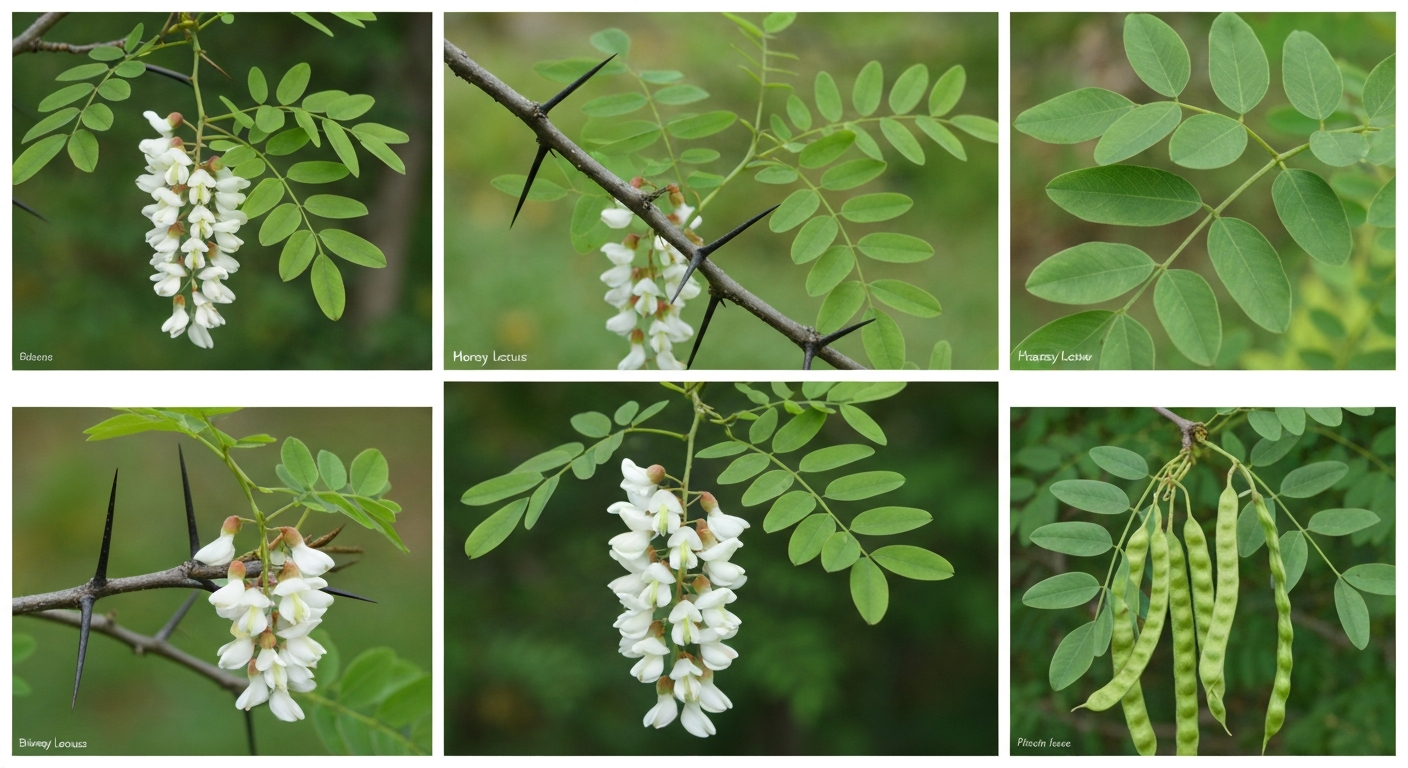
TL;DR: "Locust" refers to two unrelated legume trees — black locust (Robinia pseudoacacia) and honey locust (Gleditsia triacanthos). For black locust tree identification, look for once-pinnate compound leaves with oval leaflets, paired thorns at leaf bases, white fragrant spring flowers, and bark with deep rope-like ridges. Honey locust has fern-like bipinnate leaves, long twisted seed pods, and often large branched trunk thorns (though street trees are usually thornless). Both fix nitrogen and colonize disturbed ground — but only black locust is native to the Appalachians; honey locust is native to the central US. When leaves are ambiguous, thorns, pods, and bark separate them fast — or confirm with the Tree Identifier app.
🌿 Locust tree identification starts with one rule: if the leaves are compound, check whether they are once-pinnate (black locust — oval leaflets on one stem) or twice-pinnate (honey locust — tiny leaflets on branched side-stems). That single split resolves most identify locust tree questions before you ever touch the bark.
Robinia vs Gleditsia: two genera, one confusing name
Locust tree identification gets tangled because English uses "locust" for two different genera in the pea family (Fabaceae). Botanists place black locust in Robinia and honey locust in Gleditsia. They are not close relatives — they converged on similar common names because both have compound leaves, thorns, and legume seed pods.
Understanding the genus split is the foundation for every other ID feature:
- Black locust (Robinia pseudoacacia): Once-pinnate compound leaves; paired spines at leaf bases; white pea-like flowers in hanging racemes; flat brown pods; deeply furrowed bark with rope-like ridges. Native to the Appalachian and Ozark regions; widely planted and escaped beyond native range.
- Honey locust (Gleditsia triacanthos): Bipinnate (twice-pinnate) compound leaves; large branched thorns on trunk and branches (wild form); greenish-yellow spring flowers; long twisted pods with sweet pulp; scaly, plate-like bark. Native to central North America; common street tree in thornless form.
Both genera share legume traits: nitrogen-fixing root nodules, alternate leaf arrangement, and seed pods that split open when ripe. Neither is a true "locust" in the biblical sense — that name was applied by early colonists who thought the pods resembled carob (St. John's bread). The botanical reality is simpler: Robinia and Gleditsia are fast-growing pioneer trees that thrive in full sun on disturbed soil.
If compound leaf terminology is new, the Tree Anatomy Glossary defines pinnate, bipinnate, and leaflet in plain English.
Black locust (Robinia pseudoacacia)
Black locust is the tree most people mean when they search black locust tree identification. It is a medium to large deciduous tree — typically 40 to 80 feet — with an irregular crown and a reputation for aggressive root suckering.
Leaves: Pinnately compound — one central rachis with oval leaflets arranged in pairs along it, plus one leaflet at the tip. Usually 7 to 21 leaflets per leaf, each 1 to 2 inches long, bluish-green above and paler below. Leaflets are entire (smooth-edged), not toothed. Leaves turn clear yellow in fall and drop early compared to many neighbors.
Thorns: Sharp paired spines at the base of each leaf where it attaches to the twig — one spine on each side. Suckers and young shoots can be densely armed. This is the quickest black locust field mark when leaves are present.
Flowers: Fragrant white pea-like flowers in drooping racemes, 4 to 8 inches long, appearing in late spring after leaves unfold. The scent is strong and sweet — unmistakable when a grove is in bloom.
Pods: Flat, brown, papery legume pods, 2 to 4 inches long, containing hard dark seeds. Pods persist on branches into winter and litter the ground beneath mature trees.
Bark: Young bark is smooth, gray-brown, sometimes with orange undertones. Mature bark develops deep vertical furrows and ridges that look braided or rope-like — the classic black locust bark identification pattern. Scraping the bark reveals orange-red inner tissue.
Form and habitat: Colonizes old fields, roadsides, fence rows, and burned or logged ground. Spreads by seed and root suckers, forming clonal thickets. Planted for fence posts and erosion control because the heartwood is extremely rot-resistant. Common across the eastern US and planted worldwide.
Confused with: Honey locust (bipinnate leaves, different thorns), Kentucky coffeetree (much larger leaflets, thick pod), and young sumac (compound leaves but serrated leaflets and red fruit clusters).
Honey locust (Gleditsia triacanthos)
Honey locust is the bipinnate locust — the one with fern-like foliage lining city streets across North America, usually in thornless cultivated form.
Leaves: Bipinnately compound — the main leaf stem branches into sub-stems (pinnae), each bearing many small leaflets. The overall effect is lacy and fern-like, quite different from black locust's bold oval leaflets. Identification honey locust tree leaves is easiest on a single full leaf held against the sky: you should see two orders of branching before the tiny leaflets.
Thorns: Wild honey locust carries large, branched thorns — sometimes several inches long — scattered along the trunk and major branches. They are stout and woody, not the paired leaf-base spines of black locust. Most urban plantings use thornless cultivars ('Inermis' and related selections), so absence of thorns does not rule out honey locust on a city sidewalk.
Flowers: Small, greenish-yellow, inconspicuous clusters in late spring — far less showy than black locust's white racemes. Many people never notice honey locust flowers.
Pods: Long, twisted, flat legume pods — often 12 to 18 inches — with sweet, edible pulp between the seeds (the "honey" in the name). Pods are maroon when young, turning dark brown; many hang on the tree through winter. This is a strong honey locust tree identification feature from fall through early spring.
Bark: Gray-brown, breaking into scaly plates with curled edges that reveal orange-brown inner bark. Less deeply furrowed than mature black locust — more shaggy and plate-like than rope-like.
Form and habitat: Medium to large tree, 60 to 80 feet, with an open, spreading crown and fine-textured shade. Native to river floodplains and moist soil in the central US. Widely planted as a street and park tree for dappled shade and drought tolerance once established.
Confused with: Black locust (once-pinnate leaves, white flowers), mimosa or silk tree (also bipinnate but with pink powder-puff flowers and smooth gray bark), and Kentucky coffeetree (similar leaf size but much coarser leaflets and thick leathery pods).
Locust tree identification by leaf
Locust tree identification by leaf is the fastest method from late spring through summer. Both species have compound leaves and alternate arrangement — so the key is pinnate vs bipinnate structure.
- Confirm alternate arrangement. Locust leaves are alternate on the twig — one leaf per node, staggered left and right. Opposite arrangement rules out both locusts.
- Count branching orders. Hold one full leaf by the petiole. If leaflets attach directly to a single central stem, you have black locust (once-pinnate). If the central stem branches into side-stems that bear leaflets, you have honey locust (bipinnate).
- Size the leaflets. Black locust leaflets are oval and relatively large — easy to see individually. Honey locust leaflets are small and numerous, creating a fine, feathery texture.
- Check the margin. Both have entire (smooth) leaflet margins — no teeth. Toothed compound leaves point to sumac, walnut, or ash instead.
- Note fall color. Black locust turns clear yellow and drops early. Honey locust also turns yellow but often holds leaves slightly longer.
Photograph the entire leaf including the point where it meets the twig — paired thorns at that junction confirm black locust. See Best Photo for Tree ID for framing tips that improve both manual ID and app results.
Thorns: the fastest field split
Thorns separate locust species more reliably than almost any other feature — when they are present.
Black locust thorns are paired spines at the base of each leaf, where the leaf stalk meets the twig. They are straight, sharp, and typically less than an inch long. Walk up to a branch at eye level and look where leaves attach — the spines sit right at that junction. Root suckers and saplings are often heavily spiny; always approach thickets with care.
Honey locust thorns are a different beast entirely. On wild trees, stout branched thorns project from the trunk and scaffold branches — sometimes reaching several inches in length. They look like medieval weapons, not delicate spines. Cultivated thornless honey locusts in cities have been bred to eliminate these — so a thornless street tree with bipinnate leaves is almost certainly honey locust, not black locust.
Practical rule: Paired small spines at leaf bases = black locust. Large branched trunk thorns = wild honey locust. No thorns on a city tree with bipinnate leaves = thornless honey locust cultivar.
Seed pods and flowers
Pods and flowers provide strong seasonal cues for identify locust tree work when leaves are absent or ambiguous.
Black locust flowers appear in late spring as hanging racemes of white, pea-shaped blossoms — intensely fragrant. A hillside of blooming black locust smells like vanilla and jasmine from a distance. The flowers are the best spring ID feature when you can reach a branch.
Black locust pods are flat, brown, papery, and relatively short — 2 to 4 inches. They hang in clusters and persist into winter. Seeds are hard and dark.
Honey locust flowers are small, greenish-yellow, and easy to overlook — they do not produce the showy display of black locust.
Honey locust pods are the signature feature: long, flat, twisted legumes, often over a foot long, with sweet pulp between seeds. Livestock and wildlife eat the pulp; early settlers used it as a sugar substitute. Pods curling on the ground beneath a street tree are a honey locust giveaway even when the crown is out of reach.
Black locust bark identification
Black locust bark identification matters when leaves are out of reach or in winter. Bark changes with age, so compare trees of similar trunk diameter.
Young black locust has smooth, thin, gray-brown bark — not very distinctive on saplings. Use thorns and leaf scars on twigs to supplement bark on young trees.
Mature black locust develops deep, vertical furrows and ridges that interlace like rope or braid. The pattern is tighter and more linear than honey locust's scaly plates. Color is gray-brown with orange tones visible in the furrows. This rope-ridge bark on a medium to large trunk is one of the strongest black locust bark identification signals in the field.
Honey locust bark breaks into flat, scaly plates that curl at the edges, exposing orange-brown inner bark. It looks shaggy rather than deeply braided. On older street trees, the plate pattern is consistent from chest height upward.
For bark-focused photography and app tips, see our guide to tree bark identification apps.
Invasive status and ecological notes
Both locust trees are pioneer species — fast-growing, sun-loving, and quick to colonize disturbed ground. That ecology makes them valuable in native range and problematic where they escape.
Black locust is native to a relatively small region — the Appalachian Mountains and Ozark Plateau — but has been planted globally for timber and erosion control. It spreads aggressively by root suckers and seed, forming dense thickets that shade out native understory. It is listed as invasive in much of Europe — where it is colloquially called false acacia — and is considered invasive in parts of the Pacific Northwest and Midwest outside its historical range. All parts of the tree except the flowers are toxic to livestock if consumed in quantity.
Honey locust is native to central and eastern North America, especially floodplain forests, but is invasive in Australia, South Africa, and parts of South America where it was introduced as an ornamental or fodder tree. Thornless cultivars rarely reproduce from seed in cities, but wild form with thorns and pods still spreads in riparian zones in introduced regions.
Knowing whether you are in native or introduced range adds context to locust tree identification — the same species can be a welcome native in one state and a listed invader in another. Black locust appears on lists of common backyard trees in the eastern US, where it self-seeds into fence lines and old lots.
Common lookalikes
Locust tree identification trips people up in predictable ways:
Kentucky coffeetree (Gymnocladus dioicus)
Also has large compound leaves, but they are twice-pinnate with much bigger, bluer leaflets than honey locust — and the tree often stands leafless late into spring. Pods are thick, leathery, and contain hard seeds in a sticky pulp. No thorns. Bark is scaly but the overall silhouette is coarser and more open than honey locust.
Mimosa or silk tree (Albizia julibrissin)
Bipinnate leaves like honey locust, but with pink powder-puff flowers in summer and smooth gray bark. Mimosa is invasive in the Southeast and often grows as a multi-stemmed small tree, not a tall street shade server.
Sumac (Rhus)
Compound leaves with toothed leaflets — not smooth like locust. Red fruit clusters in upright cones. No thorns, no legume pods. Staghorn sumac has fuzzy twigs; smooth sumac does not.
Black locust vs honey locust quick comparison
When you need to identify black locust tree vs honey locust at a glance: black locust = once-pinnate leaves, white flowers, paired leaf-base thorns, rope-ridge bark, short flat pods. Honey locust = bipinnate leaves, inconspicuous flowers, branched trunk thorns (or none on cultivars), scaly bark, long twisted pods. The leaf structure alone resolves most cases.
Using the Tree Identifier app for locust trees
Manual locust tree identification builds lasting skill, but a photo check saves time when you are staring at a thorny fence-line thicket or a bipinnate street tree and want a confident species name.
What to photograph: One clear shot of a full compound leaf showing leaflet arrangement — critical for separating once-pinnate from bipinnate. One bark photo at chest height on a mature trunk. If thorns are visible, include a twig shot showing where they attach. Pods or flowers in season add strong confirmation.
What to watch for: Apps sometimes confuse honey locust with mimosa when only fine bipinnate leaves are shown without bark context. Thornless honey locust can resemble other street trees if the leaf photo is cropped too tight. Black locust is usually well recognized when paired leaf-base thorns or rope-ridge bark appear in the frame.
Workflow: Snap the leaf, run it through Tree Identifier, then verify thorns, bark, and pods match. If the app returns black locust but the leaves are bipinnate, you have honey locust — take a second photo showing the full leaf structure. For a broader photo-first workflow, read What Type of Tree Is This?
Locust tree identification is one of the easier compound-leaf IDs once you split Robinia from Gleditsia. The app handles the edge cases; your eyes handle thorns, pods, and habitat context.
Frequently asked questions
What is the difference between black locust and honey locust?
Black locust (Robinia pseudoacacia) has once-pinnate compound leaves with oval leaflets, paired thorns at leaf bases, white fragrant spring flowers, and smooth-to-furrowed bark with rope-like ridges. Honey locust (Gleditsia triacanthos) has twice-pinnate (bipinnate) leaves with tiny leaflets, large branched thorns on the trunk (often absent on street trees), and long twisted seed pods with sweet pulp. They are unrelated genera in the legume family — similar names, different trees.
How do I identify a locust tree by its leaves?
Start with compound leaf structure. Black locust leaves are pinnately compound — one central stem with oval leaflets arranged in pairs along it, usually 7 to 21 leaflets per leaf. Honey locust leaves are bipinnate — the main leaf branches into sub-stems, each bearing many small leaflets, giving a fern-like look. Identification honey locust tree leaves is easiest in summer when the fine texture is obvious. Black locust leaflets are larger, bluer-green, and turn yellow in fall.
Does black locust have thorns?
Yes. Black locust has sharp paired spines at the base of each leaf where it meets the twig — one spine on each side of the leaf attachment point. Young shoots and suckers can be heavily armed. Mature trunks usually lose most leaf-base thorns but remain spiny on branches. Honey locust thorns are different: large, branched, and often scattered along the trunk and limbs. Many planted honey locusts are thornless cultivars.
What does black locust bark look like?
Young black locust bark is smooth and gray-brown, sometimes with orange tones in the furrows. Mature bark develops deep vertical ridges and furrows that look braided or rope-like — a strong black locust bark identification cue. The inner bark is orange-red when scraped. Honey locust bark is scaly and plate-like, with curling edges that reveal orange-brown inner bark — more shaggy than the rope-ridge pattern of black locust.
Are locust trees invasive?
It depends on species and region. Black locust is native to the Appalachian region but spreads aggressively by root suckers and seed, and is listed as invasive in parts of Europe, the Pacific Northwest, and other areas outside its native range. Honey locust is native to central North America but is invasive in Australia, South Africa, and parts of South America. Both are fast-growing pioneer trees that colonize disturbed ground — useful in native habitat, problematic where they escape cultivation.
Can I identify a locust tree in winter?
Yes. Look for persistent seed pods hanging on branches — black locust pods are flat, brown, papery, and 2 to 4 inches long; honey locust pods are longer, twisted, and often remain through winter. Bark patterns differ: rope-like furrows on black locust, scaly plates on honey locust. Thorns on twigs and trunks help too, though thornless honey locust cultivars lack them. Winter locust tree identification improves with pod and bark photos together.
How accurate are tree ID apps for locust trees?
Good apps recognize black locust and honey locust when photos show clear compound leaves or distinctive bark. Black locust is well represented in training data across eastern North America. Honey locust can confuse apps when only thornless street trees are photographed — the bipinnate leaf is the best feature. For best results, photograph one full leaf against the sky, add a bark shot, and note whether thorns are present. Confirm with the Tree Identifier app and cross-check pods or flowers if available.
Try Tree Identifier — free on iPhone
Photograph a locust leaf or bark and get a species match in seconds.
Download on the App Store