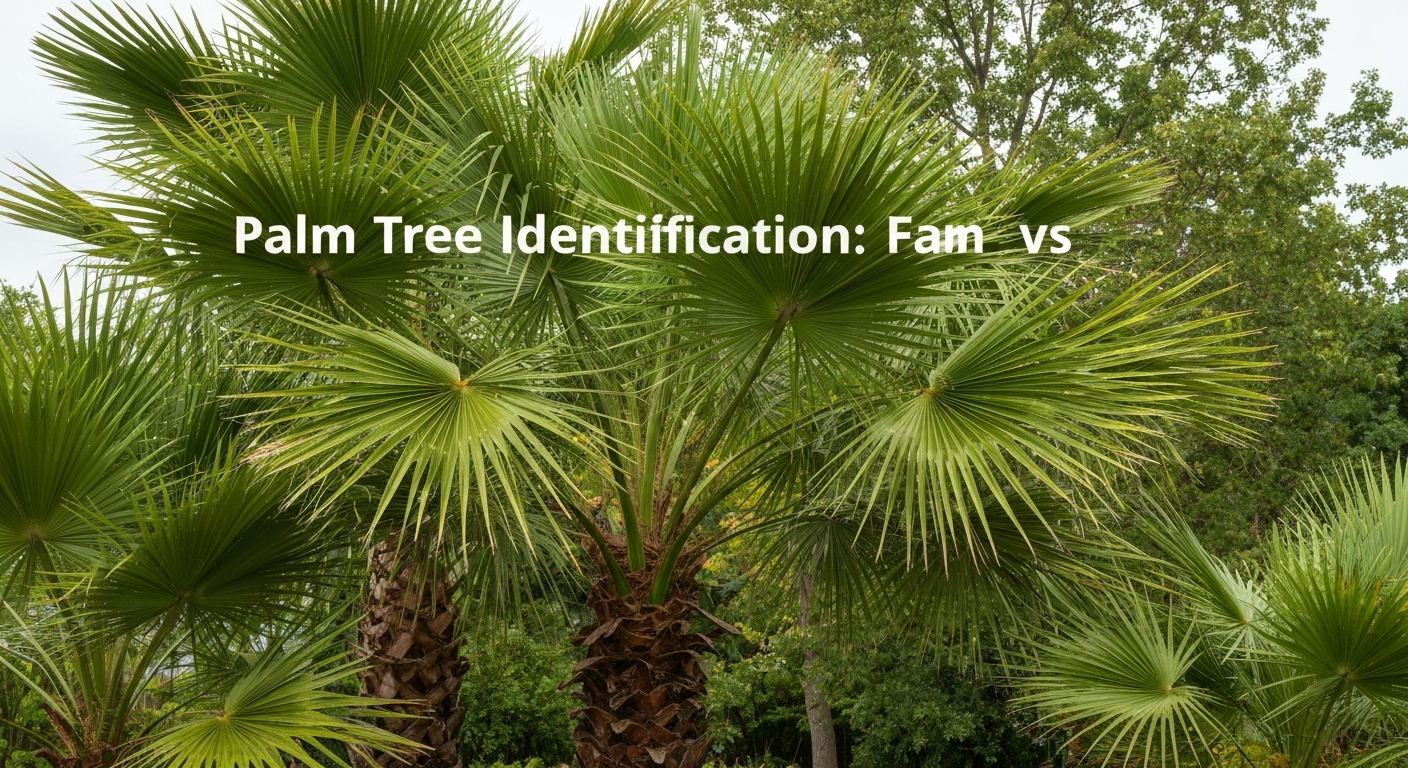
TL;DR: Palm tree identification begins with frond architecture: fan palms (palmate) have leaf segments radiating from one point; feather palms (pinnate) have leaflets in two rows along a long midrib. Add trunk texture — smooth ringed, fibrous hairy, or absent on young plants — plus fruit and your region. Common US landscape palms include cabbage palm, queen palm, date palm, and windmill palm. Indoor palm plant identification focuses on areca, parlor, and kentia palms. Photograph one frond and the trunk, then confirm with the Tree Identifier app.
🌴 Palm tree identification rule #1: Fan = segments from one hub (Sabal, windmill, saw palmetto). Feather = leaflets on a rachis (queen, date, areca). Everything else follows from that split.
Understanding palms — not quite trees
Palms belong to family Arecaceae — roughly 2,600 species of woody monocots found in tropics and subtropics worldwide. Unlike oak or pine, palms lack true bark and annual growth rings. A single terminal bud produces all new fronds; damage there can kill the plant.
People search palm tree identification for everything from 80-foot queen palms lining boulevards to tabletop parlor palms in apartments. Botanically, form varies enormously: solitary tall trunks, clustering cane-like shoots, or low creeping shrubs. Palm plant identification always starts at the leaf, not the trunk height.
Core traits for any palm:
- Fronds (leaves): Palmate (fan) or pinnate (feather) — the primary split.
- Trunk: Solitary or clustering; smooth, ringed, fibrous, or subterranean.
- Inflorescence: Large branched spikes among or below fronds; species-specific flower color.
- Fruit: Drupes, berries, or nuts — dates, coconuts, or small black spheres on queen palm.
- Habitat: Coastal Florida scrub, desert oasis, Pacific Northwest courtyard — context narrows species fast.
An identification types of palm trees chart typically rows species by frond type first, then cold hardiness and native region. That matches how field botanists think.
Fan palms vs feather palms
The fan vs feather split is the foundation of palm tree identification worldwide.
Fan palms (palmate leaves)
Frond segments (leaflets or lamina folds) radiate from a single point at the end of the petiole — like fingers from a palm. Segments may be deeply split to the hub or only partially divided.
Examples: Cabbage palm (Sabal palmetto), windmill palm (Trachycarpus fortunei), California fan palm (Washingtonia filifera), saw palmetto (Serenoa repens).
ID tip: Fan palms often costate — fold like pleated paper when young. Mature fronds are stiff and circular or semicircular in outline.
Feather palms (pinnate leaves)
A long central rachis carries many leaflets in two rows, sometimes with a crownshaft — a smooth green tube where fronds attach on some tropical species.
Examples: Queen palm (Syagrus romanzoffiana), date palm (Phoenix dactylifera), coconut (Cocos nucifera), areca palm (Dypsis lutescens).
ID tip: Feather fronds arch or droop; leaflet shape — linear, sickle-shaped, or fishtail — separates genera.
When someone asks how to identify palm plant species from a distance, frond silhouette alone often suffices: round fan crown vs feathery plume crown.
Common US landscape palms
Cabbage palm (Sabal palmetto)
Florida and Southeast state tree. Fan fronds 3 to 5 feet wide on long petioles without thorns. Young plants show no above-ground trunk — a rosette of fans emerging from ground level for years. Mature trunks are smooth, light gray, often curved, with old frond bases persisting as a criss-cross boot on the upper trunk — the "bootjacked" look.
White flowers on branched spikes within the crown; small black berries. Extremely salt- and hurricane-tolerant. Cabbage palm is the default fan palm on coastal highways from South Carolina to Florida.
Queen palm (Syagrus romanzoffiana)
Tall feather palm to 50 feet with smooth, ringed, light gray trunk — clean column without fiber. Bright green gracefully arching fronds. Orange dates (fruit) hang in heavy clusters in winter — a queen palm signature when present.
Planted widely in California, Arizona, Florida, and Gulf Coast cities. Queen palm tree identification at maturity is straightforward: feather fronds plus slender ringed trunk plus hanging orange fruit.
Date palm (Phoenix dactylifera)
Massive feather palm of deserts and irrigated Southwest landscapes. Trunk shows diamond-shaped leaf scar pattern from old frond bases. Fronds are stiff, blue-green to gray-green, with vicious spines at the base of the petiole. Cultivated dates hang in heavy amber clusters.
Canary Island date palm (Phoenix canariensis) is a common lookalike — thicker trunk, denser crown, also spiny. Date palm identification in Phoenix or Las Vegas often means checking trunk girth and planting context.
Windmill palm (Trachycarpus fortunei)
Most cold-hardy common landscape palm — survives snow in Seattle and Vancouver. Fan fronds on a hairy fibrous trunk wrapped in brown mesh-like fiber. Moderate height to 30 feet. Small hanging yellow flower clusters in spring.
Windmill palm identification: fan fronds plus shaggy fibrous trunk in temperate cities is distinctive. No other common US palm combines fan leaves with a woolly trunk.
Indoor palm identification
Indoor palm plant identification applies the same fan-vs-feather logic at houseplant scale. Most popular house palms are feather types; parlor and kentia dominate offices and living rooms.
Areca palm (Dypsis lutescens)
Also called butterfly palm or golden cane palm. Clustering yellow-green cane stems emerge from the pot like bamboo clumps. Feather fronds are full and arching, slightly golden in bright light. Never a single thick trunk — multiple stems are the areca palm identification giveaway.
Parlor palm (Chamaedorea elegans)
Small feather palm for low light. Thin green stems; delicate fronds with widely spaced, narrow leaflets. Grows slowly to 4 to 6 feet indoors. No trunk development — stems stay reed-like. Parlor palm is the default mall and dentist-office palm.
Kentia palm (Howea forsteriana)
Elegant solitary feather palm with one slender dark trunk (over years indoors). Fronds are dark green, gracefully drooping, with broader leaflets than parlor palm. Premium houseplant — kentia palm identification is arching dark feather fronds on a single stem versus parlor's clustered thin canes.
Other indoor palms you may see
Lady palm (Rhapis excelsa): Fan fronds divided into narrow segments on clustering bamboo-like stems — fan type indoors. Majesty palm (Ravenea rivularis): Large feather fronds, needs humidity; sold as impulse patio plant. Ponytail palm (Beaucarnea recurvata): Not a true palm — bulbous base and grass-like leaves from Agave relatives.
Trunk, crown, and fruit clues
After frond type, palm tree identification uses trunk architecture:
- No trunk, ground-level fans: Young cabbage palm, saw palmetto, or dwarf palmetto.
- Smooth ringed column: Queen palm, royal palm, many Caribbean species.
- Fibrous hairy trunk: Windmill palm, Mexican fan palm (lower trunk).
- Diamond leaf-scar pattern: Date palms and other Phoenix species.
- Clustering stems: Areca, lady palm, clumping bamboo palms.
Fruit narrows species when present: queen palm orange drupes, date palm amber clusters, cabbage palm small black berries on long stalks. Flowers emerge from spathes — large bracts that split open. Photographing fruit clusters is high-value for palm plant identification apps.
Regional quick reference
Geography filters an identification types of palm trees chart to realistic candidates:
- Southeast coastal plain: Cabbage palm, saw palmetto, dwarf palmetto — fans; occasional planted queen palms.
- South Florida: Coconut, royal, coconut, many tropical feather palms native and exotic.
- Southwest deserts: Date palm, California fan palm, Mexican fan palm.
- California coast: Queen palm, Mexican fan palm, date palm lining streets.
- Pacific Northwest: Windmill palm almost exclusively among hardy outdoor palms.
- Indoors anywhere: Parlor, areca, kentia, lady palm.
Misidentification often confuses Washingtonia fan palms (tall, smooth trunk, skirt of dead fronds) with Sabal (bootjacked trunk, no persistent dead-frond skirt on mature trees). Compare trunk texture and frond attachment scars.
Photographing palms for identification
Palm tree identification photos need frond architecture visible:
Best shots: One frond held flat or lying on pavement showing fan hub or feather rachis and leaflets. Trunk texture from chest height — fiber, rings, or boots. Fruit cluster if season allows.
Weak shots: Distant skyline silhouette without frond detail; sun-backlit crown only; young rosette with no trunk context (harder but still workable with fan shape).
See Best Photo for Tree ID for lighting and framing. For frond terminology — petiole, rachis, leaflet — see Tree Anatomy Glossary.
Using Tree Identifier for palm plant identification
Tree Identifier handles common US landscape palms and popular houseplant palms when frond structure is clear in the photo.
Workflow: Photograph one frond. Add trunk or clustering stems if possible. Compare app suggestions against regional expectations — a fan palm in Portland is almost certainly windmill palm, not cabbage palm.
Indoor palm identification: Include multiple stems in frame for areca vs single trunk for kentia. Parlor palm's fine leaflets need reasonable focus — move closer rather than zoom digitally.
Palm tree identification rewards the fan-vs-feather habit. Once automatic, you'll narrow most encounters to two or three species before opening any app.
Frequently asked questions
How do you identify a palm tree?
Identify palm trees by frond type first: fan palms have leaf segments radiating from one point like a hand; feather palms have leaflets arranged along a central midrib like a feather. Then note trunk — smooth columnar, fibrous, or clustering — plus crown shape, flowers, and fruit. Habitat and planting context narrow species in the US from cabbage palm and queen palm outdoors to areca and parlor palm indoors.
What is the difference between fan palms and feather palms?
Fan palms (palmate) have undivided or deeply split leaves with segments spreading from a single point at the petiole tip — like a folded paper fan. Feather palms (pinnate) have a long rachis with many leaflets in two rows — like a compound leaf on a giant scale. Sabal and windmill palm are fan types; queen palm and date palm are feather types. Frond type is the fastest palm tree identification split.
What are the most common palm trees in US landscapes?
Common landscape palms include cabbage palm (Sabal palmetto) in the Southeast — fan fronds, no trunk on young plants; queen palm (Syagrus romanzoffiana) in warm coastal areas — tall feather palm with smooth ringed trunk; date palm (Phoenix dactylifera) in arid Southwest — massive feather fronds and diamond-pattern trunk; and windmill palm (Trachycarpus fortunei) — hairy fibrous trunk, fan fronds, surprisingly cold-hardy.
How do you identify indoor palm plants?
Indoor palm identification uses the same frond split. Areca palm (Dypsis lutescens) has multiple golden-green feather fronds from clustered cane stems. Parlor palm (Chamaedorea elegans) is a small feather palm with delicate divided leaflets on thin stems. Kentia palm (Howea forsteriana) has arching dark green feather fronds on a single slender trunk. Size, leaflet fineness, and stem clustering separate common houseplant palms.
Can you use a palm tree identification chart?
Yes — an identification types of palm trees chart organized by frond type (fan vs feather), trunk texture, and region works well. Start with palmate vs pinnate, then trunk — smooth, ringed, or fibrous — then fruit if present. Charts cannot replace local context: a fan palm in Seattle is likely windmill palm; in Florida scrub it may be saw palmetto or cabbage palm.
Is a palm tree actually a tree?
Botanically palms are woody monocots — not dicot trees like oak or maple. They have a single growing point (crown shaft) and no true secondary wood or bark rings. People use palm tree identification for any tall palm, but many species are shrubs (saw palmetto) or clustering understory plants (areca). Form follows species, not a universal tree definition.
Can tree ID apps identify palm plants?
Yes, when photos show clear frond architecture — fan vs feather — and ideally trunk or crown context. Apps handle common landscape and indoor palms well. Distant silhouettes or damaged fronds reduce accuracy. Photograph one frond flat on pavement plus a trunk shot for best palm plant identification results with Tree Identifier.
Try Tree Identifier — free on iPhone
Photograph palm fronds or trunk texture and get a species match in seconds.
Download on the App Store