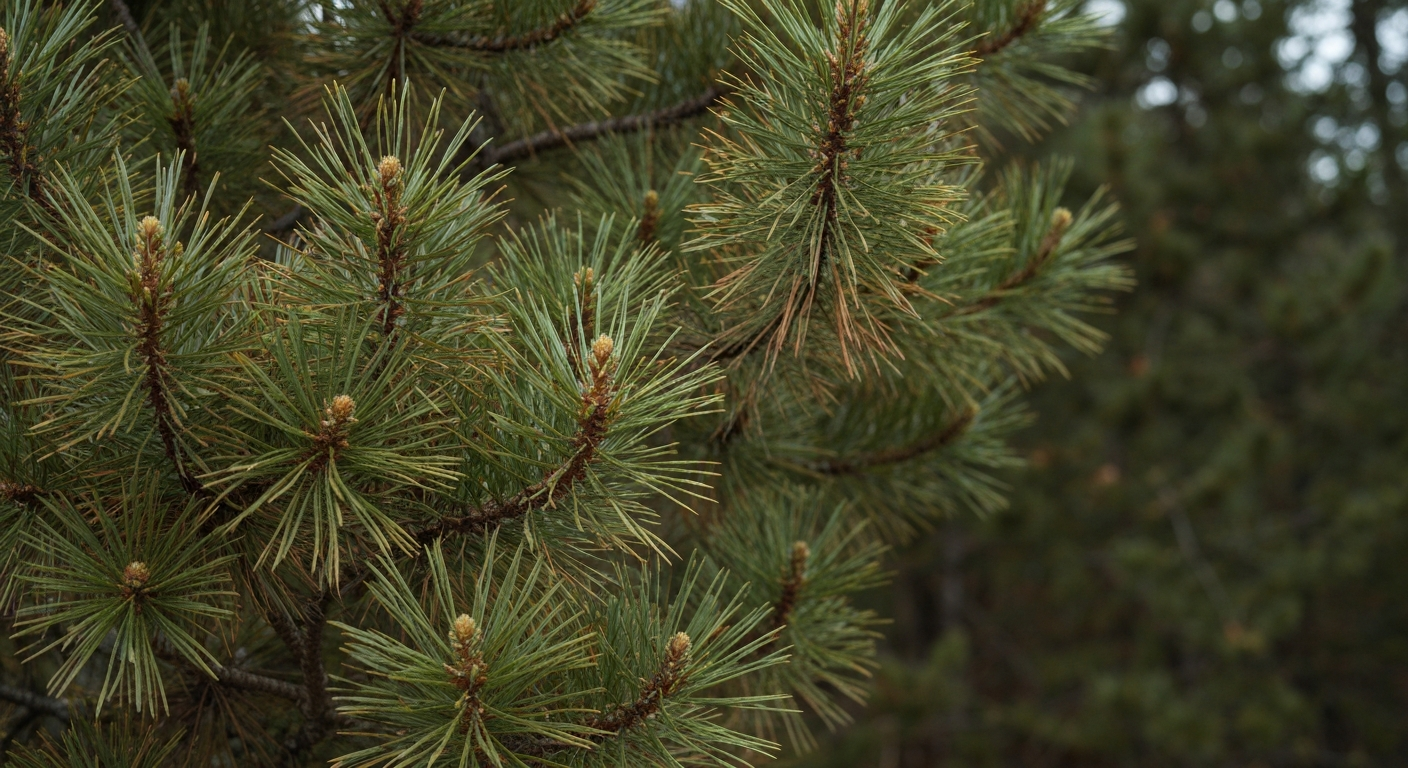
TL;DR: To identify pine trees, confirm genus Pinus first — needles grow in bundles (fascicles), not singly like spruce or in flat sprays like fir. Count needles per bundle: five points to eastern white pine in the East; two often means red pine or some southern pines; three covers loblolly, longleaf, slash, shortleaf, and ponderosa depending on region. Add pine cone identification — prickles on scales, cone length, and whether cones cling to branches for years. Yellow pine identification is lumber-trade language for hard pines with stiff two- or three-needled bundles, distinct from soft five-needled white pine. Photograph a fascicle and one cone, then confirm with the Tree Identifier app.
🌲 Pine tree identification in one step: count needles per bundle. Five = eastern white pine in most of the East. Two or three = dig into yellow pine, red pine, or ponderosa using cones and range.
Why pine tree identification starts with needles
Pines are the only common North American conifers with needles bundled in fascicles — a papery sheath at the base holds two to five needles together. Spruce needles are single and square in cross-section; fir needles attach individually to the twig and leave flat round scars; cedar and juniper scale-leaves look nothing like pine. If you can count a bundle, you are identifying pine trees, not guessing at generic evergreens.
Botanists split pines into soft pines (white pine group — five needles, flexible, cones without armature) and hard pines (yellow pine group — mostly two or three stiff needles, cones often prickly). That split maps directly to how foresters talk about yellow pine identification versus white pine in lumber yards. Field naturalists use the same characters.
Core pine tree identification checklist:
- Needles per fascicle: 2, 3, or 5 — the primary key.
- Needle length and stiffness: Soft and flexible vs stiff and sharp.
- Sheath persistence: Some species keep a brown sheath at the bundle base; others shed it.
- Cones: Size, shape, prickles on scales, whether cones persist on the tree.
- Bark: Plate size, color, furrow pattern on mature trunks.
- Habitat and range: Coastal plain vs mountain dry site narrows southern species fast.
Identifying pine trees without cones is normal — needles and bark often suffice. Pine cone identification becomes decisive when two species share needle count in the same region.
Eastern white pine identification
Eastern white pine (Pinus strobus) is the flagship soft pine of eastern North America — tall, graceful, and immediately recognizable when you count five.
Needles: Five per bundle, soft, flexible, bluish-green to dark green, 3 to 5 inches long. Needles bend without snapping. Fascicle sheath is slender and often falls off on older bundles.
Cones: Slender cylinders, 4 to 8 inches long, slightly curved, hanging from upper branches. Scales are thin without sharp prickles — a key pine cone identification feature. Cones mature in two years and drop; they do not persist for years like some hard pines.
Bark: Young trees — smooth gray-green. Mature trunks — broad ridges and furrows, gray-brown, not orange-plated like ponderosa or red pine.
Form: Single straight trunk with horizontal whorled branches; crown becomes flat-topped and open in old trees. White pine was the colonial mast tree — specimens exceed 150 feet in virgin stands.
Range: Eastern US and southeastern Canada, west to Minnesota and Iowa; planted widely outside native range.
Five needles eliminate most co-occurring pines in the East. The only confusion is planted exotic five-needled pines — Japanese white pine in gardens — but wild forest context plus native range keeps eastern white pine identification straightforward.
Yellow pine identification — southern hard pines
Yellow pine identification is forestry shorthand for several hard Pinus species whose wood is yellowish and resinous. In the US South and Mid-Atlantic, that usually means loblolly, longleaf, slash, and shortleaf pine. All have stiff needles in bundles of two or three — never five.
Loblolly pine (Pinus taeda)
The most planted timber pine in the US. Needles: Usually three per bundle, occasionally two, 6 to 9 inches, stiff, dark yellow-green. Cones: 3 to 6 inches, prickly scales, often persistent on branches. Bark: Scaly plates, reddish-brown on older trunks. Habitat: Lowland to upland, moist acidic soils, old fields, plantation rows — ubiquitous across the Southeast.
Longleaf pine (Pinus palustris)
Grass-stage seedling famous in longleaf savanna ecology. Needles: Three per bundle, the longest of any pine — often 8 to 18 inches, drooping like wire from branch tips. Cones: Large, 6 to 10 inches, prickly. Form: Tall straight trunk, sparse crown — open park-like savannas. Range: Coastal plain from Virginia to Texas; restoration plantings expanding.
Slash pine (Pinus elliottii)
Coastal plain specialist. Needles: Two or three per bundle, 8 to 10 inches, glossy. Cones: Glossy brown, prickly, persistent. Bark: Thick, deeply furrowed, orange-brown plates. Distinguish from loblolly by wetter flatwoods habitat and heavier cone persistence on branches.
Shortleaf pine (Pinus echinata)
Ozark and Appalachian hard pine. Needles: Two or three per bundle, 3 to 5 inches — shorter than loblolly. Cones: Small to medium, prickly. Bark: Scaly, often with small resin pockets called pitch tubes after fire. Overlaps loblolly range but tolerates drier upland sites.
Yellow pine identification in mixed stands: start with needle count (two vs three), then needle length (longleaf is unmistakably long), then habitat (wet flatwoods vs dry sandhill). Pine cone identification — size and how many seasons cones remain on the tree — breaks ties when needle counts match.
Red pine identification
Red pine (Pinus resinosa) — also called Norway pine in Minnesota — is a two-needled hard pine of the northern US and Canada, not a southern yellow pine despite shared needle count with some southern species.
Needles: Exactly two per bundle, 4 to 6 inches, stiff, dark yellow-green, twisted. Field test: bend a needle sharply — red pine snaps cleanly; white pine bends. Austrian pine also has two needles but is planted, not native wild in most red pine range.
Cones: Round to egg-shaped, about 1.5 to 2.5 inches, spineless or nearly so — blunt scales without prominent prickles. Cones often cluster near branch tips.
Bark: Distinctive on mature trees — reddish-orange to pinkish plates separated by dark furrows. Upper trunk may look lighter orange.
Form: Straight trunk, narrow crown, often in even-aged plantation rows across the Great Lakes states.
Range: Northeast, Great Lakes, southern Canada on dry sandy and rocky soils.
Red pine vs jack pine (also two needles): jack pine needles are shorter, often curved, on gnarled trees in poor sandy soil; cones may be curved and persist closed for years until fire opens them. Red pine is taller, straighter, with larger spineless cones.
Ponderosa pine identification
Ponderosa pine (Pinus ponderosa) dominates western dry forests — the classic yellow pine identification species west of the Great Plains.
Needles: Mostly three per bundle (some interior populations show two), 5 to 10 inches, stiff, dark yellow-green. Bundles radiate from branch tips like a bottle brush.
Cones: Large, 3 to 6 inches, oval, with a sharp prickle on each scale — excellent pine cone identification marker. Cones persist on branches for years in many stands.
Bark: Young trees — blackish and furrowed ("blackjack" phase). Mature trunks — large flat orange-yellow plates with black crevices — jigsaw puzzle bark you can smell like vanilla or butterscotch on warm days in some regions.
Form: Massive trunk, open crown, often solitary on dry slopes.
Range: Western US from British Columbia to Mexico, east to the Black Hills and western Great Plains outliers.
Ponderosa overlaps with Jeffrey pine at higher elevations in California — Jeffrey has stouter needles, larger cones, and resinous scent on bruised bark. Lodgepole pine has two short needles and small cones; western white pine has five soft needles like eastern white pine but in the mountains.
Pine cone identification in detail
Pine cone identification rewards close looks at scale armature and cone habit:
- Prickles: Absent or tiny on eastern white pine and red pine. Prominent sharp points on loblolly, longleaf, slash, shortleaf, and ponderosa.
- Length: White pine — long and slender. Red pine — small and egg-shaped. Longleaf — among the largest native pine cones.
- Persistence: Hard pines often hold closed cones on branches for years (serotiny in some species). White pine cones drop after opening.
- Position: Cones hang down on most pines; note whether they cluster at tips or along branches.
- Closed vs open: Fire-adapted jack pine and lodgepole may hold closed cones until heat opens them.
Pick up one fallen cone and roll a scale between fingers — prickly or smooth tells you hard vs soft pine faster than bark alone in winter.
Bark and winter pine tree identification
Winter identifying pine trees uses bark plates and silhouette:
White pine: Gray furrows, no orange puzzle plates. Whorled branch tiers visible on younger trees.
Yellow pines: Thick, scaly, often reddish or orange-brown plates; longleaf and slash show heavy furrows.
Red pine: Orange-red plated bark — one of the most distinctive winter trunks in the North Woods.
Ponderosa: Yellow-orange jigsaw plates on mature trunks; do not rely on bark alone on young ponderosa still in dark "blackjack" phase.
Needle bundles may remain on branches for years after needles die — count those fascicles in winter. See Tree Bark Identification App Guide for bark photography tips.
Common pine lookalike mistakes
Spruce and fir
Neither has fascicles. Spruce — square needles, sharp, single. Fir — flat needles, friendly to touch, scarred twig when needle pulls off. If there is no bundle sheath, it is not a pine.
Planted Austrian and Scots pine
Austrian pine (black pine) — two stiff dark needles, thick cones, often in parks and windbreaks. Scots pine — two twisted blue-green needles, orange upper bark. Both confuse red pine identification in planted settings — check whether the tree is wild on native range soil or in a landscaped row.
Distant "pine" silhouettes
Cedars, hemlocks, and firs appear conical from highways. Drive closer or stop for a fascicle count — identifying pine trees from silhouette alone fails often.
Using Tree Identifier for pine tree identification
Tree Identifier recognizes eastern white pine, common yellow pines, red pine, and ponderosa pine from needle bundle photos, cones, and bark.
Best photos: One fascicle with sheath base visible, needles spread so count is obvious. One mature cone on the ground or in hand. Optional bark photo at chest height on mature trees.
Limitations: Seedlings and plantation rows of uniform age lack cones — lead with needle count. Fallen needles without fascicle sheath make counting harder; pick attached bundles from living branches.
Regional tip: Enable location context mentally — five needles in Maine is white pine; three needles in Georgia is likely loblolly or longleaf, not ponderosa.
Pine tree identification is one of the most structured conifer IDs in North America — fascicle count gives you the genus and often the species before you open a field guide. Yellow pine identification, red pine, white pine, and ponderosa pine all collapse into needles and cones once you know what to count.
Frequently asked questions
How do you identify a pine tree?
Identify pine trees by needles bundled in fascicles — not single needles like spruce or flat needles like fir. Count needles per bundle: five means eastern white pine in the East; two often means red pine or some southern pines; three means loblolly, ponderosa, or longleaf among others. Add cone shape, bark, and range. Pine cone identification confirms species when needles are ambiguous.
What is yellow pine identification?
Yellow pine identification usually refers to southern pines in lumber trade — loblolly, longleaf, slash, and shortleaf pine — or to ponderosa pine in the West. These are hard pines with mostly two or three needles per bundle, stiff needles, and often prickly cones. They differ from soft pines like eastern white pine, which has five soft needles per bundle and slender cones without sharp spine tips.
How many needles does an eastern white pine have?
Eastern white pine (Pinus strobus) has five needles per bundle. Needles are soft, flexible, bluish-green, and 3 to 5 inches long. Cones are slender, 4 to 8 inches, without sharp prickles on scales. White pine is the only common five-needled pine in most of the eastern US — counting five is a fast pine tree identification shortcut.
How do you tell red pine from other pines?
Red pine (Pinus resinosa) has exactly two stiff needles per bundle, each 4 to 6 inches long. Needles snap cleanly when bent sharply — a field test. Cones are egg-shaped, about 2 inches, without prickles. Bark on mature trunks is reddish-orange and plated. Red pine is common in the Great Lakes and Northeast on dry sandy sites.
What does a ponderosa pine look like?
Ponderosa pine (Pinus ponderosa) has mostly three needles per bundle, 5 to 10 inches long, in yellow-green to dark green bundles. Cones are large, 3 to 6 inches, with a sharp prickle on each scale — useful for pine cone identification. Mature bark forms large orange-brown plates with a jigsaw puzzle look. It dominates dry montane forests in the West.
How does pine cone identification help?
Pine cone identification narrows species when needle counts overlap. White pine cones are long, thin, and spineless. Red pine cones are small and blunt. Southern yellow pines and ponderosa have thicker scales, often with prickles. Cone size, shape, whether cones persist on branches for years, and prickle presence split lookalikes faster than bark alone.
Can tree ID apps identify pine trees?
Yes, when photos show needles in clear fascicles, a cone in frame, or bark on a mature trunk. Apps struggle with distant forest silhouettes or seedlings. For identifying pine trees, photograph a needle bundle pulled gently from the branch, one mature cone, and bark at chest height. Tree Identifier handles common North American pines well with those cues.
Try Tree Identifier — free on iPhone
Photograph pine needle bundles or cones and get a species match in seconds.
Download on the App Store