TL;DR: True poplars belong to the genus Populus — cottonwoods, aspens, balsam poplar, and white poplar are all poplars despite different common names. For poplar tree identification, look for alternate simple leaves (often triangular or rounded) with fine teeth, flattened leaf stems on many species, and wind-pollinated catkins in spring. Cottonwood has huge triangular leaves and thick furrowed bark; quaking aspen has trembling round leaves and white bark; balsam poplar smells resinous in early spring; white poplar has lobed, two-toned leaves. Tulip poplar is not a true poplar. When leaves are ambiguous, bark and habitat narrow the ID fast — or confirm with the Tree Identifier app.
🌿 Poplar tree identification starts with one rule: if the common name includes cottonwood, aspen, or poplar and the tree has alternate, toothed leaves on flattened petioles, you are almost certainly in genus Populus — not maple, not willow, and not tulip poplar.
Understanding the Populus genus
Poplar tree identification gets easier once you accept that English common names are messy. Botanists use Populus for a genus of fast-growing, wind-pollinated trees in the willow family (Salicaceae). Cottonwoods, aspens, balm poplars, and many trees simply called poplars are all Populus species. They share a general look: deciduous, alternate leaves; dioecious flowers in dangling catkins; light, soft wood; and a preference for sun and disturbed or moist sites.
Poplars are not maples (opposite leaves) and not true poplars if you are looking at tulip poplar — that is Liriodendron tulipifera, a completely different family. The most useful genus-level traits for poplar identification are:
- Leaf arrangement: Alternate on the twig — one leaf per node, staggered left and right.
- Leaf shape: Simple, not compound; usually broad and triangular, ovate, or nearly round.
- Leaf margin: Fine, sharp teeth (serrations) along the edge in most species.
- Petiole: Often flattened sideways, which makes leaves flutter in the slightest breeze — famously in quaking aspen.
- Flowers: Catkins appear before or with leaves in spring; seeds of cottonwoods are attached to cottony fluff.
- Habitat: Many poplars colonize riverbanks, floodplains, burned areas, and roadsides — pioneer species that need full sun.
If you are learning tree anatomy terms like petiole, margin, and alternate arrangement, the Tree Anatomy Glossary defines them in plain English.
Eastern cottonwood (Populus deltoides)
Eastern cottonwood is the large poplar most people in the central and eastern United States encounter along rivers and in bottomlands. It is the classic answer to cottonwood vs poplar questions: cottonwood is a poplar.
Leaves: Large — often 3 to 6 inches long — broadly triangular (deltoid) with a flattened base and coarse, curved teeth. The leaf stem is flattened. Leaves turn yellow in fall.
Bark: Young trees have smooth yellow-green to grey bark. Mature trees develop thick, deeply furrowed, grey bark with heavy ridges — rugged and unmistakable on old floodplain giants.
Form and habitat: Can reach 100 feet or more. Trunk often massive on old specimens. Grows along streams, rivers, and moist low ground; also planted as a fast shade tree. Spreads by wind-dispersed cottony seed in late spring — the fluff blankets roads and ponds.
Confused with: Eastern cottonwood hybridizes with other poplars in planted settings. Narrow-leaved cottonwood (P. angustifolia) in the Rockies has lance-shaped leaves. Willows share riparian habitat but usually have narrower leaves.
Quaking aspen (Populus tremuloides)
Quaking aspen is the most widespread deciduous tree in North America and one of the easiest poplars to recognize once you have seen the trembling leaves and pale bark.
Leaves: Nearly round to broadly oval, 1 to 3 inches, with fine teeth and a pointed tip. The long, flattened petiole makes the whole leaf quiver in wind — the namesake tremble. Fall color is bright yellow to gold.
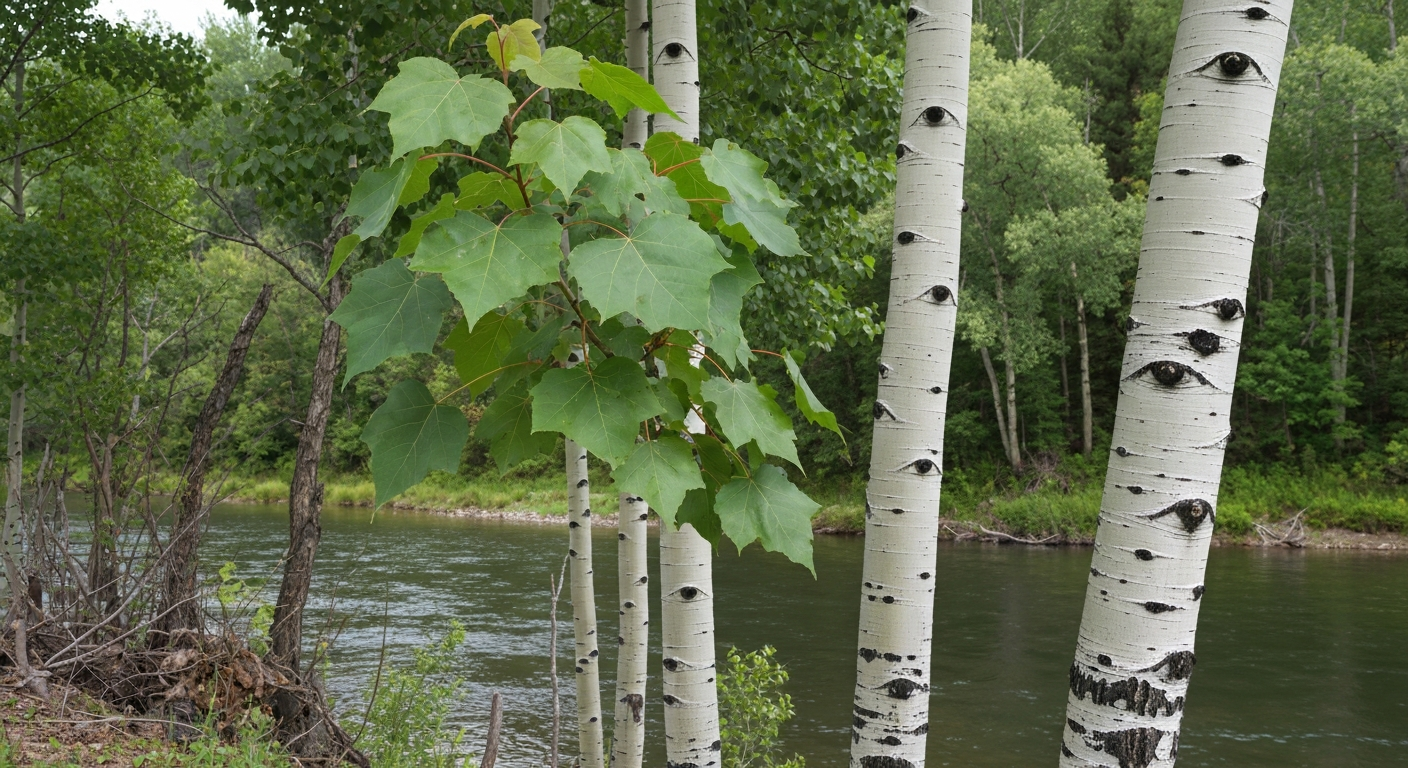
Bark: Smooth, thin, chalky white to greenish-white on mature trunks, marked with dark knots and scars that look like eyes. One of the whitest barks in the northern forest.
Form and habitat: Usually smaller than cottonwood — 40 to 60 feet — often in dense clonal groves sharing one root system. Found from Alaska to the Appalachians, especially after fire or logging. Prefers cool climates and sunny openings.
Confused with: Bigtooth aspen (P. grandidentata) has larger, coarser teeth. Paper birch has white bark but peels in papery sheets and leaves are ovate with doubly serrated edges, not round.
Balsam poplar (Populus balsamifera)
Balsam poplar — also called balm of Gilead — is the northern poplar whose sticky, fragrant buds announce spring before anything else in the boreal forest.
Leaves: Ovate to triangular, 2 to 4 inches, dark green above and often paler or whitish beneath, with fine teeth. Less dramatically triangular than cottonwood.
Bark: Grey to brown, furrowed on older trees; younger bark may be smoother and darker. Not white like aspen.
Form and habitat: Range across Canada and the northern US, including Alaska. Grows in moist woods, river edges, and mixed forest. Hybridizes with eastern cottonwood where ranges overlap, producing trees with intermediate traits.
Confused with: Balsam fir is a conifer — different entirely. Balsam poplar buds are large, resinous, and aromatic in late winter; crush one and the balsam scent is diagnostic.
White poplar (Populus alba)
White poplar is a European species widely planted as an ornamental and sometimes escaped in North America. It is the poplar with the unmistakable two-toned foliage.
Leaves: Round to maple-like with three to five lobes on strong shoots; smoother, less lobed leaves on older branches. Upper surface dark green; underside covered in dense white hairs, so wind lifts the leaves and flashes silver.
Bark: Dark grey, deeply furrowed and blocky at the base; upper branches paler. Rougher and darker than aspen bark.
Form and habitat: Medium-sized tree, often 40 to 70 feet. Planted in parks, shelterbelts, and old homesteads. Suckers aggressively from roots — clonal thickets are common.
Confused with: Silver maple has opposite leaves, not alternate. White poplar is also distinct from Lombardy poplar (P. nigra 'Italica'), a narrow columnar cultivar with triangular leaves and no lobes.
Poplar tree identification by leaf
Poplar tree identification by leaf is the fastest method from late spring through summer. Work through this sequence:
- Confirm alternate arrangement. Poplar leaves are never opposite in pairs like maple. If leaves are opposite, you are not looking at Populus.
- Measure and shape. Huge triangular leaves point to cottonwood. Small, nearly round leaves point to aspen. Lobed leaves with white undersides point to white poplar.
- Check the margin. Poplars have fine, regular teeth — not smooth margins, not deep lobes (except white poplar's leaf lobes, which are different from oak lobes).
- Look at the petiole. Hold a leaf by the stem and roll it between your fingers. A flattened, ribbon-like petiole that flexes side to side is classic Populus — especially aspen and cottonwood.
- Note the leaf underside. White-fuzzy below means white poplar. Silvery or pale below can also appear on balsam poplar and some cottonwoods.
Photograph the leaf against a clear sky or your palm so the margin and petiole show clearly. See Best Photo for Tree ID for framing tips that improve both manual ID and app results.
Poplar tree bark identification
Poplar tree bark identification matters when leaves are out of reach or in winter. Bark changes with age, so compare trees of similar size.
Young poplars of many species start with smooth, thin, greenish-grey or yellow-brown bark. Do not rely on bark alone on saplings — use buds and twigs too.
Mature cottonwood bark is thick, grey, and deeply furrowed with long, rugged ridges. On large floodplain trees it can look almost like old oak from a distance — but the leaf litter below (large triangular leaves) tells the truth.
Aspen bark stays relatively smooth and pale for much of the tree's life, with prominent black scarring. It does not peel in horizontal sheets like birch.
White poplar bark is dark and furrowed at the base, lighter above — a two-tone trunk pattern different from aspen's uniform whiteness.
Balsam poplar bark is grey-brown and moderately furrowed — less dramatic than cottonwood, darker than aspen. Winter buds coated in sticky resin are the giveaway.
For bark-focused photography and app tips, see our guide to tree bark identification apps.
Flowers, catkins, and seeds
Poplars are dioecious — individual trees are usually male or female, not both. Flowers are catkins: long, dangling clusters without petals, adapted for wind pollination.
Spring timing: Catkins often appear in early spring before or as leaves unfold. Male catkins release pollen; female catkins mature into seed structures.
Cottonwood seeds: Female cottonwoods produce seeds embedded in cottony fluff — the source of the name and the June snowstorm along rivers. Finding cotton on the ground is a strong cottonwood signal even if you cannot see the crown.
Aspen catkins: Fuzzy, cylindrical, and early — a useful ID feature when leaves are still small. Aspen rarely produces the heavy cotton of cottonwood.
Catkins are easy to overlook but powerful for poplar tree id when you are learning your local riparian trees in March and April.
Common lookalikes and naming traps
Poplar identification trips people up in predictable ways:
Tulip poplar (Liriodendron tulipifera)
Not a poplar. Tulip poplar has four-lobed leaves with a flat top — like a tulip silhouette — and smooth, not finely toothed, margins. Bark is furrowed and grey but leaves are the quick tell. Tulip poplar is a common backyard and forest giant in the eastern US; it appears on lists of common backyard trees but belongs to a different genus entirely.
Willows (Salix)
Willows share the willow family and riparian habitat. Leaves are usually narrower and lance-shaped, without the broad triangle of cottonwood. Many willows have a silvery underside, but leaf shape and branch flexibility differ. Willows often weep or sprawl; cottonwoods stand rigid and tall.
Silver maple (Acer saccharinum)
Opposite leaves rule out poplar immediately. Silver maple has deeply lobed, pale-backed leaves and is common in wet yards — a frequent misidentification when people search poplar tree identification by leaf from memory.
Black poplar and Lombardy poplar
Populus nigra and its columnar cultivar Lombardy poplar are European introductions. Leaves are triangular like cottonwood but the tree form is often narrow and upright. Less common than white poplar in North American plantings but still seen in older landscapes.
Using the Tree Identifier app for poplars
Manual poplar tree identification builds lasting skill, but a photo check saves time when you are staring at a riparian giant or a pale-barked grove and want a confident species name.
What to photograph: One clear leaf shot showing the full blade, margin, and petiole. One bark photo at chest height on a mature trunk. If catkins are present in spring, include them — they help narrow sex and species.
What to watch for: Apps sometimes confuse willows with young cottonwood, or tulip poplar with true poplars if only the bark is shown. Always sanity-check against your location: quaking aspen in the Southeast lowlands is unlikely; eastern cottonwood in alpine tundra is unlikely.
Workflow: Snap the leaf, run it through Tree Identifier, then verify bark and habitat match. If the app returns cottonwood but the bark is smooth and white, you may have aspen — take a second photo. For a broader photo-first workflow, read What Type of Tree Is This?
Poplar tree id is one of the easier riparian IDs once you separate true Populus from tulip poplar and willows. The app handles the edge cases; your eyes handle the habitat context.
Frequently asked questions
Is cottonwood the same as a poplar?
Yes. Cottonwoods are poplars — they belong to the genus Populus. Eastern cottonwood (Populus deltoides) is the large riparian tree most Americans call cottonwood. The word poplar is often used for the whole genus or for European species like white poplar and Lombardy poplar. Cottonwood vs poplar is really a common-name question, not a botanical split.
How do I identify a poplar tree by its leaves?
Check three traits: alternate arrangement on the twig, a flattened leaf stem (petiole) on many species, and a broadly triangular to rounded blade with fine teeth on the margin. Cottonwood leaves are large and distinctly triangular. Quaking aspen leaves are nearly round with a pointed tip. White poplar leaves are lobed with a white-fuzzy underside. Poplar tree identification by leaf works best on mature, sun-exposed foliage.
What does poplar bark look like?
It varies by species and age. Young poplars often have smooth greenish-grey or pale bark. Mature eastern cottonwood develops thick, deeply furrowed grey bark. Quaking aspen has smooth white bark with dark scars and eye-shaped marks. Balsam poplar bark is grey-brown and furrowed. White poplar shows dark blocky furrows on the lower trunk with paler upper bark. Poplar tree bark identification is often easier on older trees.
What is the difference between aspen and poplar?
Aspen is a type of poplar. In North America, quaking aspen (Populus tremuloides) and bigtooth aspen (Populus grandidentata) are Populus species commonly called aspens. People say aspen when they mean the smaller, often clonal trees with trembling leaves and pale bark — but botanically they are poplars. European trembling aspen (Populus tremula) is another Populus species.
Is tulip poplar a real poplar?
No. Tulip poplar or yellow poplar (Liriodendron tulipifera) is not in the genus Populus. It is a magnolia relative with tulip-shaped flowers and four-lobed leaves without the flattened poplar petiole. The name causes constant confusion in poplar tree identification searches. If the leaves look like a tulip outline and the tree is a tall eastern forest species, you are looking at Liriodendron, not Populus.
Can I identify a poplar in winter?
Yes, with bark and buds. Look for large resinous buds on balsam poplar, pale smooth bark with black knots on aspen, and thick furrowed bark on mature cottonwood. Persistent cottony seed fluff on the ground in spring also signals cottonwood nearby. Winter poplar tree identification improves when you combine bark photos with twig and bud close-ups.
How accurate are tree ID apps for poplars?
Good apps recognize common Populus species when the photo shows clear leaves or distinctive bark. Cottonwood, quaking aspen, and white poplar are usually well represented in training data. Confusion happens with willows, young poplars, and anything labeled tulip poplar. For best results, photograph a leaf against the sky, add a bark shot, and confirm the result matches your region.
Try Tree Identifier — free on iPhone
Photograph a poplar leaf or bark and get a species match in seconds.
Download on the App Store