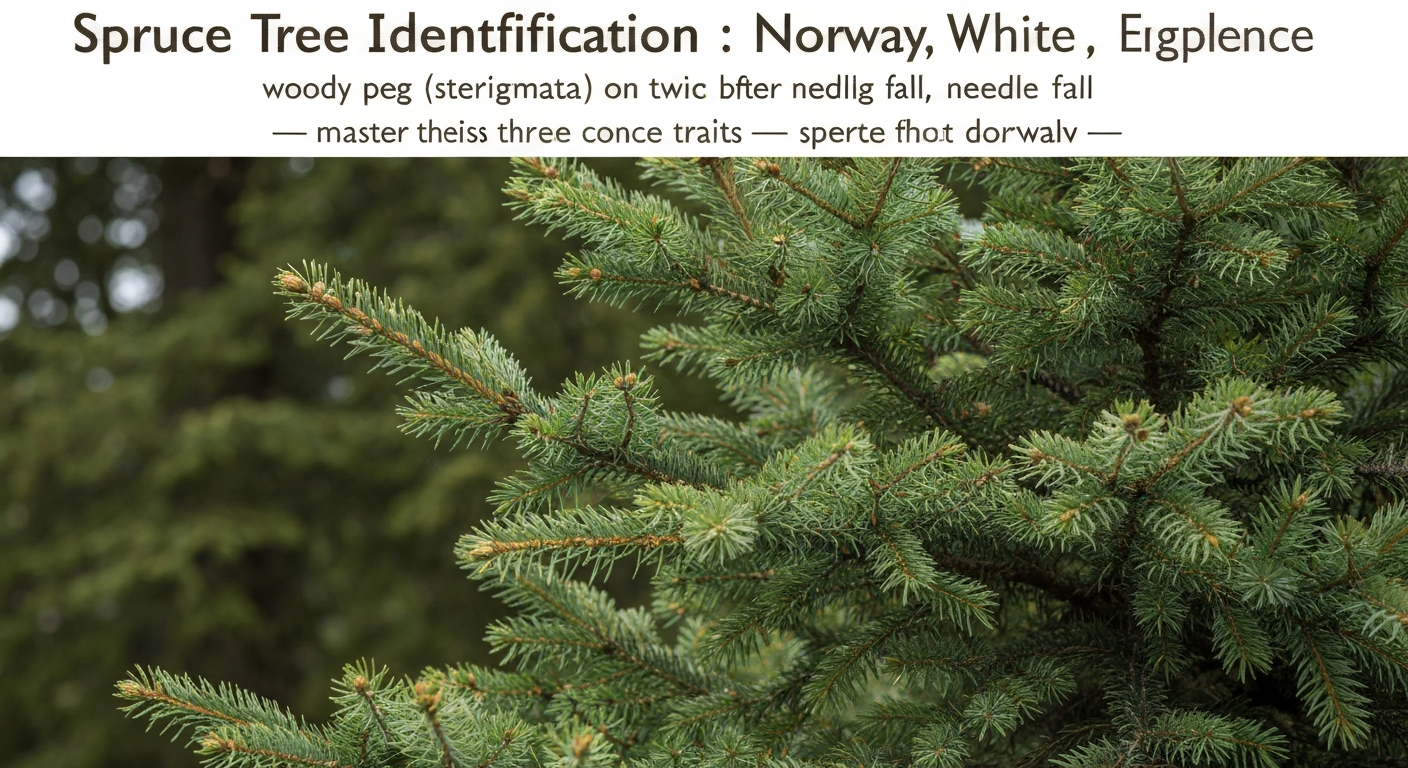
TL;DR: Spruce tree identification uses three traits: square sharp needles that roll between your fingers, woody pegs (sterigmata) left on the twig when needles fall, and cones that hang downward. Norway spruce (Picea abies) has weeping branches and large cones; white spruce (Picea glauca) has short stiff needles and a skunky crush smell; Engelmann spruce (Picea engelmannii) dominates Rocky Mountain subalpine forests. Photograph pegged twigs and cones, then confirm with the Tree Identifier app.
🌲 Spruce identification in one touch: roll a needle between finger and thumb — if it spins easily, it is square spruce; if flat, it is fir. Check the twig for woody pegs.
Understanding spruces — genus Picea
Spruces belong to genus Picea in the pine family (Pinaceae) — alongside pines, firs, larches, and hemlocks. Roughly 35 species worldwide; North America hosts white, black, Colorado blue, Sitka, and Engelmann spruce among natives, plus widespread plantings of Norway spruce.
Spruce tree identification is essential because spruces dominate boreal and montane forests, anchor the Christmas tree industry, and appear in every northern landscape planting. Confusing spruce with fir or pine leads to wrong timber expectations, wrong wildlife habitat assumptions, and wrong ornamental care.
Genus-level traits for Picea:
- Needles: Four-sided (square cross-section), sharp, stiff, attached individually to woody pegs.
- Twigs: Rough after needle fall — pegs (sterigmata) persist, giving sandpaper texture.
- Cones: Hang downward, papery flexible scales, often smaller than pine cones.
- Crown: Conical when young; older trees may open or develop a spike top.
- Bark: Thin, scaly, gray to brown — not thick platy like mature pine.
The square needle and woody peg test
The fastest spruce identification field test takes five seconds:
- Pull one needle from the twig.
- Roll it between thumb and finger.
- Square spruce needles spin easily — you feel four sharp edges.
- Look at the attachment point on the twig — a raised woody peg remains.
Fir needles are flat — they do not roll; they bend. Fir twigs are smooth after needle removal — round flat scars, no pegs. Pine needles come in bundles of two to five — never single on pegs.
Photograph a twig showing multiple needles emerging from pegs, plus one hanging cone if available. See Best Photo for Tree ID for conifer close-up tips.
Spruce vs fir — side by side
This comparison solves most northern conifer confusion:
| Trait | Spruce (Picea) | Fir (Abies) |
|---|---|---|
| Needle shape | Square, sharp, rolls | Flat, soft, two white lines below |
| Twig after needle pull | Woody peg remains | Smooth round scar |
| Cones | Hang down, stay intact | Stand upright, fall apart on tree |
| Crush scent | Resinous, sharp | Often citrusy (balsam fir) |
| Branch attachment | Stiff, often drooping on Norway | More horizontal, flexible |
At timberline in the Rockies, Engelmann spruce and subalpine fir grow together — peg vs smooth twig is the field split. For fir details, see dedicated fir guides in our blog.
Spruce vs pine
Pine identification starts with needle bundles (fascicles). White pine has five needles per bundle; red pine has two; ponderosa has three. Spruce never bundles — every needle is solo on its peg.
Pine cones are typically larger and woodier with thick scales. Spruce cones are smaller, more papery, and consistently pendant. Mature pine bark forms broad orange plates; spruce bark stays relatively thin and scaly.
Norway spruce identification
Norway spruce (Picea abies) is Eurasian, planted across North America as ornamental, windbreak, and timber tree. Norway spruce identification features:
Habit: Pyramidal crown with conspicuously pendulous branchlets — lower branches sweep downward like a weeping form. One of the easiest spruces to recognize by silhouette in park plantings.
Needles: Dark green, four-sided, half to one inch, stiff, on pegged twigs.
Cones: Largest common spruce cones — four to seven inches long, cylindrical, hanging, with notched scale tips. Cones are major Norway spruce identification markers.
Bark: Thin gray-brown, flaking in small scales. Purple-brown on young stems.
Context: Churchyard spruces, European-style windbreak rows, and suburban specimens are often Norway spruce. Naturalized seedlings appear in Northeast forests.
White spruce identification
White spruce (Picea glauca) spans Canada and the northern US — boreal forest workhorse.
Needles: Short — half to three-quarters inch — blue-green to green, stiff, square, prickly. Denser on twigs than Norway spruce.
Smell: Crushed needles produce a sharp odor some describe as skunky or cat-urine — memorable white spruce identification field clue, though not everyone detects it.
Cones: Slender cylinders one and a half to two and a half inches, light tan, hanging.
Crown: Narrow conical, branches ascending rather than weeping.
Varieties: Black Hills spruce (Picea glauca var. densata) is a compact slow-growing form from South Dakota.
Colorado blue spruce (Picea pungens) is closely related with intensely blue needles and sharper prickliness — popular ornamental; see blue color as cultivar marker.
Engelmann spruce identification
Engelmann spruce (Picea engelmannii) dominates subalpine zones of the Rocky Mountains and interior Northwest.
Needles: Blue-green, four-sided on pegs, often slightly longer and more flexible than white spruce — less brutally prickly.
Cones: Two to three inches, oblong-cylindrical, hanging on short stalks, papery scales with ragged edges.
Bark: Thin, loose scales, purple-brown to gray on young boles; furrowed on old trees at high elevation.
Habitat: 6,000 to 11,000 feet, mixed with subalpine fir, often at timberline. Engelmann spruce identification in the field pairs with elevation and the peg vs fir twig test.
Hybridizes with white spruce where ranges overlap — intermediate forms occur.
Other North American spruces
Black spruce (Picea mariana)
Boreal bog species — short needles, small cones often clustered near crown top, gnarled form in muskeg. Needles blue-green on pegs. Wetland habitat is diagnostic.
Sitka spruce (Picea sitchensis)
Pacific coastal giant — flat needle arrangement appears more two-ranked than other spruces but needles are still square on pegs. Large woody cones. Massive size on coast.
Red spruce (Picea rubens)
Eastern montane — yellow-green glossy needles, cones one to two inches, associated with Appalachian highlands. Declining in some areas due to acid rain history.
Bark, cones, and winter ID
Winter spruce tree identification uses bark, cone persistence, and twig texture:
Cones: Spruce cones often persist on branches one to two years — pendant papery cylinders visible against sky. Fir cones disintegrate — you see upright spike stalks instead.
Twigs: Rough pegged texture year-round. Run a finger along a bare winter twig — spruce feels rough, fir feels smooth.
Bark: Thin scaly plates — less distinctive than pine. Old Norway spruce develops buttress flare at base in open plantings.
Ecological and economic notes
Spruce wood is light, strong, and resonant — used for soundboards, construction, and pulp. Norway and Sitka spruce dominate timber plantings. White and Engelmann spruce support boreal and montane wildlife — cones feed crossbills and red squirrels.
Spruce budworm and bark beetles affect stands cyclically. Blue spruce in landscapes suffers from needle cast fungi in humid regions.
Christmas tree lots sell Norway, white, and blue spruce — square needle test works on cut trees too.
Using Tree Identifier for spruce
Tree Identifier recognizes spruce from needle close-ups, pegged twigs, and hanging cone photos.
Best photos: Twig with needles showing woody peg bases. Single hanging cone against sky. Crown silhouette if weeping (Norway) vs stiff (white).
Species level: Add cone size and color — large cones suggest Norway; small slender cones suggest white or black spruce.
Spruce tree id becomes automatic once you feel a square needle roll and see pegs on the twig — the conifer ID skill that unlocks every northern forest.
Frequently asked questions
How do you identify a spruce tree?
Identify spruce (Picea) by square sharp needles that roll easily between thumb and finger, each needle attached to a woody peg (sterigma) on the twig that remains after needles drop, and cones that hang downward from upper branches. Spruce crowns are often conical and dense. Needles are stiff and prickly — not flat and friendly like fir. Crush a needle: spruce smells sharp and resinous but not citrusy like some firs.
What is the difference between spruce and fir?
Spruce needles are square in cross-section, sharp, and roll between fingers; they attach to woody pegs on the twig. Fir (Abies) needles are flat, soft, and usually have two white lines of stomata on the underside; they attach directly to the twig without pegs, leaving smooth round scars when removed. Spruce cones hang down; fir cones stand upright on branches and disintegrate on the tree. This spruce vs fir split is the most important conifer ID skill in northern forests.
What is the difference between spruce and pine?
Pine (Pinus) needles grow in bundles (fascicles) of two to five needles wrapped at the base — spruce needles attach individually to pegs with no bundle. Pine cones are woody and often larger; spruce cones are smaller and papery-scaled. Pine bark is often platey orange-brown on mature trees; spruce bark is thinner and scaly gray-brown. Count needles per bundle to identify pine species.
How do you identify Norway spruce?
Norway spruce (Picea abies) has drooping branchlets with a weeping habit on lower branches, needles four-sided and dark green half to one inch long, and the largest cones among common spruces — four to seven inches, hanging. Bark is thin gray-brown with flaking scales. Planted widely as ornamental and timber tree; naturalized in parts of the Northeast. Pendulous branch tips distinguish it from stiff white spruce.
How do you identify white spruce?
White spruce (Picea glauca) has short stiff needles half to three-quarters inch, blue-green to green, square and prickly, on pegged twigs. Cones are slender, one and a half to two and a half inches, light brown, hanging. Crown is narrow conical. When crushed, needles smell unpleasant to some — skunky or cat-pee odor — a field clue for white spruce identification. Native across Canada and northern US.
How do you identify Engelmann spruce?
Engelmann spruce (Picea engelmannii) has blue-green needles similar to white spruce but often longer and more flexible, with cones two to three inches on short stalks. Native to Rocky Mountains and Pacific Northwest high elevations. Needles four-sided on woody pegs. Often associates with subalpine fir at timberline — use peg vs smooth twig to separate. Bark is thin scaly purple-brown on young trees.
Can tree ID apps identify spruce?
Yes when photos show needles on pegged twigs or hanging cones. Close-up of a twig with woody pegs after needle removal is diagnostic. Apps may confuse spruce species with similar needle color — add cone size and branch habit photos. Tree Identifier handles Picea well from needle and cone images. Photograph needles rolling between fingers is not required — show pegged twig and cone instead.
Try Tree Identifier — free on iPhone
Photograph spruce needles on pegged twigs or hanging cones and get a species match in seconds.
Download on the App Store