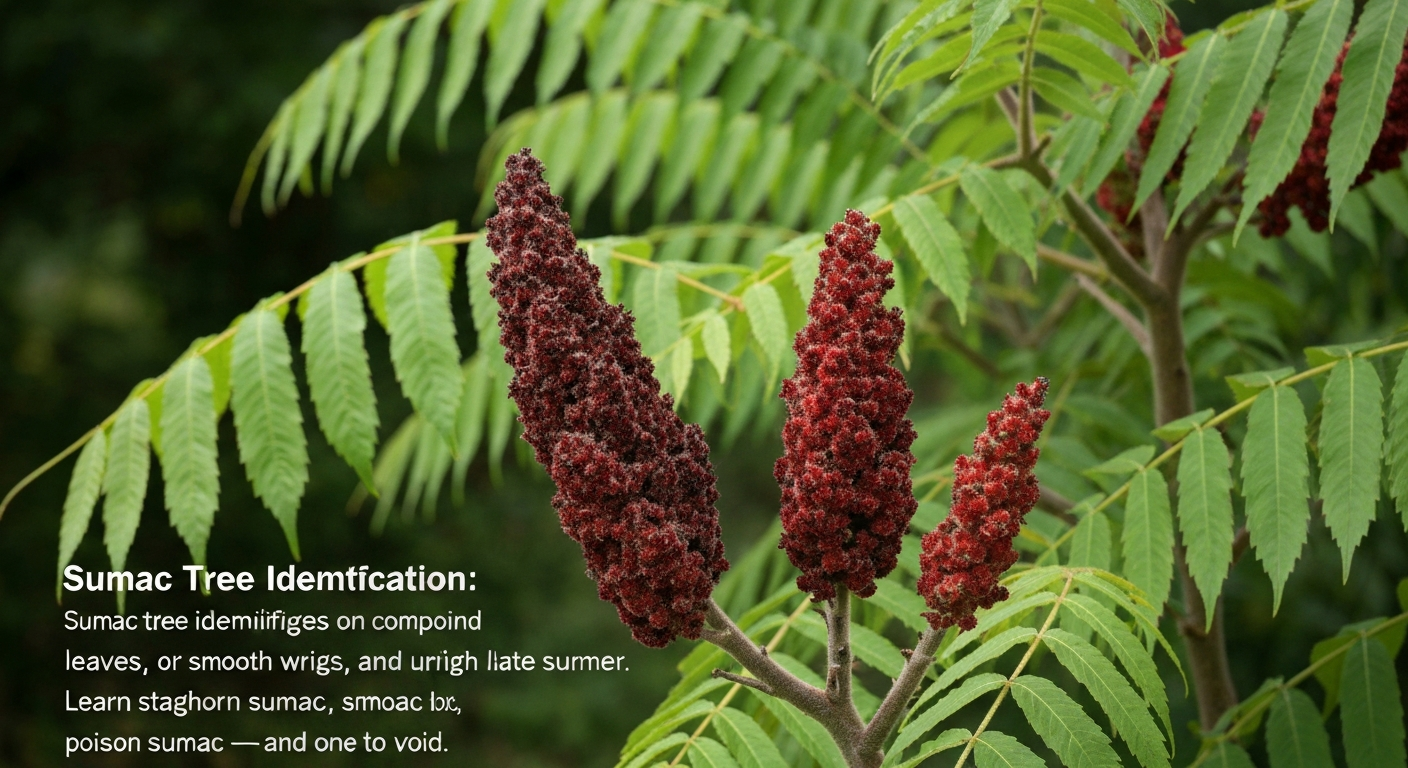
TL;DR: To identify sumac tree colonies in eastern North America, look for large pinnately compound leaves with many toothed leaflets, upright cone-shaped clusters of red fuzzy berries, and brilliant red fall color. Staghorn sumac (Rhus typhina) has velvety hairy twigs; smooth sumac (Rhus glabra) has hairless twigs. Both are safe, colony-forming shrubs or small trees on dry roadsides and field edges. Poison sumac (Toxicodendron vernix) is different — smooth leaflet edges, white drooping berries, swamp habitat, severe rash. Photograph leaves and berry clusters from a safe distance and confirm with the Tree Identifier app.
🔴 Sumac tree identification has a safety split: upright red fuzzy berry cones on dry ground = edible staghorn or smooth sumac. Drooping white berries in a swamp = poison sumac — do not touch.
Understanding sumac — genus and family
Sumacs belong to the cashew family (Anacardiaceae) — the same family as poison ivy, poison oak, mango, and cashew. Edible sumacs in genus Rhus (sometimes split with Schmaltzia in recent taxonomy) are woody plants native to North America, Africa, and Eurasia. In the US, staghorn sumac and smooth sumac dominate dry open habitats.
People say sumac tree because mature colony stems reach 15 to 20 feet and look tree-like, but growth form is usually multi-stemmed — a thicket of suckers from one root system rather than a single trunk. Sumac tree identification often means identifying the colony leader with the best fruit display.
Key genus-level traits for Rhus sumacs:
- Leaves: Pinnately compound — one long petiole with 11 to 31 leaflets arranged in pairs.
- Leaflet margin: Toothed (serrated) on staghorn and smooth sumac — not smooth.
- Fruit: Dense clusters of small red drupes covered in acid hairs, standing upright at branch tips.
- Habitat: Dry, disturbed, sunny — roadsides, fence rows, old fields, rocky slopes.
- Fall color: Intense scarlet to orange-red — among the showiest native autumn foliage.
- Colony habit: Spreads by rhizomes; rings of stems expand outward over years.
Poison sumac is no longer placed in Rhus — it is Toxicodendron vernix, aligned with poison ivy. Sumac tree identification must separate edible red-berried sumacs from toxic white-berried poison sumac before any foraging.
Staghorn sumac tree identification
Staghorn sumac (Rhus typhina) is the fuzzy one — named because young stems feel like velvet on a deer antler in summer.
Twigs and branches: Dense fine hairs cover young growth, fruit stalks, and often the first-year twigs. Rub a twig between fingers — staghorn feels noticeably fuzzy.
Leaves: Large compound leaves, often 12 to 24 inches long, with 11 to 31 leaflets. Each leaflet is lance-shaped, 2 to 4 inches, with sharp serrated teeth. Leaflets attach in pairs along a central rachis, often with one leaflet at the tip.
Fruit: Iconic upright pyramidal or conical heads of red drupes, densely hairy, 4 to 8 inches tall, persisting into winter. Staghorn sumac tree identification is easiest in August through October when fruit is fully red.
Bark: Smooth gray-brown on older stems; younger bark may retain some hair.
Form: Open, irregular crown; stems lean outward. Colonies along highways are classic staghorn sumac habitat in the Northeast and Midwest.
Range: Eastern US and southern Canada, west to Iowa and Missouri; planted ornamentally elsewhere.
Smooth sumac identification
Smooth sumac (Rhus glabra) overlaps staghorn sumac in range and habitat. Smooth sumac tree identification relies on texture differences and subtle fruit shape.
Twigs: Hairless — smooth, glaucous blue-green to brown. No velvety feel.
Leaves: Similar compound structure — 11 to 31 toothed leaflets — sometimes slightly narrower leaflets than staghorn. Rachis may be winged with a thin flange of tissue between leaflet pairs on smooth sumac — a useful ID character under magnification.
Fruit: Upright red clusters like staghorn, but drupe heads are typically slightly less densely hairy and may appear smoother from a distance. Still definitively red and upright — not poison sumac.
Habitat: Dry open woods, prairies, dunes, roadsides — often slightly drier and more western in distribution than staghorn, though ranges overlap broadly.
Fall color: Equally brilliant red; colonies can paint entire hillsides.
Staghorn vs smooth sumac confuses experts when fruit is absent. Default to twig texture: fuzzy = staghorn, smooth = smooth sumac. When in doubt, photograph both twig and fruit cluster for app confirmation.
Poison sumac — the critical lookalike
Poison sumac (Toxicodendron vernix) is the reason sumac tree identification matters for safety, not just curiosity.
Leaflets: Entire margin — smooth edges without teeth. Leaflets are oval, 2 to 4 inches, arranged along a red rachis. Compound leaf structure looks similar from a distance, but smooth edges vs toothed edges is the fastest split.
Fruit: Pale white, cream, or gray drupes in loose drooping clusters — never upright dense red cones. Berry clusters hang beneath branches.
Habitat: Wet — swamps, bogs, peatlands, flooded woods. You wade or wear boots to reach it. Staghorn and smooth sumac avoid standing water; they want dry disturbed soil.
Form: Small tree or shrub to 20 feet in swamp margins; fewer stems per colony than upland sumacs.
Toxicity: Urushiol oil in all parts causes blistering dermatitis worse than many poison ivy cases. Never burn poison sumac wood — smoke carries urushiol.
Rule: Red upright fuzzy berries on a dry roadside = edible sumac. White drooping berries in a swamp with smooth-edged leaflets = poison sumac. No exceptions in eastern North America.
Sumac leaf identification in detail
Sumac leaf identification when fruit is absent depends on compound leaf architecture:
- Confirm pinnately compound: One petiole, many leaflets — not palmately compound like poison ivy (which has only three leaflets anyway).
- Count leaflets: Often 15 to 25 on mature leaves; number varies with shoot vigor.
- Check teeth: Serrated leaflet margins = staghorn or smooth sumac. Smooth margins = stop and reassess for poison sumac.
- Rachis wing: Smooth sumac may show a flat wing of tissue along the leaf stem between pairs — staghorn rachis is typically narrower without a prominent wing.
- Leaf size: Sumac leaves are among the largest compound leaves on dry-site shrubs — often bigger than black locust or ash leaves in the same fence row.
Photograph one full compound leaf laid flat on pavement — the entire rachis and all leaflets visible. See Best Photo for Tree ID for compound-leaf photography tips.
Bark, winter, and colony form
Winter sumac tree identification uses bark, fruit persistence, and colony silhouette:
Persistent fruit: Red staghorn and smooth sumac cones often remain through winter, darkening but still recognizable. Birds eat drupes gradually.
Bark: Thin, smooth gray-brown; older stems may show slight fissuring. Not shaggy like birch, not blocky like oak.
Buds: Small, rounded, hairy on staghorn; smoother on smooth sumac.
Colony rings: Sumac spreads outward; older central stems die while new shoots ring the edge. A circular thicket in an old field is classic sumac architecture.
Without leaves or fruit, winter ID is harder — wait for fruit stalks or learn twig texture. For bark-focused methods, see Tree Bark Identification App Guide.
Other sumac species you might encounter
Fragrant sumac (Rhus aromatica)
Low shrub, trifoliate leaves — only three leaflets, not the long pinnate frond of staghorn. Fruit is red and hairy but on a much smaller plant. Crushed leaves smell citrusy. Common on rocky slopes and dunes.
Winged sumac (Rhus copallinum / Rhus copallina)
Southeastern and mid-Atlantic species with prominently winged rachis — green tissue flange between leaflet pairs. Red upright fruit like other sumacs. Toothed leaflets.
Tree of heaven (Ailanthus altissima) — not a sumac
Invasive weed tree with compound leaves that superficially resemble sumac from a car window. Tree of heaven has smooth leaflet bases with one or two teeth near the bottom, foul-smelling crushed leaf, and winged seeds (samaras) — not red berry cones. Sumac tree identification errors often involve ailanthus on highways — check fruit type.
Edible and cultural uses (edible sumacs only)
Staghorn and smooth sumac red drupes are sour from malic acid on the hairs — the basis for "sumac-ade" (steeped drink) and Middle Eastern sumac spice (a different species, Rhus coriaria, is used commercially, but native sumacs are also harvested).
Foraging rules:
- Positive ID as staghorn or smooth sumac with toothed leaflets and red upright fruit.
- Harvest from clean sites away from road exhaust.
- Never harvest white-berried wetland plants.
- Sumac tree identification is step one; food safety is step two.
Using Tree Identifier for sumac
Tree Identifier recognizes staghorn and smooth sumac from leaf and fruit cluster photos across their native range.
Best photos: One upright red fruit cluster filling the frame. One compound leaf showing toothed leaflets and full rachis. Include twig texture if possible — fuzzy vs smooth splits the two common species.
Caution: Do not touch plants you suspect are poison sumac for close-up photography. Use zoom, verify habitat (swamp vs roadside), and check leaflet margins in the photo before approaching.
Fall foliage only: Red leaves alone may return generic "sumac" or confuse with maple. Add fruit stalk or twig photo when possible.
Sumac tree identification is one of the most rewarding roadside IDs — dramatic fruit, dramatic fall color, and a clear safe-vs-toxic split once you know the red-upright vs white-drooping rule.
Frequently asked questions
How do you identify a sumac tree?
Identify sumac tree species by compound leaves with many leaflets, often large and fern-like, and upright dense clusters of red fuzzy berries (drupes) in late summer and fall. Staghorn sumac has fuzzy hairy twigs like deer antlers in velvet; smooth sumac has smooth twigs. Both are colony-forming shrubs or small trees. Leaves turn brilliant red in fall. Poison sumac lacks red fuzzy berries — it has pale drooping berry clusters and grows in wet swamps.
What does staghorn sumac look like?
Staghorn sumac (Rhus typhina) is a multi-stemmed shrub or small tree to 15 feet with large pinnately compound leaves 1 to 2 feet long. Twigs and fruit clusters are densely covered in short hairs — the staghorn name. Red conical berry heads stand upright at branch tips. Bark on older stems is smooth gray-brown. Brilliant red fall foliage is a roadside signature across eastern North America.
What is the difference between staghorn and smooth sumac?
Staghorn sumac (Rhus typhina) has fuzzy hairy young twigs and fuzzy red fruit clusters. Smooth sumac (Rhus glabra) has smooth, hairless twigs and smoother fruit clusters. Leaves are similar — long compound leaves with 11 to 31 toothed leaflets. Both form colonies from roots and produce red upright berries. Smooth sumac is slightly more widespread in dry open habitats; staghorn sumac tolerates poor soil and appears often on roadsides.
How do you identify poison sumac?
Poison sumac (Toxicodendron vernix) has smooth-edged leaflets without teeth — unlike staghorn and smooth sumac which have serrated leaflet margins. It grows in wet swamps and peat bogs, not dry roadsides. Berries are white or pale gray and hang in loose drooping clusters, not upright red cones. All parts cause severe dermatitis like poison ivy. Never touch white-berried sumac-like plants in wetlands without positive ID.
Are sumac berries poisonous?
Staghorn and smooth sumac red berries are not poisonous — they are used to make tart sumac spice (ground dried drupes) and pink lemonade-style drinks. Poison sumac has white or gray berries and is toxic. The critical sumac tree identification rule: upright red fuzzy clusters on dry upland sites are edible sumac; drooping pale clusters in swamps are poison sumac.
Is sumac a tree or a shrub?
Both. Staghorn and smooth sumac are woody plants that grow as large shrubs or small trees — usually 10 to 20 feet, often multi-trunked from root suckers forming colonies. People search identify sumac tree because mature colony leaders look tree-like. Botanically they are shrubby sumacs in the cashew family (Anacardiaceae), related to mangoes and poison ivy.
Can tree ID apps identify sumac?
Yes, for staghorn and smooth sumac when photos show compound leaves or distinctive red upright berry clusters. Apps may struggle with colony sprigs lacking fruit or with fall foliage only. Poison sumac should be identified carefully — photograph leaflet margins (smooth vs toothed) and habitat. Tree Identifier works well on clear leaf and fruit cluster photos from safe distance.
Try Tree Identifier — free on iPhone
Photograph sumac leaves or red berry clusters and get a species match in seconds.
Download on the App Store