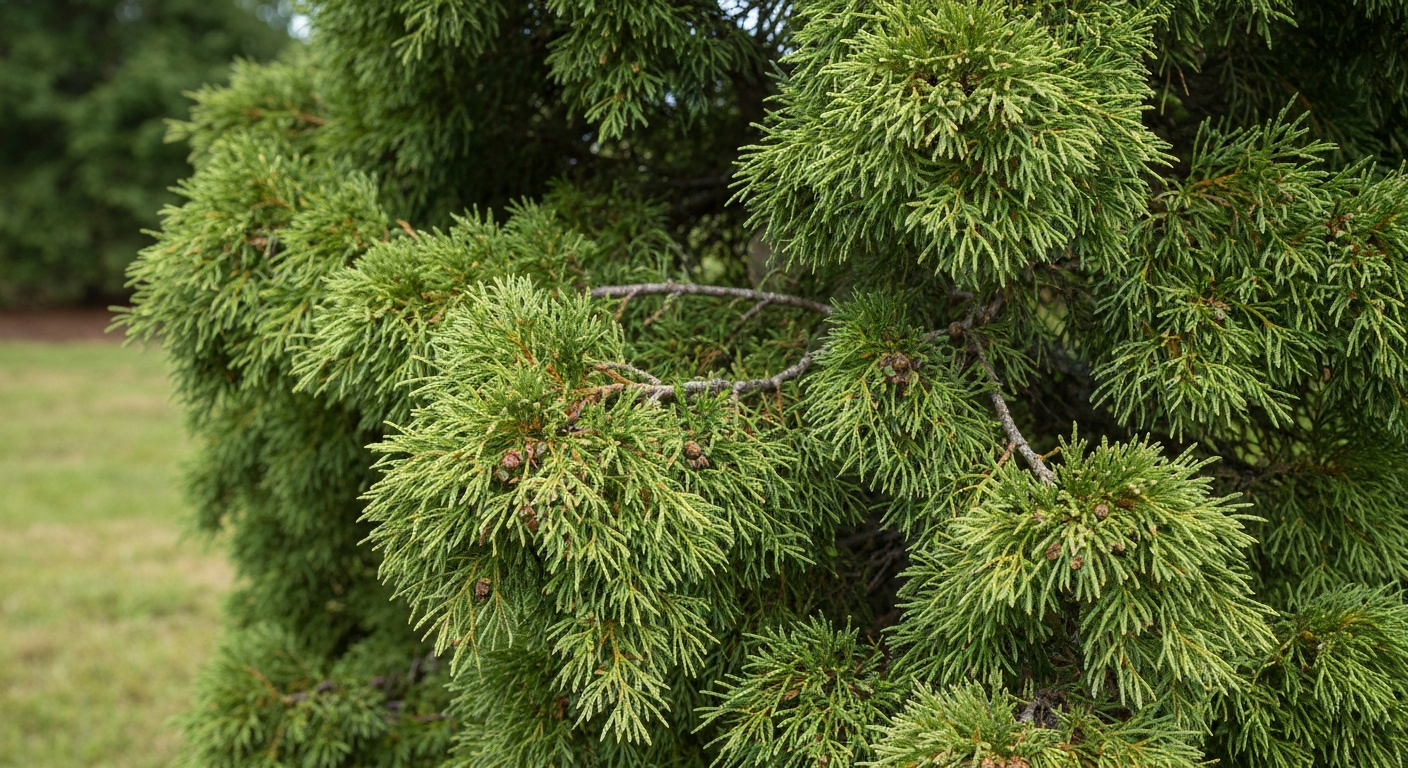
TL;DR: Thuja identification centers on flat, fan-shaped sprays of tiny scale-like leaves (not needles), aromatic foliage when crushed, and small upright woody cones on the branches. Eastern arborvitae (Thuja occidentalis) is a common hedge and foundation plant; western redcedar (Thuja plicata) is a massive Pacific Northwest native. Thuja is not a true cedar (Cedrus) and not a juniper — junipers have berry-like cones and often prickly leaves. Photograph a flat spray against the sky and confirm with the Tree Identifier app.
🌲 Thuja identification in one line: soft flat sprays + scale leaves + tiny upright cones. Prickly foliage with blue berries = juniper, not Thuja.
Understanding Thuja — genus and common names
Thuja is a small genus of conifers in the cypress family (Cupressaceae). Five species exist worldwide; two dominate North American thuja identification: northern white-cedar, called eastern arborvitae (Thuja occidentalis), and western redcedar (Thuja plicata). The name arborvitae means "tree of life" — early settlers used vitamin C-rich foliage medicinally.
Common names cause confusion. "Redcedar" and "white-cedar" suggest true cedars, but Cedrus species (Atlas cedar, Lebanon cedar) are unrelated Old World pines. Thuja is closer to cypress and juniper. Thuja identification requires ignoring the word cedar in common names and focusing on spray architecture.
Genus-level traits:
- Foliage: Scale-like leaves in opposite pairs, tightly pressed to the stem, arranged in flat, fan-shaped sprays.
- Texture: Soft, flexible sprays — not stiff needles like pine or spruce.
- Aroma: Crushed leaves release a sharp, pleasant, resinous scent — cedar-like or citrus-pine.
- Cones: Small, woody, oval, standing upright on branchlets — not hanging like pine cones, not fleshy like juniper berries.
- Bark: Fibrous, stringy, shreddy — peels in long strips on mature trunks.
- Form: Narrow pyramidal habit in many cultivars; forest trees develop buttressed bases.
Flat scale-like sprays — the signature feature
Thuja identification starts with the spray. Each branchlet flattens into a fan or feather shape, like a tiny green ladder laid in one plane.
Scale leaves: Tiny — a few millimeters — rhomboid or diamond-shaped, overlapping in opposite pairs along the stem. No separate needle juvenile leaves on mature sprays (unlike some junipers).
Flat arrangement: The entire spray lies flat. Run your hand along it — Thuja feels soft and pliable. This separates Thuja from prickly junipers immediately.
Green color: Bright yellow-green to deep green depending on species and cultivar. Winter bronzing occurs on some arborvitae cultivars — not a ID dead-end, check spray structure.
Stomatal bloom: Western redcedar may show white X-shaped markings on the lower leaf surface — stomatal lines. Eastern arborvitae is less prominently marked.
Photograph one entire flat spray against a bright sky so the two-dimensional fan shape is obvious. See Best Photo for Tree ID for conifer foliage tips.
Eastern arborvitae (Thuja occidentalis)
Eastern arborvitae is the thuja identification species most Americans know — it frames driveways, screens neighbors, and lines cemeteries from Maine to Minnesota and south in cultivation.
Size: Wild trees reach 40 to 60 feet; garden cultivars ('Emerald Green', 'Green Giant' is actually a hybrid — see below) range from 3-foot balls to 60-foot columns.
Sprays: Flat, fan-shaped, relatively small — each fan often 0.5 to 1 inch wide on typical branchlets.
Cones: About 0.5 inch long, oval, upright, brown when mature. Often sparse on pruned hedges.
Bark: Gray to red-brown, shreddy, fibrous.
Habitat: Cool moist sites — swamp edges, limestone cliffs, lake shores in the wild. In landscapes, tolerates pruning and partial shade.
Cultivars: Hundreds of named forms — columnar, globe, golden, weeping. Thuja identification at cultivar level needs nursery tags; genus ID uses spray and cone characters regardless of height.
Western redcedar (Thuja plicata)
Western redcedar is the giant of thuja identification — a rainforest tree of the Pacific Northwest.
Size: 150 to 200 feet in old growth; massive fluted trunk base.
Sprays: Larger, drooping, lustrous dark green. Branchlets hang more pendulously than eastern arborvitae — graceful swoop on forest trees.
Cones: Slightly larger than eastern — up to 0.75 inch, upright, leathery-woody.
Bark: Gray to cinnamon-brown, deeply furrowed, stringy — strips pull off easily.
Aroma: Strong cedar scent from wood and foliage — iconic for chests and shingles.
Range: Coastal British Columbia through Washington, Oregon, Idaho, Montana; disjunct in interior wet valleys.
Western redcedar in a botanical garden outside range still keys to Thuja by flat sprays and upright cones — size and droop hint at species.
Thuja cones — small, upright, woody
Cones complete thuja identification when foliage alone is ambiguous.
Shape: Oval to oblong, like tiny wooden eggs.
Orientation: Upright on the twig — pointing skyward, not dangling.
Texture: Woody and leathery, not fleshy. Scales few and fused — unlike the woody scales of a pine cone opening wide.
Color: Green maturing to brown; may persist on the tree.
Quantity: Mature trees produce cones annually but hedges pruned every year may never show them — look at untrimmed leaders or wild specimens nearby.
Cones distinguish Thuja from junipers (berry-like galbuli) and from many pines (large hanging cones). For fruit terminology, see Tree Anatomy Glossary.
Thuja vs juniper
Juniper confusion is the most common thuja identification mistake because both are scaly Cupressaceae conifers used in landscaping.
Thuja: Flat soft sprays. Upright woody cones. Opposite scale pairs in flattened planes. Pleasant aromatic crush. No sharp points.
Juniper (Juniperus): Often three-dimensional, not neatly flat — awl-like juvenile leaves on many species, especially sharp on young growth. "Berries" are fleshy seed cones (blue, waxy). Crushed juniper smells gin-like or sharp but foliage often pricks skin.
Quick field test: Slap the foliage against your palm. Thuja feels soft. Common juniper (e.g., J. virginiana, eastern redcedar — another misnamed cedar) often hurts.
Cone test: Search for fruit. Woody upright mini-eggs = Thuja. Blue berries = juniper.
Thuja vs false cypress (Chamaecyparis)
False cypress — including Hinoki cypress (Chamaecyparis obtusa) and Lawson cypress (Chamaecyparis lawsoniana) — shares scale-like leaves with Thuja.
Spray shape: False cypress sprays often appear more drooping and less distinctly fan-flat. Hinoki has a characteristic drooping tip to branchlets.
Cones: False cypress cones are typically rounder, like tiny wooden balls, not elongated upright eggs.
Scent: Hinoki has a distinctive lemon-clean aroma; Thuja is sharper and more cedar-resin.
Native range: Chamaecyparis species are Asian or western North American; Thuja occidentalis is eastern. In a Japanese garden, Hinoki vs arborvitae matters for care and ID.
When scale detail is unclear, photograph cones and overall tree form. Apps handle Thuja vs Chamaecyparis well from combined cues.
Other Thuja species and hybrids
Global thuja identification includes species beyond the two North American natives:
Thuja standishii (Japanese arborvitae)
Native to Japan; rare in cultivation outside collections. Similar flat sprays; cones slightly larger. Hybridizes with T. plicata.
Thuja koraiensis (Korean arborvitae)
Low shrubby species from Korea and Manchuria. Small sprays; ornamental in specialist gardens.
Thuja Green Giant (T. standishii × T. plicata hybrid)
Popular fast-growing screen plant — not a species but a hybrid. Combines western redcedar vigor with Japanese arborvitae habit. Flat sprays and upright cones confirm Thuja genus; exact parentage needs nursery label.
Bark, wood, and winter ID
Winter thuja identification uses bark and persistent foliage:
Bark: Fibrous strips — pull a strip on mature western redcedar and it comes away in a long ribbon. Eastern arborvitae bark is thinner on small stems.
Evergreen foliage: Thuja holds green leaves through winter in cold climates — hedges stay green when deciduous trees are bare.
Winter bronzing: Some arborvitae cultivars turn brownish bronze in cold wind — temporary color, not death. Spray structure still identifies Thuja.
Seedlings: Young Thuja have the same flat spray architecture at inches tall — useful for seedling identification in conifer plantings.
For bark-focused methods, see Tree Bark Identification App Guide.
Landscape, ecology, and lookalike summary
Thuja occupies distinct ecological and horticultural niches:
- Hedges and privacy screens: Eastern arborvitae and Green Giant dominate North American landscaping.
- Rainforest canopy: Western redcedar is a climax species in wet Pacific forests — shade-tolerant, rot-resistant wood.
- Wildlife: Deer browse arborvitae heavily — ragged hedge tops may be herbivory, not disease.
- Not yew: Yew (Taxus) has flat needles but produces red arils (berry cups), not cones. Yew is toxic; Thuja is not yew.
- Not incense cedar: Calocedrus decurrens has similar scale leaves but longer hanging cones and a different western range.
Thuja identification succeeds when you combine touch (soft sprays), smell (aromatic crush), sight (flat fans and upright cones), and context (hedge vs rainforest giant).
Using Tree Identifier for Thuja
Tree Identifier recognizes arborvitae and western redcedar from flat spray photos.
Best photos: One flat spray filling the frame, backlit to show outline. Include an upright cone if visible. Whole-tree photo helps separate columnar cultivars from forest giants.
Hedge challenges: Sheared hedges lack cones and may blur species — photograph unsheared growth at the top or a nearby untrimmed specimen.
Regional range: App models weight native distribution — western redcedar photos from Seattle vs arborvitae from Vermont both resolve within genus and often species.
Thuja identification is tactile — crush a leaf, feel the flat spray, and the genus announces itself before you reach for a field guide.
Frequently asked questions
How do you identify Thuja?
Identify Thuja (arborvitae and western redcedar) by flat, fan-shaped sprays of tiny scale-like leaves in opposite pairs, not needles. Foliage is soft and aromatic when crushed. Cones are small, woody, and stand upright on the branches. Bark is fibrous and shreddy. Form is usually a narrow pyramid or column in garden cultivars, or a large conical tree for western redcedar.
What is the difference between arborvitae and western redcedar?
Northern white-cedar or arborvitae (Thuja occidentalis) is native to eastern North America, smaller, often under 40 feet, with fan-shaped flat sprays and cones about 0.5 inch long. Western redcedar (Thuja plicata) is a massive Pacific Northwest tree to 200 feet with larger sprays, longer pendulous branchlets, and cones about 0.5 to 0.75 inch. Both are true Thuja — not true cedars (Cedrus).
How do you tell Thuja from juniper?
Thuja has flat, soft, scale-like leaves in flattened sprays — foliage feels pliable and aromatic like cedar or citrus. Junipers (Juniperus) usually have sharp awl-shaped or scale leaves that are often prickly, and they produce berry-like fleshy cones (juniper berries), not small upright woody cones. Juniper foliage is often prickly to the touch; Thuja is soft.
How do you tell Thuja from false cypress (Chamaecyparis)?
False cypress and Thuja both have scale-like leaves, but false cypress (Chamaecyparis, including Hinoki cypress) often has drooping flattened sprays with a different texture and usually rounder woody cones. Thuja sprays are distinctly flat and fan-shaped with opposite scale pairs. Crushed Thuja smells sharp and pleasant; false cypress scent varies by species. Microscopic detail: Thuja scale leaves are decurrent; arrangement differs on close inspection.
What do Thuja cones look like?
Thuja cones are small, oval to oblong, woody, and stand upright on the twigs — unlike juniper berries which are fleshy and round. They look like tiny wooden eggs perched on the foliage, often less than an inch long, brown when mature. Cones may be abundant on mature trees but easy to overlook because of small size.
Is Thuja a true cedar?
No. Thuja is called arborvitae or redcedar in common names but belongs to cypress family Cupressaceae, not genus Cedrus (true cedars from the Old World). Eastern arborvitae (Thuja occidentalis) and western redcedar (Thuja plicata) are the two main North American Thuja species. The word cedar here refers to aromatic wood, not botanical Cedrus.
Can tree ID apps identify Thuja?
Yes, when photos show flat spray structure and overall form. Close-ups of scale leaves and any visible upright cones help. Apps distinguish Thuja from needled pines and spruces easily. Tree Identifier recognizes arborvitae and western redcedar from foliage sprays in North American ranges.
Try Tree Identifier — free on iPhone
Photograph arborvitae or western redcedar sprays and get a Thuja match in seconds.
Download on the App Store