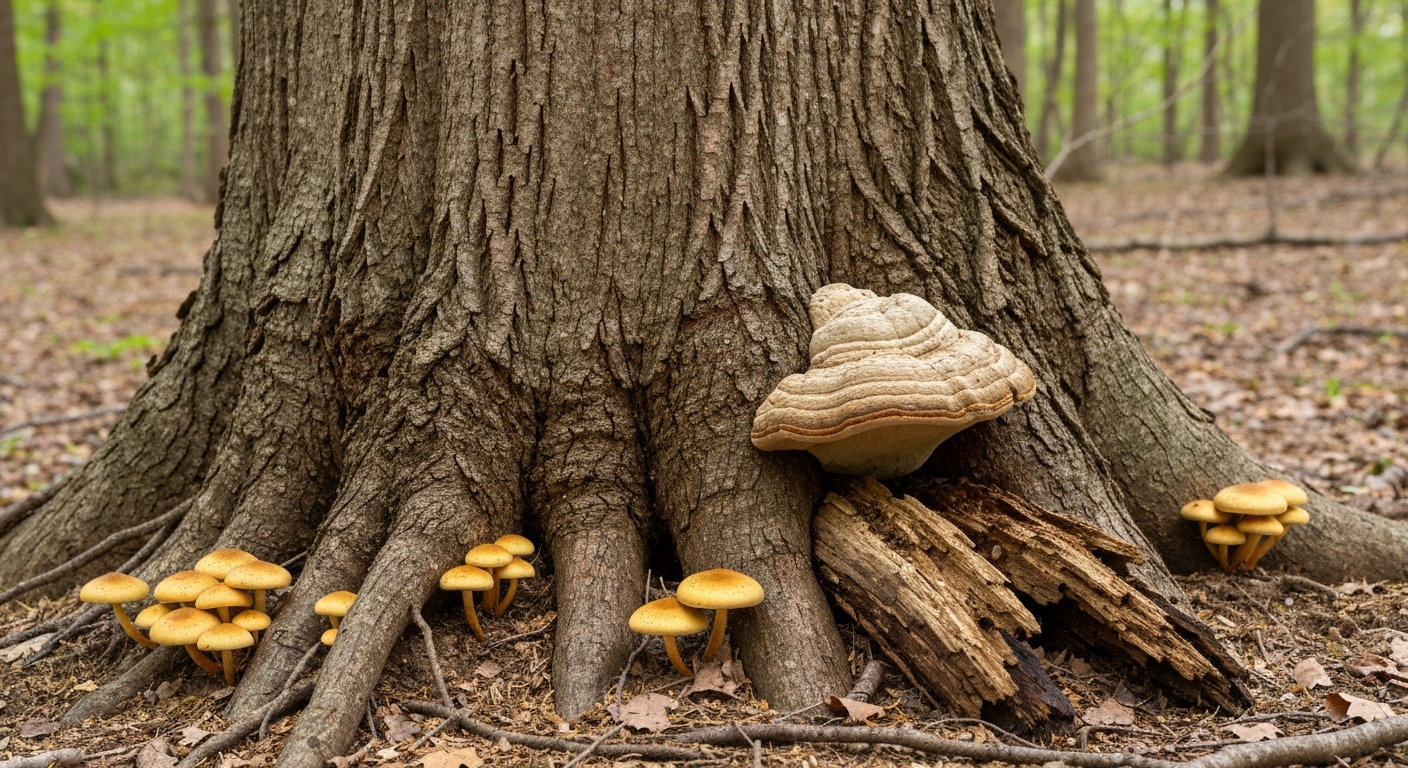
TL;DR: Mushrooms and conks at a tree base are clues, not a diagnosis by themselves. Use a mushroom ID app or field guide for the fungus, and a tree ID app for the host species — they answer different questions. Honey fungus (Armillaria), artist's conk (Ganoderma), and velvet conk (Inonotus) are the three decay fungi homeowners most often encounter. Beneficial mycorrhizae rarely produce obvious mushrooms at the trunk. Call an arborist when you see hard conks on the lower trunk, dieback, lean, or mushrooms on a tree that looks unhealthy.
📌 Tree Identifier identifies the tree, not the fungus. Knowing the host species tells you how susceptible it is, how long it might survive with decay, and whether treatment is worthwhile.
Tree ID apps vs. fungus ID apps — know which question you're asking
When someone searches for tree root fungus identification, they often open the wrong app first. A tree identification app like Tree Identifier is trained on leaves, bark, branching, and overall tree form. It answers: what species is this tree? A mushroom identification app or community platform like iNaturalist answers: what fungus is this fruiting body? Both pieces of information matter, but they are not interchangeable.
Consider a cluster of tan mushrooms at the base of a mature oak. The fungus app might return Armillaria mellea (honey fungus). The tree app might confirm the host is a pin oak. Together, that pairing is alarming — oaks are susceptible to Armillaria root rot, and the combination suggests active infection. If the tree app says the host is a healthy-looking red maple and the fungus app suggests a harmless mulch-decomposer, the same visual scene may be low priority.
This guide focuses on what you can observe at the tree base, which fungi are most common on roots and trunks, and how to combine visual assessment with the right identification tools. It is not a substitute for a certified arborist when structural safety is in question.
What you'll see at the base: a visual field guide
Fungi at tree bases show up in a few repeatable forms. Learning to categorize what you see is the first step in tree root fungus identification.
Mushrooms (soft, short-lived fruiting bodies)
Mushrooms are the reproductive structures of fungi. They appear after rain or in cool, humid weather, often in clusters. At a tree base, look for:
- Cap shape and color — convex to flat caps; honey tan, brown, white, or reddish
- Gills or pores underneath — gilled mushrooms (like many agarics) vs. pore surfaces (polypores that sometimes form stalked mushrooms)
- Ring on the stalk — a skirt-like remnant below the cap, common on Armillaria
- Clustering pattern — tight groups emerging from roots, buried wood, or mulch vs. scattered individuals in lawn soil
- Substrate — growing directly from trunk wood, exposed roots, stump, or only from soil nearby
Mushrooms can disappear within days. Photograph them when you first notice them — for fungus ID apps, capture the cap top, underside (gills or pores), and stalk base including what they're growing from.
Conks and brackets (hard, woody shelf fungi)
Tree conk identification is often more urgent than mushroom spotting because conks indicate long-term internal decay. Conks are:
- Hard, woody, and perennial — they add a new layer each year
- Attached flat to vertical or horizontal wood like a shelf or hoof
- Often found on the lower trunk, root flare, or large exposed roots
- Sometimes with a lacquered or varnished appearance (Ganoderma) or velvety upper surface (Inonotus)
If you can easily slice through it with a knife, it's probably a fresh mushroom. If it's tough like wood, treat it as a conk and take structural concern seriously.
Mycelium, rhizomorphs, and other below-ground signs
Not all root-zone fungi produce visible mushrooms. Other signs include:
- White fan-shaped mycelium under loose bark at the root collar (classic Armillaria)
- Black shoestring-like rhizomorphs on roots or in soil — Armillaria's spreading "bootlaces"
- Soft, crumbly, or discolored wood at the base when bark is peeled back (advanced decay)
- Honey-colored mushrooms on buried stumps or old root pieces even when the main trunk looks fine
Do not aggressively peel bark or dig roots without reason — you can harm the tree and spread pathogens on tools. A light check for white mycelial fans is sometimes done by arborists; homeowners should photograph and consult rather than excavate extensively.
Mycorrhizae vs. pathogens: not all root fungi are enemies
Most tree roots in healthy forests and yards are colonized by mycorrhizal fungi — symbiotic partners that extend the root system's reach and trade minerals for sugars from the tree. Mycorrhizae are usually invisible; they do not produce large mushrooms at the trunk base routinely.
When you do see fungi associated with living trees, they fall into rough categories:
- Mycorrhizal associates — beneficial; may produce occasional mushrooms in soil near (not on) the tree; tree looks healthy
- Saprophytes — decomposing dead organic matter (mulch, buried logs, old stump roots); often harmless to the living tree
- Parasitic / pathogenic decay fungi — actively killing root or trunk tissue; often paired with crown thinning, small leaves, dieback, or conks
The mistake homeowners make is assuming any fungus on tree roots means the tree is doomed. A ring of mushrooms in the mulch ring after a wet week may be unrelated to tree health. The concern rises when fruiting bodies emerge from the trunk or root wood itself, especially alongside decline symptoms.
Three common species: Armillaria, Ganoderma, and Inonotus
Armillaria — honey fungus
Honey fungus is the common name for Armillaria species, among the most destructive root pathogens in North America and Europe. Identification clues:
- Clusters of honey-colored to brown mushrooms, often in fall, with a ring on the stalk and white spore print
- Grows from trunk base, roots, or buried wood
- White mycelial fans under bark at root collar when advanced
- Black rhizomorphs in soil — distinctive but not always visible
- Often affects multiple trees in a group as it spreads root-to-root
Susceptible hosts include oaks, maples, fruit trees, and many ornamentals. Stress from drought, soil compaction, or root injury increases risk. There is no simple chemical cure; management focuses on removing infected stumps and roots, avoiding unnecessary root wounds, and sometimes installing root barriers between valuable trees.
Ganoderma — artist's conk and relatives
Ganoderma species produce hard, shelf-like conks on trunks and roots. Ganoderma applanatum (artist's conk) has a dull, whitish pore surface that bruises brown — historically used for etching. Ganoderma lucidum (reishi) has a lacquered reddish cap in some forms. Clues:
- Perennial woody brackets, often hoof-shaped, on lower trunk or roots
- White to brown pore surface underneath (no gills)
- Indicates white rot — cellulose and lignin decay inside the wood
- Common on hardwoods; also appears on stumps
A single conk on a large live oak does not always mean immediate failure, but it means decay is present. An arborist should assess how extensive the rot column is and whether the tree poses a hazard.
Inonotus — velvet conk and root rot
Inonotus dryadeus and related species cause root and butt rot, especially on oaks. The conk is often thick, lumpy, and velvety on top when young, with a yellowish to brown pore surface. Clues:
- Large, irregular conks at the root flare or lower trunk of oaks
- Often associated with old or stressed trees
- Indicates advanced butt rot — decay at the structural base
- High priority for professional hazard evaluation
If you are doing tree conk identification and land on Inonotus on a mature tree near a house or driveway, schedule an arborist inspection promptly.
Other fungi you might mistake for root problems
Not every mushroom at a tree base is Armillaria. Common alternates:
- Coprinoid mushrooms in mulch — ink caps and allies decomposing wood chips; tree unaffected
- Stropharia or Agaricus in lawns — soil saprotrophs near trees but not on wood
- Turkey tail (Trametes versicolor) — thin, leathery, banded brackets on dead wood; often on stumps, not always on living trunks
- Oyster mushrooms (Pleurotus) — on dead or dying wood; indicate decay but species and host context determine urgency
Photograph the fungus and the attachment point. "Growing from soil six inches from the trunk" is a different story than "growing directly from the root flare wood."
Using photo apps: identify the host tree first
For homeowners, the most actionable phone workflow is:
- Photograph the fungus — cap, underside, stalk base, and substrate. Submit to iNaturalist or a mushroom ID app for a suggested species.
- Photograph the tree — a clear leaf (or bark in winter), plus a shot of the whole tree for context. Submit to Tree Identifier or your preferred tree app.
- Note symptoms — dieback, thin canopy, mushrooms on multiple trees, recent construction near roots, mulch piled against the trunk.
- Cross-reference susceptibility — once you know the tree species, search extension guides for that species plus the suspected fungus.
Tree apps excel at answering whether the host is an oak, maple, pine, or cherry — which changes everything about Armillaria risk and treatment economics. If you're unsure how to get a clean leaf or bark photo, see our best photo for tree ID guide. For bark-only winter identification, the tree bark identification guide covers technique.
Knowing your tree also helps when talking to an arborist. "There's a conk on my tree" is vague. "There's a hoof-shaped conk on a pin oak I've identified, with upper canopy dieback over two years" gets a faster, more useful assessment.
Tree health clues that matter more than the mushroom itself
Fruiting bodies are symptoms of fungal activity, not the whole story. Evaluate the tree:
- Crown dieback — dead branch tips, thinning foliage, smaller leaves than normal
- Lean or soil mounding — root failure on the opposite side
- Cracks or cavities at the base; carpenter ant activity (often secondary)
- Mulch volcanoes — mulch piled against the trunk promotes bark decay and hides problems
- Recent root disturbance — trenching, grade changes, driveway expansion within the dripline
A vigorous tree with mushrooms only in surrounding mulch is a different management conversation than a leaning tree with conks on the root flare. The fungus ID tells you what organism is present; the tree health assessment tells you what to do about it.
When to call an arborist
Home diagnosis has limits. Hire a certified arborist (ISA credential) when:
- Hard conks appear on the lower trunk or root flare of a large tree
- Mushrooms emerge directly from trunk wood and the tree shows decline
- The tree leans, has target issues (house, sidewalk, play area), or failed partially in a storm
- Multiple trees in a row develop similar symptoms — possible Armillaria epidemic
- You're unsure whether the tree is structurally sound for another season
Arborists use resistograph drilling, sonic tomography, or aerial inspection to estimate internal decay. They can also recommend root collar excavation if mulch or soil is buried too deep — a common fix that is not about the fungus at all.
Do not wait until a tree fails. Root and butt rot can leave a tree looking half-healthy while the base is hollow. Conks are often a late visible sign of years of internal activity.
Safety: mushrooms, spores, and working around decayed trees
Never eat wild mushrooms from a tree base unless identified in person by a qualified mycologist. Many wood-growing species have toxic look-alikes. Children and pets should be kept away from unknown mushrooms.
- Do not compost suspected pathogen fruiting bodies near other trees if Armillaria is suspected — dispose in trash.
- Clean tools if you cut infected wood — bleach or alcohol reduces spread to healthy trees.
- Avoid standing under trees with advanced decay during windstorms; hazard trees can fail without warning.
- Wear gloves when handling mushrooms if you have sensitivities; spore loads from large bracket fungi can irritate airways when dry.
- Do not burn large quantities of unknown fungi indoors; spores and particles can be irritating.
Identification for curiosity is safe with photos and distance. Structural work on decayed trees is not a DIY job.
Practical next steps in your yard
If you've found mushrooms at the tree base this week, work through this checklist:
- Photograph fungus and tree features the same day mushrooms are fresh.
- Identify the host tree with Tree Identifier or a regional guide like our common backyard trees reference.
- Check whether fungi grow from wood vs. only from mulch or soil.
- Look for dieback, lean, or old wounds at the base.
- Submit fungus photos to iNaturalist for community ID; compare with extension factsheets for your state.
- Call an arborist if conks, decline, or hazard targets are present.
- Fix cultural issues — remove mulch from touching the trunk, avoid root injury, water during drought if the species needs it.
Root fungus identification is a skill that blends mycology and arboriculture. You do not need to master both overnight. Identifying the tree is often the faster, more useful first step — and it's exactly what a dedicated tree app is built for.
Frequently asked questions
Is fungus at the base of a tree always a problem?
No. Many fungi at tree bases are harmless saprophytes breaking down dead wood, mulch, or buried roots — or beneficial mycorrhizal partners helping the tree absorb water and nutrients. Pathogenic root rot fungi are a concern when you also see crown dieback, leaning, basal wounds, or fruiting bodies that match known decay species like Armillaria, Ganoderma, or Inonotus. Context matters more than the mere presence of mushrooms.
What is honey fungus (Armillaria) and how do I recognize it?
Honey fungus refers to several Armillaria species that attack living tree roots and wood. Look for clusters of honey-colored to brown mushrooms with a ring on the stalk and gills underneath, often appearing in fall around the base of stressed or dying trees. Underground, you may find flat white mycelial sheets (rhizomorphs) under bark at the root collar. Armillaria spreads to neighboring trees and is one of the most serious root pathogens in temperate landscapes.
Can I identify tree root fungus with a phone app?
Mushroom and fungus ID apps (iNaturalist, Picture Mushroom, Seek) can suggest a fungal species from a clear photo of the fruiting body. Tree identification apps like Tree Identifier identify the host tree, not the fungus. For management decisions, you need both: the fungus type tells you the disease risk; the tree species tells you susceptibility, expected lifespan, and whether the tree is worth treating or removing.
What is the difference between a conk and a mushroom at a tree base?
Mushrooms are soft, short-lived fruiting bodies with caps and gills or pores — they often appear after rain and may last only days. Conks (also called brackets or shelf fungi) are hard, woody, perennial growths attached flat to the trunk or roots; they persist for years and indicate that a wood-decay fungus has been active inside the tree for a long time. Conks on the lower trunk or root flare usually signal internal rot and warrant a professional arborist inspection.
Should I remove mushrooms growing at my tree's base?
Removing visible mushrooms does not remove the fungus inside the tree or soil — the mycelium remains. Picking them is fine for aesthetics or to keep children and pets away, but it does not cure an infection. Do not eat wild mushrooms at tree bases unless identified by an expert; many toxic species grow on wood. Focus on assessing tree health and identifying both the fungus and host species rather than simply clearing fruiting bodies.
When should I call an arborist about fungus on tree roots?
Call a certified arborist if you see conks on the trunk or root flare, clusters of mushrooms on a tree with dieback or lean, mushrooms on multiple nearby trees, soft or sunken wood at the base, or fungus on a large tree near structures or high-traffic areas. Arborists can assess structural risk, test for specific pathogens, and recommend removal, root barrier, or monitoring. Early consultation is cheaper than emergency removal after failure.
Identify the host tree with Tree Identifier
AI-powered tree ID from a leaf, bark, or whole-tree photo. Know what species you're protecting before you call the arborist.
Download on the App Store