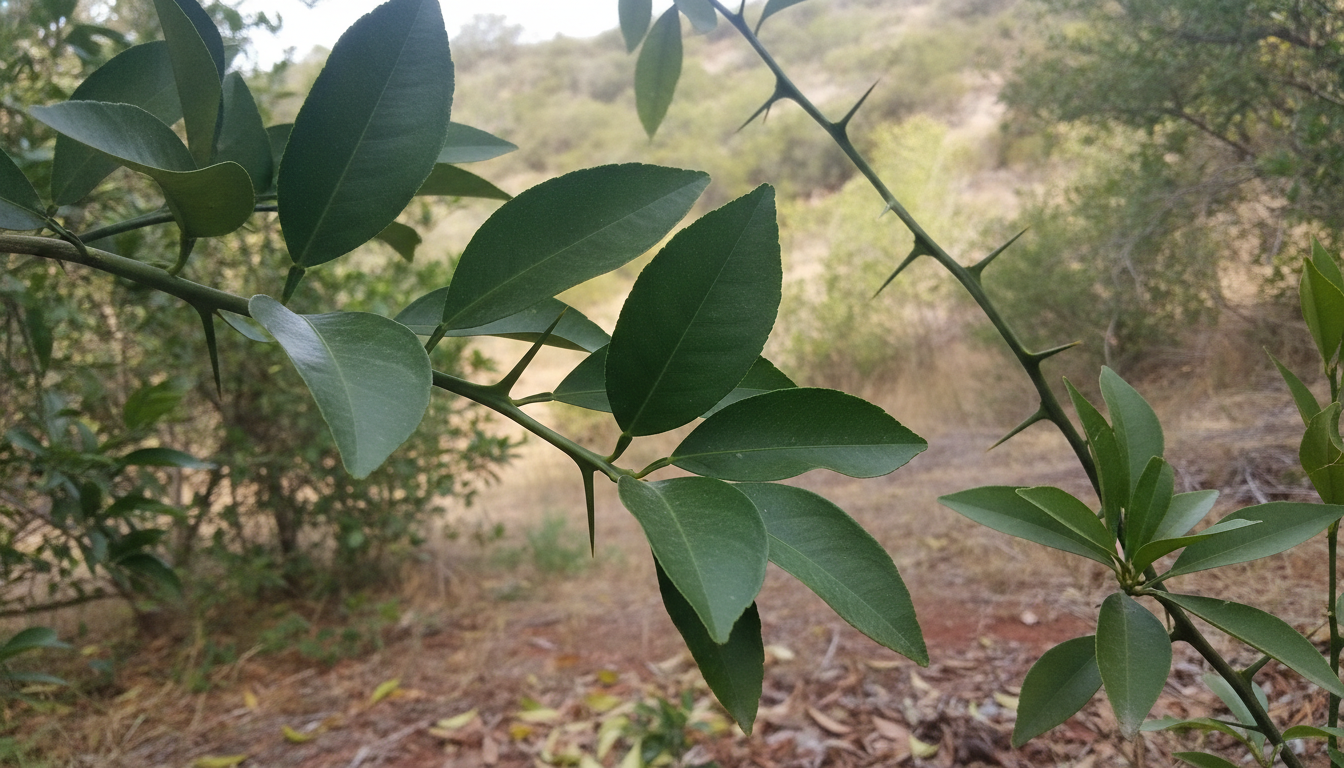
People searching “leaves identify citrus tree with thorns” usually have a glossy green blade, a sharp point beside it, and a guess that the plant is a lemon. That guess is often right at the genus level and wrong at the variety level. True citrus in the genus Citrus does carry spines, especially on young wood, but so do hawthorns, locusts, osage orange, and the trifoliate orange used as a rootstock. The leaf is the separator if you photograph the petiole, not just the pretty blade.
This guide is a field check for that leaf: simple versus three leaflets, winged petiole, a single axillary thorn, and the scent when the blade is crushed. It will not name Meyer versus Eureka from foliage. For the general leaf workflow, use Identify Trees by Leaf, then come back here for the citrus-specific traps.
The four characters that actually matter
Work in this order so a thorn does not bully the identification.
- Blade: One glossy, leathery, simple-looking leaf. True citrus leaves are unifoliolate: they look simple, with a joint where the blade meets the petiole.
- Petiole: Often flattened into a wing. Wing width varies by species group. A wing is not a second leaflet.
- Thorn: Typically one spine in the leaf axil, the angle between petiole and stem. Juvenile shoots and suckers are thornier than old fruiting wood.
- Scent: Tear or crush a small piece of blade. Oil glands release a sharp citrus smell. Lookalikes do not.
If any one of those fails, stop calling it a lemon. Three leaflets means you are probably holding trifoliate orange. No citrus smell plus a long woody thorn means hawthorn or osage orange territory. A whole feather-shaped leaf of many leaflets means locust, not citrus.
What a citrus leaf looks like up close
Hold the leaf so the petiole points toward you. The blade is usually oval to elliptic, dark green above, paler beneath, and dotted with translucent oil glands if you hold it to the light. The margin may be smooth, bluntly toothed, or finely crenate. Lemon leaves are often more noticeably toothed than sweet orange leaves. That tooth pattern is a hint, not a cultivar label.
The petiole wing is the feature phone photos crop out. On grapefruit and sour orange the wing is broad and obvious, sometimes heart-shaped beside the blade. On lemon and many limes it is narrow. On many mandarins it is almost absent, so the leaf looks like an ordinary simple leaf until you find the joint and the oil scent. Photograph the entire petiole in the same frame as the blade. A blade-only close-up is how citrus gets filed as “unknown glossy shrub.”
The thorn, when present, is a single spine at the node. It is not a branched trunk weapon and not a pair of spines flanking the bud the way black locust does. Nursery trees and mature backyard lemons may show thorns only on water sprouts or on growth below the graft. Look at the lower trunk: if a thorny, different-looking shoot arises from beneath a swollen graft union, that shoot is rootstock. Identifying the fruiting variety from that sucker will send you to the wrong plant.
Wing width is a group clue, not a variety name
| Group | Leaf and petiole | Thorns | Do not conclude |
|---|---|---|---|
| Lemon | Often toothed margin, narrow petiole wing | Common on young wood | A named lemon cultivar |
| Lime | Smaller blade, narrow wing | Variable; some very thorny | Key lime versus Persian lime from one leaf |
| Sweet orange | Ovate blade, modest wing | Often sparse on mature wood | Navel versus Valencia |
| Grapefruit and sour orange | Broader petiole wing | Present, especially on sour orange seedlings | Which grapefruit selection |
| Mandarin | Smaller leaf, wing slight or absent | Often fewer on cultivated trees | Satsuma versus clementine |
| Trifoliate orange | Three leaflets, not one blade | Stout, often green thorns | That it is a lemon because it is thorny and citrus-scented |
Fruit, if it is on the tree, is allowed as a second character. A leaf identification that ignores a hanging grapefruit is incomplete, and a leaf identification that invents a cultivar because the fruit is yellow is also incomplete. Lemons, some citrons, and unripe fruit of other kinds are all yellow-green at stages. Name the group. Leave the cultivar for a nursery tag or a known graft.
Trifoliate orange, the three-leaflet lookalike
Citrus trifoliata (still widely sold and discussed as Poncirus trifoliata) is the plant that makes this search hard. It is citrus in the broad sense, it smells citrus when crushed, and it is fiercely armed. The leaf is the giveaway: three leaflets, the center one usually larger, on a winged leaf stalk, with thorns that can be longer and stiffer than a typical lemon spine. The plant is deciduous in cold climates, which evergreen backyard lemons are not. It is planted as a hardy hedge and used as a rootstock under edible citrus.
If your “lemon” drops its leaves in winter and every node carries a serious thorn plus a three-part leaf, you are looking at trifoliate orange or a hybrid with it, not a standard lemon canopy. Hybrids such as citrange can blur the leaflet count. When you see both simple leaves and three-leaflet leaves on one plant, photograph both and treat the result as a citrus hybrid or a grafted tree with rootstock mixed into the crown. Say that plainly. Do not force a single species name.
Hawthorn, locust, and osage orange
These are the non-citrus thorns that share a backyard or a fencerow with someone hoping for fruit.
Hawthorn (Crataegus): Thorns are modified shoots, often an inch to several inches, and they can be branched. Leaves are simple and often lobed or sharply toothed, with no citrus petiole wing and no citrus oil. Spring flowers are in clusters. Fruit is a small pome, the haw, not a rinded citrus fruit. A crushed leaf smells green or slightly bitter, not like a peel.
Black locust (Robinia): Leaves are odd-pinnate, a row of leaflets along a central stalk. Spines are paired at the nodes. There is no single glossy citrus blade.
Honey locust (Gleditsia): Leaves are pinnate or bipinnate. Thorns on the trunk and branches are often branched and enormous. Nothing about the foliage suggests a lemon.
Osage orange (Maclura pomifera): Simple alternate leaves without a winged citrus petiole, often with milky sap if a leaf stalk is torn, and stout axillary thorns. The fruit, when present, is a large yellow-green brain-textured ball, not a lemon. No citrus scent.
If you are sorting unknown trees from photos more broadly, the leaf arrangement notes in the tree anatomy glossary keep “compound” and “simple” from getting swapped before you ever reach scent.
A photo that a person or an app can actually use
One frame should include the whole leaf and the petiole wing. A second frame should show the thorn at the node, with the stem in view so it is obvious there is one spine, not a pair. A third, if you can do it safely, is a note that the crushed leaf smelled like citrus. Flower or fruit photos help only after the leaf has placed the plant in citrus.
Best Photo for Tree ID covers light and background. For this plant, shade-on-gloss is the usual failure: a reflective blade becomes a white smear and the wing disappears. Overcast light or open shade keeps the oil glands and the petiole edge visible.
Tree Identifier can match citrus and the trifoliate lookalike from those frames. Expect a genus or species-group result. A confident cultivar name from a leaf is a reason to distrust the result, not a reason to relabel the tree.
What not to decide from leaves
Do not price the tree, do not assume the fruit is edible in quantity, and do not treat a thorny sucker as the variety you think you planted. Sour orange and trifoliate rootstocks are common under sweet trees. The leaves on that sucker identify the rootstock. The leaves in the canopy identify the grafted top, and only to the group level described above.
Also skip the urge to call every thorny evergreen a citrus. Holly is evergreen and can be spiny, but the spines are on the leaf margin, the leaf is not a winged citrus petiole, and there is no rind-oil smell. That margin-spine versus axillary-spine distinction takes one careful look and prevents a whole wrong path.
Frequently asked questions
How do leaves identify a citrus tree with thorns?
True citrus usually has one glossy simple leaf, a petiole that may be winged, and a single spine in the leaf axil. Crushing the leaf releases a citrus-oil scent. Juvenile shoots and rootstock suckers are thornier than mature named cultivars.
Why does my citrus have thorns on some branches and not others?
Thorns are common on young growth, water sprouts, and the rootstock below a graft. Many fruiting cultivars are nearly spineless on older canopy wood. A thorny shoot from below the graft union may be the rootstock, not the variety that produces the fruit.
What tree has three leaflets and big thorns?
Trifoliate orange has three leaflets, stout green thorns, and is deciduous in cold climates. It is a common rootstock and hedge, and it is the usual mix-up when someone expects a lemon leaf.
Can I tell lemon from lime or orange by the leaf?
Petiole wing width and leaf size narrow the group. Grapefruit and sour orange tend to have broader wings; lemon and many limes narrower ones; mandarins are often nearly wingless. Leaves alone should not name a cultivar.
Do hawthorns smell like citrus when the leaf is crushed?
No. Hawthorn thorns are sharp modified shoots, and the leaves lack a winged citrus petiole and oil-gland citrus scent. Fruit, when present, is a small pome.
Can an app identify citrus from a thorny leaf?
A clear photo of one leaf including the petiole wing, plus the thorn in the axil, is enough for a genus-level citrus match. Do not expect a cultivar name from foliage alone.
Try Tree Identifier — free on iPhone
Photograph the whole leaf, the petiole wing, and the thorn at the node.
Download on the App Store