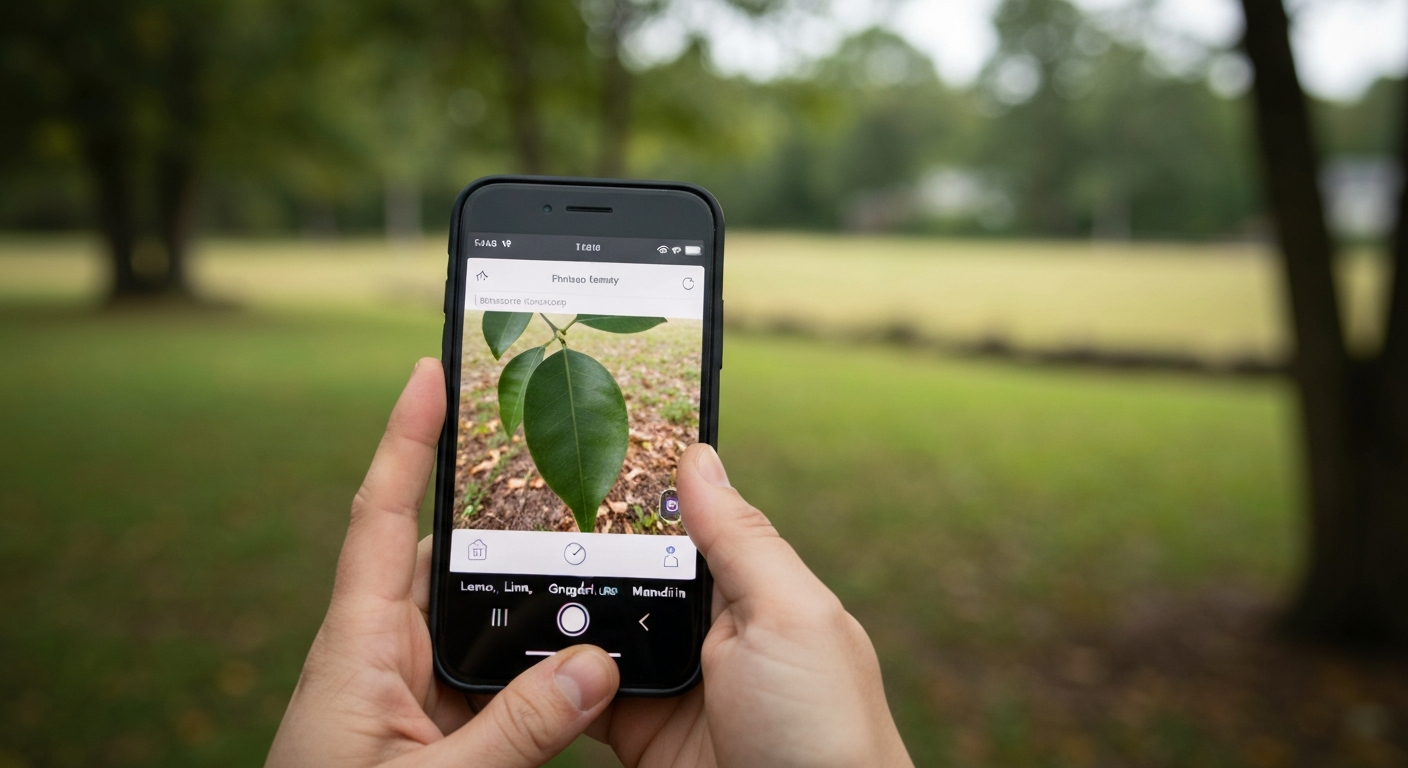
TL;DR: This citrus tree leaves identification chart covers five common types: lemon — oval 2 to 4 inch leaves, thorny, sharp lemon scent; lime — smaller narrower leaves, very thorny on key lime; orange — dark glossy oval leaves, sweet citrus smell; grapefruit — largest leaves, 4 to 6 inches broad; mandarin — smaller narrower leaves than sweet orange. All share a winged petiole (leaf stem flange) and evergreen glossy foliage. Crush a leaf for scent, check thorns, photograph leaf with petiole, and confirm with fruit or the Tree Identifier app.
🍊 Citrus tree leaves identification chart baseline: simple evergreen leaf + winged petiole + citrus scent when crushed = genus Citrus. Species splits on leaf size, thorns, and fruit.
How to use this citrus leaf chart
Citrus tree leaves identification chart works best as a multi-trait checklist — no single leaf character confirms species because cultivars and rootstocks vary. Walk through four steps:
- Confirm citrus genus: Winged petiole, glossy simple leaf, aromatic oils when crushed.
- Measure leaf length: Small (under 2 in) → key lime or mandarin. Medium (2–4 in) → lemon or orange. Large (4–6 in) → grapefruit.
- Note thorns: Heavy thorns → lemon, key lime, bitter orange. Few thorns → many sweet orange and grapefruit cultivars.
- Check fruit: If present, fruit overrides leaf ambiguity every time.
Photograph one leaf with the full petiole and wing visible against white paper. See Best Photo for Tree ID for lighting tips.
Shared citrus leaf traits — genus Citrus
All trees in this citrus tree leaves identification chart belong to genus Citrus (and close relatives like kumquat in Citrus or Fortunella depending on taxonomy). Shared features:
- Leaf type: Simple — one blade per petiole, not compound.
- Arrangement: Alternate on twigs (sometimes appearing clustered on short shoots).
- Evergreen: Leaves persist year-round in hardiness zones 9–11 and in containers indoors.
- Winged petiole: Narrow flange of green tissue along the leaf stem — diagnostic for citrus.
- Texture: Leathery, glossy upper surface; oil glands visible as tiny dots (lenticels/pellucid dots).
- Scent: Crush a leaf — immediate citrus essential oils. Intensity and character vary by species.
- New growth: Often purple-red flush before hardening green.
For general leaf terminology, see Tree Anatomy Glossary.
Citrus tree leaves identification chart — quick reference
Use this table as your field chart. Ranges overlap — fruit confirms.
- Lemon (Citrus limon): Leaf 2–4 in, oval, medium green, winged petiole moderate, thorns common, scent sharp lemon.
- Key lime (Citrus aurantiifolia): Leaf 1–2 in, small rounded, very thorny, wing short, fruit small green.
- Persian lime (Citrus latifolia): Leaf 2–3 in, larger than key lime, fewer thorns, seedless green fruit.
- Sweet orange (Citrus sinensis): Leaf 2–4 in, dark green glossy, wing prominent, thorns few, scent sweet.
- Grapefruit (Citrus paradisi): Leaf 4–6 in, broad oval, largest standard citrus leaf, vigorous tree.
- Mandarin / tangerine (Citrus reticulata): Leaf 1.5–3 in, narrow oval, lighter green, loose peel fruit.
- Grapefruit vs orange: Grapefruit leaf noticeably longer and wider on a larger tree.
Lemon tree leaves
Lemon (Citrus limon) is the backyard standard — vigorous, thorny, productive.
Leaf shape: Elliptic to oval, pointed tip, wedge-shaped base where petiole attaches.
Size: 2 to 4 inches long, 1 to 2 inches wide on mature foliage.
Color: Medium green, lighter than sweet orange. New leaves reddish-purple.
Margin: Finely crenate or wavy — tiny rounded teeth visible with magnification.
Petiole wing: Moderate width — not as exaggerated as grapefruit.
Thorns: Stout, ½ inch or longer on water sprouts and young wood.
Scent: Immediate sharp lemon oil when crushed — the clearest scent in this citrus tree leaves identification chart.
Fruit cue: Oval yellow lemons with pointed nipple ends, year-round in warm climates.
Lime tree leaves — key lime vs Persian lime
Limes confuse the chart because two species dominate markets.
Key lime (Mexican lime, Citrus aurantiifolia): Small tree, very thorny. Leaves 1 to 2 inches, rounded tips, short winged petiole. Leaves look miniature compared to lemon. Fruit small, round, green-yellow when ripe, seedy.
Persian lime (Tahiti lime, Citrus latifolia): Larger tree, fewer thorns. Leaves 2 to 3 inches — approach lemon size but narrower and lighter green. Fruit larger, oval, seedless, sold green.
Lime vs lemon leaves: Lime leaves smaller and often rounder; lime trees more densely thorny per branch length. Crush test: lemon is sharper, lime is generic sharp-citrus.
Orange tree leaves
Sweet orange (Citrus sinensis) — Valencia, navel, blood orange — shares leaf form across cultivars.
Leaf shape: Oval to elliptic, pointed tip, entire margin or nearly so.
Size: 2 to 4 inches, proportionally narrower than grapefruit.
Color: Dark glossy green — darkest among common citrus in this chart.
Petiole wing: Prominent, often as wide as half the leaf blade on vigorous shoots.
Thorns: Variable — commercial grafted trees often nearly thornless; seedlings and rootstock suckers thorny.
Scent: Sweet orange peel aroma — warmer than lemon.
Bitter orange (Citrus aurantium): Seville orange — very thorny, leaves like sweet orange, bitter fruit for marmalade. Thorn density helps separate from sweet orange when fruit is absent.
Grapefruit tree leaves
Grapefruit (Citrus paradisi) produces the largest leaves in this citrus tree leaves identification chart.
Size: 4 to 6 inches long, 2 to 3 inches wide — unmistakably big next to mandarin leaves on the same property.
Shape: Broad oval, blunt to pointed tip, large winged petiole.
Tree form: Vigorous, tall, spreading — grapefruit trees outgrow lemons in the same yard.
Color: Dark green, slightly lighter than orange but larger surface area.
Fruit: Large round yellow or pink globes — confirmation is trivial when fruit hangs.
Mandarin and tangerine leaves
Mandarin (Citrus reticulata) includes tangerines, clementines, and satsumas.
Leaf size: 1.5 to 3 inches — smaller than sweet orange, narrower elliptic shape.
Color: Lighter green, slightly matte compared to glossy orange leaves.
Petiole wing: Present but narrower relative to blade.
Thorns: Moderate on some cultivars; satsuma often thorn-light.
Fruit: Small, flattened poles, loose peel — best species confirm.
Mandarin vs orange leaf ID without fruit: mandarin leaves smaller, lighter, narrower on a usually smaller tree.
Winged petioles — the citrus signature
The winged petiole is the single best genus-level character for citrus tree leaves identification chart use. The petiole — stem connecting blade to twig — flattens into a narrow leaf-like strip alongside the main stalk. Other evergreen trees in warm climates (magnolia, laurel, avocado) lack this wing.
Photograph the petiole: Lay the leaf flat, wing fully visible. Apps use petiole shape as a strong feature.
Wing width varies: Grapefruit and vigorous orange shoots have wide wings. Key lime has a short subtle wing.
Thorns on citrus trees
Citrus thorns are sharp modified stems at leaf axils — not prickles like rose thorns.
High thorn species: Lemon, key lime, bitter orange, trifoliate orange rootstock (Poncirus trifoliata — trifoliate leaves, not simple).
Lower thorn species: Sweet orange, grapefruit, many mandarins on grafted stock.
Rootstock suckers: Commercial citrus is grafted. Shoots from below the graft may have different leaves (trifoliate) and heavy thorns — not the scion species you want to ID.
Check the graft union low on the trunk before reading leaves on suckers.
Scent test — field confirmation
Crushing a leaf releases citrus oils — safe, fast, and species-hinting:
- Lemon: Sharp, clean lemon cleaner scent.
- Lime: Bright citrus, less specifically lemon.
- Orange: Sweet orange peel, floral undertone.
- Grapefruit: Bitter-orange edge, less sweet.
- Mandarin: Sweet, mild, candy-like.
Wash hands after — citrus oils can phototoxically sensitize skin in strong sun (rare but possible).
Lookalikes outside Citrus
Trifoliate orange (Poncirus trifoliata)
Rootstock and hedge plant — trifoliate compound leaves with three leaflets, not simple. Extremely thorny. Deciduous in cold climates. Not in the citrus leaf chart but common on failed grafts.
Calamondin (Citrus microcarpa ×)
Small leaves, small orange fruit, ornamental — leaf size between mandarin and key lime.
Kumquat (Citrus japonica / Fortunella)
Smallest citrus leaves in cultivation, 1 to 2 inches, fruit eaten peel and all.
Growing region and context
This citrus tree leaves identification chart assumes USDA zones 9–11 outdoor growth — Florida, California, Arizona, Gulf Coast, and international Mediterranean climates. Container citrus indoors may have smaller leaves from lower light — compare leaves on the same tree, not across environments.
If you are wondering what type of tree is this in a warm-climate yard, citrus is likely when you find winged petioles and fruit remnants.
Using Tree Identifier for citrus
Tree Identifier recognizes lemon, orange, lime, grapefruit, and mandarin with leaf and fruit photos.
Best photos: One leaf with full winged petiole. One fruit on branch if present. Avoid backlit silhouettes — gloss causes glare.
Indoor trees: Include pot context; dwarf cultivars have proportionally smaller leaves but same winged petiole.
The citrus tree leaves identification chart gets you to genus and likely species — fruit harvest season provides the final confirmation every time.
Frequently asked questions
How do you identify citrus trees by leaves?
Identify citrus trees by evergreen simple leaves with a winged petiole — a narrow leaf-like flange on the leaf stem. Leaves are glossy, oval to lance-shaped, and aromatic when crushed. Thorns are common on lemon and lime. Leaf size and shape vary: grapefruit leaves are largest; kumquat leaves are smallest. Scent when crushed helps — lemon smells sharp, orange sweeter. One tree often carries both leaves and fruit for confirmation.
What do lemon tree leaves look like?
Lemon tree leaves (Citrus limon) are oval to elliptic, medium green, glossy, 2 to 4 inches long with a winged petiole. Margins are finely serrated or wavy. New growth may be reddish. Lemon trees often have stout thorns on branches. Crushed leaves smell strongly of lemon. Leaves are slightly lighter green than orange tree leaves.
How do you tell lime from lemon leaves?
Lime tree leaves (Citrus aurantiifolia, key lime) are smaller and narrower than lemon — often 1 to 2 inches, more rounded at the tip, with a shorter winged petiole. Lime trees are thornier relative to size. Persian lime leaves are larger, closer to lemon. Crushed lime leaves smell sharply citrus but less distinctly lemon. Fruit on the tree is the fastest split — small round green limes vs oval yellow lemons.
What do orange tree leaves look like?
Orange tree leaves (Citrus sinensis) are oval, 2 to 4 inches, dark glossy green with a prominent winged petiole. Margins are entire or barely toothed. Orange leaves feel stiffer and darker than lemon. Sweet orange trees may have few thorns; bitter orange (Citrus aurantium) is thornier. Crushed leaves smell sweet-orange, not sharp lemon.
How do grapefruit leaves differ from orange leaves?
Grapefruit tree leaves (Citrus paradisi) are the largest common citrus leaves — 4 to 6 inches long, broad oval, dark green, with a large winged petiole. Grapefruit trees are large vigorous growers. Leaves are bigger and wider than sweet orange. Fruit size confirms ID. Mandarine and tangerine leaves are smaller and narrower than standard orange.
Do all citrus trees have thorns?
Many citrus trees have thorns, especially lemon, lime, and bitter orange. Sweet orange and grapefruit cultivars are often thornless or lightly thorned after grafting. Thorns are modified stems — sharp, woody, at leaf axils. Thorniness varies by cultivar and rootstock. Do not rely on thorns alone for citrus tree leaves identification chart use — combine with leaf size, petiole wing, and scent.
Can tree ID apps identify citrus from leaves?
Yes when photos show a clear leaf with winged petiole and glossy blade. Apps work better with fruit present — leaves alone can confuse lemon, lime, and orange. Photograph one leaf with petiole visible, a fruit if any, and note crushed scent in field notes. Tree Identifier handles common citrus in warm-climate yards and conservatories.
Try Tree Identifier — free on iPhone
Photograph citrus leaves with winged petioles and get a species match in seconds.
Download on the App Store