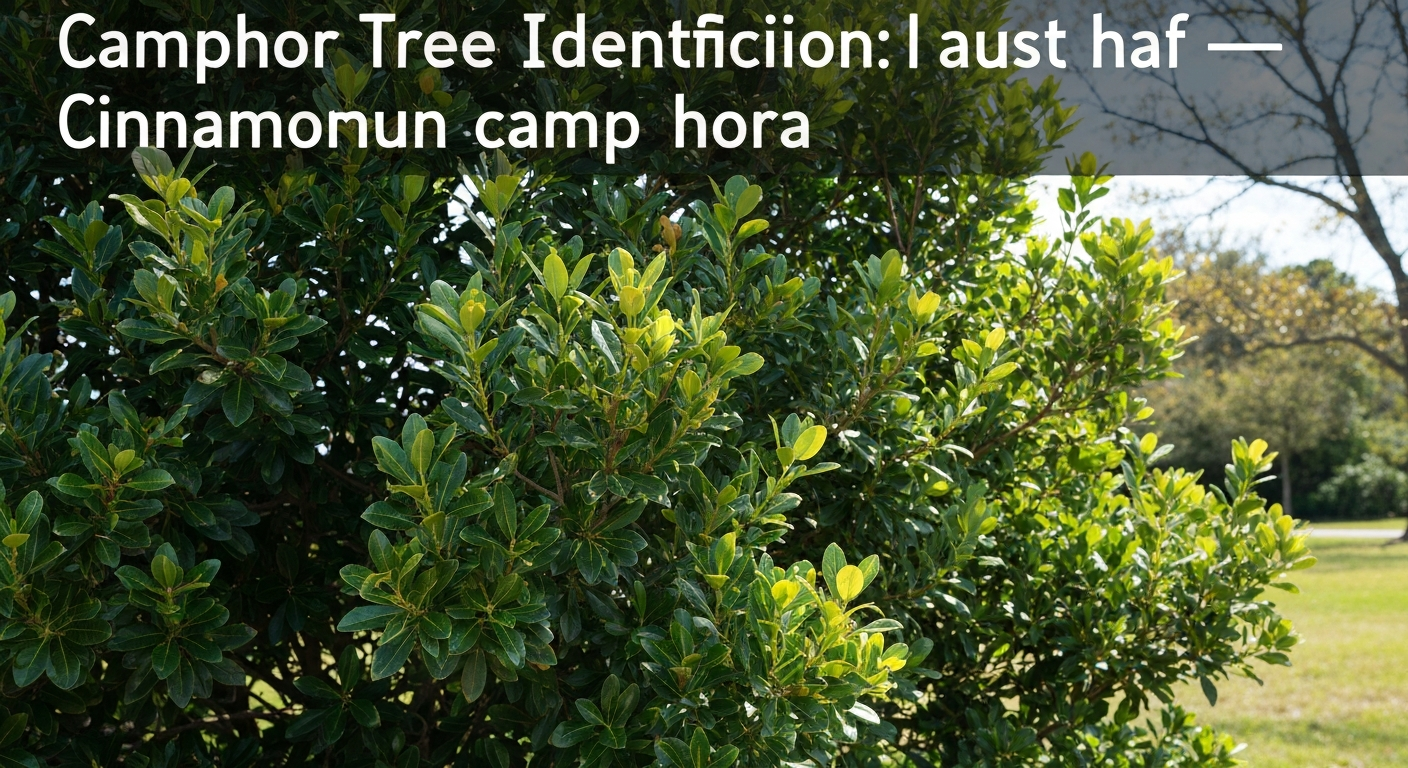
TL;DR: Camphor tree identification (Cinnamomum camphora) starts with scent — crush a leaf and the sharp camphor-medicinal aroma is definitive. Evergreen glossy alternate leaves two to four inches with three prominent veins, pale bluish underside, and black berries on red cup stalks confirm the ID. Invasive across the southeastern US. Photograph leaves and berries, crush one leaf for the scent test, and confirm with the Tree Identifier app.
🌿 Camphor tree identification in one step: crush a leaf — if it smells like medicated chest rub, you have Cinnamomum camphora.
Understanding camphor tree — Cinnamomum camphora
Camphor tree (Cinnamomum camphora), also called camphor laurel or camphorwood, belongs to the laurel family (Lauraceae) — relatives of avocado, bay laurel, and cinnamon. Native to China, Japan, Taiwan, and Vietnam, it was introduced to the southern United States in the 1870s as an ornamental shade tree and has since become one of the most problematic woody invasives in Florida and the Gulf Coast.
Camphor tree identification matters for homeowners, land managers, and hikers in the South because the species displaces native oaks, magnolias, and pines in hammocks and floodplain edges. It is also the commercial source of camphor oil — distilled from wood and leaves for topical balms and moth repellent.
Key species traits:
- Scent: Strong camphor aroma from crushed leaves — primary ID feature.
- Leaves: Evergreen, alternate, simple, oval-elliptical, glossy dark green above, pale below.
- Veins: Three main veins from leaf base — camphor, cinnamon, and sassafras share this laurel-family pattern.
- Fruit: Black drupes on bright red cup-shaped receptacles, fall to winter.
- Bark: Dark brown, rough, furrowed on mature trunks.
- Form: Medium to large tree to 60 feet, broad rounded crown, often multi-trunked.
The camphor scent test
No other common southeastern landscape tree smells like camphor when leaves are crushed. The scent is sharp, penetrating, and medicinal — reminiscent of Vicks VapoRub, Tiger Balm, or old-fashioned mothballs.
Field protocol:
- Pick one leaf from the tree you are identifying — not ground litter that could be from a neighbor.
- Fold and crush the blade between thumb and finger.
- Smell immediately — camphor volatiles release on tissue damage.
- If camphor scent is present, you have camphor tree or a close Cinnamomum relative — extremely rare outside botanical gardens in the US.
Rain-moistened fallen leaves under a camphor canopy release ambient odor without crushing — you may smell camphor before you see the tree. Mowing camphor seedlings produces the same scent cloud.
Apps cannot smell — always pair visual ID with the crush test in the field.
Camphor leaf identification
Leaves provide year-round camphor tree identification because the species is evergreen in hardiness zones 9 through 11 and semi-evergreen at the northern edge of its escaped range.
Size and shape: Two to four inches long, one to two inches wide, oval to elliptical with wavy margins. Tip tapers to a point; base is rounded to wedge-shaped.
Color and texture: Thick and leathery, glossy dark green above, glaucous pale green to bluish-white below — the underside flash is visible when wind flips leaves.
Arrangement: Alternate on the twig — one leaf per node, staggered. Not opposite like many broadleaf evergreens.
Venation: Three prominent veins arise from the leaf base and run toward the tip — a hallmark of Lauraceae. Smell still separates camphor from sassafras (root-beer scent) and red bay (bay spice scent).
New growth: Young expanding leaves may be reddish bronze before turning green — common in spring flush.
Photograph upper and lower leaf surfaces side by side. See Tree Foliage Identification Guide for evergreen broadleaf tips.
Flowers and berries
Flowers: Small, yellow-green, in axillary clusters, appearing spring. Not showy — most people identify camphor from leaves and fruit, not blooms.
Fruit: Round drupes ripening glossy black, about quarter-inch diameter, each on a conspicuous bright red cup (enlarged receptacle). The red-and-black fruit display persists into winter — strong camphor tree identification marker when leaves are hard to reach.
Dispersal: Birds — especially robins and cedar waxwings — eat berries and spread seeds into natural areas. Seedlings appear in fencerows and wood edges.
Camphor bark and form
Bark: Young stems smooth greenish-brown with lenticels. Mature bark dark brown to gray, rough, irregularly furrowed — similar to many hardwoods but less distinctive than leaves or scent.
Crown: Broad, dense, rounded — popular historically for shade. Lower branches often retained in yard plantings, creating a wide dome.
Size: 40 to 60 feet in open conditions; faster growth than many native hardwoods.
Wood: Pale, aromatic, source of commercial camphor extraction in Asia. US trees are rarely harvested for oil.
Invasive range and ecology
Escaped camphor dominates disturbed sites in:
- Florida — statewide, especially central and north Florida hammocks.
- Georgia and South Carolina coastal plain.
- Alabama, Mississippi, Louisiana, Texas Gulf Coast.
- California — limited escaped populations from old plantings.
Camphor tolerates drought, salt spray, and poor soil — competitive advantages over native species. It resprouts vigorously after cutting; land managers often combine cut-stump herbicide treatment with native replanting.
Restoration volunteers learn camphor tree identification early — it is among the first species targeted on workdays.
Lookalikes in the southern landscape
Cherry laurel (Prunus caroliniana)
Evergreen, alternate, glossy leaves — superficially similar. Scratch twig smells almond (cyanogenic), not camphor. Leaves narrower, no bluish underside flash. Fruit purple-black without red cup. Native to Southeast.
Red bay (Persea borbonia)
Evergreen Lauraceae with three-veined leaves. Crush smells spicy bay, not camphor. Threatened by laurel wilt disease — still present in native wetlands.
Sassafras (Sassafras albidum)
Deciduous — absent in winter when camphor stays green. Crush root or leaf smells root beer. Three leaf shapes on same tree (entire, two-lobed, three-lobed). Native.
Live oak (Quercus virginiana)
Evergreen but leaves are oval, revolute margins, no camphor scent, acorns present. Completely different on crush test.
Chinese tallow (Triadica sebifera)
Deciduous invasive with heart-shaped leaves turning red in fall — no camphor scent. Milky sap when broken.
Avocado (Persea americana)
Same family, planted in frost-free zones. Larger leaves, no camphor scent. Fruit is avocado.
Management considerations
Homeowners with yard camphor face a choice: mature trees provide dense shade but drop berries that seed neighbors' yards and natural areas. Replacement with native live oak, magnolia, or red maple reduces invasive pressure.
Removal: cut and treat stump with appropriate herbicide per local extension guidance — camphor resprouts from stump without treatment. Wear gloves; some people develop dermatitis from leaf oils.
Do not confuse edible cinnamon (Cinnamomum verum) with camphor — different species, different chemistry. Camphor oil is toxic if ingested in quantity.
Using Tree Identifier for camphor
Tree Identifier recognizes Cinnamomum camphora from leaf and berry photos in the Southeast and California.
Best photos: Leaf upper and lower surface showing three veins and pale underside. Cluster of black berries on red cups. Note "camphor smell on crush" in your field log — apps cannot record scent but you can verify.
Range check: Results in Florida or Georgia with glossy three-veined evergreen leaves are highly likely camphor in disturbed or yard habitat.
Camphor tree identification is one of the few tree IDs where smell beats photography — crush first, photograph second, confirm with the app.
Frequently asked questions
How do you identify a camphor tree?
Identify camphor tree (Cinnamomum camphora) by crushing a leaf — a strong camphor-medicinal aroma is definitive. Leaves are evergreen, alternate, simple, oval to elliptical, two to four inches, glossy dark green above, pale and sometimes bluish-white below with three prominent veins. Bark on mature trees is dark brown, rough, and furrowed. Small black berries on red cup-like stalks ripen in fall. Native to East Asia; invasive in the southeastern US from Texas to North Carolina and Florida.
What does a camphor tree smell like?
Crushed camphor leaves smell sharply medicinal — like camphor chest rub, Vicks VapoRub, or mothballs. The scent comes from camphor oil in leaf tissues. Walking under a camphor tree after rain or mowing fallen leaves releases the odor. No native southeastern tree shares this exact aromatic signature — scent is the fastest camphor tree identification test.
Is camphor tree invasive?
Yes in the southern United States. Cinnamomum camphora spreads aggressively by bird-dispersed berries, outcompetes native vegetation in disturbed hammocks and floodplains, and is listed as invasive in Florida, Georgia, and other Gulf states. It tolerates drought and poor soil once established. Land managers often target camphor for removal in restoration projects. Identification helps homeowners decide whether to retain or replace yard trees.
What is the difference between camphor tree and laurel cherry?
Camphor tree has camphor scent when crushed, three-veined glossy leaves pale below, and black berries on red stalks. Cherry laurel (Prunus caroliniana) smells like almonds when twig is scratched, not camphor. Cherry laurel leaves are narrower, leathery, without the bluish underside. Cherry laurel fruit is dark purple-black drupe without red cup. Both are evergreen southern yard trees — crush test separates them instantly.
What do camphor tree berries look like?
Camphor berries are round, pea-sized, ripening from green to glossy black in fall and winter. Each berry sits on a bright red cup-shaped stalk (receptacle) — the red-and-black combination is distinctive. Birds eat fruit and disperse seeds, driving invasive spread. Berries persist while new leaves flush, making camphor identifiable year-round in the South.
How do you identify camphor tree bark?
Mature camphor bark is dark brown to gray, rough, and irregularly furrowed — not shaggy or peeling. Young trunks may show greenish-brown smooth bark with lenticels. Bark lacks the mottled white patches of sycamore and the blocky plates of live oak. Bark alone is less diagnostic than leaf scent; use bark to confirm on leafless storm-damaged branches by checking alternate leaf scar pattern and any remaining foliage scent.
Can tree ID apps identify camphor tree?
Yes from glossy leaf photos showing three-vein pattern and pale underside. Apps cannot smell camphor — photograph leaves and mention scent in your field notes. Tree Identifier recognizes Cinnamomum camphora in the Southeast and California where planted. Berry photos with red cups improve confidence. Invasive range overlap helps validate results.
Try Tree Identifier — free on iPhone
Photograph camphor leaves and berries — then confirm with a crush-test scent check in the field.
Download on the App Store