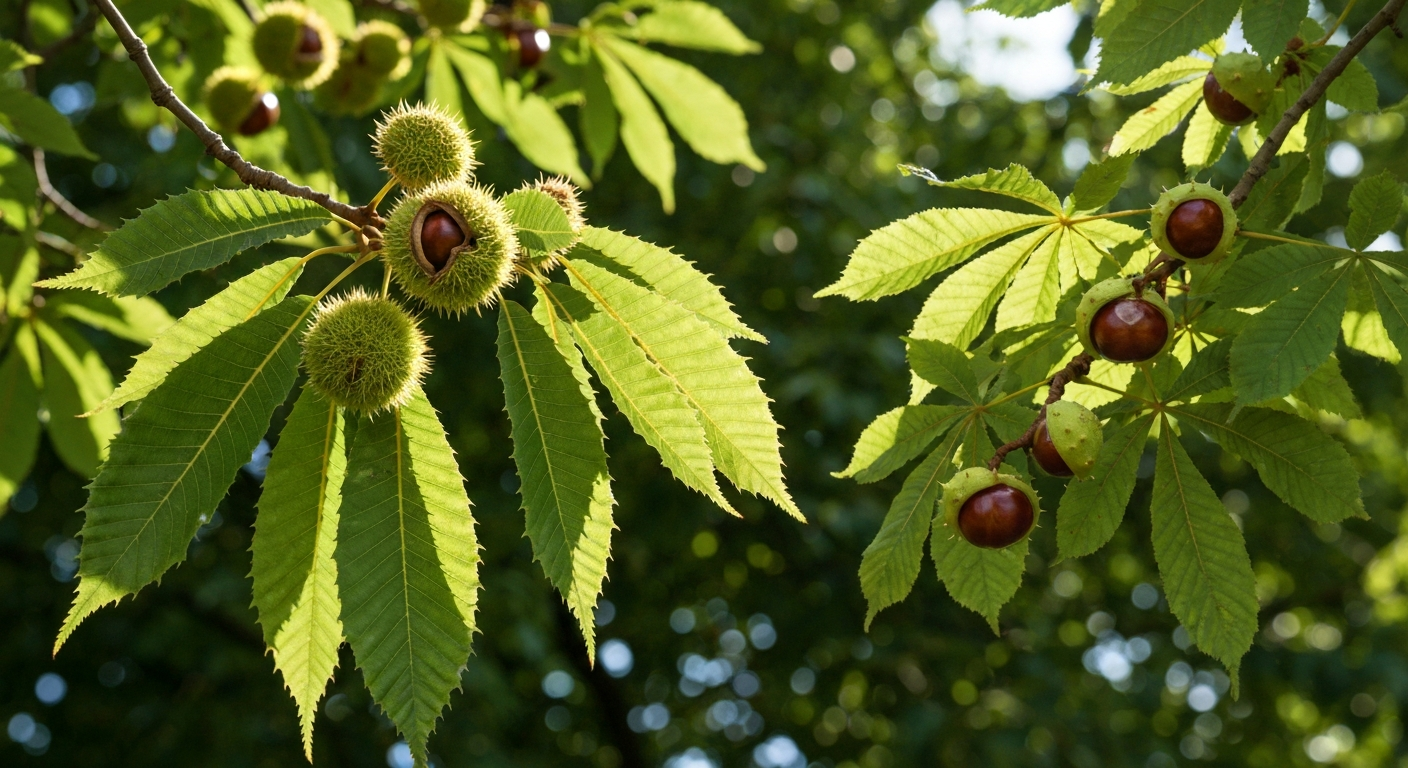
TL;DR: True chestnuts belong to the genus Castanea — American chestnut, European sweet chestnut, and chinquapins share long, toothed simple leaves and edible nuts in very spiny burrs. Horse chestnut (Aesculus hippocastanum) is a different family entirely: palmately compound leaves and large inedible nuts. Chestnut oak (Quercus montana) is an oak with wavy-toothed leaves and acorns — the name refers to leaf shape, not kinship. For chestnut wood identification, look for light brown, straight-grained, rot-resistant lumber without oak's prominent rays. When names collide, leaves and fruit decide: simple toothed leaf plus spiny burr equals Castanea; hand-shaped compound leaf equals horse chestnut; leathery wavy leaf plus acorn equals chestnut oak. Confirm with the Tree Identifier app when you need a fast second opinion.
🌰 Chestnut tree identification starts with one question: is the leaf simple or compound? A single long blade with hooked teeth points to Castanea. Five to seven leaflets in a fan shape points to horse chestnut. A thick, simple leaf with rounded wavy teeth and acorns on the ground points to chestnut oak — not a chestnut at all.
Three different trees, one confusing name
Search results for chestnut wood identification, horse chestnut identification, and chestnut oak leaf identification all land in the same forest — but they describe three unrelated lineages. Botanists sort them like this:
- True chestnuts (Castanea): Beech family (Fagaceae). Simple, alternate, toothed leaves. Nuts enclosed in very spiny burrs that split open at maturity. Wood prized for durability.
- Horse chestnut (Aesculus): Soapberry family (Sapindaceae). Palmately compound leaves — leaflets radiate from one point. Large flower spikes in spring; nuts are glossy, bitter, and toxic.
- Chestnut oak (Quercus montana): Beech family, but genus Quercus. Simple leaves with wavy rounded teeth — superficially chestnut-like. Fruit is an acorn in a scaly cup, never a spiny burr.
English common names are the source of most mistakes. European settlers called any tree with chestnut-shaped leaves a chestnut. Horse chestnut got its name because people fed the nuts to horses (not because it is a true chestnut). Chestnut oak earned its name from leaves that resemble American chestnut foliage. American chestnut identification therefore requires more than the word chestnut in a field guide heading — you need leaf architecture, fruit type, and bark together.
If terms like alternate, compound, and margin are new, the Tree Anatomy Glossary defines them with photos and plain-language notes.
American chestnut (Castanea dentata)
American chestnut was once the dominant canopy tree across much of the eastern United States — straight, fast-growing, and abundant. Chestnut blight arrived in the early 1900s and destroyed virtually every mature tree. Today, American chestnut identification usually means recognizing root sprouts and the occasional surviving stem, not the forest giants of old photographs.
Leaves: Simple, alternate, lance-shaped to oblong, 5 to 8 inches long, with a pointed tip. Margins have prominent hooked teeth — each tooth often curves forward like a tiny sickle. Parallel side veins run straight to each tooth, a classic Fagaceae pattern shared with beech. Leaves are dull green above and paler beneath.
Fruit: Nuts develop inside a very spiny burr — a green, hedgehog-like globe that splits into sections when ripe. Inside are one to three small, sweet chestnuts with a pointed tip and flat base. Finding an open burr on the forest floor is one of the strongest American chestnut identification signals, though chinkapin and planted sweet chestnut produce similar burrs.
Bark: Smooth and grey on young stems, developing shallow furrows with age. On older pre-blight trees, bark was distinctive: grey, twisted, and muscular on a straight trunk. Sprouts today often die back before bark reaches that character.
Form and habitat: Historically a large forest tree to 100 feet on moist, well-drained slopes and ridges. Sprouts appear in cutover oak-hickory forest, along woodland edges, and in Appalachia where root systems still survive underground.
Confused with: Chinese chestnut and European sweet chestnut are planted ornamentals and orchard trees with broader leaves and larger nuts. Allegheny chinkapin (C. pumila) is a shrub or small tree with smaller leaves and burrs. Chestnut oak shares toothed leaves but produces acorns.
European sweet chestnut (Castanea sativa)
Sweet chestnut is the edible chestnut of European commerce — roasted at street markets and grown in orchards worldwide. In North America it appears as a planted tree in parks, estates, and farms, especially in milder climates.
Leaves: Simple and toothed like American chestnut, but usually broader and more oblong, with a coarser saw-tooth margin. Veins are prominent and straight.
Fruit: Very spiny burrs, often larger than American chestnut burrs, containing one to three nuts. Orchard cultivars are selected for large, easy-to-peel nuts.
Bark: Grey, deeply furrowed in a striking spiral or twisted pattern on mature trunks — more rugged than typical American chestnut bark.
Confused with: American chestnut in areas where both occur as plantings. Sweet chestnut trunks are often larger in cultivation; bark furrows are deeper and more patterned.
Horse chestnut (Aesculus hippocastanum)
Horse chestnut is the showy street and park tree with candle-like white flower panicles in May and conkers rattling in spiny husks by autumn. Horse chestnut tree identification is straightforward once you see the leaf — it looks nothing like a true chestnut.
Leaves: Palmately compound — typically five to seven leaflets spread like fingers from the end of a long petiole. Each leaflet is broad, ovate, with fine serrations and a tapered tip. The whole leaf can be 8 to 12 inches across. Leaflets are opposite along the petiole tip, not alternate on a twig.
Fruit: A large, round, glossy brown nut — the conker — with a pale elliptical scar on one side. Nuts sit in a thick, green, sparsely spiny husk that splits open. They are not edible. Horse chestnut identification by fruit is easy: smooth nut, not a pointed sweet chestnut; husk spines are short and blunt compared to Castanea burrs.
Bark: Dark brown to grey, scaly plates on mature trees. Young bark is smoother. Not the smooth grey of American chestnut.
Form and habitat: Medium to large tree, widely planted in temperate cities and campuses. Native to the Balkans; naturalized in parts of North America. Often grows as a solitary ornamental rather than a forest dominant.
Confused with: Ohio buckeye and other Aesculus species share the palmate leaf. Red buckeye is smaller; bottlebrush buckeye is a shrub. None are Castanea.
Chestnut oak (Quercus montana)
Chestnut oak — sometimes called rock chestnut oak or mountain chestnut oak — is a sturdy white-oak-group species of dry ridges and rocky slopes in the Appalachians and northeastern US. Chestnut oak leaf identification is the skill hikers need when they assume any toothed tree must be a chestnut.
Leaves: Simple, alternate, oblong to oval, 4 to 8 inches long. Margins have rounded, wavy teeth — not the deep lobes of red oak or the bristle tips of black oak. The blade is thick, leathery, dark yellow-green above, and paler with fine hairs beneath. Fall color is yellow-brown to russet.
Fruit: Acorns mature in one season (white oak group). The cup encloses about one-third of the nut and has scaly, not spiny, tissue. Acorns on the ground immediately rule out Castanea.
Bark: On dry sites, bark is thick, dark, and deeply blocky — almost black on old trees. On moister slopes, bark can be lighter grey and more ridged. Rugged bark on a ridge-top oak is a habitat clue.
Form and habitat: Medium to large tree on dry, rocky ridges, south-facing slopes, and oak-heath barrens. Tolerates poor soil where other oaks struggle. Often shares canopy with scarlet oak and red maple.
Confused with: Chinkapin oak (Q. muehlenbergii) has narrower, more regularly toothed leaves on calcareous soils. Swamp chestnut oak (Q. michauxii) has similar leaves but grows in bottomlands with larger acorns and whitish pubescence on leaf undersides.
Leaf shape: the fastest field split
Leaf shape resolves most chestnut naming confusion in under a minute. Work through this sequence:
- Simple or compound? One blade per petiole means Castanea or chestnut oak. Multiple leaflets in a fan means horse chestnut or another buckeye.
- Tooth type. Long, narrow leaf with hooked, forward-pointing teeth and parallel veins suggests American chestnut or sweet chestnut. Thick, leathery leaf with rounded wavy teeth suggests chestnut oak.
- Leaflet count. Horse chestnut identification is clinched by five to seven broad leaflets with fine serrations — no other common chestnut-name tree matches that silhouette.
- Texture. Chestnut oak leaves feel stiff and leathery. American chestnut leaves are thinner and more flexible. Horse chestnut leaflets are soft and large.
- Check the ground. Spiny burrs split open mean Castanea. Smooth conkers in a weakly spiny husk mean horse chestnut. Acorns mean oak.
Photograph the leaf flat against your palm or the sky so the margin and vein pattern show clearly. See Best Photo for Tree ID for framing tips that help both manual ID and app recognition.
Spiny burrs, husks, and acorns
Fruit is the tiebreaker when leaves are ambiguous or out of reach.
Castanea burrs: Dense, sharp spines cover the entire surface. The burr is round to slightly oval and splits along seams when nuts ripen in early autumn. Nuts are small, flattened on one side, with a pointed tip — the edible chestnut of history and holiday recipes.
Horse chestnut husks: Green, thick, with short spines or warts — not the dense needle-spines of true chestnut. Usually one large nut per husk. Glossy brown surface with a pale eye-shaped scar. Not for human consumption.
Chestnut oak acorns: No spines on the cup. Nuts are oblong, often striated, seated in a scaly cup that may be bowl-shaped. White oak group acorns germinate soon after falling — you may see sprouts still attached.
Collect one fruit sample per tree and photograph it beside a leaf from the same branch. That pair eliminates most misidentifications between American chestnut identification quests and chestnut oak leaf identification mistakes.
Bark identification in the field and in lumber
Bark helps when crowns are high and leaves are wind-torn.
American chestnut: Smooth grey on sprouts; on rare older stems, shallow interlacing ridges. Sprouts often show orange-brown inner bark when damaged — a subtle clue.
Sweet chestnut: Deep, twisted furrows forming spiral ridges — dramatic on orchard trees.
Horse chestnut: Scaly, plate-like bark breaking into irregular chunks. Darker and rougher than most Castanea.
Chestnut oak: Thick, dark, deeply blocky bark on ridge-top specimens — among the darkest oak barks in eastern forests.
For bark photography and app tips, see our guide to tree bark identification apps.
Chestnut wood identification
Chestnut wood identification matters to woodworkers, restoration builders, and anyone salvaging lumber from pre-1940 barns. True chestnut lumber comes from Castanea — overwhelmingly American chestnut in North American antiques.
Color and grain: Heartwood is light to medium brown, sometimes with a reddish or grey cast. Sapwood is pale and clearly demarcated. Grain is straight to slightly wavy with a coarse, open texture and low natural luster.
Ring pattern: Growth rings are distinct and fairly wide on fast-grown historic stock. End grain shows clear pores without the large rays that make oak easy to spot on a quartersawn face.
Rot resistance: American chestnut was famous for fence posts and exterior siding that survived decades without treatment. That durability — plus wide boards from huge historic trees — is why reclaimed chestnut commands premium prices.
Separating chestnut from oak: Oak shows prominent ray flecks on quartersawn surfaces; chestnut does not. Oak is generally denser and heavier in the hand. Ash is lighter and has a more pronounced cathedral grain on flatsawn faces.
Separating chestnut from hemlock or fir: Softwoods lack visible pores — end grain looks smoother and more uniform. Chestnut is a ring-porous hardwood.
Historical context: If the structure dates to before the 1930s and the wood is wide, straight-grained, and rot-resistant in an eastern US building, chestnut wood identification is plausible — but confirm with grain detail, not guesswork alone. Modern commercial chestnut is almost always reclaimed or imported European sweet chestnut.
Common lookalikes and naming traps
Chestnut identification trips people up in predictable ways:
Chinkapin and chinquapin oak
Allegheny chinkapin (Castanea pumila) is a true chestnut — a shrub or small tree with smaller leaves and burrs. Chinquapin oak (Quercus muehlenbergii) is an oak with narrow, toothed leaves and acorns. The similar spelling confuses searchers. Fruit type separates them instantly.
Beech (Fagus)
American beech shares the Fagaceae family and has parallel veins, but leaves have smooth margins — no teeth. Beech bark is smooth and grey; beech nuts are small triangles in a spiny husk quite different from chestnut burrs.
Yellow birch and young poplar
Neither is related, but smooth grey bark on young stems can suggest chestnut sprouts. Check leaves: birch has ovate, finely serrated leaves; poplars have alternate triangular leaves and flattened petioles. See our poplar identification guide if poplar is in the mix.
Planting vs wild origin
Horse chestnut and sweet chestnut are common in designed landscapes. American chestnut sprouts appear in wild forest. Context narrows the ID before you open a field guide.
Using the Tree Identifier app for chestnuts
Manual chestnut tree identification builds lasting skill, but a photo check saves time when you are staring at a toothed leaf and wondering whether it is a blight sprout, a chestnut oak on a dry ridge, or a park horse chestnut.
What to photograph: One clear leaf shot showing the full blade and margin — or the entire compound leaf for horse chestnut. One fruit photo if available: burr, conker husk, or acorn. One bark image at chest height for backup.
What to watch for: Apps may label chestnut oak as American chestnut when only a toothed leaf is shown. Horse chestnut identification rarely fails if the compound leaf is in frame. For chestnut wood identification, apps are not a substitute for grain analysis — photograph end grain and face grain in good light if you must try.
Workflow: Snap the leaf, run it through Tree Identifier, then verify fruit and bark match. If the app returns chestnut oak but you found a spiny burr, trust the burr. For a broader photo-first workflow, read What Type of Tree Is This?
Chestnut names are tangled, but the biology is orderly: Castanea for edible nuts in fierce burrs, Aesculus for conkers and hand-shaped leaves, Quercus montana for ridge-top oaks with wavy teeth and acorns. The app handles edge cases; your photos of leaves and fruit handle the rest.
Frequently asked questions
Is horse chestnut a real chestnut?
No. Horse chestnut (Aesculus hippocastanum) is not in the genus Castanea. It belongs to the soapberry family (Sapindaceae), while true chestnuts are in the beech family (Fagaceae). Horse chestnut has palmately compound leaves with five to seven leaflets and produces large, smooth, inedible nuts in a spiny husk — not the sweet edible chestnut of Castanea. Horse chestnut identification starts with the hand-shaped leaf, not an oak-like simple blade.
How do I tell American chestnut from horse chestnut?
American chestnut (Castanea dentata) has single, long, lance-shaped leaves with prominent hooked teeth and parallel side veins. Horse chestnut has compound leaves — five to seven broad leaflets radiating from one point like a hand. American chestnut nuts are small, sweet, and enclosed in a very spiny burr that splits open. Horse chestnut nuts are larger, glossy brown, and nearly round with a pale scar — toxic and not for eating. American chestnut identification is easiest in summer on foliage; horse chestnut tree identification is unmistakable once you see the palmate leaf.
What does chestnut wood look like?
True chestnut wood is light to medium brown with a straight grain and coarse, open texture. It is naturally rot-resistant and was prized for fence posts, barn siding, and outdoor furniture. Growth rings are distinct; the wood lacks the prominent rays seen in oak. Chestnut wood identification in old buildings often relies on width of boards, ring pattern, and historical context — most new chestnut lumber is reclaimed because mature Castanea trees are rare in North America after chestnut blight.
What is the difference between chestnut oak and American chestnut?
They are unrelated. Chestnut oak (Quercus montana) is an oak with simple, wavy-margined leaves and acorns in a scaly cup. American chestnut is a Castanea species with toothed leaves and spiny burrs holding edible nuts. Chestnut oak leaf identification focuses on the rounded teeth and thick, leathery blade without the bristle-tipped lobes of red oak group species. If the fruit is an acorn, you have an oak — not a chestnut.
How do I identify chestnut oak by its leaves?
Chestnut oak leaves are oblong to oval, 4 to 8 inches long, with wavy or rounded teeth along the margin — not deep lobes. The blade is thick, leathery, and dark green above, often paler and somewhat hairy beneath. Veins run straight to each tooth. Compare with chinkapin oak, which has smaller, more regular teeth. Chestnut oak leaf identification works best on mature canopy leaves in late summer when size and texture are fully developed.
Can you still find American chestnut trees in the wild?
Yes, but mostly as root sprouts that die back before reaching maturity. Chestnut blight (Cryphonectria parasitica) killed billions of American chestnuts in the early 1900s. Sprouts still emerge from surviving root systems in eastern forests, and occasional blight-resistant individuals persist. American chestnut identification on these sprouts uses the same leaf and bark traits — long toothed leaves and smooth grey bark with a twisted, muscular trunk form on older stems.
How accurate are tree ID apps for chestnuts?
Apps handle horse chestnut and chestnut oak well when leaves are clear. American chestnut is harder because it is rare and often confused with sprouts of related Castanea species or chestnut oak. For chestnut wood identification, apps cannot analyze lumber — use grain photos only as a rough check. Photograph a leaf showing the full margin, add a fruit or burr shot if available, and confirm with bark. The Tree Identifier app works best with multiple photos from the same tree.
Try Tree Identifier — free on iPhone
Photograph a chestnut leaf, burr, or bark and get a species match in seconds.
Download on the App Store