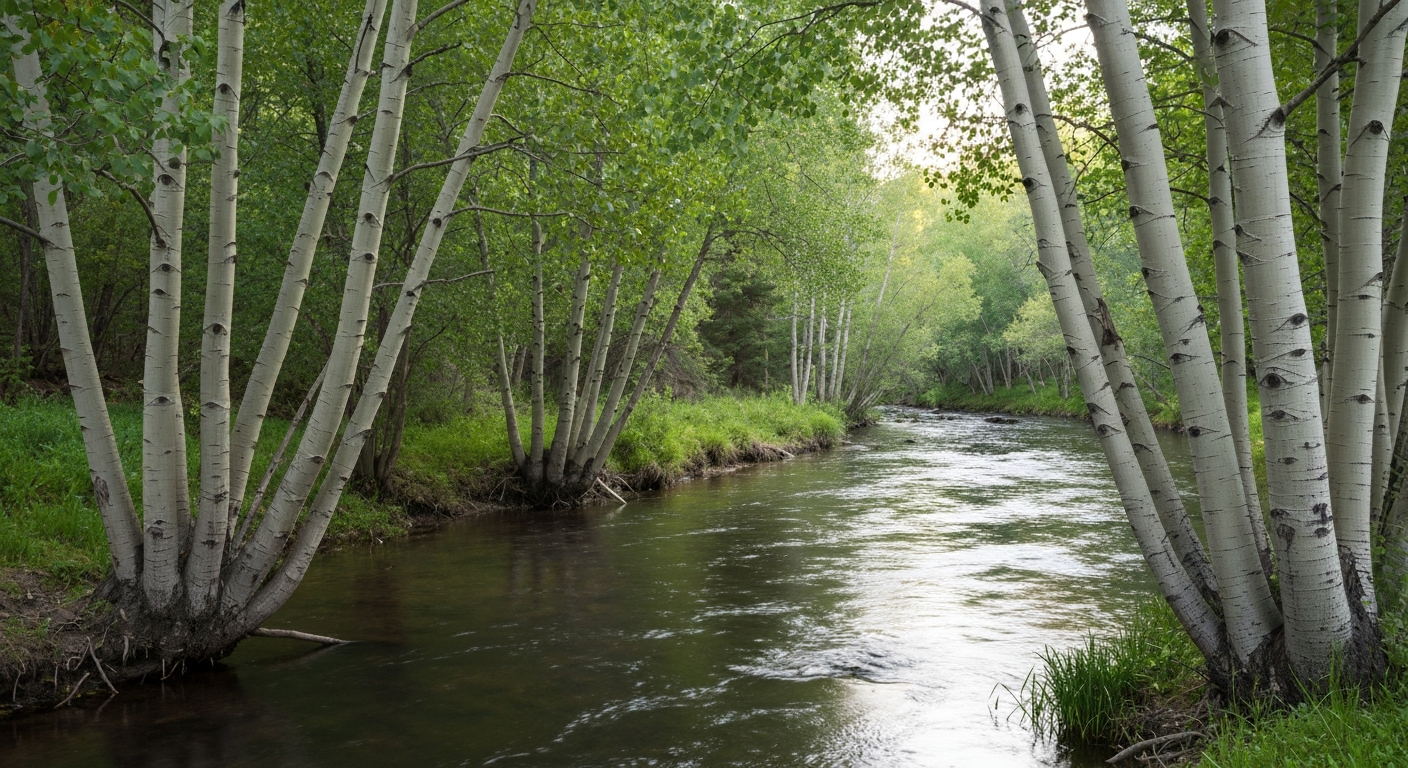
TL;DR: Cottonwood tree id means eastern cottonwood (Populus deltoides) — a poplar of river floodplains with large triangular leaves on flattened petioles that flutter audibly in wind, cottony seed fluff from female trees in June, and deeply furrowed gray bark on old trunks. Cottonwood sapling identification uses the same triangle-shaped toothed leaves and smooth pale bark before furrows develop. Cottonwood is the largest native poplar in much of North America. Photograph leaves with petioles, bark, or cotton drifts, then confirm with the Tree Identifier app.
🍃 Cottonwood tree id shortcut: triangle leaf + flattened petiole + leaf flutter = poplar. Add June cotton fluff or floodplain giant size = eastern cottonwood.
Cottonwood and poplar — same genus
Cottonwood is poplar — genus Populus, willow family (Salicaceae). Eastern cottonwood (Populus deltoides) is the dominant cottonwood species across central and eastern North America, named for the delta-shaped leaves and the cottony seed dispersal of female trees.
Poplars share:
- Flowers: Catkins — drooping male spikes in early spring; female catkins develop into seed capsules.
- Seeds: Tiny seeds with cottony hairs for wind dispersal (on female plants).
- Growth: Extremely fast on moist sites; short-lived relative to oaks.
- Leaves: Simple, alternate, usually toothed — shape splits species.
- Habitat: Moist — floodplains, riverbanks, irrigation ditches, low fields.
For the full poplar family picture, see How to Identify Poplar Trees — cottonwood is the flagship floodplain species in that guide.
Eastern cottonwood identification characters
Populus deltoides grows 80 to 100 feet or more on rich bottomland soil — often the tallest tree visible from a river bridge.
Leaves: Broadly triangular, 3 to 5 inches long and nearly as wide, coarsely toothed margin, pointed tip, somewhat flattened base. Petiole is distinctly flattened side-to-side — hold a leaf by the stalk and roll it between fingers; it flexes easily in one plane.
Leaf movement: The flattened petiole acts like a hinge. Cottonwood leaves tremble in light wind — louder and larger-leaved than quaking aspen.
Bark: Young trees smooth gray-green to yellow-gray. Mature cottonwood bark identification: thick, deeply furrowed, ash-gray ridges with dark valleys — rugged at eye level on old floodplain veterans.
Form: Massive trunk, often slightly leaning; open crown on solitary trees; rows along streams from root suckers and seeding.
Range: Eastern US to Great Plains, north into southern Canada; riparian zones.
Cottonwood leaves in detail
Cottonwood identification at leaf level is reliable from late May through September.
- Triangle test: Outline resembles an equilateral or broad isosceles triangle — wider than quaking aspen leaves.
- Petiole flattening: Critical character — aspen petioles are round and laterally flattened only at the blade junction; cottonwood flattening is obvious along the full stalk length.
- Teeth: Coarse, curved, one tooth per vein tip at margin.
- Surface: Bright green above, paler below; may be slightly resinous-scented when crushed on spring shoots.
- Fall color: Yellow — often brief before leaf drop.
Photograph one leaf with petiole visible against sky or trunk — cottonwood tree id apps use the triangle-plus-petiole combo. See Identify Trees by Leaf for general leaf photo framing.
Cottonwood sapling identification
Cottonwood sapling identification matters because young trees colonize disturbed moist ground years before they develop furrowed bark.
Leaves: Same triangular toothed shape as mature trees — may be slightly smaller on weak shoots but triangle is evident on first true leaves.
Bark: Smooth, thin, greenish-gray or yellow-green — not white like birch saplings.
Growth rate: Vertical shoots may add several feet per year on open mudflats after flood recession.
Buds: Large, resinous, slightly sticky — terminal bud is long and pointed.
Site: Seedlings appear in sandbars, ditch banks, and excavated wet soil — moisture is mandatory.
Compare cottonwood sapling identification with willow saplings: willows have narrower lance leaves without the broad triangle. Compare with aspen: aspen leaves are smaller, more rounded, on round petioles.
Cottonwood bark identification by age
Cottonwood tree bark identification changes dramatically with age — use the right stage characters.
Young bark (under 10 inches diameter)
Smooth, pale, slightly yellow or green cast. Lenticels visible as small horizontal marks. May look like young aspen but trunk diameter grows faster.
Middle-aged bark
Shallow furrows begin; bark thickens. Gray dominates; greenish cast fades.
Old floodplain veterans
Deep vertical fissures, thick corky ridges, trunk diameters of 4 to 6 feet possible. Bark at breast height is rugged, never shaggy-peeling like sycamore or smooth like beech.
Winter cottonwood bark identification on large trees is among the most reliable characters when leaves are gone — photograph furrow pattern with a hand or hat for scale. More bark methods in Tree Bark Identification App Guide.
Cotton fluff and spring catkins
The cotton that names cottonwood is seed dispersal fluff — not pollen, not fungus.
Male trees: Reddish dangling catkins in early spring before leaves — pollen source, no cotton.
Female trees: Green catkins mature; capsules split in late May and June releasing seeds on white cotton threads. Neighborhoods downwind of female cottonwoods see snow-like drifts.
Duration: Cotton season lasts one to three weeks depending on weather — annoying for gutters, ecologically effective for colonizing bare sandbars.
ID use: Cotton on the ground beneath a triangular-leaved tree in June confirms female cottonwood with near certainty.
Other cottonwood and poplar species
Black cottonwood (Populus trichocarpa)
Pacific Northwest native; similar triangle leaves but western range; bark may be furrowed at younger age.
Necklace poplar / plains cottonwood (Populus deltoides subspecies)
Variation across the Great Plains — same triangle leaf theme.
Quaking aspen (Populus tremuloides)
Rounder leaves, round petioles flattened laterally at blade, white bark on upper trunks, upland forests not floodplains.
Lombardy poplar (Populus nigra 'Italica')
Cultivated columnar form; triangular leaves but stiff upright habit; planted windbreaks.
Balsam poplar (Populus balsamifera)
Northern species; fragrant sticky buds; ovate leaves less perfectly triangular.
Cottonwood tree id in the eastern US defaults to Populus deltoides when you see floodplain giants with triangle leaves.
Habitat and ecology
Eastern cottonwood marks water — not necessarily standing water, but accessible groundwater and flood deposition.
Riverbanks: Dominant canopy on major rivers — Mississippi, Missouri, Ohio, Platte systems.
Disturbance: First woody colonizer on fresh sandbars after flood scour.
Wildlife: Cavities in old trunks used by owls and wood ducks; beaver feed on bark and shoots.
Human use: Soft fast-grown lumber; pallets and crates; historically dugout canoes from massive trunks.
If your tree is on a dry ridgetop, it is probably not cottonwood — reconsider aspen or birch.
Using Tree Identifier for cottonwood
Tree Identifier recognizes eastern cottonwood from leaf, bark, and whole-tree photos in its native range.
Best photos: Single leaf showing full triangle and flattened petiole. Bark furrows on mature trunk. June cotton on ground beneath canopy optional context shot.
Challenges: Distant riparian tree line without leaf detail may return generic poplar — zoom a leafy branch.
Saplings: Triangle leaf is enough on moist site seedlings — mention habitat in notes if app asks.
Cottonwood tree id rewards river walkers and suburban residents alike — whether you love or hate the June cotton, the triangle leaf and fluttering petiole are unforgettable once learned.
Frequently asked questions
How do you identify a cottonwood tree?
Identify eastern cottonwood (Populus deltoides) by large triangular deltoid leaves 3 to 5 inches long with coarse teeth and a flattened petiole that makes leaves flutter loudly in wind. Female trees release masses of cottony seeds in early summer. Bark on old trees is thick, gray, and deeply furrowed. Cottonwood grows tall along rivers and moist bottomlands — often the largest tree on the floodplain.
What do cottonwood leaves look like?
Cottonwood leaves are broadly triangular — the delta shape behind the name Populus deltoides — with a flattened leaf stalk (petiole) that twitches in the slightest breeze. Margins are coarsely toothed. Leaves are 3 to 5 inches long, bright green above, paler below. Late-season leaves may turn yellow. The leaf quiver is audible on hot summer days.
How do you identify a cottonwood sapling?
Cottonwood sapling identification uses the same triangular toothed leaves on long flattened petioles — even seedlings show the triangle outline. Sapling bark is smooth greenish-gray to yellow-green, not deeply furrowed yet. Rapid vertical growth on moist open sites is typical. Compare with poplar and aspen saplings: cottonwood leaves are larger and more equilateral-triangular than quaking aspen.
What does cottonwood bark look like?
Young cottonwood bark is smooth and pale gray-green. Middle-aged trunks develop deep vertical furrows and thick gray ridges — cottonwood bark identification on mature floodplain trees is unmistakable. Bark is not white like birch or papery like sycamore. Old cottonwoods have massive buttressed trunks with rugged fissured bark.
Why does cottonwood produce cotton?
Female cottonwood trees release seeds attached to cottony fluff — botanical cotton — in May and June. Wind carries seeds for miles. The fluff piles in gutters and along riverbanks. Male trees produce red dangling catkins in spring without cotton. Cotton is a seed dispersal adaptation, not a disease.
Is cottonwood the same as poplar?
Yes — cottonwood is a poplar in genus Populus. Eastern cottonwood (Populus deltoides) is the common US floodplain species. Other poplars include quaking aspen, bigtooth aspen, balsam poplar, and Lombardy poplar. All share cottony seeds (on female plants), catkin flowers, and fast growth.
Can tree ID apps identify cottonwood?
Yes — triangular fluttering leaves and deeply furrowed bark photograph well. Apps may confuse cottonwood with other poplars — include a leaf showing the flattened petiole and full triangle shape. Tree Identifier handles cottonwood tree id across central and eastern North America.
Try Tree Identifier — free on iPhone
Photograph cottonwood leaves, bark, or whole trees and get a species match in seconds.
Download on the App Store