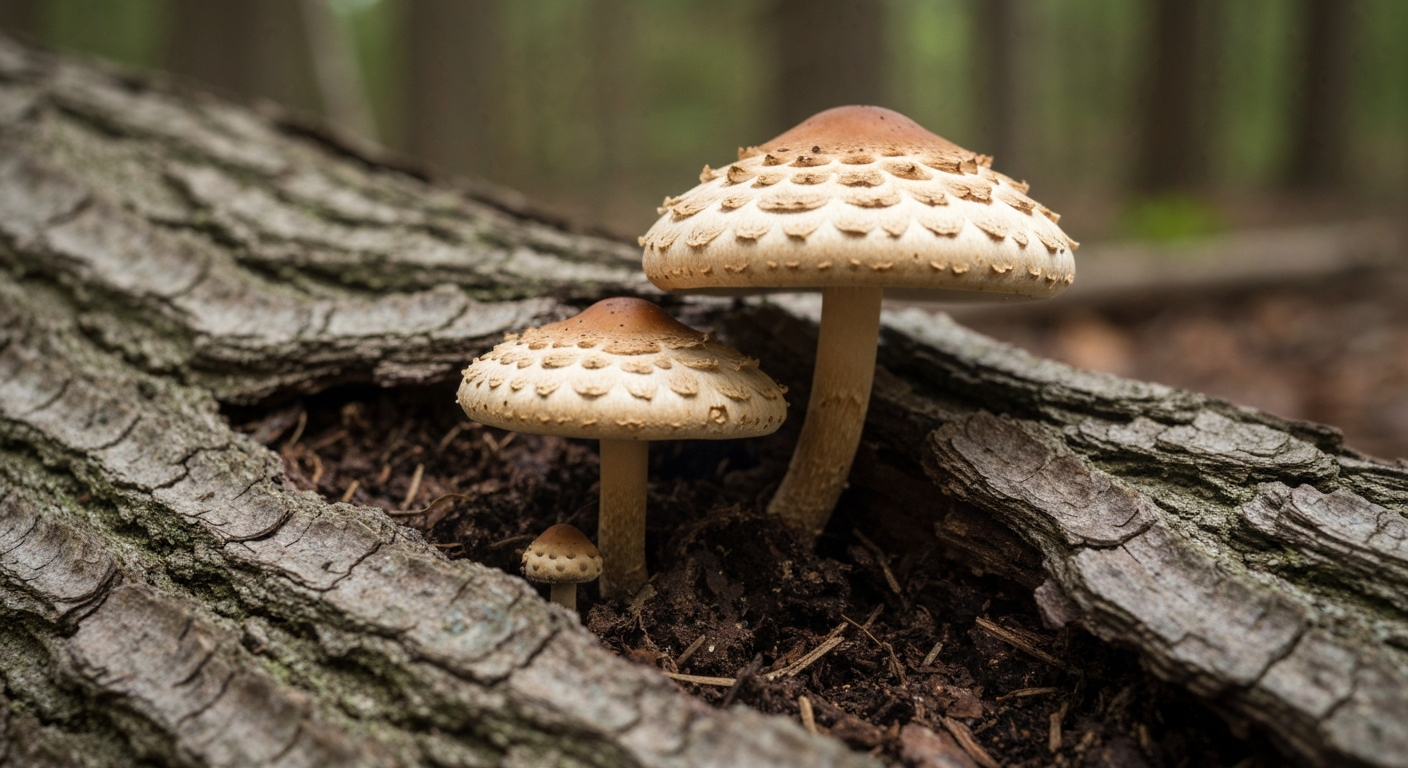
TL;DR: Fungus on tree stump identification starts with growth form: thin banded brackets = turkey tail (Trametes versicolor); golden clustered mushrooms with a stem ring at the base = honey fungus (Armillaria); hard woody shelf with white pores that bruise brown = artist's conk (Ganoderma applanatum); fan-shaped caps with gills on hardwood = oyster mushroom (Pleurotus ostreatus). Most stump fungi recycle dead wood. Honey fungus is the main concern — it can spread to living trees through roots. Photograph top, underside, and habitat, then use the Tree Identifier app for the original tree species if the stump bark remains.
🍄 Fungus on tree stump identification rule: check the underside — pores (tiny holes), gills (blade-like plates), or smooth crust split most stump species. Never eat stump mushrooms from photos alone.
Why stumps grow fungi
When a tree is cut, the stump and roots remain a massive store of lignin and cellulose. Wood-decay fungi colonize this resource — fungus on tree stump identification is really about naming the decomposers at work.
Stumps create ideal habitat: sustained moisture in root wood, shade, and no bark barrier on the cut face. Different fungi specialize in white rot (breaking lignin, leaving pale stringy wood) or brown rot (leaving brittle brown cubes). The species you see on the surface tell you which rot strategy dominates.
Knowing the fungus does not always tell you which tree stood there — but if bark patches remain, identify the host with Tree Bark Identification skills first, then note which fungi prefer hardwood vs softwood.
Step-by-step fungus on tree stump identification
Work through these observations in order:
- Growth form: Bracket (shelf) vs mushroom (cap and stem) vs crust (flat paint-like layer).
- Underside: Pores, gills, teeth, or smooth — the critical split.
- Texture: Thin and flexible vs hard and woody.
- Color pattern: Concentric bands, uniform brown, golden clusters.
- Location on stump: Top cut face, sides, or ground-level roots.
- Season: Some fruit only in fall (honey fungus); brackets may persist year-round.
- Host wood: Hardwood stump vs conifer — oyster prefers hardwood; some polypores grow on both.
Photograph the fungus from above and below. Include a scale object (coin, key). See Best Photo for Tree ID — same lighting principles apply to fungi.
Turkey tail (Trametes versicolor)
Turkey tail is the poster species for fungus on tree stump identification — common, colorful, and distinctive once you check the underside.
Appearance: Thin leathery brackets 1 to 3 inches wide, overlapping in rows like roof shingles. Upper surface shows concentric bands of brown, tan, orange, blue-gray, and cream — resembling a fanned turkey tail.
Underside: White to cream with tiny pores — use a hand lens. No gills. Surface of cap may feel velvety or fuzzy.
Texture: Flexible — you can bend a fresh bracket without breaking it.
Role: White-rot decomposer of hardwood stumps and logs. Not edible (too tough) but extensively studied for medicinal compounds — do not self-medicate.
Lookalikes: False turkey tail (Stereum) has a smooth underside, not porous. Trametes betulina is more hairy and whitish.
Honey fungus (Armillaria species)
Honey fungus is the most ecologically significant fungus on tree stump identification list — it attacks living trees and spreads through root systems.
Mushroom form: Cap-and-stem mushrooms in dense clusters, often at stump base or on exposed roots in late summer and fall. Caps honey-yellow to brown, 1 to 4 inches, often with fine dark scales. Stem has a persistent ring (annulus). Gills pale, attached to stem.
Rhizomorphs: Black shoestring-like fungal cords under bark or in soil — a diagnostic sign when mushrooms are absent. Peel bark at the stump base to check.
What it means: Armillaria may have killed the original tree or colonized the stump afterward and still infect nearby living trees through root grafts. Inspect neighboring trees for thinning crown, small yellow leaves, or white mycelial fans under bark.
Caution: Some Armillaria species are edible when cooked (honey mushrooms) but require expert ID — toxic lookalikes exist. For homeowners, treat honey fungus as a tree-health warning, not a foraging opportunity.
Artist's conk (Ganoderma applanatum)
Artist's conk is a perennial woody bracket — hard, long-lived, and unmistakable when you scratch the pore surface.
Appearance: Shelf bracket attached horizontally, 2 to 12 inches or more wide. Top is knobby, brown, with a whitish or yellowish growing margin on active specimens. Very hard — feels like wood, not leather.
Underside: White pore surface with tiny holes. Scratch with a fingernail or stick — it bruises dark brown immediately. Artists historically etched drawings into the white layer as it dried.
Perennial growth: New pore layer each year; older brackets develop a layered woody cross-section.
Role: White-rot decomposer of hardwood stumps and logs, especially maple, beech, and poplar. Also appears on living trees as a pathogen — on stumps it finishes the job.
Related species: Lacquered bracket or reishi (Ganoderma sessile, Ganoderma lucidum in some regions) has a varnished reddish top — more common on living oaks but occasionally on stumps.
Oyster mushroom (Pleurotus ostreatus)
Oyster mushrooms are the edible favorite on hardwood stumps — but fungus on tree stump identification must exclude toxic lookalikes.
Appearance: Fan-shaped or oyster-shell caps, white to gray to tan, 2 to 8 inches, growing in overlapping clusters on stump sides and cut faces. Gills run down a short lateral stem or attach directly to wood (stem absent).
Texture: Soft, fleshy, fresh specimens smell mildly anise-like or woody.
Season: Cool weather — fall through spring in many regions; flushes after rain.
Edibility: Pleurotus ostreatus is edible and cultivated commercially — but jack-o'-lantern (Omphalotus illudens) grows on buried roots and stumps too, with brighter orange gills, grows on soil/roots more than bare wood, and is poisonous. Jack-o'-lantern gills glow faintly green in complete dark — a bizarre test, not a home ID method. Expert confirmation required before eating any stump mushroom.
Other common stump fungi you may see
Split gill (Schizophyllum commune)
Small white fan brackets with a split down the center of the "gill" — fuzzy underside. Extremely common on decaying hardwood worldwide.
Velvet foot (Flammulina velutipes)
Orange-brown caps with dark velvety stems, on hardwood in cold weather. Edible cultivated enoki is a cultivated form — wild ID still needs care.
Chicken of the woods (Laetiporus sulphureus)
Bright orange-yellow shelving masses without gills — pores below. Soft when young. Edible for many when young. Grows on living and dead hardwood.
Phellinus and other dark crusts
Hard black crust-like fungi on old stumps — advanced decay, hard to ID without microscopy.
What stump fungi mean for your landscape
Most fungus on tree stump identification results are informational, not alarming:
- Turkey tail, artist's conk, oyster (saprotrophic): Recycling the stump in place. Slow natural removal. No chemical needed.
- Honey fungus: Potential threat to adjacent living trees. Consider stump grinding, root barrier, or removing infected roots. Monitor nearby trees for decline.
- Stump persistence: Fully rotted stumps sink into soil over 5 to 15 years depending on size, species, and climate.
If you removed a tree because of disease, the fungus on the stump may be the same pathogen — do not assume all stump fungi are harmless recyclers. Honey fungus and some Ganoderma species blur the line.
Safety and foraging rules
Fungus on tree stump identification for curiosity is safe — touching brackets is fine. Eating is a different domain:
- Never eat stump mushrooms identified from an app or blog alone.
- Stump fungi bioaccumulate decay products and soil contaminants — urban stumps near roads are poor foraging sites.
- When in doubt, photograph and consult a local mycological society.
Connecting fungi to the original tree
Stump bark remnants help you learn what died. Oak stumps grow different polypore communities than pine stumps. If you are identifying the tree that was removed, photograph remaining bark patterns and use Tree Identifier on bark and any leaves still sprouting from the stump (suckers).
Suckers from the stump can produce leaves for leaf identification even years after cutting — helpful when the fungus tells you nothing about the host.
Seasonal calendar for stump fungi
Spring: Oyster flushes on cool wet hardwood stumps.
Summer: Turkey tail brackets expand; artist's conk adds new pore layer.
Fall: Honey fungus mushrooms peak — walk the yard after rains.
Winter: Persistent brackets (turkey tail, artist's conk) remain; mushrooms mostly absent except in mild climates.
Using Tree Identifier alongside fungus ID
Tree Identifier identifies trees, not fungi — but pairing tools matters. Name the host tree from bark and sucker leaves, then document which fungi appear on that wood species over time. Oak stumps vs maple stumps build different fungal gardens.
For the tree side of the equation, photograph bark at the stump flare and any sprouting leaves. Fungus on tree stump identification completes the picture of what is happening in your yard's wood cycle.
Frequently asked questions
What fungus grows on tree stumps?
Common stump fungi include turkey tail (Trametes versicolor) — colorful concentric bands on thin leathery brackets; honey fungus (Armillaria species) — golden clustered mushrooms with ring on stem at stump base; artist's conk (Ganoderma applanatum) — hard brown shelf with white pore surface that bruises brown; and oyster mushroom (Pleurotus ostreatus) — white to tan fan-shaped caps with gills running down the stem on hardwood stumps.
How do you identify turkey tail on a stump?
Turkey tail (Trametes versicolor) forms thin flexible bracket fungi in overlapping rows on stumps and logs. Caps show concentric zones of brown, gray, orange, and blue-gray bands like a turkey's fanned tail. Underside is white to cream with tiny pores — not gills. Surface is velvety or slightly hairy. Turkey tail is one of the most common fungus on tree stump identification finds in North America.
Is fungus on a tree stump dangerous?
Stump fungi are usually decomposing dead wood — not attacking living trees directly from the stump, though honey fungus (Armillaria) can spread to nearby living trees through root contacts. Most bracket fungi are not poisonous to touch but many are not edible. Do not eat stump mushrooms without expert ID. Honey fungus indicates root-rot risk for adjacent trees. Artist's conk and turkey tail signal advanced wood decay in the stump itself.
What does honey fungus look like on a stump?
Honey fungus (Armillaria mellea and related species) produces clusters of golden-yellow to honey-brown mushrooms with a ring on the stem, often at the base of stumps or on buried roots in fall. Caps are 1 to 4 inches, gills pale, stems may fuse in bundles. Black rhizomorphs — shoestring-like fungal cords — may be visible under bark at the stump base. Honey fungus on tree stump identification often includes both mushrooms and these dark root-like threads.
How do you identify artist's conk on a stump?
Artist's conk (Ganoderma applanatum) is a hard woody bracket shelf, brown on top with a whitish growing edge, attached to hardwood stumps and logs. Underside is white with tiny pores — scratch it and it bruises dark brown (artists once drew on the surface). No gills. Perennial brackets may grow thicker each year with a new white pore layer. Very hard and woody — knife barely marks the top.
Are oyster mushrooms on stumps edible?
True oyster mushrooms (Pleurotus ostreatus and relatives) on hardwood stumps are considered edible when freshly identified and cooked. Caps are oyster-shaped fans, often white to tan, with gills running down a short lateral stem. Confirm fungus on tree stump identification carefully — oyster lookalikes on stumps include toxic jack-o'-lantern (Omphalotus) which grows in clusters on buried roots and has gills that glow faintly green in dark. Never eat without 100% ID.
What does fungus on a stump mean for my yard?
Fungi on stumps mean the wood is decomposing — nature's recycling program. Turkey tail and artist's conk are saprotrophic, breaking down lignin and cellulose. Honey fungus is more concerning: it can colonize living roots and spread to nearby trees, especially stressed specimens. Remove stumps near valuable trees if honey fungus is confirmed. Other stump fungi generally pose little threat beyond slow stump rot.
Try Tree Identifier — free on iPhone
Identify the tree species from stump bark and sucker leaves — then track which fungi colonize the wood.
Download on the App Store