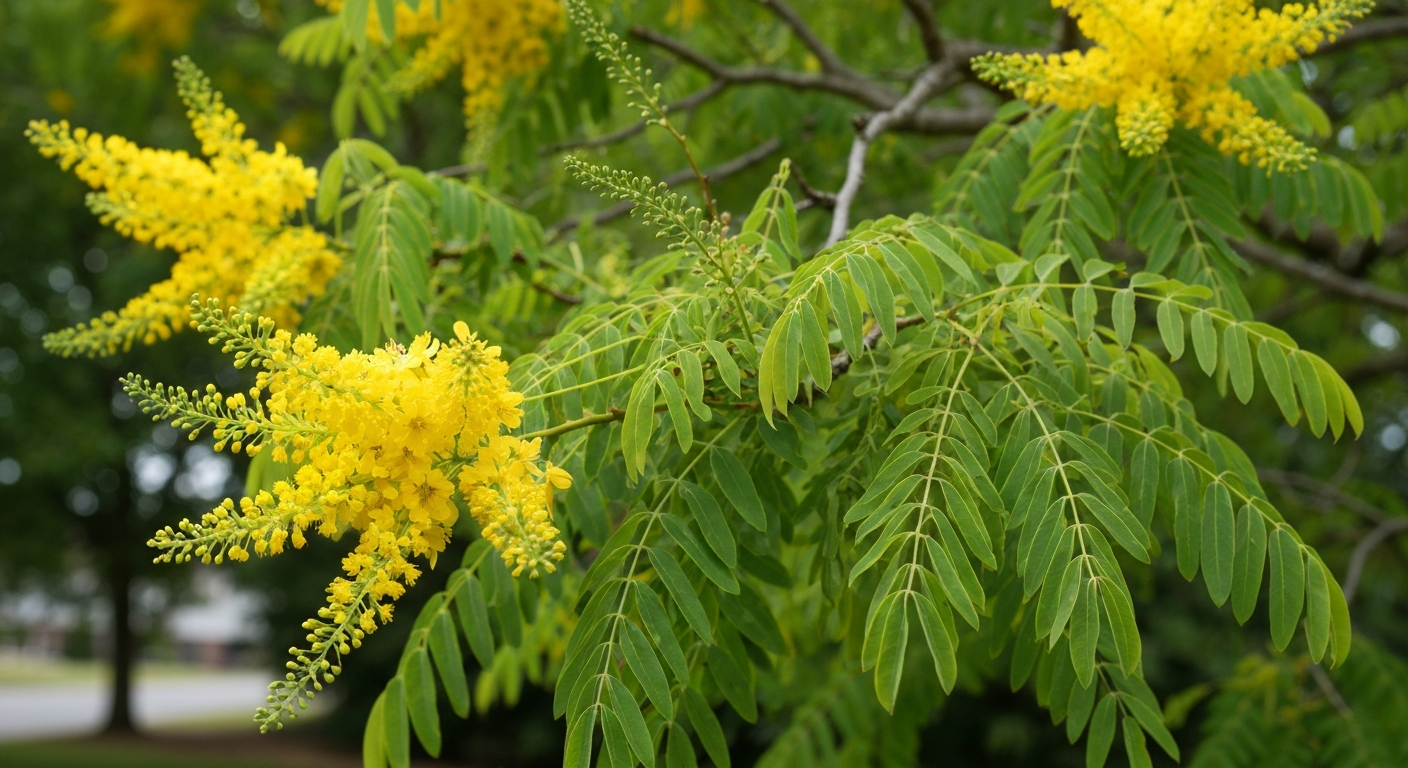
TL;DR: Golden rain tree identification for Koelreuteria paniculata hinges on midsummer yellow flower panicles that seem to drench the crown, followed by papery three-sided bladderseed pods that blush pink then dry brown, all under alternate pinnate leaves. It is a tough medium ornamental — rounded crown, light brown ridged bark — common in yards and along streets. Photograph flowers or lantern pods plus one full compound leaf and confirm with the Tree Identifier app.
🌧️ Golden rain tree ID trio: yellow summer panicles → inflated papery bladder pods → pinnate leaves. If you see lantern capsules turning rose-bronze in late summer, you are almost certainly looking at Koelreuteria.
What is golden rain tree?
Golden rain tree (Koelreuteria paniculata), also spelled goldenrain tree, is a deciduous ornamental native to East Asia and widely planted across the United States for heat and drought toughness. Genus Koelreuteria sits in the soapberry family (Sapindaceae) — distant kin to maples and buckeyes — which helps explain the inflated capsules that feel papery rather than woody.
People search golden rain tree identification when the yellow midsummer show arrives later than crabapple or dogwood bloom, when rose-tinted lantern fruits appear, or when seedlings sprout under street trees. The name describes falling yellow blossoms (and later falling capsules) more than rain itself.
Typical mature size is 30 to 40 feet tall and wide, sometimes larger on excellent sites. Crowns are rounded to irregular. Wood is brittle in ice storms relative to oaks, but the species thrives in compacted urban soils where fussier natives fail.
Yellow flower panicles — the midsummer signature
Unlike spring-blooming street trees, golden rain tree peaks mid to late summer. Thousands of small bright yellow flowers pack into large branched panicles that stand above and throughout the canopy. From a distance the crown looks dusted in gold; up close each flower is modest but collectively they justify the common name.
Golden rain tree identification during bloom is nearly foolproof in parking lots and suburbs with Asian ornamentals nearby. Bees love the nectar. After pollination, the show shifts to fruit — often more distinctive than flowers for late-season walkers.
Timing varies by region: warmer zones may bloom earlier; cooler Midwest and Northeast plantings may wait until July or August. Note nearby pollen-heavy maples bloom months earlier — seasonal mismatch alone eliminates many lookalikes.
Papery bladderseed pods
The fruit is the character that seals golden rain tree identification after blooming ends. Capsules are inflated and papery — bladder-like — often three-sided or three-lobed, about 1 to 2 inches long. They hang in loose clusters.
Color sequence:
- Early: Pale green to chartreuse lanterns.
- Mid: Pink, rose, or bronze blush on sunlit sides — highly photogenic.
- Late: Tan to brown dry paper, rattling with hard dark seeds.
Pods persist into winter on twigs, making cold-season ID easier than for trees that drop fruit early. Kids call them paper lanterns. Do not eat seeds; identification, not foraging, is the goal.
Compare pod architecture to true legumes in How to Identify Tree Seed Pods — golden rain tree capsules are inflated septicidal capsules, not peapods like locust or redbud.
Pinnate leaves and canopy texture
Leaves are alternately arranged and pinnately compound, with numerous toothed leaflets along a rachis. Vigorous sprouts may show partial bipinnate division. Leaflet size is moderate — larger than mimosa’s tiny leaflets, smaller than black walnut’s long leaflets.
Spring leaves emerge reddish or bronze on some individuals before greening. Summer foliage is medium green; fall color is commonly yellow. Leafing can continue late, and trees leaf out relatively late in spring.
Golden rain tree identification without flowers uses leaf plus any leftover bladder pods. Crushed foliage lacks the spicy walnut odor and lacks ash’s opposite arrangement. Branching is alternate.
For compound-leaf comparison skills that separate walnut, ash, locust, and soapberry relatives, practice with Identify Trees by Leaf.
Bark, twigs, and whole-tree form
Young bark is smoother and lighter; mature bark develops thin ridges and furrows in light brown to gray-brown tones — not the dark diamonds of black walnut, not the platy white of sycamore. Twigs are moderately slender with small buds.
Form in open yards is rounded and somewhat open; in rows the silhouette is formal enough for street use. Broken limbs after ice are a maintenance note, not an ID trait — but storm debris often includes twig clusters still holding dry pods, which helps winter golden rain tree identification after wind events.
Review bark and fruit vocabulary in the Tree Anatomy Glossary if capsule vs legume vs samara language is new.
Lookalikes and related species
Chinese flame tree and other Koelreuteria: Closely related plantings may show stronger bipinnate leaves and pinker capsule clusters marketed as flame trees. Treat them as cousin-level golden rain tree identification — same genus, similar bladder fruits — and check cultivar tags when precision matters.
Pride of India / other yellow summer trees: Some regions plant other yellow bloomers; check for bladder pods specifically. Without papery lanterns, reconsider.
Tree of heaven: Compound leaves and weedy toughness, but foul smell, glandular leaflet bases, and winged samaras — never bladder lanterns.
Locusts: True peapods and (often) spines or thorns; flowers usually white or creamy pea blossoms, not open yellow panicles of Koelreuteria.
When you only know “yellow summer tree,” walk the fruit: bladder pods mean golden rain tree far more often than any lookalike.
Seedlings, volunteers, and site context
Golden rain tree seeds freely under parent canopies. Seedlings show pinnate leaflets early. Urban land managers in some Southern and Mid-Atlantic areas list the species as invasive or cautionary; Midwestern plantings may be more restrained. Golden rain tree identification of seedlings helps decide pull-or-keep before roots hit sidewalks.
Habitat cue: planted beds, street strips, campus lawns, and older suburban lots more than deep native woodland. Finding it in a prairie remnant may indicate escape; finding it beside a parking lot is expected.
Context among other common plantings sits in common backyard trees and decision trees like What Type of Tree Is This?.
Seasonal calendar for golden rain tree identification
- Late spring: Late leaf-out, reddish new foliage possible.
- Mid–late summer: Yellow panicles — easiest bloom window.
- Late summer–fall: Green to pink bladder pods — peak fruit ID.
- Winter: Brown papery capsules cling; bark and crown shape remain.
Photograph in the stage you meet it. If you catch pink lanterns, you rarely need a second visit.
Using Tree Identifier
Tree Identifier recognizes golden rain tree reliably from flower panicles and bladder pods. For foliage-only puzzles, fill the frame with a complete pinnate leaf and include a second photo of any residual capsules on the twig tips.
Capture tips:
- Panicle against sky for flower color accuracy.
- Pod cluster showing inflated paper texture and three-sided form.
- Leaf flat on a notebook so leaflet count and teeth are visible.
- Avoid heavy backlit silhouettes that wash yellow to white.
Pair the app with a quick mental check: soapberry family bladder pods plus midsummer gold = golden rain tree. That combo almost never misfires in North American landscapes.
For photography habits that raise match rates across species, see Best Photo for Tree ID and the overview at App to Identify Trees.
Golden rain tree identification rewards late-summer walkers — when most trees are quiet green, Koelreuteria puts on yellow rain and paper lanterns you can spot from the sidewalk.
Frequently asked questions
How do you identify a golden rain tree?
Golden rain tree identification uses three summer-to-fall signs: large upright and spreading panicles of small bright yellow flowers, then papery lantern-like capsules that turn from green to pink-bronze to brown, plus alternately arranged pinnate leaves with toothed leaflets. Bark on mature trunks is light brown with shallow ridges. The tree is medium-sized, often 30 to 40 feet, with a rounded crown popular in yards and parking strips.
What do golden rain tree pods look like?
Pods are inflated papery capsules — often called bladderseed pods — roughly triangular or three-lobed, 1 to 2 inches, hanging in clusters. They start green or chartreuse, blush pink to rose in late summer, then dry brown and persist into winter. Seeds inside are hard and dark. Those lantern pods are the strongest golden rain tree identification character after flowering ends.
When does golden rain tree bloom?
Koelreuteria paniculata typically blooms mid to late summer — often July into August depending on climate — later than most spring-flowering ornamentals. Flowers are small, yellow, packed into large branched panicles that seem to rain color across the canopy. After bloom, bladder pods develop quickly.
Are golden rain tree leaves compound?
Yes. Leaves are pinnately compound (sometimes partially bipinnate on vigorous shoots) with numerous toothed leaflets. New growth can look almost ferny. Fall color is often yellow. Leaflets lack the huge size of walnut leaflets and lack the opposite arrangement of ash.
Is golden rain tree invasive?
In parts of the United States — especially warmer regions — golden rain tree can seed freely and naturalize, so local guidance varies. Identification is separate from planting advice: positive golden rain tree identification helps homeowners and land managers decide whether to keep, monitor, or remove seedlings.
What is the difference between golden rain tree and Chinese flame tree?
Both are Koelreuteria. Classic golden rain tree is K. paniculata with yellow flowers and bladder pods. Chinese flame tree (K. bipinnata and related) often shows more fully bipinnate leaves and pinkish capsule displays marketed as flame color. Check leaf division depth and capsule color when golden rain tree identification meets lookalike cousins.
Can a tree ID app identify golden rain tree?
Yes — yellow panicles or rose-tinted bladder pods photograph clearly. Add a full pinnate leaf for confirmation when only green foliage is present. Tree Identifier recognizes Koelreuteria well from flower and pod photos in landscape settings.
Try Tree Identifier — free on iPhone
Photograph yellow panicles or bladderseed pods and confirm golden rain tree in seconds.
Download on the App Store