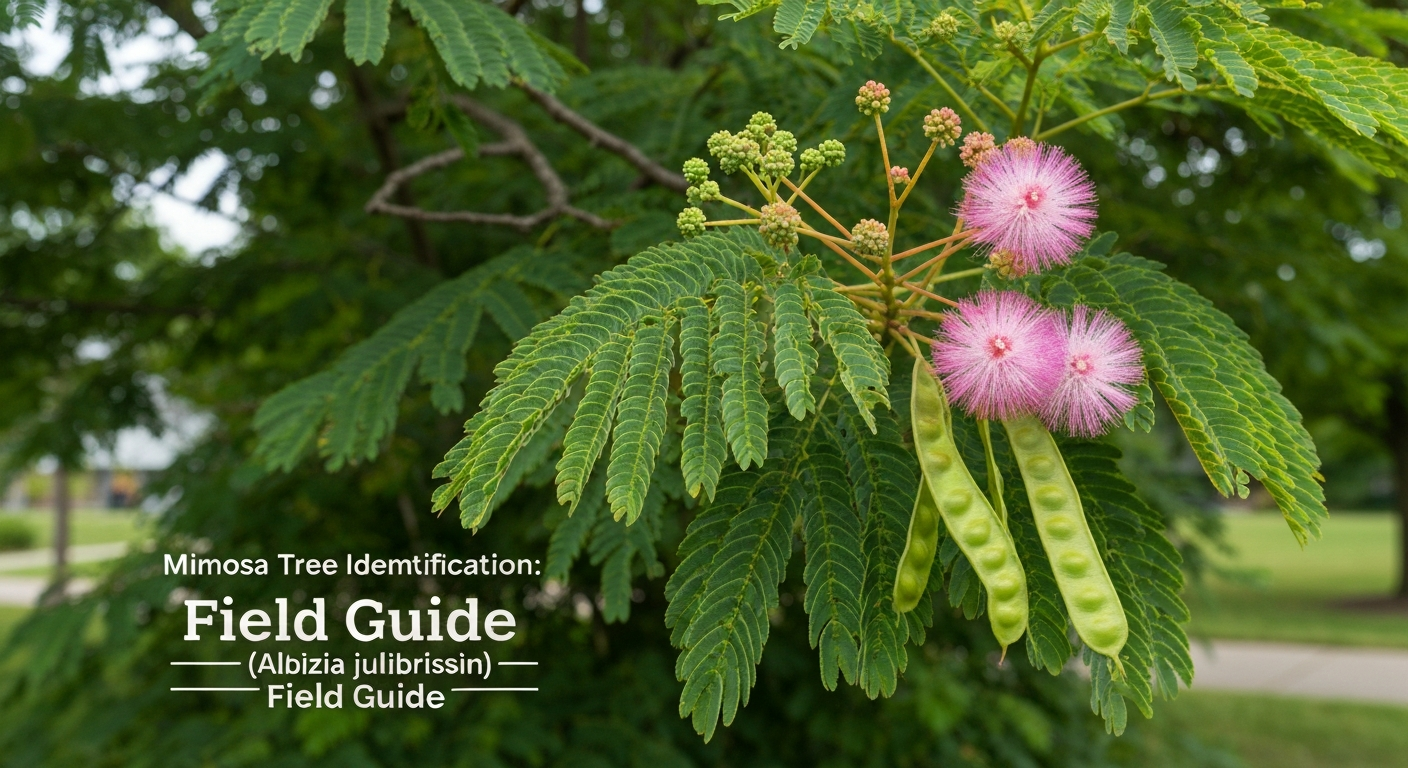
TL;DR: In North America, mimosa tree identification almost always means silk tree (Albizia julibrissin) — not the botanical genus Mimosa in the strict sense. Look for bipinnately compound fern-like leaves that fold at night, fluffy pink powderpuff flowers in mid-summer, and flat brown seed pods on smooth gray bark. Silk tree is invasive across the Southeast and spreads along roadsides. Mimosa tenuiflora is a different tropical species with white flowers and thorny stems — relevant mainly to Latin American flora, though the name confuses US searches. Photograph flowers, foliage, or winter pods and confirm with the Tree Identifier app.
🌸 US mimosa tree identification = silk tree (Albizia julibrissin): pink powderpuff flowers, feathery bipinnate leaves, flat seed pods. Mimosa tenuiflora is a different tropical plant with white blooms and thorns.
Naming confusion — mimosa, silk tree, and Albizia
Common names collide here. What Americans call mimosa tree is silk tree or pink siris — botanically Albizia julibrissin, in the legume family (Fabaceae). True Mimosa species exist (sensitive plant Mimosa pudica is famous for folding leaves), but the pink-flowering yard and roadside tree across the US South is not in genus Mimosa.
Search volume for mimosa tenuiflora identification reflects a different plant — tepezcohuite or jurema, a spiny shrub native to dry tropical Mexico and Central America. It has small white globular flower heads and traditional medicinal bark use. You will not find it lining Georgia highways; you will find silk tree.
This guide covers silk tree as the US default mimosa tree identification target, with a clear split from Mimosa tenuiflora for searchers who need the distinction.
Silk tree — key identification characters
Albizia julibrissin is a fast-growing deciduous tree to 20 to 40 feet, often multi-stemmed with a broad flat-topped or umbrella crown.
- Leaves: Bipinnately compound — feathery sprays 10 to 20 inches long composed of hundreds of tiny leaflets.
- Leaf movement: Leaflets fold upward at dusk and during heavy rain (nyctinasty).
- Flowers: Pink powderpuffs of long silky stamens, sweetly fragrant, mid to late summer.
- Fruit: Flat legume pods, papery, brown, 4 to 6 inches, persisting on branches.
- Bark: Smooth light gray on young and middle-aged trunks; lenticels visible; may develop shallow fissures on very old trees.
- Thorns: None — unlike Mimosa tenuiflora.
Any one character is striking; together they are unmistakable among temperate street trees.
Mimosa tree leaves in detail
Mimosa tree leaves are the feathery signature visible from May through September (and sometimes mistaken for a large fern from a distance).
Bipinnate structure: The primary petiole attaches to the twig and branches into secondary axes (pinnae), each bearing rows of tiny leaflet pairs (pinnules). Leaflets are oblong, only 1/4 to 1/2 inch long, with an entire margin.
Arrangement: Alternate on the stem — one compound leaf per node, staggered.
Night folding: Watch a silk tree at sunset — leaflets lift and the whole leaf collapses like a closing fan. Kids notice this before adults do; it is a reliable party-trick ID character.
Comparison: Honey locust has bipinnate leaves too, but leaflets are larger, pods are twisted legumes not flat papery strips, and flowers are greenish spikes not pink puffs. See Tree Foliage Identification Guide for compound-leaf terminology.
Pink powderpuff flowers
Silk tree flowers are unlike any native US tree bloom — reason mimosa tree identification is easy in July.
Structure: Each flower head is a dense sphere of long pink stamens emerging from a small calyx — petals are reduced or absent. The puff is 1 to 2 inches across, often darker pink at the tips of stamens.
Timing: Blooms appear on new wood in mid to late summer — June through August in the South, slightly later northward where silk tree survives.
Fragrance: Sweet, honeyed — attracts bees and butterflies heavily.
Location on tree: Flowers sit at the ends of branches, often above the feathery foliage layer, creating a pink canopy tier.
Photograph one flower head against green leaves — apps and field guides recognize this combo instantly. For photography tips, see Best Photo for Tree ID.
Seed pods and winter identification
When flowers finish, silk tree produces legume fruit that makes winter mimosa tree identification straightforward.
Immature pods: Green, flat, slightly curved, hanging in clusters.
Mature pods: Brown, papery, 4 to 6 inches long, containing several hard flat seeds.
Persistence: Pods often remain on the tree through winter — rattling in wind on bare gray branches.
Seed dispersal: Seeds germinate readily along roadsides, riparian zones, and vacant lots — core of the invasive problem.
Winter photos of flat pods on smooth gray bark with lenticels are excellent for Tree Identifier when leaves and flowers are absent.
Bark and form
Bark: Young silk tree bark is smooth, pale gray, almost beech-like but with more prominent lenticels. Older trunks may show shallow vertical fissures but never thick corky ridges of cottonwood or oak.
Form: Multi-trunked vase or umbrella shape; long arching branches that droop under flower weight. Low branching common — canopy starts near head height on open-grown specimens.
Size: Often 20 to 30 feet in cultivation; seedling volunteers may flower when only 6 feet tall.
For bark comparison methods, see Tree Bark Identification App Guide.
Mimosa tenuiflora — not the US roadside tree
Mimosa tenuiflora (syn. Mimosa hostilis) deserves explicit coverage because the keyword targets this species while US field context shows silk tree.
Native range: Southern Mexico through Central America and parts of South America — tropical dry forest and thornscrub.
Form: Shrub or small tree, often multi-stemmed, armed with sharp thorns on branches.
Leaves: Bipinnate like silk tree but adapted to arid conditions — often smaller overall on stressed plants.
Flowers: Small white spherical heads — not large pink powderpuffs.
Uses: Bark traditionally used for skin remedies; tannin-rich. Not a US landscape tree.
If you are doing mimosa tenuiflora identification in the Americas outside the US tropics, look for thorns plus white globular blooms. If you are in Atlanta or Charlotte staring at a pink summer bloomer, you have Albizia julibrissin.
Invasive status and ecological impact
Silk tree is beautiful — and problematic. It is listed invasive in the Southeast, mid-Atlantic, and increasingly in the lower Midwest.
Spread: Abundant seed production, hard-coated seeds, tolerance of drought and poor soil, and root suckering on damaged roots.
Habitat: Riverbanks, forest edges, roadsides, old homesites — anywhere disturbance opens ground.
Impact: Outcompetes native vegetation; fixes nitrogen which can alter soil chemistry on poor sites; weak wood breaks in ice storms.
Management: Do not plant new specimens. Remove seed-bearing trees where conservation is a priority; cut and treat stumps to limit suckering.
Native alternatives for pink spring color: eastern redbud (Cercis canadensis). For summer interest: sourwood or native viburnums.
Lookalikes and confusion species
Honey locust (Gleditsia triacanthos)
Bipinnate leaves, but leaflets larger, no pink flowers, twisted pods, and often thorns on wild forms (thornless cultivars exist).
Jacaranda (Jacaranda mimosifolia)
Similar feathery foliage and legume family kinship, but purple trumpet flowers in spring — planted in frost-free climates, not naturalized like silk tree in the eastern US.
Persian silk tree relatives (Albizia spp.)
Other Albizia species are rare in cultivation; silk tree dominates.
Using Tree Identifier for mimosa
Tree Identifier recognizes silk tree from flower, leaf, and pod photos across its established US range.
Best photos: Single pink powderpuff against foliage. One full bipinnate leaf spray showing the doubling of pinnae. Winter branch with flat brown pods.
Challenges: Distant umbrella-shaped tree without detail may return generic legume — move closer for flowers or a leafy twig.
Name note: App results may say silk tree or Albizia julibrissin rather than mimosa — same plant.
Mimosa tree identification is one of the easiest summer IDs in the South once you connect the common name to silk tree and separate it from tropical Mimosa tenuiflora.
Frequently asked questions
How do you identify a mimosa tree?
In the United States, mimosa tree identification almost always means silk tree (Albizia julibrissin): bipinnately compound fern-like leaves that fold closed at night, fluffy pink powderpuff flowers in summer, and flat brown seed pods persisting into winter. Bark is smooth gray with lenticels on young trunks. The tree is invasive across the Southeast and tolerates poor soil and drought.
What is the difference between mimosa tree and Mimosa tenuiflora?
Mimosa tenuiflora (also called tepezcohuite or jurema) is a tropical shrub or small tree native to Mexico and Central America — not the pink-flowering roadside tree common in the US South. Mimosa tenuiflora has small white spherical flower heads and thorny stems; silk tree (Albizia julibrissin) has large pink staminal puff flowers and is thornless. Searchers typing mimosa tenuiflora identification in the US usually mean silk tree.
What do mimosa tree leaves look like?
Mimosa tree leaves are bipinnately compound — the main petiole branches twice into many tiny leaflets, creating a feathery fern-like spray 10 to 20 inches long. Each leaflet is tiny, oblong, and arranged in pairs along secondary axes. Leaves fold upward at night (nyctinasty) and during rain. This foliage is unique among common US street trees.
When does mimosa tree bloom?
Silk tree blooms in mid to late summer — June through August in most of its US range. Flowers are pink to rose powderpuffs about 1 to 2 inches across, composed mostly of long silky stamens with little visible petal. Trees may flower heavily even on young specimens. Fragrance is sweet and honey-like.
Is mimosa tree invasive?
Yes — Albizia julibrissin is listed as invasive in the Southeast, mid-Atlantic, and spreading north and west. It seeds freely along roadsides, riverbanks, and disturbed ground. Flat seed pods release hard seeds; roots sucker on damaged trees. Many states discourage new planting. Native alternatives include redbud and serviceberry for pink spring color.
What do mimosa seed pods look like?
Mimosa seed pods are flat, papery legume pods 4 to 6 inches long, brown when mature, persisting on bare branches into winter. Pods contain several hard brown seeds. Clusters of old pods on gray bark are a reliable winter mimosa tree identification character when leaves are gone.
Can tree ID apps identify mimosa?
Yes — silk tree is distinctive in flower and foliage. Apps recognize pink powderpuff blooms and bipinnate leaves easily. Winter photos of pods on smooth gray bark also work. Tree Identifier covers Albizia julibrissin across its US range when flowers, leaves, or pods are clearly visible.
Try Tree Identifier — free on iPhone
Photograph mimosa flowers, feathery leaves, or seed pods and get a species match in seconds.
Download on the App Store