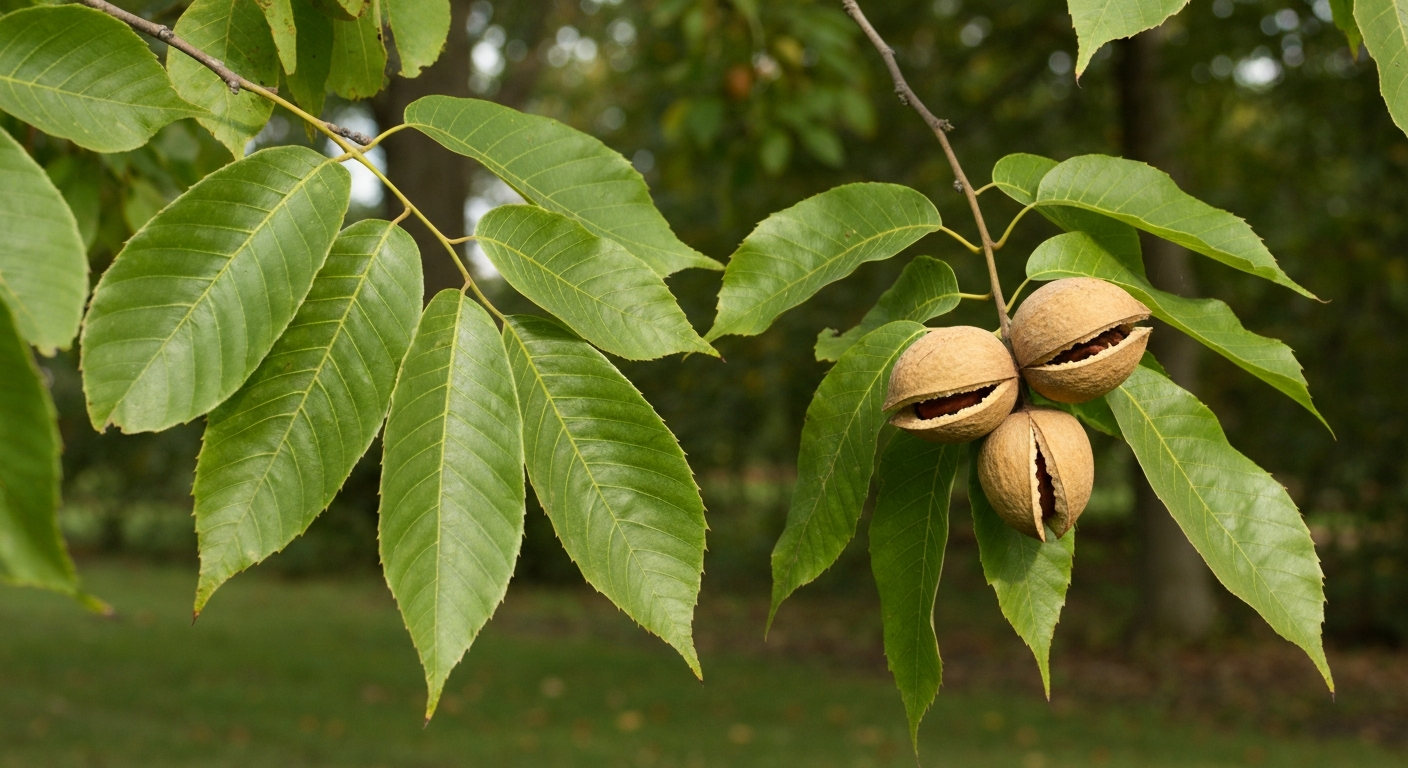
TL;DR: Nut tree identification in North America centers on five woody groups — walnut, hickory, pecan, chestnut, and butternut — each with distinct leaves and fruit. Walnut and butternut (Juglans) have large pinnately compound leaves and nuts in thick green husks that stain hands black. Hickory and pecan (Carya) share compound leaves but produce nuts in husks that split into four sections. Chestnut (Castanea) is different — simple leaves with bristle-tipped teeth and nuts inside spiny burrs. Fallen nuts under the canopy are often the fastest clue. Photograph one compound leaf, one nut with husk, and bark, then confirm with the Tree Identifier app.
🥜 Nut tree identification shortcut: compound leaves + ground fruit. Walk the drip line in autumn — husks and nuts tell you walnut vs hickory vs chestnut before you look up.
How nut trees fit together botanically
Most native nut trees discussed here belong to two plant families. Walnuts and butternuts are Juglans in the walnut family (Juglandaceae). Hickories and pecans are Carya in the same family — close relatives with similar chemistry and wood. Chestnuts are Castanea in the beech family (Fagaceae), related to oaks and beeches, not to walnuts.
That family split matters for nut tree identification: walnut-family trees have pinnately compound leaves and often aromatic tissues — crush a leaflet and you smell spicy citrus-pine. Chestnuts have simple entire leaves with coarse teeth — one blade per petiole, not a row of leaflets.
Universal nut tree identification workflow:
- Leaf type: Compound (walnut, hickory, pecan) vs simple serrated (chestnut).
- Leaflet count and shape: Narrow and many on pecan; large and few on butternut.
- Fruit on ground: Green fleshy husk vs splitting husk vs spiny burr.
- Bark: Shaggy plates on shagbark hickory; dark furrows on black walnut.
- Habitat: River bottom pecan vs upland pignut hickory vs yard black walnut.
- Twig scars: Monkey-face leaf scars on butternut; chambered pith inside walnut twigs.
Nut tree identification rewards autumn walks — the tree drops its name at your feet.
Black walnut identification
Black walnut (Juglans nigra) is the dominant wild walnut across eastern and central North America — large shade tree, valuable timber, and aggressive allelopathic root chemistry that suppresses competing plants under the canopy.
Leaves: Pinnately compound, 1 to 2 feet long, with 15 to 23 leaflets common on vigorous shoots. Leaflets are lance-shaped, 3 to 5 inches, with fine serrations. Crushed leaflets smell distinctly spicy — nut tree identification by scent works on walnut before fruit falls.
Nuts: Round to oval, hard thick shell, enclosed in a green fleshy husk the size of a tennis ball. Husks blacken and stain skin permanently — wear gloves when collecting. Husks do not split cleanly into four parts like hickory; they rot and peel.
Bark: Dark gray to nearly black on mature trunks, deep irregular furrows — rugged bark you can recognize at a distance in winter.
Form: Straight trunk, oval crown, often solitary in pastures and fencerows where squirrels planted nuts.
Range: Eastern US to the Great Plains; planted westward. English walnut (J. regia) appears in orchards and yards — similar compound leaves but larger nuts bred for thin shells; not a wild forest ID target in most of the US.
Black walnut nut tree identification in summer: large compound leaves plus dark furrowed bark and bare soil under the tree from juglone toxicity.
Butternut identification
Butternut or white walnut (Juglans cinerea) is the overlooked sibling of black walnut — sweeter nut, lighter wood, and critically endangered from butternut canker disease.
Leaves: Pinnately compound with 11 to 17 leaflets — fewer and often larger than black walnut. Leaf stem (rachis) and undersides may feel sticky from fine hairs.
Nuts: Elongated, lemon-shaped, with sticky hairs on the husk — not round like black walnut. Husks stain but nuts are smaller and sweeter.
Twigs: Leaf scar looks like a monkey face — three lobes resembling eyes and mouth. Twigs have chambered pith — cut a twig crosswise and see hollow chambers stacked like a bee hive. Black walnut also has chambered pith; combine with nut shape and leaflet count.
Bark: Light gray, smoother than black walnut — almost silvery on young trunks.
Range: Northeast, Appalachians, upper Midwest; declining range-wide. Report healthy mature butternuts to local forestry programs — nut tree identification here supports conservation.
Butternut vs black walnut: fewer leaflets, sticky rachis, elongated sticky nut, lighter bark, monkey-face scars. When in doubt, wait for fallen fruit.
Hickory tree identification
Hickories (Carya) split into two groups — true hickories (shagbark, pignut, mockernut, shellbark) and pecan hickories (pecan, water hickory, bitternut). All have pinnately compound leaves and nuts in husks that split into four valves at maturity.
Shagbark hickory (Carya ovata)
The easiest hickory to name from bark alone. Bark: Long curling plates peeling outward from trunk — shaggy at eye level and above. Leaves: 5 leaflets common, sometimes 7, each 4 to 6 inches, fine teeth. Nuts: Round, thick four-part husk splitting to reveal sweet nut. Range: Eastern US, common in mixed hardwood forests.
Pignut hickory (Carya glabra)
Upland workhorse. Bark: Tight gray ridges, not shaggy. Leaves: Usually 5 leaflets, smooth margins or faint teeth. Nuts: Pear-shaped or round, husk splits but nut often bitter — "pignut" fed hogs. Habitat: Dry slopes, oak-hickory forests.
Mockernut hickory (Carya tomentosa)
Leaves: 7 to 9 leaflets, often fuzzy underneath — "mockernut" for large husks hiding small nuts. Bark: Interlaced ridges, between shagbark and pignut in texture. Nuts: Very thick husk, hard shell, small edible kernel.
Shellbark hickory (Carya laciniosa)
Bottomland giant. Bark: Shaggy like shagbark but plates tighter and bark harder. Leaves: Often 7 to 9 large leaflets. Nuts: Largest hickory nuts — sweet. Habitat: Floodplains and rich soil.
Hickory nut tree identification without bark: split husk into four sections, hard shell, sweet vs bitter kernel. Shagbark is the only common eastern hickory with dramatically peeling bark.
Pecan tree identification
Pecan (Carya illinoinensis) is the pecan-hickory species people know from pie — native to river bottoms, dominant in commercial orchards across the South.
Leaves: Pinnately compound with 9 to 17 narrow leaflets — more leaflets than most true hickories, each leaflet longer and more slender, often curved or sickle-shaped. Leaf rachis may have fine hairs.
Nuts: Oblong, thin-shelled compared to wild hickories, in a husk splitting into four sections. Orchard varieties produce larger nuts than wild river-bottom trees.
Bark: Gray-brown, ridged and furrowed in narrow vertical plates — not shaggy. Mature orchard trunks look like hardened alligator skin.
Form: Tall straight trunk in floodplains; spreading orchard crowns under cultivation.
Range: Mississippi River valley and South-Central US native; orchards from Georgia to Arizona.
Pecan vs hickory nut tree identification: count leaflets — pecan has more, narrower leaflets. Pecan nuts are oblong; shagbark nuts are round. Water hickory (C. aquatica) shares bottomland habitat but has bitter nuts and 7 to 9 leaflets — pecan leaf fronds look feathery by comparison.
Chestnut tree identification
American chestnut (Castanea dentata) was the great forest chestnut before chestnut blight — nut tree identification today often means finding sprouts, planted Asiatic chestnuts, or hybrids rather than mature American giants.
Leaves: Simple — one blade per petiole, not compound. Lance-shaped, 5 to 8 inches, with prominent hooked teeth ("dentata" = toothed). Each serration ends in a bristle tip — coarser than beech leaves.
Fruit: Nuts enclosed in a spiny burr 2 to 3 inches across — green, extremely sharp. Burr splits open at maturity revealing one to three nuts. This spiny ball is definitive chestnut nut tree identification; nothing else in the eastern forest matches it.
Bark: Smooth gray-brown, often with spiral furrows on mature trunks — distinct from shaggy hickory or furrowed walnut.
Form: Straight trunk, spreading crown; modern American chestnuts mostly sprout from old root systems as shrubby stems.
Chinese chestnut (C. mollissima) and Japanese chestnut planted in yards share spiny burrs but have larger nuts and broader leaves. See How to Identify a Chestnut Tree for species-level splits. Horse chestnut (Aesculus) is unrelated — palmate leaves, not simple serrated blades.
Compound leaf details for nut tree identification
When fruit is absent, compound leaf architecture carries nut tree identification:
- Confirm pinnately compound: Leaflets in pairs along a central rachis, often with one terminal leaflet.
- Count leaflets: Pecan 9–17 narrow; black walnut 15–23; butternut 11–17 larger; shagbark hickory often 5.
- Smell crushed leaflet: Walnut-family spicy aroma — walnut, butternut, hickory, pecan. Chestnut lacks this — simple leaf anyway.
- Check rachis: Sticky hairs suggest butternut; winged rachis is not typical on these nut trees.
- Measure leaf size: Black walnut compound leaves among the largest in eastern forests — often 2 feet.
Photograph one entire compound leaf on a neutral background — see Best Photo for Tree ID for compound-leaf tips.
Bark, twigs, and winter nut tree identification
Winter nut tree identification without leaves:
Shagbark hickory: Unmistakable peeling shag — start here if bark is visible.
Black walnut: Dark deep furrows, no shag plates.
Butternut: Lighter smoother gray bark; monkey-face leaf scars on twigs.
Pecan: Hard ridged furrows, orchard-scale trunk diameter in mature trees.
Chestnut: Smooth-ish gray bark with spiral pattern; twigs may show swollen blight cankers on American chestnut sprouts.
Scan the ground for old husks and shells — nut tree identification persists in litter for months. Squirrel gnawed shells piled at a log are secondary confirmation.
Common nut tree lookalike mistakes
Tree of heaven and sumac
Both have compound leaves but produce winged seeds or red berry clusters — not nuts. Tree of heaven smells foul when crushed; sumac has red upright drupes. Neither produces hickory-style four-part husks or walnut green balls.
Ohio buckeye and horsechestnut
Palmately compound leaves — leaflets radiate from one point like fingers, not paired along a rachis. Buckeye nuts are glossy brown with a pale scar; enclosed in smooth husks, not spiny chestnut burrs.
Acorns vs nuts
Oaks produce acorns in cupules — not walnut husks or chestnut burrs. Nut tree identification in conversation sometimes lumps acorns with "nuts," but botanically this guide focuses on walnut-family and chestnut fruit types.
Using Tree Identifier for nut trees
Tree Identifier recognizes black walnut, common hickories, pecan, and chestnut from leaf and fruit photos.
Best photos: One full compound leaf showing all leaflets. One nut on the ground with husk attached or split. Shagbark hickory bark photo is alone sufficient in many cases.
Tricky pairs: Walnut vs butternut without nuts — include twig leaf scar close-up if possible. Hickory species overlap — app gives genus-level or common species; confirm with bark and husk split.
Chestnut: Photograph spiny burr and simple serrated leaf together — avoids confusion with unrelated ornamentals.
Nut tree identification connects forest ecology, foraging, and yard trees — compound leaves and fallen fruit make it one of the most satisfying autumn ID projects in eastern North America.
Frequently asked questions
How do you identify a nut tree?
Identify nut trees by pinnately compound leaves — one stem with many leaflets arranged in pairs — plus fallen nuts or husks on the ground. Walnut and butternut have large aromatic compound leaves and nuts in thick green husks that stain hands. Hickory and pecan have similar leaves but nuts in splitting husks with hard shells. Chestnut has serrated leaf margins and spiny burrs enclosing nuts.
How do you tell walnut from hickory?
Walnut leaves are large with 11 to 23 leaflets and a distinctive spicy aroma when crushed. Bark on black walnut is dark gray-brown with deep furrows. Hickory leaves look similar but nuts have four-part husks that split open; hickory bark may be shaggy on shagbark species or tight-ridged on pignut. Walnut husks stay green and fleshy longer and stain everything black.
What does a pecan tree look like?
Pecan (Carya illinoinensis) has pinnately compound leaves with 9 to 17 narrow leaflets, often curved. Nuts are oblong with thin shells in a husk that splits into four sections. Bark is ridged and furrowed, not shaggy. Pecan is native to river bottoms in the South and widely planted in orchards — nut tree identification in pecan country often means orchard rows with long narrow leaflets.
How do you identify chestnut trees?
American chestnut (Castanea dentata) has coarsely serrated leaf margins — each tooth ends in a bristle tip. Nuts sit inside a very spiny burr that splits open when ripe. Leaves are simple, not compound — unlike walnut and hickory. Chinese and Japanese chestnuts planted ornamentally share spiny burrs but have larger nuts; see our chestnut tree guide for species splits.
What is the difference between walnut and butternut?
Butternut or white walnut (Juglans cinerea) has fewer leaflets — 11 to 17 — with sticky hairs on the leaf stem and leaf scars that look like monkey faces on twigs. Nuts are elongated and sticky-hairy, not round like black walnut. Butternut bark is lighter gray and smoother. Butternut is rare today due to butternut canker — nut tree identification matters for conservation.
When is the best time for nut tree identification?
Late summer through fall is ideal — nuts and husks litter the ground under the canopy. Summer leaf ID works when you know compound leaf architecture. Winter nut tree identification uses bark, twig leaf scars, and leftover husks. Photograph one compound leaf, one nut with husk, and bark for the strongest ID package.
Can tree ID apps identify nut trees?
Yes, when photos show compound leaves, nuts with husks, or distinctive bark like shagbark hickory. Apps may confuse walnut and butternut without nuts present — leaf scar and leaflet count help. Tree Identifier recognizes common North American nut trees from leaf and fruit photos across their native range.
Try Tree Identifier — free on iPhone
Photograph compound leaves or fallen nuts and get a species match in seconds.
Download on the App Store