The world of trees is incredibly diverse, filled with an astonishing array of shapes, sizes, and unique characteristics. For the budding arborist or the casual nature enthusiast, learning to identify specific species can be a deeply rewarding endeavor. Among the many fascinating trees you might encounter, one stands out with its distinctive appearance and rich history: the Osage Orange tree, scientifically known as Maclura pomifera. Often referred to as 'Hedge Apple,' 'Bois d'Arc,' or 'Horse Apple,' this remarkable tree is a master of disguise in plain sight, its peculiar fruit making it almost impossible to forget once seen. Our comprehensive guide will walk you through every aspect of Osage Orange identification, ensuring you can confidently spot this intriguing species in any landscape.
Whether you're exploring a local park, hiking a woodland trail, or simply observing the trees in your neighborhood, the ability to pinpoint an Osage Orange adds a layer of depth to your outdoor experiences. Its unique features, from its thorny branches to its unmistakable fruit, make it a truly memorable specimen. In this post, we’ll delve into the primary characteristics that define the Osage Orange, offering clear, actionable tips for identifying trees by their leaves, bark, fruit, and overall form. By the end of this guide, you'll be well-equipped to undertake precise Osage Orange identification and appreciate the ecological and historical significance of this extraordinary tree. And for those moments when you need an extra hand, remember that the Tree Identifier app is always ready to assist, turning your smartphone into a powerful botanical assistant.
Why Master Osage Orange Identification?
Beyond the simple satisfaction of knowing a tree's name, mastering Osage Orange identification offers several compelling benefits. Historically, this tree played a crucial role in the lives of Native American tribes, particularly the Osage Nation, who cherished its incredibly strong and flexible wood for making bows – hence the French name "bois d'arc," meaning "bow wood." Early European settlers later discovered its utility, planting it extensively to create impenetrable hedgerows that served as natural fences before the advent of barbed wire. These living fences were so effective they could "turn any stock," from cattle to horses, making them invaluable for demarcating property lines and containing livestock across the burgeoning American frontier.
Today, while its role as a living fence has diminished, the Osage Orange remains an important ecological player. Its dense canopy provides shade, and its robust nature allows it to thrive in various challenging conditions, from drought to poor soils. Identifying this tree allows you to connect with a piece of natural history and appreciate its enduring legacy. Furthermore, its wood is still prized for specialty items, and its distinctive fruit, though largely inedible for humans, provides interesting landscape features and, for some animals, a source of sustenance. Understanding its characteristics not only enhances your botanical knowledge but also deepens your connection to the environment around you.
The Unmistakable Features of Osage Orange (Maclura pomifera)
Osage Orange identification is surprisingly straightforward once you know what to look for. Unlike some other species that require a keen eye for subtle differences, the Osage Orange boasts several highly distinctive traits that make it stand out. Let's break down these key features.
1. The Fruit: The "Hedge Apple"
Without a doubt, the most iconic feature of the Osage Orange is its fruit. Often called "hedge apples," these large, bumpy, lime-green spheres are unlike anything else found in most temperate forests.
- Appearance: Spherical or slightly irregular, typically 4 to 6 inches (10-15 cm) in diameter. The surface is deeply wrinkled and bumpy, resembling a brain. The color is a vibrant green when mature, often turning yellowish-green as it ages and falls from the tree in autumn.
- Texture: Firm and dense, but when cut or damaged, it exudes a sticky, milky white sap that can be irritating to the skin and difficult to remove.
- Season: Fruits begin to develop in late spring and mature throughout the summer, becoming most prominent from late August through October. They are often seen littering the ground beneath the trees in fall.
- Edibility: While not poisonous, the fruit is generally considered inedible for humans due to its tough, fibrous texture, bitter taste, and sticky sap. Some animals, like squirrels, may gnaw on them to get to the seeds, but the fleshy part is largely ignored.
If you see a tree laden with these peculiar, large green orbs, you can be almost certain you've found an Osage Orange. No other common tree in North America produces a fruit quite like it.
2. Leaves: Simple and Glossy
While the fruit is the star, the leaves also offer reliable clues for Osage Orange identification.
- Arrangement: Alternately arranged along the stem.
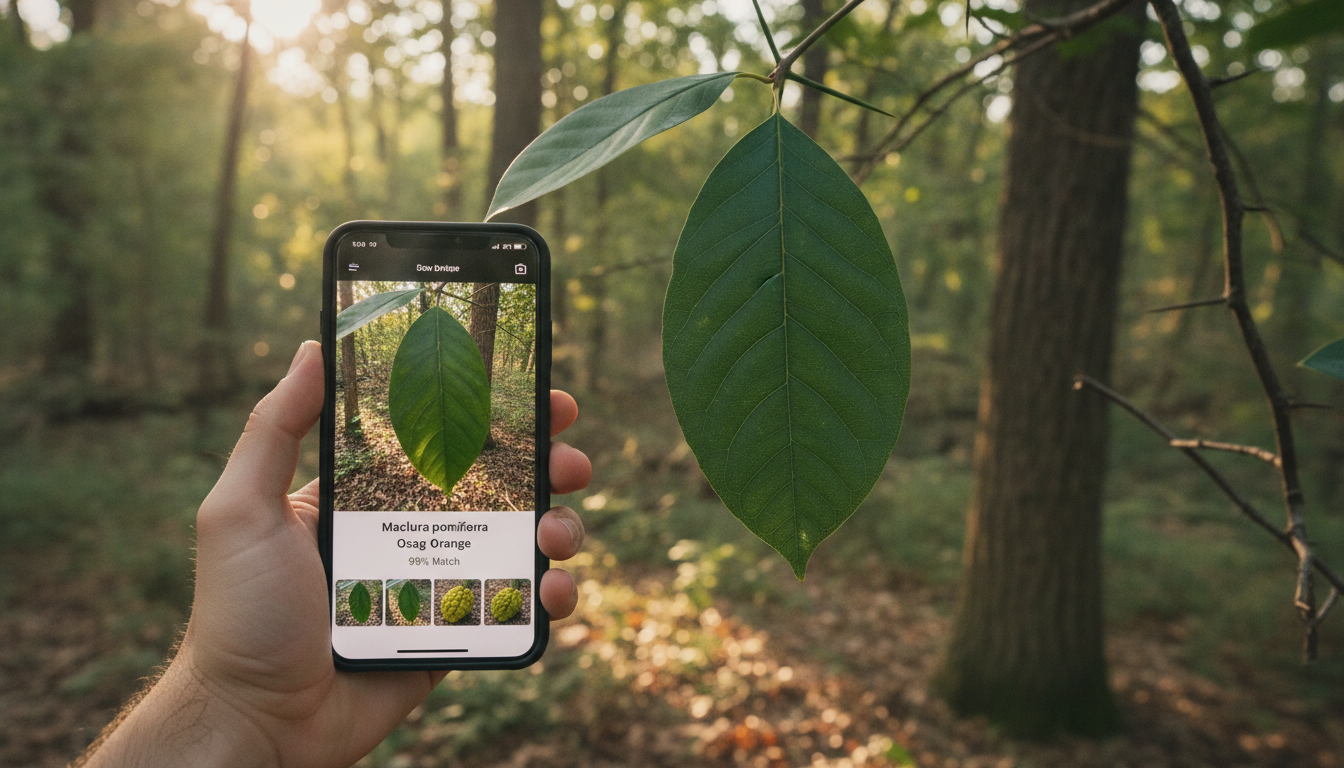
- Shape: Simple, ovate to oblong, with an entire (smooth) margin and a long, pointed tip (acuminate apex).
- Size: Typically 3 to 5 inches (7-13 cm) long and 2 to 3 inches (5-8 cm) wide.
- Color and Texture: They are a vibrant, glossy dark green on the upper surface, lighter green underneath. The texture is thick and firm. In autumn, the leaves turn a clear, bright yellow before falling.
- Sap: Like the fruit, if a leaf or petiole is broken, it will often exude a milky sap, though less profusely than the fruit.
The glossy, deep green leaves provide a lush canopy throughout the growing season, contributing to the tree's dense appearance. For more detailed leaf identification techniques, refer to our guide on how to identify trees by leaf.
3. Bark: Deeply Furrowed and Orange-Brown
The bark of the Osage Orange tree is another distinctive feature, particularly on mature specimens.
- Color: Ranges from light orange-brown to grayish-brown, often with hints of orange in the furrows.
- Texture: On young trees, the bark is relatively smooth, but as the tree matures, it develops deep, irregular furrows and ridges, giving it a ropey or interwoven appearance.
- Pattern: The ridges often crisscross, forming a distinctive diamond or braided pattern.
The rough, deeply furrowed bark provides a rugged appearance, often contrasting with the tree's otherwise vibrant green foliage and fruit.
4. Thorns: Sharp and Abundant
The presence of formidable thorns is a significant characteristic, especially on younger trees and branches.
- Appearance: Sharp, stiff, and straight, typically about 0.5 to 1 inch (1-2.5 cm) long. They are usually found in the axils of the leaves, along the twigs and branches.
- Color: Greenish when young, maturing to a reddish-brown or gray.
- Function: These thorns were a key reason the Osage Orange was so effective as a living fence, deterring livestock and intruders alike.
While some cultivated varieties are thornless, and older trees may have fewer thorns on their main trunk and larger branches, their presence is a strong indicator for Osage Orange identification.
5. Twigs and Branches: Zigzag Growth
Even the twigs offer clues for identification.
- Growth Habit: Twigs often exhibit a somewhat zigzag growth pattern.
- Buds: Small, rounded, and partially sunken into the twig.
- Pith: When a twig is cut lengthwise, the pith (the spongy material in the center) is white and chambered.
- Wood: The wood itself is incredibly hard, dense, and durable. When freshly cut, it has a bright yellow-orange color, which darkens to a rich brown with age and exposure. This distinctive color is why the wood is sometimes used as a natural dye.
6. Overall Form and Size
The general shape and size of the tree can also aid in Osage Orange identification.
- Size: A medium-sized deciduous tree, typically growing 20 to 40 feet (6-12 meters) tall, though some can reach up to 60 feet (18 meters).
- Canopy: Often develops a broad, rounded, spreading crown, especially when grown in open areas. When planted closely in hedgerows, they can form dense, impenetrable thickets.
- Trunk: Usually has a relatively short trunk, often branching low to the ground.
The robust and somewhat unruly growth habit, combined with its distinctive foliage and fruit, makes the Osage Orange a recognizable presence in many landscapes.
Habitat and Range
Understanding where a tree naturally grows can be a valuable part of the identification process. The Osage Orange is native to a small region of North America, specifically the Red River Valley area of Oklahoma, Texas, and Arkansas. However, its usefulness as a hedgerow plant led to its widespread cultivation across the United States, particularly in the Midwest and Great Plains regions. Today, it can be found naturalized in nearly every state east of the Rocky Mountains, thriving in a variety of conditions.
It is remarkably adaptable, tolerating a wide range of soil types, from heavy clays to sandy loams, and is highly resistant to drought, heat, and strong winds. You'll often find it growing along fence lines, in old pastures, abandoned fields, and as street trees or in urban parks. Its resilience makes it a common sight in disturbed areas where other trees might struggle.
Distinguishing Osage Orange from Look-Alikes
While the Osage Orange has many unique characteristics, it's always good to consider potential look-alikes. However, the truth is that very few trees truly resemble the Osage Orange in its entirety. The "hedge apple" fruit is so singular that if present, it immediately confirms the identification.
Without the fruit, some might briefly confuse its glossy, simple leaves with other trees. For instance, the leaves of the Alder tree are also simple and alternately arranged, but their margins are typically serrated or doubly serrated, not entire, and they lack the milky sap or thorns of the Osage Orange. The bark pattern can sometimes be vaguely similar to certain oaks or elms, but the distinct orange tint and ropey texture of the Osage Orange bark usually differentiate it.
The key is to look for a combination of features. If you find a tree with glossy, entire-margined leaves, sharp thorns on its branches, deeply furrowed bark with an orange hue, and especially if you see the characteristic "hedge apples" on the ground or hanging from the branches, you can be confident in your Osage Orange identification. Remember, a single photo of just a leaf or bark might not be enough to confirm identification if other key features are missing. Always try to observe multiple traits.
A Step-by-Step Guide to Osage Orange Identification
To solidify your ability to identify the Osage Orange, follow these steps during your next outdoor excursion:
- Look for the Fruit (Late Summer to Fall): This is your strongest indicator. Search for large, bumpy, lime-green "hedge apples" on the tree or scattered on the ground beneath it. If you find these, your identification is almost complete.
- Examine the Leaves: Observe the leaves. Are they simple, alternately arranged, glossy dark green, and ovate with a pointed tip and smooth (entire) margins? If you break a leaf or petiole, does it exude a milky sap?
- Check for Thorns: Carefully look at the twigs and branches. Are there sharp, stiff thorns present, especially on younger growth?
- Inspect the Bark: Observe the trunk and larger branches. Is the bark deeply furrowed with an interwoven or ropey pattern, often showing an orange-brown or grayish-brown color with orange hints in the furrows?
- Note the Overall Form: Does the tree have a broad, spreading crown, typically growing 20-40 feet tall?
By systematically checking these features, you'll find that Osage Orange identification becomes a quick and accurate process.
Leveraging Technology for Tree Identification
Even with a detailed guide, sometimes you encounter a tree that leaves you puzzled. This is where technology can be an invaluable ally. The Tree Identifier app is designed to put the power of botanical expertise right in your pocket.
Here’s how the Tree Identifier app can enhance your Osage Orange identification efforts:
- Photo Recognition: Simply snap a photo of the Osage Orange's leaves, bark, fruit, or even a full shot of the tree. The app's advanced artificial intelligence will analyze the image and provide potential matches, often with high accuracy. This is particularly helpful if you're unsure about a subtle characteristic or want to confirm your initial thoughts.
- Detailed Information: Once identified, the app offers a wealth of information about the Osage Orange, including its scientific name, common names, detailed descriptions of its features, habitat, and interesting facts. This reinforces your learning and provides context beyond simple identification.
- Learning Tool: Beyond specific osage orange identification, the app serves as a fantastic learning resource. You can explore other species, compare features, and build your overall tree identification skills. It's like having a field guide that updates itself and learns from your input.
- Accessibility: Whether you're in a remote forest or an urban park, as long as you have your smartphone, you have a powerful identification tool at your fingertips. No need to carry heavy field guides or worry about internet connectivity if you've downloaded offline packs.
For those moments when a photo isn't quite enough for a definitive identification, the app can often narrow down possibilities, guiding you to further observations that will clinch the ID. It’s an excellent complement to traditional identification methods, making tree spotting more accessible and enjoyable for everyone.
Beyond Identification: The Legacy of the Osage Orange
The Osage Orange is more than just a tree with peculiar fruit; it's a testament to resilience and utility. Its wood, extremely hard and rot-resistant, has been used for everything from fence posts and railroad ties to tool handles and fine cabinetry. The bright yellow heartwood also yields a natural dye. Its dense, thorny growth made it an ideal windbreak and living fence, shaping the landscape of the American frontier. Even its common name, "Hedge Apple," speaks to its historical role.
Understanding the Osage Orange means appreciating its journey from a limited native range to a widespread presence across North America, thanks to human intervention and its remarkable adaptability. It’s a tree that tells a story of survival, utility, and the intricate relationship between people and the natural world.
Summary of Osage Orange Identification Features
To help you quickly reference the key identification points, here's a concise table summarizing the characteristics of the Osage Orange:
| Feature | Description | Key Differentiator |
|---|---|---|
| Fruit | Large (4-6 in), bumpy, lime-green, spherical "hedge apples" with milky sap. | Unmistakable; no other common tree has similar fruit. |
| Leaves | Simple, alternate, ovate to oblong, glossy dark green, entire (smooth) margin, pointed tip, milky sap when broken. | Glossy, smooth margin, milky sap. |
| Bark | Deeply furrowed, ropey or interwoven pattern, orange-brown to grayish-brown with orange tints. | Distinctive texture and orange hue. |
| Thorns | Sharp, stiff, straight, 0.5-1 inch long, found on twigs and branches (especially young growth). | Prominent and numerous on most specimens. |
| Twigs | Zigzag growth, small sunken buds, chambered pith. | Zigzag pattern, yellow-orange wood when cut. |
| Overall Form | Medium-sized (20-40 ft), broad, rounded, spreading crown. | Robust, often unruly growth. |
Conclusion
The Osage Orange is a truly captivating tree, steeped in history and characterized by a suite of highly distinctive features. With this guide, you now possess the knowledge and tools for confident Osage Orange identification. From its iconic, brain-like "hedge apples" to its thorny branches, glossy leaves, and rugged bark, each characteristic tells a part of its unique story.
Next time you're outdoors, keep an eye out for this remarkable species. The joy of identifying a tree, especially one as unique as the Osage Orange, connects us more deeply with the natural world. And remember, for those times when you need a little extra help or wish to explore further, the Tree Identifier app is your perfect companion. Happy tree spotting!