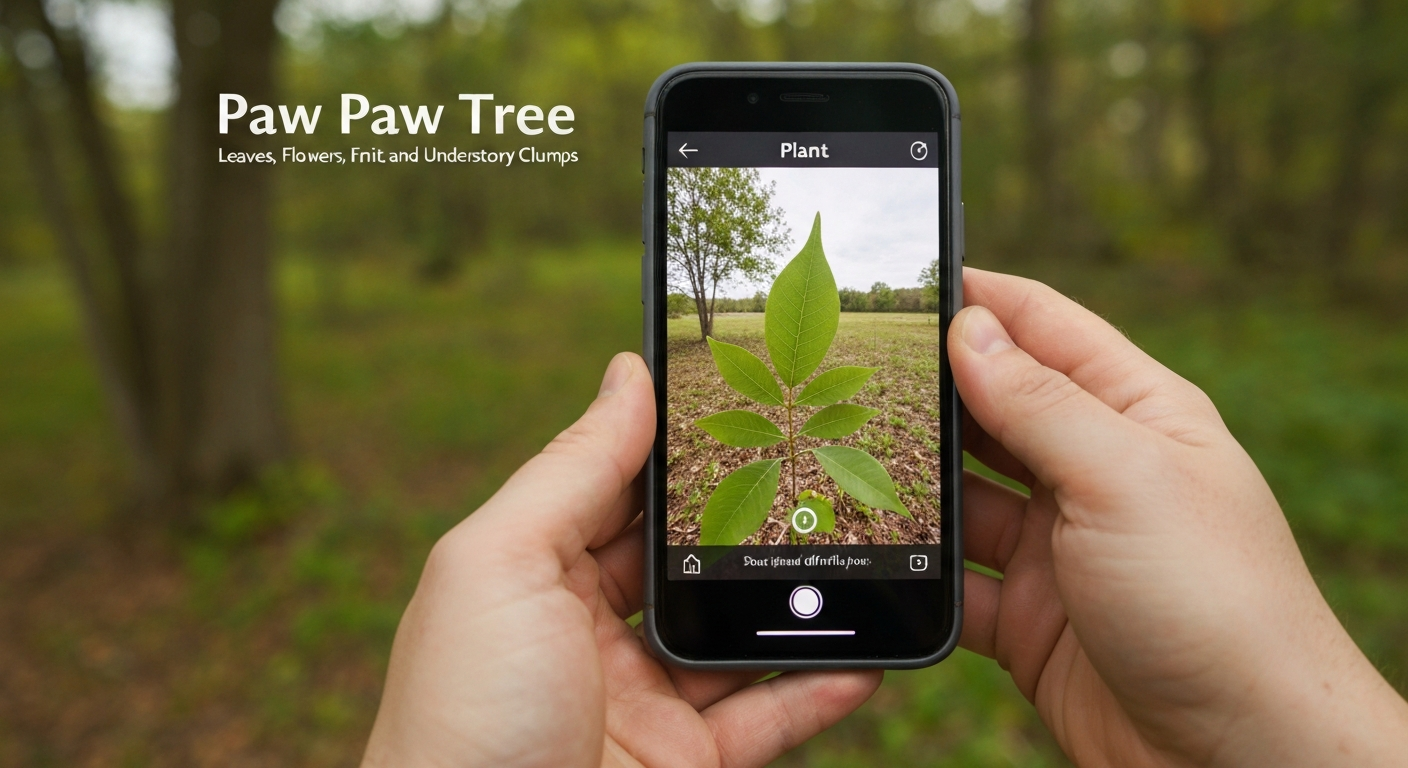
TL;DR: Paw paw tree identification for Asimina triloba focuses on oversized drooping simple leaves with smooth edges, fleshy maroon-brown spring flowers, and green custard fruits that look like small mangoes. Expect clonal understory clumps — many stems from one root system — in rich eastern woods rather than lone sidewalk trees. Photograph a full leaf or fruit cluster and confirm with the Tree Identifier app.
🌿 Paw paw ID trio: tropical-size entire leaves in a shady thicket + maroon fleshy flowers in spring + mango-shaped soft fruit in late summer. No thorns, no compound leaves, no acorns.
Why paw paw tree identification feels tropical
Paw paw is the largest native edible fruit of temperate North America and a member of the tropical custard-apple family (Annonaceae). That ancestry shows: leaves look like they belong in a greenhouse, flowers are meaty maroon bells, and fruit flesh is banana-mango custard. Learning paw paw tree identification means accepting a northern tree with tropical manners.
Scientific name Asimina triloba refers to the three-lobed (three-parted petal) floral design. Common names include pawpaw, Michigan banana, and poor man’s banana. Spelling varies — paw paw, pawpaw, paw-paw — but the plant is one species across most of the East.
Unlike canopy oaks, paw paws live in the filtered light beneath taller trees. If your mystery plant stands alone in blazing sun on a parking strip, reconsider. If it forms a leafy room of huge leaves beside a creek trail, you are in paw paw country.
Leaves — the easiest everyday character
Leaves are alternate, simple, and entire (untoothed). Shape is oblong to obovate — broader toward the tip — tapering to a pointed tip and a wedge base. Length commonly runs 6 to 12 inches; some shade leaves are larger. Leaves droop from slender twigs, creating layered planes of green.
Crushed leaves release a slight green pepper or resinous odor that helpers remember after one field session. Fall color is a clean lemon to butter yellow before drop.
Paw paw tree identification by leaf alone is strong when size, smooth margin, and understory colony habit align. Compare with magnolia (different buds and fruit cones), basswood (toothed margins and cordate bases), and pawpaw lookalikes that lack the drooping tropical feel.
Practice size and margin reading with Identify Trees by Leaf.
Brownish flowers — pollination quirks
Spring flowers are unusual among temperate hardwoods: fleshy, maroon to brownish purple, nodding from leaf axils, roughly 1 to 2 inches wide. Three outer petals cup the center. Fragrance is subtle and sometimes described as yeasty or faintly carrion-like — evolved for flies and beetles.
Paw paws are often self-incompatible. A single clone may flower heavily yet set little fruit without pollen from a genetically different nearby clump. Foragers know to plant more than one genotype; ID hikers should not expect fruit under every flowering colony.
Flowering coincides with early leaf expansion. Photograph flowers against a hand for scale — those maroon bells seal paw paw tree identification instantly when present.
Custard fruit — mangoes of the understory
Fruit develops as a large berry with thin skin and soft pulp. Immature fruits are green; ripe fruits yellow or mottled brown, soft to the touch, fragrant. Shape varies from plump kidney to mango-like oblong, often 3 to 6 inches. Large brown bean-like seeds fill the flesh.
Ripening window is brief — late August through September in many regions. Wildlife and humans compete for drops. Finding a perfume of ripening fruit on a trail is a location pin for the parent clump.
Do not confuse with Osage orange (inedible hedge-apple balls in open sun) or green walnuts. Paw paw fruit is soft and sweet-smelling when ripe, hanging from understory twigs, not bouncing on pasture ground under thorned hedges.
Fruit photos for apps should show whole fruit plus leaf. Scale references help. See Best Photo for Tree ID.
Understory clumps and colony habit
Paw paws sucker aggressively from roots. A “tree” is often a colony of many stems — young pencil sprouts to wrist-thick poles — occupying a patch of forest floor. Heights typically 10 to 25 feet in shade; open-grown planted trees may go taller.
Paw paw tree identification should treat the colony as the unit. Single-stem show trees exist in orchards and yards, but wild form is clumpy. Dead central stems with vigorous flanks are normal.
Bark on young stems is smooth gray-brown with pale lenticels and mottling. Older thin trunks develop slightly scaly or ridged texture but never the deep furrows of oak. Twigs are slender with naked buds (no scales) — a winter anatomy clue shared with some other species but useful with leaf scars.
Winter vocabulary help: Tree Anatomy Glossary.
Habitat and range
Native range spans from the Great Lakes and Mid-Atlantic south through the lower Midwest and into the South, favoring rich, moist, slightly acidic to neutral woods. Floodplain terraces, cove forests, and shaded creek edges are classic. Paw paws dislike permanently flooded swamp soil and hard, sunny clay lawns.
Western and far northern absences are real — check range before forcing an ID. Local natural areas and native plant plantings expand encounters into suburbs.
Context among everyday species: common backyard trees (paw paw is less common as a street tree but increasingly planted by native gardeners).
Lookalikes
Magnolia species: Large leaves possible, but flower structure, fruit cones, and usually different habitat planting context differ. Magnolia buds are often large and fuzzy.
American persimmon: Alternate simple leaves but smaller, different bark (blocky alligator), and tomato-like fruit.
Sassafras: Mitten and ghost-shaped leaves, aromatic roots, different fruit.
Tree-of-heaven seedlings: Compound leaves, not large simple leaves.
When habit + leaf size + entire margin + understory clump align, false positives drop. Stuck? Walk through What Type of Tree Is This?.
Seasonal calendar for field ID
- Late winter: Naked buds on colony stems; no leaves.
- Spring: Maroon flowers with emerging large leaves.
- Summer: Deep shade of oversized foliage; green fruit swelling if pollinated.
- Late summer–early fall: Soft ripe fruit; yellowing foliage soon after.
Paw paw tree identification is easiest with fruit, but summer leaf colonies are reliable once you learn the tropical size and droop.
Using Tree Identifier
Tree Identifier recognizes paw paw from large entire leaves, maroon flowers, and custard fruit. For colony patches, photograph one clear leaf filling the frame and a second shot showing multiple stems to capture habitat habit.
Capture tips:
- Include a hand or notebook edge for leaf scale.
- Shoot flowers in soft light so maroon color does not crush to black.
- Photograph fruit with at least one attached leaf.
- Avoid only distant canopy snaps that hide leaf margins.
Pair app results with pollination knowledge: flowering colonies without fruit are still paw paws. App confidence should not depend solely on mango-shaped fruit being present.
More app workflow help: App to Identify Trees.
Paw paw tree identification rewards slow forest walks — when the canopy is maple and oak overhead, the strange tropical understory leaves and occasional custard fruit mark one of eastern North America’s most memorable native trees.
Frequently asked questions
How do you identify a paw paw tree?
Paw paw tree identification uses large simple alternate leaves that look tropical — often 6 to 12 inches long, oblong with smooth edges, drooping from thin twigs — plus brownish-maroon bell flowers in spring and green to yellow mango-shaped fruits in late summer. Trees usually grow as understory clumps from root suckers rather than lone canopy giants. Crushed leaves smell slightly peppery. Bark is smoothish gray-brown with pale blotches on younger stems.
What do paw paw leaves look like?
Leaves are simple, alternate, and entire (no teeth), with a long oval to obovate shape that narrows toward the base. They hang gracefully and create a layered understory look unlike oak or maple. Size is unusually large for northern hardwoods — a key paw paw tree identification trait. Fall color is often clear yellow.
What does a paw paw flower look like?
Flowers are fleshy, maroon to brownish purple, about 1 to 2 inches across, with three outer petals — unusual among temperate trees. They appear with or just after early leaves in spring and smell faintly fermented to attract flies and beetles rather than bees. Many blossoms never set fruit without cross-pollination.
What does paw paw fruit look like?
Fruit is a large berry — green, then yellowish or brown-blushed when ripe — resembling a small mango or potato in shape, often 3 to 6 inches. Soft custard flesh surrounds large brown seeds. Ripening is late summer into early fall. Finding fallen fruit under an understory clump confirms paw paw tree identification fast.
Where do paw paw trees grow?
Asimina triloba is native across much of the eastern United States in rich moist woods, floodplain edges, and shaded ravines. It forms clonal patches. You rarely find it as a lonely sidewalk ornamental unless planted. Look in forest understories more than sunny lawns.
Are paw paws trees or shrubs?
Both in feel. Mature stems can reach 15 to 30 feet as small trees, but colony suckering creates shrub-like thickets of many trunks. Paw paw tree identification should expect a patch of stems of mixed ages sharing a root system.
Can a tree ID app identify paw paw?
Yes from large entire leaves or distinctive maroon flowers and fruit. Leaf-only photos work when size and smooth margins are clear. Tree Identifier recognizes Asimina well in eastern forest photos; include fruit when available for highest confidence.
Try Tree Identifier — free on iPhone
Photograph paw paw leaves, maroon flowers, or custard fruit and get a match in seconds.
Download on the App Store