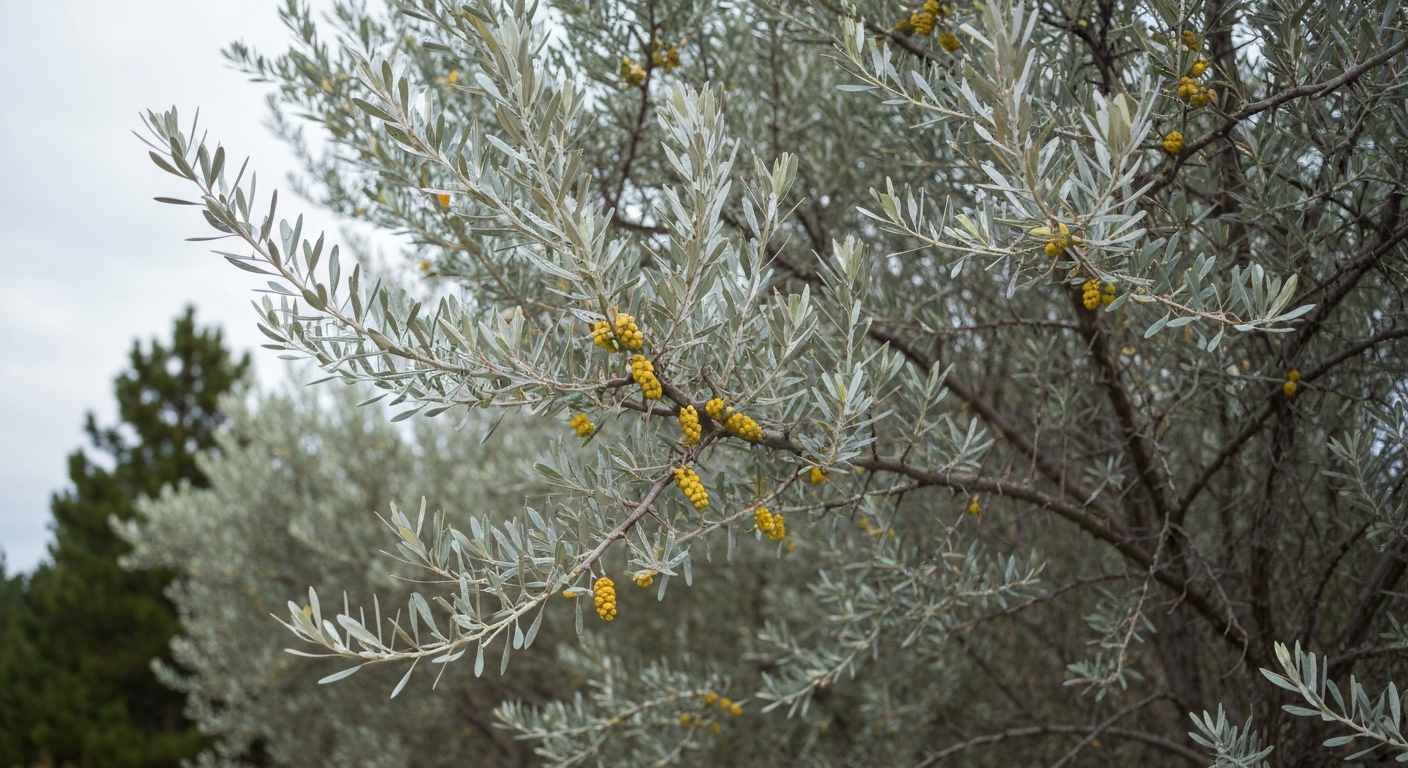
TL;DR: Russian olive identification (Elaeagnus angustifolia) rests on narrow silvery-scaled leaves, often thorny branches, fragrant yellow spring flowers, and olive-shaped silvery-yellow fruit. It grows as a shrub or small tree along rivers and disturbed ground across the western and central US — invasive in many states. Do not confuse with autumn olive (E. umbellata), which has wider oval leaves and red speckled fruit in the East. Photograph silvery leaf undersides and confirm with the Tree Identifier app.
🫒 Russian olive identification shortcut: Narrow silvery leaves + river corridor + optional thorns = Elaeagnus angustifolia. Autumn olive has wider leaves and red fruit.
Understanding russian olive — genus and origin
Russian olive is Elaeagnus angustifolia, in family Elaeagnaceae — same family as autumn olive, sea buckthorn, and silverberry. Native to southern Europe and central Asia, it was planted widely in North America for windbreaks, erosion control, and ornament from the late 1800s through mid-1900s. It escaped cultivation and now ranks among the most disruptive riparian invaders in the Intermountain West and Great Plains.
Despite the name, russian olive is not a true olive (Olea). The name reflects olive-shaped fruit. Russian olive identification matters for restoration volunteers, ranchers, and hikers who encounter silver-leaved thickets along rivers from Montana to New Mexico and east to the Dakotas and Texas.
Genus-level traits for Elaeagnus:
- Leaves: Simple, alternate, covered in silvery or coppery peltate scales on at least the underside.
- Flowers: Small, fragrant, yellow or silvery, tubular, hidden among leaves in spring.
- Fruit: Drupes with sweet mealy flesh; birds disperse seeds.
- Nitrogen fixation: Root nodules with actinorhizal bacteria — helps invade poor soils.
- Habitat: Disturbed, dry to moist — russian olive especially favors riverbanks and floodplains.
Russian olive leaf identification
Russian olive leaf identification is the fastest field skill. Leaves are narrow and lance-shaped — noticeably longer than wide, unlike the oval leaves of autumn olive.
Size and shape: 1 to 3 inches long, ¼ to ⅝ inch wide. Entire margin — no teeth or lobes. Tip pointed; base tapered to short petiole.
Color and scales: Upper surface dull green to gray-green, sometimes with scattered scales. Lower surface densely silvery or bronze from overlapping scales — the hallmark of russian olive identification. Wind flips leaves and produces a silver flash along a thicket edge.
Arrangement: Alternate on twigs, not opposite. Leaves cluster somewhat on short shoots.
Compare with willow leaves (no scales, usually greener below) and buffaloberry (wider leaves, different venation). Silver foliage on a western riverbank strongly points to Elaeagnus angustifolia.
Thorns, bark, and growth form
Thorns: Russian olive often develops stout thorns 1 to 2 inches on older branches and suckers. Thorn presence varies — some trees are nearly thornless, others vicious. When present, thorns plus silvery narrow leaves confirm russian olive identification over unscented silver buffaloberry.
Bark: Mature trunks show shreddy, somewhat fissured gray to reddish-brown bark. Multi-stemmed shrub form is common; trained specimens develop a single trunk to 30 feet.
Form: Open, irregular crown; branches arch. Colonizes as dense thickets from root suckers and seedlings. Along the Missouri, Yellowstone, Rio Grande, and Colorado river systems, russian olive lines banks in monoculture bands.
Winter: Silvery twigs retain scale texture. Buds are small and silvery. Persistent fruit may hang into winter — yellow-brown drupes on bare branches aid winter russian olive identification.
Flowers and fruit
Flowers: Appear May to June — small, bell-shaped, silvery-yellow outside, yellow inside, intensely fragrant (some describe banana or clove scent). Flowers nestle in leaf axils, easy to overlook unless you smell them first.
Fruit: Olive-shaped drupes ripen August through October — silvery-yellow, becoming brown. Mealy yellow flesh surrounds one pit. Fruit is edible but not prized; birds are the main dispersers.
Fruit shape and color separate russian olive from autumn olive's round red speckled drupes. Russian olive fruit looks like a small dusty olive; autumn olive fruit looks like a pink-red berry with silver dots.
Russian olive vs autumn olive
Both species share silvery scaled leaves and invasive reputations — but russian olive identification vs autumn olive uses several reliable splits:
| Feature | Russian olive (E. angustifolia) | Autumn olive (E. umbellata) |
|---|---|---|
| Leaf shape | Narrow, lance-shaped | Oval to elliptic, wider |
| Leaf size | 1–3 in × ¼–⅝ in | 2–3 in × 1–1½ in |
| Fruit color | Silvery-yellow to brown | Red with silver speckles |
| Growth form | Small tree to 30 ft common | Shrub to 20 ft |
| Thorns | Often prominent | Less common |
| Primary US range | Western and central rivers | Eastern and midwestern fields |
Autumn olive colonizes old pastures and woodland edges in Pennsylvania, Virginia, and Missouri. Russian olive dominates western riparian zones. Where ranges overlap in the central US, leaf shape and fruit color resolve ID.
Invasive ecology and why ID matters
Russian olive alters ecosystems it invades. Nitrogen fixation enriches poor riparian soils — favoring more russian olive and other exotics over native cottonwood, willow, and box elder regeneration. Dense shade and root competition suppress understory natives. Bird-dispersed seed establishes new patches downstream after floods.
Many states classify russian olive as noxious or recommend eradication on public lands. Correct russian olive identification helps:
- Restoration crews prioritize cut-and-treat vs native silverberry.
- Ranchers distinguish invasive thicket from manageable native shrubs.
- Trail users recognize thorny silvery brush along kayak put-ins.
Identification is step one; management follows local extension guidance — cutting, herbicide on stumps, or biocontrol research in some regions.
Lookalikes and confusion species
Silver buffaloberry (Shepherdia argentea)
Native western shrub with silvery leaves — wider and more oval than russian olive. Red or orange fruit, not olive-shaped yellow. Often grows on same riverbanks; native status makes distinction ecologically important.
Willows (Salix species)
Riverbank willows have narrow leaves but no silvery scales — green below, usually flexible twigs without long thorns. Leaves often toothed or with prominent stipules.
Autumn olive (Elaeagnus umbellata)
Discussed above — wider leaves, red fruit, eastern bias.
True olives (Olea europaea)
Cultivated in warm climates — opposite leaves, no silvery scales, leathery dark green foliage. Not riparian in the Rockies.
Seasonal russian olive identification guide
- Spring: Fragrant yellow flowers in leaf axils; new leaves silvery as scales develop.
- Summer: Full silver leaf flash; thorny twigs visible on thicket edges.
- Fall: Yellow-brown fruit ripe; leaves may yellow before dropping.
- Winter: Scaly silvery twigs; persistent fruit; opposite of green willow stems nearby.
For general foliage photography tips, see Tree Foliage Identification Guide. For bark on thorny riparian shrubs, Tree Bark Identification App Guide covers texture documentation.
Using Tree Identifier for russian olive
Tree Identifier recognizes Elaeagnus angustifolia from leaf, fruit, and whole-shrub photos across its North American range.
Best photos: One leaf showing silvery scaled underside in sun. Thorny twig with leaves attached. Fruit cluster in late summer.
Context helps: Note river corridor habitat in your mental checklist — apps may suggest related Elaeagnus species; fruit color splits autumn vs russian olive.
Russian olive identification is a conservation skill in the West — recognize the silver flash, confirm narrow leaves and olive fruit, and you'll know when you're looking at one of the most persistent riparian invaders on the continent.
Frequently asked questions
How do you identify russian olive?
Identify russian olive (Elaeagnus angustifolia) by narrow lance-shaped leaves 1 to 3 inches long with silvery or scaly undersides, often thorny twigs, and small yellow fragrant flowers in spring. Fruit is olive-shaped, silvery-yellow to brown, mealy inside. Grows as a shrub or small tree to 30 feet along rivers and disturbed sites in the western and central US. Silvery foliage in wind is a field signature.
What do russian olive leaves look like?
Russian olive leaves are simple, alternate, narrow and lance-shaped with entire margins — no teeth. Upper surface is dull green to gray-green; underside is densely covered in silvery or coppery scales that shimmer in sunlight. Leaves are 1 to 3 inches long, much longer than wide. Russian olive identification in summer is often possible from silver leaf flash alone.
Is russian olive invasive?
Yes. Russian olive is listed as invasive or noxious in many western US states. It spreads along riparian corridors, outcompetes native cottonwoods and willows, and fixes nitrogen via root symbiosis — altering soil chemistry. Birds disperse seeds. Once established, russian olive forms dense thickets difficult to remove. Identification helps landowners and volunteers target control.
What is the difference between russian olive and autumn olive?
Russian olive (Elaeagnus angustifolia) is a tree or large shrub with narrow silvery leaves, often thorny, and olive-shaped yellow fruit. Autumn olive (Elaeagnus umbellata) is a shrub with oval leaves — wider and rounder — red speckled fruit, and fewer prominent thorns. Russian olive dominates western riverbanks; autumn olive is more common in eastern US old fields. Both have silvery scaled leaves.
Does russian olive have thorns?
Often yes. Russian olive twigs frequently bear sharp thorns 1 to 2 inches long, especially on older wood and suckering shoots — though thorniness varies by plant and age. Young saplings may appear less thorny. Thorny silvery-leaved riverbank trees in Montana, Colorado, or New Mexico are strong russian olive identification candidates.
What does russian olive fruit look like?
Russian olive fruit is a small drupe, olive-shaped, ½ to ¾ inch long, silvery-yellow maturing to brown. Surface is covered in silvery scales like the leaves. Fruit is mealy and sweet when ripe in late summer and fall. Birds eat fruit and spread seeds — a key reason russian olive colonizes new river miles.
Can tree ID apps identify russian olive?
Yes, when photos show silvery narrow leaves, thorny twig, or distinctive fruit. Apps work best on clear leaf undersides showing scales. Russian olive can resemble silver buffaloberry or willow from a distance — close leaf and fruit photos improve accuracy. Tree Identifier handles Elaeagnus angustifolia across its invasive range.
Try Tree Identifier — free on iPhone
Photograph silvery russian olive leaves or fruit and get a species match in seconds.
Download on the App Store