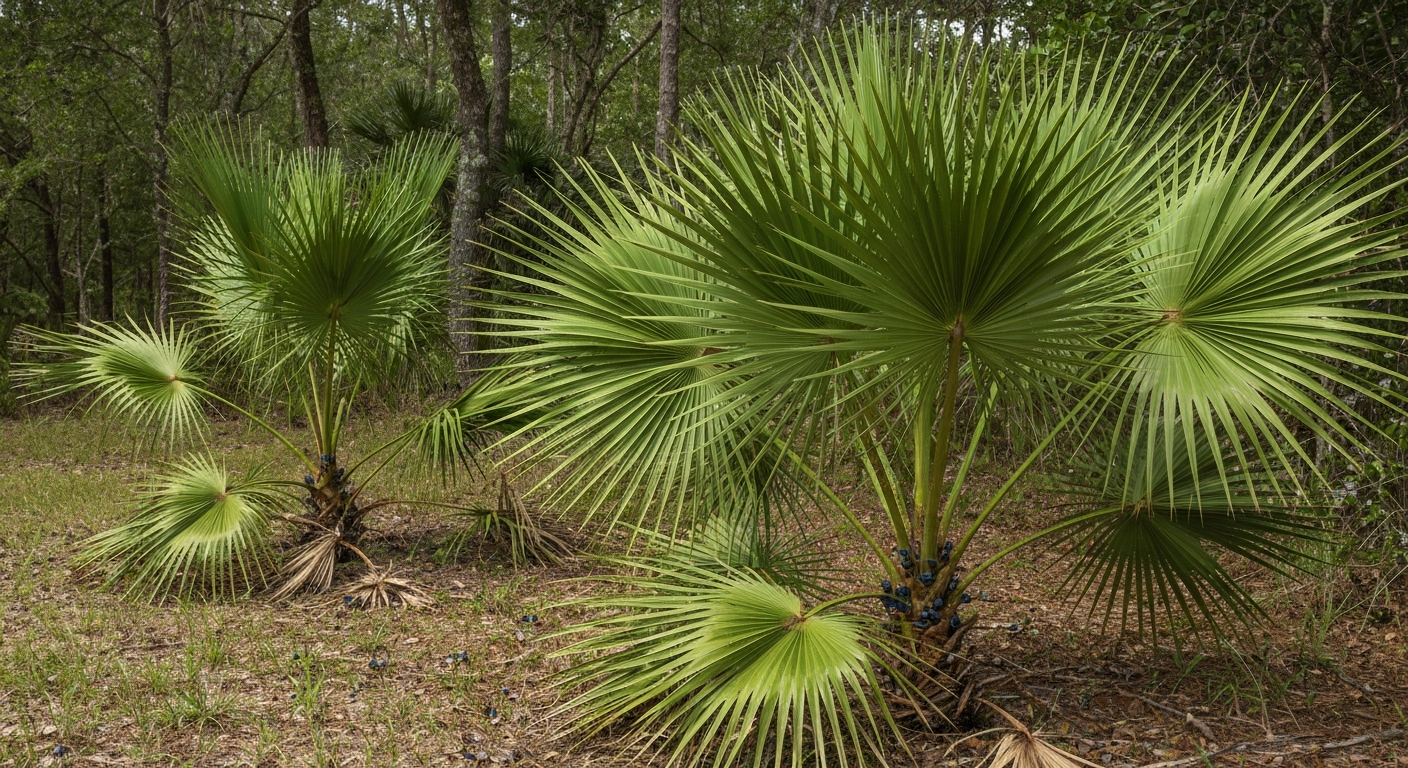
TL;DR: Saw palmetto identification (Serenoa repens) rests on low fan-palm shrubs with circular palmate fronds on petioles edged with saw-like teeth, a creeping subterranean or ground-level trunk, and blue-black berries in fall. It dominates southeastern pine flatwoods and scrub — not to be confused with tall cabbage palm (Sabal palmetto). Photograph a frond and serrated petiole, then confirm with the Tree Identifier app.
🪚 Saw palmetto identification: Waist-high fan palm + saw teeth on petiole + creeping trunk = Serenoa repens. Tall smooth-trunk fan palm = cabbage palm.
Understanding saw palmetto — Serenoa repens
Saw palmetto is Serenoa repens, the only species in genus Serenoa, in palm family Arecaceae. It is a native fan palm of the southeastern US coastal plain — not a tree in the usual sense but a woody shrub or subshrub with a creeping stem and crown of fan fronds at ground to head height.
Saw palmetto covers an estimated millions of acres in Florida alone — the characteristic green understory of longleaf and slash pine flatwoods, oak scrub, and coastal dunes. Hikers, land managers, and herbal industry workers all need reliable saw palmetto identification. The plant is ecologically central — food for bears and turkeys, cover for gopher tortoises, and fire-adapted ground cover that resprouts after prescribed burns.
Key genus traits:
- Fronds: Fan-shaped (palmate), costapalmate — leaf blade tissue extends into the petiole midrib.
- Petiole: Long, stiff, armed with sharp teeth along margins — the saw.
- Trunk: Procumbent — grows horizontally, often buried in sand or pine needles.
- Height: Frond tips typically 3 to 7 feet above ground; rarely taller on old stems.
- Fruit: Blue-black drupes on arching panicles, ripe fall.
Saw palmetto frond identification
Fan fronds are 2 to 3 feet wide, nearly circular, deeply divided into 15 to 30 stiff segments (leaflets or folds). Color ranges from yellow-green on dry sites to blue-green or silvery in open sun. Fronds are stiff enough to rattle in wind — a sound signature of pine flatwoods.
Costapalmate architecture: Unlike some fan palms where leaf tissue stops abruptly at the petiole tip, saw palmetto has a midrib that continues into the petiole with leaf tissue along it — costapalmate leaves. This is technical but confirms fan palm identity within Arecaceae.
Frond persistence: Dead brown fronds often hang downward forming a skirt around the stem — like a miniature palm tree skirt at ground level. Fire burns off dead fronds; green crown resprouts quickly.
From a distance, saw palmetto identification is simply waist-high green fans under pines. Up close, petiole teeth confirm.
The saw-toothed petiole — namesake feature
The petiole connects frond to stem — 2 to 6 feet long on mature plants, curved. Both edges bear stiff, sharp, forward-pointing teeth or spines. Running a finger along the edge causes cuts — wear gloves when handling.
Petiole cross-section is roughly half-moon with teeth on the flat edges. Teeth are persistent on old petioles even after frond blade dies — brown woody stems on forest floor still bite.
Vs cabbage palm petiole: Sabal palmetto petioles are smooth — no saw teeth — and split into two halves when dead (costapalmate Sabal has a different petiole fiber pattern). Cabbage palm petioles are also massively longer on tall trees. Saw palmetto petiole teeth are the fastest field split between the two common Florida fan palms.
Trunk, stems, and growth form
Saw palmetto does not produce an upright trunk like a landscape palm tree. Instead, a creeping rhizome-like stem runs along or below ground, occasionally forking. Aerial stems are short — you look down into the crown, not up a tall column.
Plants branch and form impenetrable thickets — critical wildlife cover but difficult for surveyors to walk through. Individual clones may be centuries old — stems grow slowly outward while center sections die.
Height variation: On fertile moist sites, saw palmetto can reach 10 feet frond tip height on elevated stems — still shrubby. On dry scrub, plants stay knee-high and silvery.
Flowers and berries
Inflorescence: Creamy white fragrant flowers on branched panicles among or below fronds, spring to summer. Flowers are tiny, beetle-pollinated.
Fruit: Oval drupes ripen blue-black September to November, about ½ inch, on arching stalks held within or below the frond crown. Bears and wildlife gorge on fruit — scat full of seeds disperses plants.
Berries are the basis for commercial saw palmetto extract (prostate health supplements) — a billion-dollar industry harvesting wild berries, mostly in Florida. Saw palmetto identification for harvesters must distinguish Serenoa from other palms — only this species has the herbal market profile and saw petiole combo.
Habitat and range
Native range: coastal plain from southeastern South Carolina through Florida, west along Gulf Coast to eastern Texas and southern Arkansas.
Pine flatwoods: Dominant ground cover under longleaf pine (Pinus palustris) and slash pine — open savanna with grass and palmetto.
Scrub and sand hills: Shorter, grayer plants on xeric white sand.
Coastal dunes and maritime forest: Salt-tolerant clones behind dunes.
Fire ecology: Saw palmetto survives fire via protected bud at ground level; dead fronds burn hot but plant resprouts. Frequent fire maintains pine flatwoods structure; without fire, saw palmetto and shrubs thicken into dense midstory.
Saw palmetto vs lookalike palms
Cabbage palm (Sabal palmetto)
Tall tree palm with smooth petioles, above-ground trunk, same fan frond type. Young cabbage palms without trunk can confuse — check petiole teeth (absent on Sabal) and whether stem creeps at ground level.
Dwarf palmetto (Sabal minor)
Another low fan palm — trunk truly subterranean like saw palmetto. Petioles smooth without saw teeth. Range overlaps inland. Dwarf palmetto fronds are often smaller; no blue-black Serenoa berry industry association.
Blue palmetto / scrub palmetto (Sabal etonia, Sabal miamiensis)
Florida scrub endemics — small Sabal species, smooth petioles, rare. Saw palmetto is far more abundant.
European fan palm or other exotics
Landscape plantings in Florida cities — not wild in flatwoods. Cultivated palms lack saw petiole and wild thicket context.
For broader fan vs feather palm context, see palm tree identification principles in related guides. Saw palmetto is definitively a fan palm shrub.
Ecological and cultural importance
Beyond saw palmetto identification for field botany, the species shapes ecosystems:
- Gopher tortoise and snake habitat: Thickets provide shade and burrow adjacency.
- Black bear diet: Fall berries are calorie-rich before winter.
- Prescribed fire: Managers map palmetto coverage when planning burn intensity.
- Herbal harvest: Wild berry raking employs seasonal workers across rural Florida.
Indigenous peoples used berries and fronds historically. Modern ID supports ethical foraging only where legal and sustainable.
Photographing saw palmetto for identification
Best shots: One fan frond from above showing circular shape. Close-up of petiole edge with visible saw teeth. Habitat shot with pines in background for context.
Safety: Do not grab petioles bare-handed for photos — use a stick to lift frond or wear leather gloves.
Weak shots: Distant thicket with no petiole detail — could be any fan palm. Photograph teeth.
See Best Photo for Tree ID for lighting tips. For frond terminology, Tree Anatomy Glossary defines petiole and palmate.
Using Tree Identifier for saw palmetto
Tree Identifier recognizes Serenoa repens from fan frond and whole-plant photos in the Southeast.
Workflow: Photograph frond flat on sand if possible — fan shape clear. Add petiole tooth close-up. App may suggest other fan palms; petiole serration and low form confirm saw palmetto identification over Sabal.
Regional expectation: In Florida pine woods, default fan palm at waist height is saw palmetto until proven otherwise.
Saw palmetto is the palm you walk past a thousand times on Gulf Coast trails — learning the saw petiole and creeping stem turns green background into a named species.
Frequently asked questions
How do you identify saw palmetto?
Identify saw palmetto (Serenoa repens) by low fan-palm shrubs with circular palmate fronds on long petioles edged with sharp saw-like teeth — the saw palmetto name. Trunk creeps horizontally underground or along ground, rarely rising above 3 to 7 feet. Habitat is pine flatwoods, scrub, and coastal dunes of the Southeast. Blue-black berries on long stalks in fall confirm ID.
What does saw palmetto look like?
Saw palmetto looks like a sprawling fan palm shrub — rosettes of stiff green to silvery fan fronds 2 to 3 feet wide on petioles 2 to 6 feet long with serrated edges. Multiple stems emerge from a creeping trunk hidden in leaf litter. Plants form impenetrable thickets. Fronds are costapalmate — leaf tissue extends into the petiole. Overall silhouette is waist-high green fans in open pine woods.
What is the difference between saw palmetto and cabbage palm?
Saw palmetto (Serenoa repens) stays low — shrub height with creeping trunk and saw-toothed petioles. Cabbage palm (Sabal palmetto) grows tall with smooth petioles without saw teeth and develops an above-ground trunk to 50 feet or more. Both have fan fronds, but cabbage palm is a tree; saw palmetto is a ground-hugging thicket palm. Habitat overlaps in Florida but growth form differs dramatically.
Why is it called saw palmetto?
The petiole — the stem connecting frond to trunk — has stiff sharp teeth or spines along both edges like a saw blade. Handling fronds without gloves causes cuts. The palmetto name groups small fan palms of the Southeast. Serenoa repens is the scientific name; saw palmetto identification often starts when someone feels the serrated petiole.
Where does saw palmetto grow?
Saw palmetto is native to the coastal plain from South Carolina through Florida and along the Gulf Coast to Louisiana and Texas. It dominates pine flatwoods, oak scrub, sand hills, and coastal maritime hammocks. Tolerates fire and drought. Saw palmetto thickets cover millions of acres in Florida — often the default understory palm.
What are saw palmetto berries used for?
Ripe blue-black berries were food for Native peoples and wildlife. Modern herbal supplements use berry extract for prostate health — a major commercial harvest in Florida. Berry clusters on long arching stalks appear September to November. Saw palmetto identification for foraging requires positive ID and knowledge of protected land rules.
Can tree ID apps identify saw palmetto?
Yes, when photos show fan frond architecture and ideally serrated petiole edges. Apps handle Serenoa repens well across the Southeast. Low shrub form and thicket context help distinguish from tall Sabal cabbage palms in the same region. Photograph frond and petiole base for best saw palmetto identification results.
Try Tree Identifier — free on iPhone
Photograph saw palmetto fronds or petioles and get a species match in seconds.
Download on the App Store