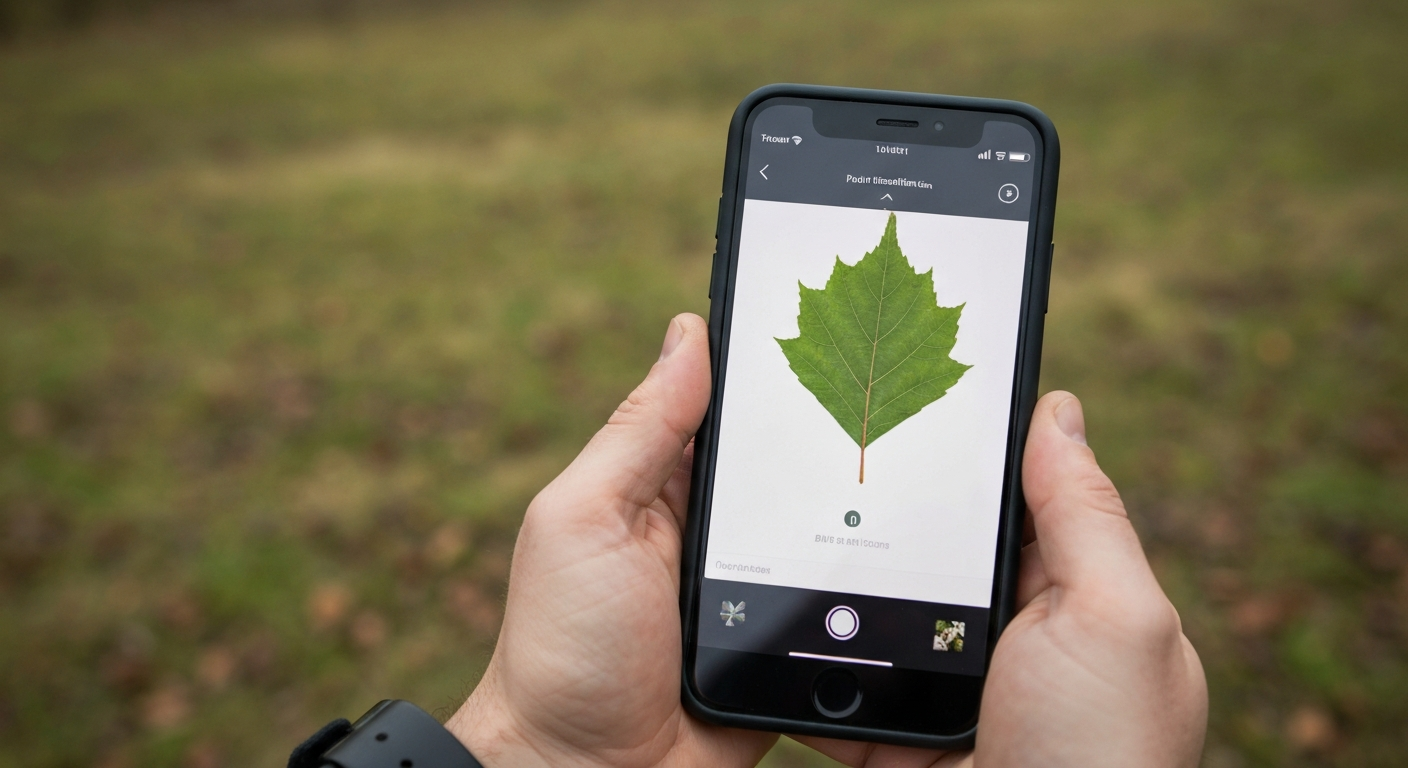
TL;DR: Tree stump identification is detective work — the canopy is gone but bark on the stump skirt, growth rings on a fresh cut face, leaf litter and seeds under the drip line, and nearby living trees still tell the story. Growth rings estimate age and growth rate; they rarely name the species alone. Bark texture at the stump base — shaggy, furrowed, papery, or blocky — is often your best clue. Collect leaves and fruit from the ground, compare neighbors in the row or woodlot, and photograph bark plus litter for the Tree Identifier app. Combine clues; no single stump feature is enough.
🪵 Tree stump identification rule: bark + litter + context beats staring at rings alone. Walk the drip line before you declare the stump unknowable.
Why tree stump identification matters
Homeowners face stumps after storm damage, arborist removals, and lot clearing. Foresters read stumps to verify harvest species and age. Ecologists track what stood in a plot before regeneration. Hunters and hikers find old cut lines in woods where every trunk is gone except rot-resistant stumps.
People search tree stump identification hoping growth rings spell out oak vs maple like a label. Rings help with age and wood type — hardwood vs conifer — but species ID from rings alone fails for most beginners. The practical approach stacks multiple partial clues until one species fits all of them.
Your field kit for tree stump identification:
- Bark on stump skirt and roots: Often persists decades below the cut.
- Cut face growth rings: Age, growth rate, hardwood vs softwood.
- Leaf litter and fruit: Leaves, acorns, nuts, cones, samaras within drip line.
- Nearby living trees: Planted rows and uniform woodlots repeat species.
- Stump size and setting: Yard vs swamp vs plantation narrows candidates.
- Tree ID app: Bark and litter photos when human memory fails.
Accept probabilistic IDs — "very likely red oak" beats forcing a wrong species name from one fuzzy ring photo.
Bark pattern on the stump
Chainsaws cut through bark at the top, but the stump skirt — bark wrapping the base and root flare — often outlasts the cut surface. Tree stump identification should start here, kneeling at ground level with your phone.
Shaggy peeling plates: Shagbark hickory, some birch species, mature cedar — long vertical curls. Hickory shag is hard to confuse; birch is papery white peeling.
Deep dark furrows: Black walnut, mature pine, some loblolly — rugged vertical ridges. Walnut furrows are nearly black; pine plates may show orange undertones.
Blocky ridges: Oak group hallmark — ash-gray ridges separated by darker furrows, like camouflage blocks. White oak vs red oak bark differs in ridge depth and flake texture but both read "oak" on stumps.
Smooth gray: American beech, young maple, some aspens — tight smooth bark with horizontal lenticels ( corky lines ) on cherry and birch family.
Scaly or plated: Sycamore flakes to reveal cream and green inner bark; pine and spruce on old stumps show resinous plates.
Photograph bark at chest-to-ground height on the stump, not the rotted cut top. Include a scale object — coin, keys, hand — so plate size is visible. See Tree Bark Identification App Guide for bark photo technique.
Reading growth rings on a cut stump
Growth rings are concentric bands of xylem laid down each growing season in temperate climates. Tree stump identification uses rings for context more than species naming.
What rings tell you
Age estimate: Count rings from the central pith to the outermost complete ring beneath the bark. That number approximates years lived if each ring equals one year — true for most US temperate hardwoods and conifers.
Growth history: Wide rings = good years with moisture and light. Narrow rings = drought, competition, injury, or shade. A sudden decade of wide rings after narrow ones may mean the tree escaped forest shade when neighbors were cut — common in woodlot stumps.
Hardwood vs softwood: Ring porous hardwoods ( oak, ash, elm ) show large earlywood pores in the lighter spring band. Diffuse-porous hardwoods ( maple, birch, beech ) look more uniform. Conifer rings are relatively uniform with resin canals visible under magnification.
Reaction wood: Eccentric rings — wider on one side — mean the tree leaned or faced persistent wind. Does not name species but explains asymmetry on the cut face.
What rings cannot reliably tell you
Oak and ash ring patterns look similar to naked eyes. Maple and birch both diffuse-porous. Pine, spruce, and fir stump faces overlap without resin smell or bark. Tree stump identification from rings alone plateaus quickly — use rings for age storytelling at the campfire, not courtroom species proof.
Fresh cuts photograph best — weathered gray stump tops blur ring boundaries. Brush sawdust off one quadrant and shoot perpendicular to the face in shade — no glare.
Leaf litter and ground clues
The drip line around a stump is a crime scene. Leaves, fruit, and twigs often belong to the removed tree, especially if the cut is recent.
Leaves: Collect the most intact examples. Oak leaves may persist brown all winter — a fresh cut oak stump often sits in oak leaf litter. Maple leaves decompose fast but appear in autumn cuts. Pine needles carpet conifer stumps for years.
Fruit and seeds: Acorn caps = oak. Hickory husks split in four = hickory. Spiny chestnut burrs = chestnut. Maple samaras helicopter in pairs. Walnut husks stain black. Cones — pine vs spruce vs fir — narrow conifer stumps fast.
Twigs: Opposite vs alternate bud arrangement on fallen twigs under the stump. Maple, ash, and dogwood opposite; oak and hickory alternate.
Root suckers: Some species regenerate from roots — black locust, sumac, aspen, apple. Sprouts emerging from the stump edge carry identifiable leaves weeks after the cut. Tree stump identification gets easy when the tree tries to grow back.
Sweep one square meter around the stump before you leave — litter beats rings for species in most backyard scenarios.
Nearby trees as context
Tree stump identification in managed landscapes is often trivial because species repeat.
Street and yard rows: If every remaining tree is Norway maple and the stump bark is smooth gray with opposite twigs on the ground, the stump is Norway maple. Suburban stumps match the five common yard species — maple, oak, pine, Bradford pear, crepe myrtle.
Plantation and harvest blocks: Loblolly pine plantations leave uniform pine stumps — ring texture, resin smell, and pine straw confirm. Oak-hickory selective cuts leave mixed stumps but harvest tags and neighbor species hint at what was taken.
Natural forest: Harder — diversity is real. Still, dominant species in the stand skew probability. A 30-inch stump in a beech-maple forest with beech leaf litter and smooth gray bark is probably American beech, not random hickory.
Historical photos and neighbors: Ask the homeowner, check Google Street View history, or match a stump to the mirror tree across the driveway. Context is honest tree stump identification, not cheating.
Stump age, decay, and when clues disappear
Fresh stumps ( under two years ): cut face crisp, bark on skirt intact, leaf litter matches, sometimes root suckers. Best window for ring counts and combined clues.
Intermediate ( two to ten years ): cut face checks and cracks, bark may slough at top of skirt, litter mixed with weed species. Bark at the base still helps; rings need wire brushing.
Old ( ten plus years ): stump hollows, bark gone, top sunk below grade. Tree stump identification shifts to litter archaeology, root sucker leaves, and neighbor context. Mushrooms on stump hint at wood type — shelf fungi on hardwoods, not species names.
Conifer stumps resist decay longer than tulip poplar or birch — a rotten stump that still smells like pine pitch is telling you something even when rings are gone.
Hardwood vs conifer stump splits
Before species, split wood type — it frames every other clue.
Conifer stumps: Pine needles or scales underfoot, resin on bark, cones nearby, uniform ring face, often tall straight stump in plantation. Needle litter persists years.
Hardwood stumps: Broadleaf litter, acorns or nuts, blocky or smooth bark patterns, ring porous or diffuse porous face. Decay faster than pine in humid climates.
Ring porous vs diffuse: Hold the cut face to light — large pores in earlywood bands suggest oak or ash. Uniform fine texture suggests maple or beech. This is wood anatomy, not stump botany for beginners — but it stops you from calling a pine stump an oak.
Step-by-step tree stump identification workflow
- Scan the setting: Yard, forest, wetland, plantation — shrink the candidate list.
- Photograph bark at the stump base: All sides if texture differs.
- Collect litter: Best leaves, fruit, cones within two stump diameters.
- Check neighbors: Same bark? Same fruit on living trees?
- Inspect cut face if fresh: Count rings for age; note porous vs uniform wood.
- Look for suckers: New leaves are live ID material.
- Run app on bark + litter: Not rings alone.
- State confidence: "Likely species X" vs forced wrong certainty.
Repeat after rain — wet bark shows texture better than dusty summer stumps.
Common tree stump identification mistakes
Rings-only guessing
Uploading a generic ring photo without bark or litter produces useless app results. Tree stump identification needs the same multi-feature approach as living trees.
Ignoring litter from other trees
Wind blows maple leaves everywhere. Prioritize litter pressed under the stump lip or embedded in bark crevices — it fell from above, not blown in from miles away.
Trusting stump diameter alone
Big stump does not mean oak — tulip poplar and sycamore grow enormous. Small stump does not mean young — poor soil stunts growth while rings still count decades.
Forgetting grafted yard trees
Fruit trees and ornamental cultivars graft at the base — stump bark below the graft differs from scion above. Yard stump may be rootstock Bradford pear while neighbors show flowering cherry scion characteristics in old photos.
Using Tree Identifier for stump ID
Tree Identifier was built for leaves and bark on living trees but handles tree stump identification when photos target surviving features.
Best photos: Bark on the stump skirt at ground level — sharp, well-lit, multiple angles. Identifiable leaves or fruit from the drip line beside the stump for scale. Fresh cut face only as supplement, not sole input.
Weak photos: Rotting top downshot, moss-covered bark with no texture, ring close-up with no other context.
Pro workflow: One bark photo, one litter photo in the same app session — combined evidence improves matches. If suckers exist, photograph those leaves first; living tissue beats decay.
For living-tree skills that transfer to stumps, see Identify Trees by Leaf and Best Photo for Tree ID.
Tree stump identification rewards patience — the tree left fingerprints at its feet even after the trunk disappeared. Bark, litter, neighbors, and apps close cases rings cannot solve alone.
Frequently asked questions
Can you identify a tree from a stump?
Often yes. Tree stump identification combines bark texture remaining on the stump and root flare, growth ring color and width on a fresh cut face, leaf litter and seeds around the base, and nearby living trees of the same species. Rings alone rarely give species — they reveal age and growth rate. Bark plus ground litter plus context is the reliable approach.
What do tree growth rings tell you?
Growth rings show age and yearly growth conditions — wide rings mean favorable years, narrow rings mean drought or stress. Ring count estimates tree age if you know rings are annual. Ring color alternates light springwood and darker summerwood in hardwoods. Rings help tree stump identification indirectly by confirming hardwood vs softwood and fast vs slow growth, not usually species alone.
How does bark help identify a tree stump?
Bark on the stump skirt below the cut often survives years. Shaggy peeling plates suggest shagbark hickory; dark deep furrows suggest walnut or oak; smooth gray with lenticels may mean beech or young maple; blocky ridges suggest oak; papery white peeling points to birch. Photograph bark at the stump base where texture is thickest.
What leaf litter reveals about a stump
Leaves piled under a stump belong to the former canopy if the tree was recently cut. Oak leaves may persist overwinter; maple leaves decay quickly. Collect intact leaves, nuts, samaras, or pine cones within the drip line. Leaf shape narrows species faster than rings when the stump is old and bark has sloughed off.
How do nearby trees help stump identification?
Neighboring trees often share species in planted rows, woodlot harvests, and natural stands. If every remaining tree is red oak and the stump matches their bark and fallen leaves, the stump is likely red oak. Yard stumps match common yard species — maple, pine, Bradford pear. Context is a legitimate tree stump identification tool.
Can tree ID apps identify stumps?
Yes, when photos show bark texture on the stump skirt, clear growth ring cross-sections, or leaf litter with identifiable leaves. Apps struggle with rotted stumps and generic ring photos. For tree stump identification, photograph bark at the base, any attached leaves or fruit on the ground, and a ring face if freshly cut. Tree Identifier works best with bark and litter combined.
How old is a tree based on stump rings?
Count annual rings from the pith outward on a level cut — each pair of light and dark bands is usually one year in temperate climates. Add years since the cut if the stump is weathered. Tropical trees and some riparian species may form false rings — ring age is estimate, not courtroom proof. Stump height does not affect ring count on the cut face.
Try Tree Identifier — free on iPhone
Photograph stump bark or leaf litter and get a species match in seconds.
Download on the App Store