TL;DR: To identify seed pods from trees, classify the fruit first — legume pod, samara, capsule, nut, catkin fragment, or conifer cone — then match size, texture, and season to species. Legume pods (locust, redbud, catalpa) are flat and split. Maples drop paired winged samaras. Magnolias and tulip trees leave woody capsules. Pines and spruces drop true cones. Collect pods under the tree they fell from, photograph with a scale reference, and confirm with the Tree Identifier app.
🌰 First question when you find a mystery pod: Is it from a conifer (cone with scales) or a flowering tree (pod, capsule, samara, or nut)? That single split eliminates half the possibilities.
Why seed pods are underrated ID clues
Leaves get all the attention, but seed pods persist when branches are bare. A sidewalk scattered with samaras, a fence line hung with locust pods, a magnolia cone-like fruit on the lawn — these are tree signatures waiting to be read.
Learning to identify seed pods from trees helps when:
- Leaves have already fallen but fruit remains on branches or ground.
- You find a pod on a hike and the canopy is fifty feet overhead.
- Winter walks offer only buds, bark, and last year's fruit.
- A neighbor asks "what tree is dropping these things on my car?"
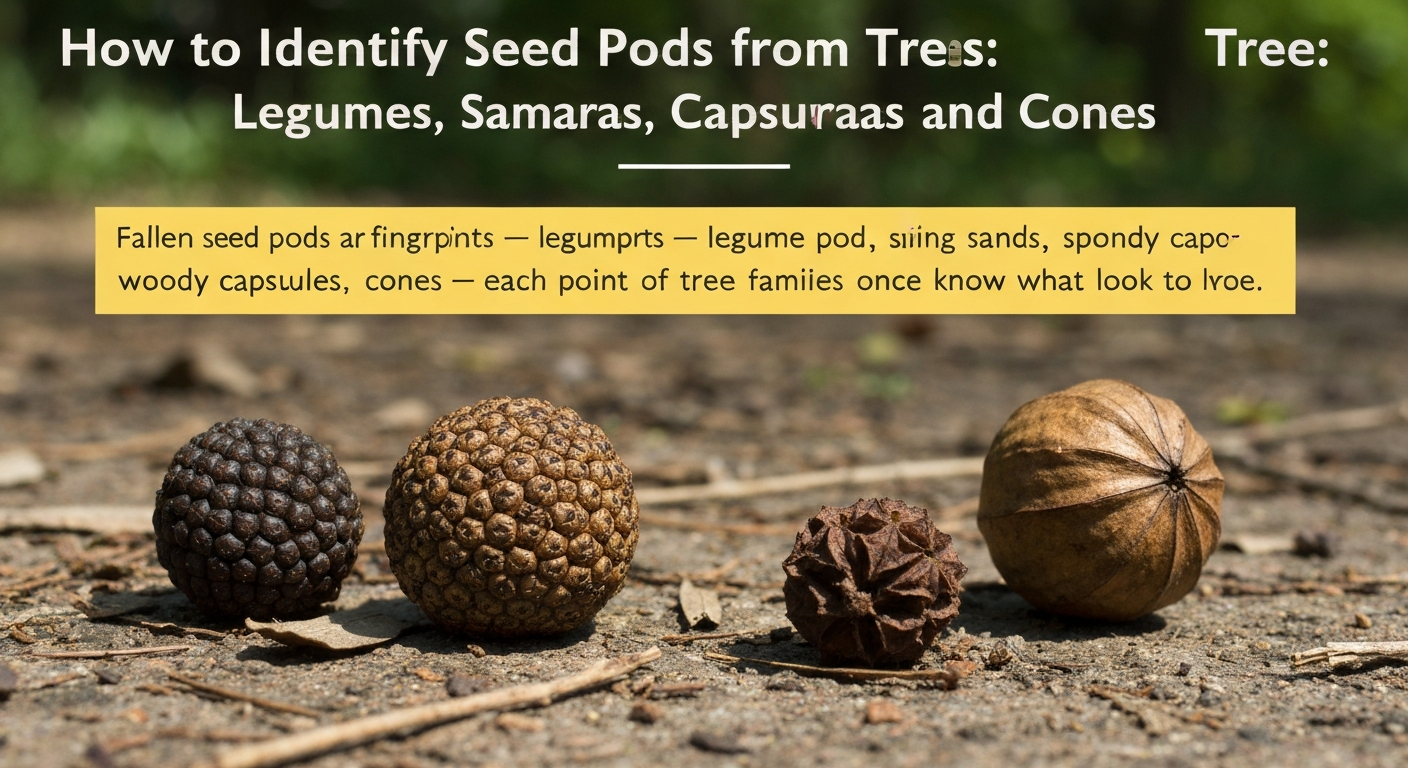
Seed pod ID is not guessing from one brown object. It is matching fruit type (the botanical category) to family traits, then narrowing to species with size, attachment, and habitat. Think of pods as fingerprints — the whorls differ by lineage.
The six fruit types you will find on the ground
Before species names, learn the six categories that cover most North American yard and forest trees:
- Legume pods — flat, often twisted, split along seams; pea-family trees.
- Samaras — winged seeds that spin; maple, ash, elm, birch (birch samaras are tiny).
- Capsules — woody, often egg-shaped, split to release seeds; magnolia, tulip tree, paulownia.
- Nuts and drupes — acorns, hickory nuts, walnut husks, cherry pits.
- Catkin remnants — dried flower spikes from birch, alder, oak, willow.
- Cones — scaled structures from pines, spruces, firs, cedars, junipers.
Each category routes you to different tree families. Our tree anatomy glossary defines these terms if you want deeper botanical vocabulary.
Legume pods: flat, split, and unmistakable
Legume-family trees (Fabaceae) produce pods that split along one or both seams to release hard seeds. If you find a flat papery or leathery pod, start here.
Black locust (Robinia pseudoacacia)
Pods 2 to 4 inches long, smooth, brown, flat with a slight twist. Often hang in clusters into winter. Tree has compound leaves with rounded leaflets and deeply furrowed bark on mature trunks. Common along highways and old fields.
Honey locust (Gleditsia triacanthos)
Pods longer — 6 to 18 inches — twisted, reddish-brown, sometimes with sweet pulp between seeds. Thornless cultivars dominate suburbs; wild forms have wicked branched thorns on trunk. Pod twist and length separate honey locust from black locust.
Catalpa (Catalpa speciosa and C. bignonioides)
Very long slender pods — 12 to 20 inches — like green beans that brown in fall. Large heart-shaped leaves. Northern catalpa has thicker pods and coarser texture than southern catalpa.
Eastern redbud (Cercis canadensis)
Flat pods 2 to 4 inches along branches, brown, often persisting after leaves drop. Heart-shaped entire leaves in summer. Spring magenta flowers before leaves — a clue earlier in the year.
Kentucky coffeetree (Gymnocladus dioicus)
Thick leathery pods 4 to 10 inches, pulp surrounds large hard seeds. Massive doubly compound leaves. Sparse winter crown — pods stand out against sky.
Mimosa or silk tree (Albizia julibrissin)
Flat brown pods 5 to 7 inches, papery, abundant on invasive trees in the South. Fern-like compound leaves and pink powder-puff flowers in summer.
Legume pod ID tip: measure length, note twist, and check whether the pod is papery or leathery. Photograph one pod on pavement next to your hand for scale.
Samaras: helicopter seeds and wing geometry
Samaras are seeds with papery wings. Wind dispersal spins them to the ground — kids call them helicopters. To identify seed pods from trees when only samaras remain, study wing shape and whether seeds are paired or single.
Maples (Acer spp.)
Paired samaras joined at the base, V-shaped or U-shaped depending on species. Red maple samaras are small, red-tinted when young, abundant in spring. Sugar maple samaras are larger with a narrower angle. Silver maple has the longest samaras — often 2 inches — and drops them in late spring. If paired samaras litter a driveway, you are under a maple. See common backyard trees for which maples dominate your region.
Ashes (Fraxinus spp.)
Single narrow samaras in clusters — paddle-shaped wing with seed at one end. Green ash and white ash samaras hang in bunches then drop. Emerald ash borer has thinned ash populations, but samaras still identify surviving trees.
Elms (Ulmus spp.)
Round, coin-like samaras with the seed centered in a papery disc. Not paired like maple. American elm samaras mature in spring — easy to miss if you only walk the block in fall.
Tree of heaven (Ailanthus altissima)
Twisted samaras in large clusters, papery, reddish when mature. Invasive weed tree with foul-smelling crushed leaf. Samaras confirm ailanthus when you confuse it with sumac or walnut from leaves alone.
Birch (Betula spp.)
Tiny samaras shed from erect catkin structures — more catkin than pod on the ground. See our catkin guide for birch fruit. Birch samara litter looks like fine tan debris under paper-bark trees.
Samara photography: one samara filling the frame, wing edge sharp, on contrasting background. Angle of the two maple wings is a species clue apps read well.
Capsules: woody fruits that split open
Capsules are dry fruits that split to release seeds — common on magnolias, tulip trees, and some ornamentals.
Southern magnolia (Magnolia grandiflora)
Large cone-like follicetum — woody, 3 to 8 inches, often called a magnolia "cone." Bright red seeds emerge from slits when ripe. Evergreen glossy leaves with rusty undersides. Pods fall intact or partially open under mature trees in the South and coastal plantings.
Tulip tree (Liriodendron tulipifera)
Upright cone-like aggregate of samaras — dry, tan, 2 to 3 inches, persists on branches into winter. Leaves have a distinctive squared-off tip. Pods stand upright like small candelabras on the tree.
Paulownia (Paulownia tomentosa)
Woody capsules 1 to 2 inches, egg-shaped, split to release thousands of tiny winged seeds. Invasive in parts of the East. Purple spring flowers before leaves on bare branches.
Capsules vs cones: magnolia "cones" are angiosperm fruits, not conifer cones — different internal structure. Slice one open (after ID) and you see seeds in chambers, not woody scales.
Nuts: acorns, hickories, walnuts
Not always called pods, but people search identify seed pods from trees when they find acorns on the sidewalk.
- Oak acorns: Cap (cupule) plus nut — cap texture and nut shape split red vs white oak groups.
- Hickory: Round nut in a husk that splits into four sections — smell spicy when crushed (pignut, mockernut).
- Walnut and butternut: Large green husk that browns and rots, leaving a hard grooved nut.
- Beech: Spiny bur-like husk opens to reveal two triangular nuts.
Nuts link to what type of tree is this workflows — photograph nut and cap together. Winter oak ID from acorn caps alone is a specialist skill but genus-level oak is easy.
Catkins on the ground: birch, alder, oak, willow
Catkins are flowering spikes — soft and pendulous in spring, dry and crumbly later. On the ground they look like tan fuzzy worms or shredded cork.
- Birch: Fine debris under paper-bark trees; erect fruiting catkins break apart.
- Alder: Small woody cone-like catkins persist on branches — unlike birch, alder "cones" are catkins, not gymnosperm cones.
- Oak: Acorn caps separate from nuts; male catkin fragments drop in spring.
- Willow: Cottony fluff in late spring carries tiny seeds — not a pod, but homeowners call it "tree fluff season."
For spring catkin identification on the branch, see catkins tree identification.
True cones: pines, spruces, firs, cedars
Conifer cones are the real cones — woody scales arranged around a central axis, seeds tucked between scales.
Pines (Pinus spp.)
Cones vary enormously — eastern white pine has long soft cones 4 to 8 inches; jack pine cones are small and curved; ponderosa pine cones are large and woody. Needle count per bundle (fascicle) pairs with cone size for species ID.
Spruces (Picea spp.)
Cones hang downward, papery flexible scales, 1 to 4 inches depending on species. Cones fall whole unlike many pines that drop scales first.
Firs (Abies spp.)
Cones stand upright on branches and disintegrate on the tree — you rarely find intact fir cones on the ground, only scale fragments. Upright cone habit on the living tree is the field mark.
Cedars and junipers
Juniper "berries" are actually fleshy cones — blue-gray, round. Eastern red cedar produces them abundantly. True cedar cones are small and barrel-shaped on ornamental cedars.
Cone ID under the tree: measure length, note whether scales are thick or thin, check if cone fell whole or shed scales. Combine with needle length from the same tree.
Field workflow: from pod to species name
Follow this sequence when you identify seed pods from trees on a walk:
- Locate the source tree — stand under the canopy; pods blow sideways on wind.
- Classify fruit type — legume, samara, capsule, nut, catkin, or cone.
- Measure and photograph — hand or coin for scale; sharp focus on texture.
- Note season — spring samaras vs fall legume pods narrows candidates.
- Glance at bark and buds on the same trunk — confirms genus from fruit alone.
- Run the photo through Tree Identifier — fruit photos are among the strongest single-feature IDs for common species.
If the app returns low confidence, add bark photo from the trunk base. See best photo for tree ID for lighting and framing.
Common mistakes when identifying seed pods
- Attributing wind-blown pods to the wrong tree — maple samaras travel blocks; find the maple overhead.
- Calling magnolia fruits "pine cones" — different plant lineages entirely.
- Ignoring cultivars — thornless honey locust pods match the species; ginkgo "fruit" is a smelly fleshy seed, not a pod.
- Single nut without cap — oak acorn caps are half the ID; photograph both.
- Spring vs fall collections — elm samaras in May vs locust pods in November — season mismatch causes confusion.
Using Tree Identifier for seed pod photos
Tree Identifier accepts fruit, seed, and pod photos — not just leaves. Best results:
- One pod centered, filling most of the frame.
- Even shade or overcast light — shiny wet pods confuse texture models.
- Include a distinctive feature — maple samara pair still joined, locust pod twist, magnolia red seeds visible in split capsule.
- Second photo of bark if the first ID confidence is under 70%.
Seed pod identification rewards patience. The tree already dropped its name tag — you just have to learn the alphabet of shapes.
Frequently asked questions
How do you identify seed pods from trees?
Identify seed pods from trees by noting pod shape, size, texture, how seeds are packaged, and what season they fall. Legume pods are flat and split open — locust, redbud, mimosa. Samaras are winged seeds — maple, ash, elm. Capsules are woody and often cone-like — magnolia, tulip tree. Cones are scales around naked seeds — pines, spruces, firs. Catkins are elongated flower clusters that become seed-bearing — birch, alder, oak. Photograph the pod next to a coin for scale and use Tree Identifier for confirmation.
What tree has long flat seed pods?
Long flat seed pods usually indicate a legume-family tree. Black locust has brown papery pods 2 to 4 inches. Honey locust has twisted reddish-brown pods often with a sweet pulp. Catalpa has very long slender pods 12 to 20 inches. Redbud has flat brown pods along branches. Kentucky coffeetree has thick leathery pods. Mimosa has flat brown pods persisting into winter. Compare pod length, twist, and whether the pod splits along both seams.
What are the helicopter seeds from trees called?
Helicopter seeds are samaras — single seeds with a papery wing that spins as it falls. Sugar maple and red maple produce paired samaras joined at the base, often called helicopters or keys. Ash produces single narrow samaras in clusters. Elm samaras are round and papery with the seed in the center. Tree of heaven has twisted samaras in large clusters. Samara shape — paired vs single, wing angle, seed position — helps identify seed pods from trees when only seeds remain on pavement.
When is the best time to identify tree seed pods?
Late summer through winter is peak seed pod season for most deciduous trees. Legume pods mature and brown in fall. Maple samaras drop in spring or early summer depending on species. Magnolia and tulip tree capsules split in fall to release red seeds. Pine cones may hang on branches for years but drop seeds in autumn. Collect pods from directly under the canopy — pods travel on wind, so match the tree overhead not every pod on a trail.
Can you identify a tree from seed pods alone?
Often yes at genus level, sometimes to species. A paired maple samara, locust legume pod, or magnolia cone-like capsule is highly diagnostic. Similar pods within a genus — multiple oak acorns or pine cone sizes — need extra cues like bark or leaf scars on the same tree. Photograph the pod filling the frame plus bark at the trunk base. Tree Identifier handles fruit and seed pod photos well on common species.
What is the difference between a seed pod and a cone?
Botanically, cones are the reproductive structures of conifers — gymnosperms with naked seeds on scales. Seed pod is a looser term people use for any dry fruit, including legume pods (angiosperms) and magnolia capsules. True cones come from pines, spruces, firs, cedars, and junipers. Angiosperm trees produce pods, capsules, drupes, nuts, or samaras instead. When you identify seed pods from trees, first ask: conifer cone or flowering-tree fruit?
Are tree seed pods poisonous?
Some are. Locust pods surround toxic seeds — livestock avoid them but children should not eat wild pods. Yew seeds inside red arils are poisonous. Castor bean pods are extremely toxic. Most common backyard pods — maple samaras, oak acorns, birch catkin fragments — are not edible but are low toxicity. Never eat unidentified seed pods. Use identification for curiosity and ecology, not foraging, unless you are an experienced forager with positive species ID.
Try Tree Identifier — free on iPhone
Photograph a seed pod, samara, or cone and get a species match in seconds.
Download on the App Store