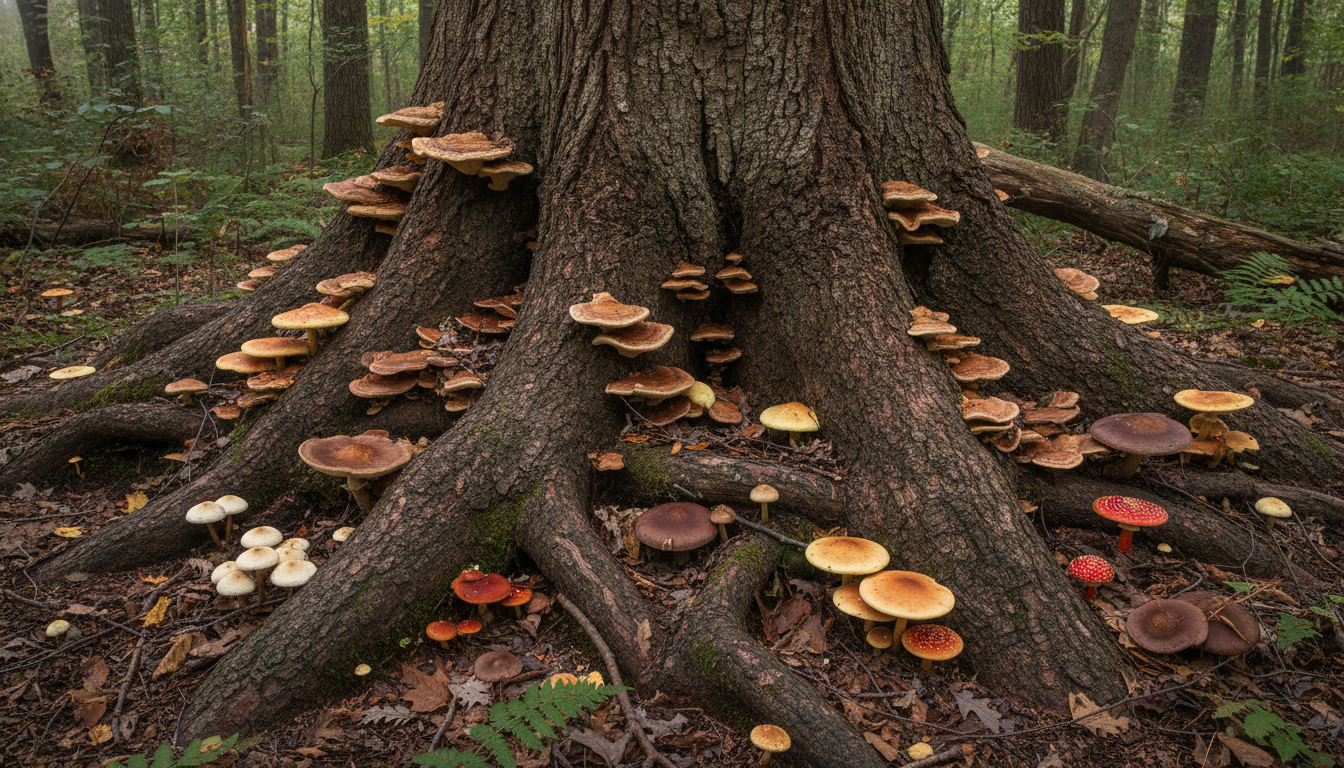
Trees are majestic, resilient pillars of our environment, yet they are constantly engaged in a silent battle against numerous threats, many of which are invisible until it's too late. Among the most common and often misunderstood adversaries are fungi. While some fungi play a vital role in decomposition and nutrient cycling, others are insidious parasites that can slowly but surely compromise a tree's health, stability, and even lead to its demise. Learning to identify tree fungus is a crucial skill for any tree enthusiast, homeowner, or budding arborist.
Spotting a mushroom or a strange growth on your tree can be alarming, but understanding what it signifies is the first step towards effective tree care. This comprehensive guide will equip you with the knowledge to recognize common types of tree fungus, interpret their presence, and take appropriate action. We'll delve into the distinct characteristics that help you identify tree fungus, from their location and form to their color and texture. With the help of tools like the Tree Identifier app, you can become more adept at diagnosing potential issues and safeguarding the health of your arboreal companions.
Why Identify Tree Fungus? The Stakes for Tree Health and Safety
The presence of fungus on a tree is rarely a neutral event. It's often a clear indicator of underlying conditions, ranging from minor decay in deadwood to severe structural compromise in living tissue. Understanding these indicators is paramount for several reasons:
- Tree Health and Longevity: Many parasitic fungi cause diseases that weaken a tree's immune system, hinder nutrient transport, and ultimately lead to decline. Early identification allows for potential intervention to extend the tree's life.
- Structural Integrity and Safety: Fungi, particularly those causing wood rot, can hollow out trunks and branches, making them brittle and prone to breakage. A seemingly healthy tree might be a ticking time bomb if its internal structure is compromised. Identifying harmful tree fungus is critical for preventing falling limbs or even entire tree failure, which can cause significant property damage or personal injury.
- Disease Prevention: Some fungal infections are contagious and can spread from one tree to another, or even to entire groves. Recognizing and managing infected trees can prevent widespread disease outbreaks.
- Property Value and Aesthetics: Healthy, well-maintained trees enhance property value and contribute to a beautiful landscape. Diseased trees, especially those with prominent fungal growths, can detract from this appeal and become liabilities.
- Ecological Balance: While some fungi are destructive, others are essential decomposers. Knowing the difference helps in appreciating the complex ecosystem within and around trees. However, when parasitic fungi take hold, they disrupt this balance, often leading to the premature death of host trees.
Ignoring fungal growths is akin to ignoring a persistent cough; it might be nothing, or it could be a sign of a serious underlying condition. Taking the time to observe and identify tree fungus is an investment in the health and safety of your environment.
Understanding Tree Fungus: The Basics of These Decomposers and Parasites
Before we dive into specific identification techniques, it's helpful to understand what fungi are and how they interact with trees. Fungi are not plants; they belong to their own biological kingdom. Unlike plants, they don't produce their own food through photosynthesis. Instead, they obtain nutrients by absorbing organic compounds from their environment. This is where their relationship with trees becomes critical.
Fungi can have several types of relationships with trees:
- Saprophytic Fungi: These are decomposers. They feed on dead or decaying organic matter, such as dead branches, stumps, or fallen leaves. While they don't directly harm living parts of a tree, their presence on a living tree often indicates that a section of the tree has died and is beginning to decay internally. They play a vital role in nutrient cycling.
- Parasitic Fungi: These are the culprits behind many tree diseases. They attack and feed on living tree tissue, causing rot, cankers, wilts, and other forms of damage. Their presence almost always signals a problem that needs attention.
- Mycorrhizal Fungi: These form a symbiotic, mutually beneficial relationship with tree roots. They help trees absorb water and nutrients from the soil in exchange for sugars produced by the tree. These fungi are typically found in the soil and are rarely visible on the tree itself, so they are not usually what people refer to when they talk about identifying tree fungus on the trunk or branches.
The visible part of a fungus, like a mushroom or a bracket, is called the "fruiting body." This is analogous to an apple on an apple tree; it's the reproductive structure. The main body of the fungus, called the "mycelium," is a network of thread-like structures (hyphae) that grows within the tree's wood, bark, or roots. By the time a fruiting body appears, the mycelium may have been at work inside the tree for months or even years, causing significant internal damage.
Fungi spread through spores, which are microscopic reproductive cells dispersed by wind, water, insects, or animals. These spores can land on wounds in a tree's bark, cracks, or even exposed root systems, germinating and initiating an infection.
Key Features for Identification: How to Identify Tree Fungus Effectively
When you encounter a fungal growth on a tree, a systematic approach to observation can greatly aid in identification. Here are the key characteristics to look for:
1. Location on the Tree
Where the fungus appears provides crucial clues about its nature and the extent of the problem. Different fungi target different parts of the tree:
- Roots/Tree Base: Fungi here often indicate root rot or butt rot, which can severely compromise stability. Examples include Honey Fungus (Armillaria) or various types of Ganoderma.
- Trunk: Fungi on the main trunk can signify heartwood decay (internal rot) or cankers. Bracket fungi (conks) are common here.
- Branches: Fungi on branches might indicate branch dieback, cankers, or sapwood decay.
- Leaves: Powdery mildews, rusts, and leaf spots are usually less destructive to the tree's overall structure but can impact photosynthesis and aesthetics.
2. Shape and Form of the Fruiting Body
The morphology of the fungus is one of the most distinctive features:
- Shelf or Bracket Fungi (Conks): These are woody, leathery, or fleshy growths that project horizontally from the trunk or branches, resembling shelves or brackets. They can be annual or perennial, growing larger each year. Common examples include Artist's Conk (Ganoderma applanatum) and Tinder Fungus (Fomes fomentarius).
- Mushrooms: Some fungi produce classic mushroom shapes, often with a cap and a stalk. These are typically softer and more ephemeral than conks, appearing after rain and quickly decaying. They often grow in clusters at the base of the tree or from exposed roots. Honey Fungus is a prime example.
- Crust Fungi: These appear as flat, often brightly colored patches growing flush with the bark, sometimes peeling at the edges. They can be thin or quite thick and leathery.
- Gilled Fungi: While many mushrooms are gilled, fewer significant tree pathogens are gilled fungi that grow directly from the wood. Those that do often grow in clusters or shelves.
- Cankers: While not always fungal, many cankers (sunken, discolored lesions on bark) are caused by fungi. These can girdle branches or trunks, leading to dieback.
3. Color
Fungal colors range widely and can be quite striking. Observe the color of the top surface, the underside, and any exposed internal flesh. White, brown, grey, black, orange, yellow, and red are all common. For instance, Chicken of the Woods (Laetiporus sulphureus) is famously bright orange and yellow.
4. Texture
Touch (if safe to do so) can provide more clues. Is it:
- Woody and hard? (e.g., many perennial conks)
- Leathery or tough? (e.g., Turkey Tail)
- Fleshy and soft? (e.g., many mushrooms)
- Slimy or gelatinous?
- Powdery or fuzzy?
5. Underside Structure
For bracket fungi and mushrooms, examine the underside of the cap:
- Pores: Many bracket fungi have tiny pores on their underside (like a sponge).
- Gills: Radiating blade-like structures.
- Teeth: Spine-like projections.
- Smooth: A completely smooth underside.
6. Host Tree Species
This is a critical piece of information. Many fungi are host-specific, meaning they only infect certain tree species. Knowing your tree's identity can narrow down the possibilities significantly. If you're unsure about your tree, the Tree Identifier app can help, or you can refer to guides like our post on how to identify trees by leaf or specific species like how to identify an alder tree.
7. Seasonality
Some fungi fruit only at certain times of the year, while perennial conks remain year-round but may grow new layers seasonally.
Common Types of Tree Fungus and Their Impact
Let's explore some of the most frequently encountered tree fungi and what their presence might mean for your trees. Remember, a photo alone is often not enough for definitive identification, but these descriptions will give you a strong starting point.
Bracket Fungi (Conks)
These are perhaps the most recognizable tree fungi, often signaling internal decay.
- Ganoderma species (Artist's Conk, Reishi, Varnish Conk):
- Appearance: Hard, woody, shelf-like brackets. Artist's Conk (G. applanatum) is typically grey-brown on top with a distinctive white pore surface that bruises brown, allowing "drawing." Varnish Conk (G. lucidum or G. sessile) often has a shiny, reddish-brown, lacquered cap.
- Location: Often found on the lower trunk, roots, or at the base of broadleaf trees (like oak, maple, birch) and sometimes conifers.
- Impact: Causes a significant white rot of heartwood and sapwood, leading to extensive decay and structural weakening. The presence of these conks usually means internal decay is well advanced.
- Fomes fomentarius (Tinder Fungus, Hoof Fungus):
- Appearance: Large, hard, hoof-shaped, perennial brackets. Greyish-brown on top, often with concentric growth rings, and a pale pore surface.
- Location: Primarily on dead or dying broadleaf trees, especially birch and beech.
- Impact: Causes a white rot, slowly decaying the host tree. While it often colonizes dead wood, its presence on a living tree can indicate severe stress or decline.
- Trametes versicolor (Turkey Tail):
- Appearance: Thin, leathery, fan-shaped brackets, often overlapping in tiers. Characterized by vibrant, concentric zones of various colors (brown, grey, blue, green, white). Has a white pore surface on the underside.
- Location: Very common on dead wood, stumps, and fallen logs, but can also appear on dead branches of living trees.
- Impact: Primarily a saprophyte, causing white rot of dead wood. While generally not a direct threat to living parts of the tree, its presence on a living tree indicates that the wood it's growing on is already dead or severely compromised.
- Phellinus species:
- Appearance: Highly variable, often woody, perennial, and hoof-shaped or shelf-like. Colors range from dark brown to black.
- Location: Various trees, often host-specific.
- Impact: Many Phellinus species are serious pathogens, causing aggressive white rot in the heartwood of living trees, leading to significant structural damage.
Root and Butt Rot Fungi
These fungi attack the roots and the base of the trunk, often leading to tree instability.
- Armillaria mellea (Honey Fungus):
- Appearance: Clusters of honey-colored mushrooms with a ring on the stalk, typically appearing in autumn. A key diagnostic feature is the presence of black, shoe-lace like rhizomorphs (mycelial strands) under the bark or in the soil around infected roots.
- Location: At the base of the trunk, on roots, or emerging from the soil nearby. Affects a wide range of broadleaf and coniferous trees.
- Impact: One of the most destructive tree pathogens, causing a white rot of both sapwood and heartwood in roots and the lower trunk. It can kill otherwise healthy trees, leading to significant structural failure.
- Laetiporus sulphureus (Chicken of the Woods):
- Appearance: Bright orange to yellow, fleshy, shelf-like brackets that often grow in large, overlapping clusters. No gills, but a smooth or finely porous underside.
- Location: Often found on oaks, but also other broadleaf trees and occasionally conifers. Can appear on the trunk or at the base.
- Impact: Causes a brown rot, leading to internal decay that can make the wood brittle and prone to breakage. While edible to humans, its presence indicates significant decay in the tree.
Canker Fungi
Cankers are localized, often sunken lesions on the bark, sometimes accompanied by fungal fruiting bodies.
- Nectria cinnabarina (Coral Spot):
- Appearance: Small, bright pink to coral-red pustules that erupt through the bark.
- Location: Often on dead or dying branches, but can spread to living tissue, particularly on stressed broadleaf trees.
- Impact: Causes cankers and dieback of twigs and branches. While usually attacking weak or dead wood, it can be a secondary pathogen on stressed trees.
- Other Canker-causing Fungi: Many fungal species cause cankers (e.g., those leading to Dutch Elm Disease or Chestnut Blight, though the latter is largely historical in North America for the American Chestnut). These often involve bark discoloration, cracking, and sunken areas, sometimes with oozing sap.
| Fungus Type | Key Appearance | Common Location | Impact on Tree |
|---|---|---|---|
| Artist's Conk (Ganoderma applanatum) | Hard, grey-brown shelf, white bruise-able underside. | Lower trunk, base, roots of broadleaf trees. | Severe white rot, extensive internal decay. |
| Tinder Fungus (Fomes fomentarius) | Large, hoof-shaped, grey-brown, perennial. | Dead/dying birch, beech, other broadleaf. | White rot, slow decay of host tree. |
| Turkey Tail (Trametes versicolor) | Thin, fan-shaped, multi-colored zones, white pores. | Dead wood, stumps, fallen branches. | Saprophytic white rot, indicates dead wood. |
| Honey Fungus (Armillaria mellea) | Clusters of honey-colored mushrooms, black rhizomorphs. | Tree base, roots, soil. | Aggressive white rot of roots/butt, lethal. |
| Chicken of the Woods ( |