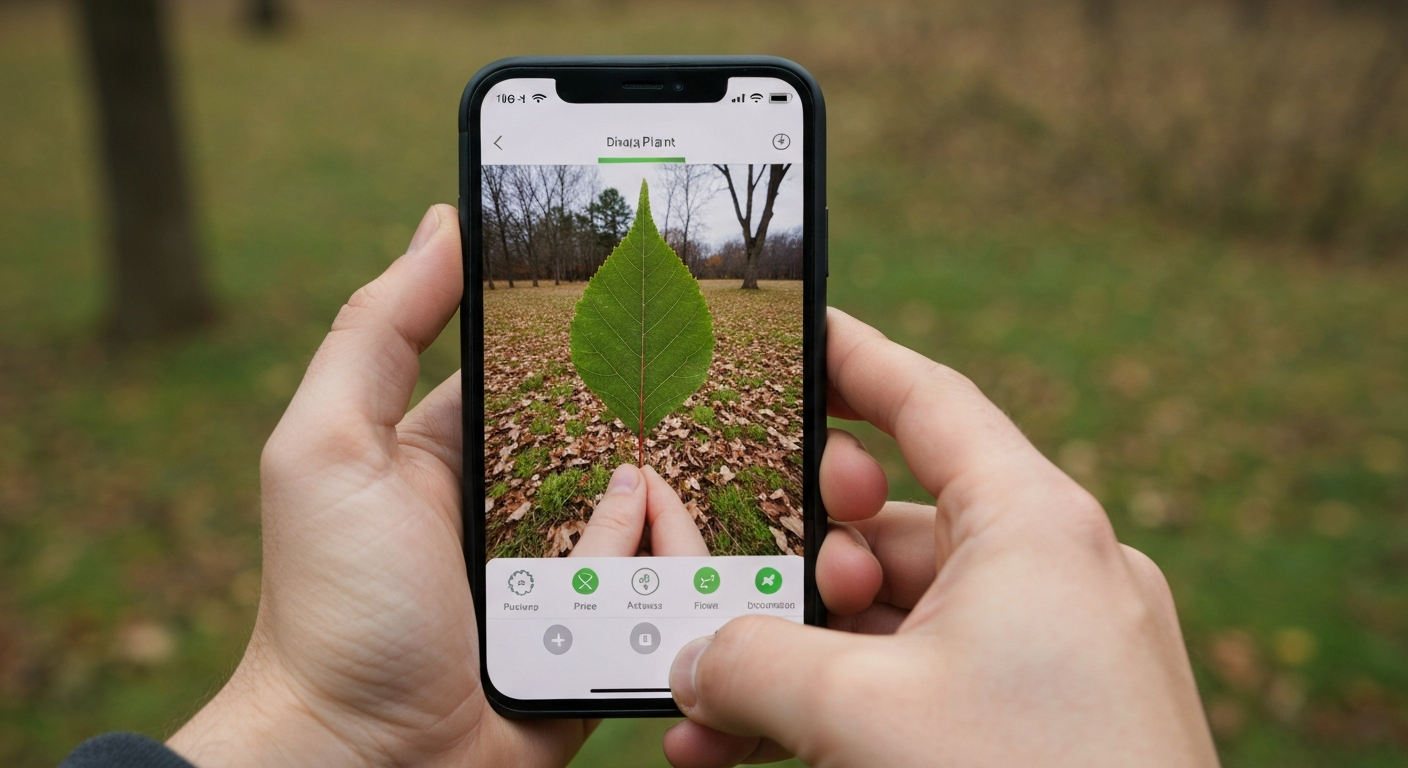
TL;DR: A free tree identifying app is not one category — it spans truly free research apps (PlantNet, iNaturalist), freemium apps with daily caps (Tree Identifier, PictureThis, LeafSnap), and trial traps that auto-convert to subscriptions. The AI accuracy on free tiers is usually identical to paid; what changes is how many photos you can scan, whether ads appear, and whether bark or offline features unlock. Test three trees you already know, read the paywall screen on day one, and use Tree Identifier if you want a tree-focused free option on iPhone without an account.
💡 The fastest filter: free means no payment ever (PlantNet, iNaturalist). Freemium means free download with limits or subscriptions (most App Store tree apps). A tree identifying app free to install is not the same as unlimited free IDs.
Why "free tree identifying app" searches are confusing
App Store listings all say "free" because download costs nothing. That word hides three very different models:
- Truly free: No subscription, no daily cap, funded by grants or non-profit missions.
- Freemium: Free tier with a daily or weekly identification limit; same AI engine as paid.
- Free trial: Full access for three to seven days, then auto-billing unless you cancel in iOS Settings → Subscriptions.
People searching tree identifying app free or free app to identify plants and trees usually want unlimited accurate IDs without surprise charges. That combination exists — but not in every top-ranked app. This guide separates marketing language from what you actually get.
Before installing anything, decide your real use case: occasional backyard curiosity (any generous free tier works), weekly hikes (you will hit caps fast), or classroom field trips (unlimited free matters). Your answer determines whether a research app or a polished freemium app fits better.
What free tree ID apps actually include
Across the major options, free tiers typically cover:
- Photo-based identification from leaf, bark, fruit, flower, or whole-tree images.
- Species name and brief description — common name, scientific name, sometimes family.
- Confidence score on better apps, so you know when to trust the result.
- Local history of past identifications stored on your device.
What free tiers usually exclude or limit:
- Daily identification count — the most common paywall.
- Ad-free experience — LeafSnap and some others show banner ads on free.
- Disease or pest diagnosis — premium add-on on PictureThis and similar.
- Offline new identifications — almost always paid or unavailable.
- Export or cloud sync of your observation log.
The critical insight for any free tree identifying app: accuracy is not paywalled on well-designed apps. You are paying for volume and convenience, not a smarter model on each scan.
Free vs paywalled: a practical breakdown
Tree Identifier (iPhone)
Tree Identifier is tree-focused rather than a general plant encyclopedia. The free tier gives you real AI identifications from leaf, bark, and whole-tree photos — the same engine as premium, with a daily free allowance suited to casual use. No account required. Photos are processed and deleted rather than mined for ads. Upgrade when you routinely exceed the free daily cap during hiking season or property work.
Strengths on free: speed (two to four seconds), clean UI, privacy-respecting design, strong North American and global tree coverage. Limitation: new IDs need internet; premium unlocks higher limits and extended history.
PlantNet
The benchmark for a tree identifying app free with no catch. Fully free, ad-free, open-source, citizen-science backed. Unlimited identifications. Trade-offs: interface is functional not flashy; bark ID is weaker than leaf ID; strongest species coverage in Europe, good but uneven elsewhere. Best when unlimited free matters more than polish.
iNaturalist
Free forever, global, community-driven. AI suggests an ID instantly; experts may confirm later. Not optimized for "I need the answer in three seconds on a trail" — better for logging observations and contributing to biodiversity data. Excellent free app to identify plants and trees when you value verified records over speed.
PictureThis
Huge plant database beyond trees. Free trial then aggressive subscription prompts. After trial, typically one to three free IDs per day. Accuracy is solid on common ornamentals. Read subscription terms before starting any trial — auto-renewal is standard.
LeafSnap
Originally leaf-only, now broader. Free with ads and usage limits. Fine for occasional leaf IDs; frustrating for a full afternoon walk. Bark and whole-tree support lag dedicated tree apps.
For a full side-by-side matrix, see our tree identification apps compared guide and app to identify trees overview.
Accuracy: does free mean worse?
No — not if the app is honest. Modern tree ID apps run your photo through a convolutional neural network trained on millions of labeled images. Free and paid users hit the same model on the same servers.
What actually drives accuracy:
- Photo quality — frame-filling leaf in even light beats a distant tree silhouette. See best photo for tree ID.
- Species commonness — sugar maple and white oak hit 90%+; obscure cultivars drop to 60–70%.
- Feature choice — fruit and flowers often beat bark alone. See bark identification guide.
- Geographic training data — European apps stumble on tropical species and vice versa.
Test protocol before trusting any free tree identifying app: photograph three to five trees whose species you already know from a field guide or arborist label. If the app misses two of five common backyard trees, the model is not reliable for your area — free or paid.
📸 One identification proves nothing. Three to five verified trees prove whether a tree identifying app free tier is worth keeping on your home screen.
Offline support on free tiers
This is where free tree identifying app marketing misleads most often. "Works offline" on an App Store screenshot usually means browse past results offline, not identify new trees without signal.
Why: on-device models large enough for reliable species-level tree ID would consume gigabytes of storage and drain battery. Server-side inference is the industry standard. On a trail without cell service, you can photograph trees now and identify later when you regain signal — a workflow iNaturalist and Tree Identifier both support via camera roll import.
PlantNet has experimented with regional offline packs; coverage is limited. Do not download a free tree identifying app expecting full offline ID unless the app explicitly states on-device inference for your region.
Free app to identify plants and trees: trees vs everything green
General plant apps (PictureThis, PlantNet) identify houseplants, weeds, and shrubs alongside trees. Dedicated tree apps optimize for woody plants — bark texture, winter silhouette, crown shape — and filter out herbaceous false positives.
Choose a general free app to identify plants and trees when:
- You photograph garden flowers, vegetables, and trees interchangeably.
- You want one app for the whole yard.
- Unlimited free IDs matter (PlantNet).
Choose a tree-focused free tree identifying app when:
- You hike, forest-manage, or teach dendrology.
- Bark and winter bud photos are common in your workflow.
- You want fewer "that's a weed not a tree" misroutes.
Many users keep two apps: PlantNet or iNaturalist for unlimited logging, plus Tree Identifier for fast on-trail tree confirmation. Both are free at basic levels.
Subscription traps and how to avoid them
The most common complaint in one-star App Store reviews is not wrong IDs — it is unexpected annual charges after a "free" download.
Protect yourself:
- Read the first paywall screen — it states trial length and price.
- After starting any trial, open Settings → Apple ID → Subscriptions immediately and set a calendar reminder to cancel.
- Prefer apps with a usable permanent free tier over trial-only models if you identify trees monthly not daily.
- Check our tree ID app free checklist and free vs paywalled breakdown before committing.
Truly free apps (PlantNet, iNaturalist) eliminate this risk entirely. Freemium apps with daily caps (Tree Identifier) let you use the product indefinitely without payment if your volume stays low.
Privacy on free tree identifying apps
Free apps monetize somehow: subscriptions, ads, or data. Research apps may use contributed photos to improve models — stated upfront. Commercial apps vary.
Green flags:
- Published privacy policy linked from App Store.
- Explicit photo deletion after identification.
- No requirement to create an account for basic use.
Red flags:
- Vague "we may share data with partners" language.
- Requests for contacts or location unrelated to ID.
- No privacy policy at all.
Your tree photos reveal where you hike and what grows on your property. Treat camera permissions seriously even on a free tree identifying app.
Who should pay — and who should not
Stay on free if you identify fewer than a few trees per week, mostly in your neighborhood, and the daily cap never blocks you.
Consider paying if you hit the cap every hike, need unlimited export for a course or survey, or want ad removal on LeafSnap-style apps.
Never pay before running the three-tree accuracy test. A subscription does not fix a model that misidentifies your local sugar maple.
Getting the most from a free tree identifying app
Maximize free tier value with field habits that cost nothing:
- Photograph one leaf against the sky or your palm — high contrast, full frame.
- Add a second photo of bark or fruit if the first ID confidence is below 70%.
- Cross-check genus with identify trees by leaf basics before accepting a rare species name.
- Save mystery trees to camera roll; batch-identify at home on Wi-Fi to preserve daily free credits on capped apps.
- Use what type of tree is this workflow when the app returns multiple similar oaks or maples.
A free tree identifying app is a powerful field tool when you understand its limits — not a magic oracle, but a fast first opinion you verify with context.
Frequently asked questions
Is there a completely free tree identifying app?
Yes. PlantNet and iNaturalist are fully free, ad-free, and funded by research institutions — no subscription required. Tree Identifier offers free basic identifications on iPhone with the same AI accuracy as paid tiers, limited by daily usage rather than feature quality. PictureThis and LeafSnap are freemium: free to download but paywalled after trials or daily caps. A tree identifying app free on the App Store is not the same as unlimited free forever.
Does the free version of a tree ID app work as well as paid?
Usually yes for each individual identification. Most apps use the same AI model on free and paid tiers — the difference is how many IDs you get per day, whether ads appear, and whether premium features like disease diagnosis or unlimited history unlock. Accuracy per photo does not improve just because you pay. Test with trees you already know before assuming free means worse.
Can a free tree identifying app work offline?
Rarely for new identifications. AI models are too large to run fully on a phone, so most free tree identifying apps send your photo to a server and need cellular or Wi-Fi. You can often browse past identifications offline after they sync. PlantNet offers limited offline mode in some regions; most commercial apps require a connection for each new scan.
What is the best free app to identify plants and trees?
For iPhone users who want fast tree-focused ID with leaf, bark, and whole-tree photos, Tree Identifier is a strong free option with a clean interface. For unlimited free IDs and citizen-science contribution, PlantNet excels in Europe and works globally. iNaturalist is best when you want community expert review rather than instant AI. For broad plant coverage beyond trees, PictureThis has a large database but aggressive subscription prompts after the trial.
How many free identifications do tree apps allow per day?
Limits vary widely. Tree Identifier allows several free identifications daily before optional upgrade. PictureThis typically offers one to three free IDs per day after trial expiry. LeafSnap shows ads and caps usage on the free tier. PlantNet and iNaturalist have no daily cap. Always read the paywall screen on first launch — it states the exact free allowance.
Are free tree identifying apps safe for privacy?
It depends on the privacy policy. Good apps delete photos after processing and do not sell image data. Research apps like PlantNet and iNaturalist may retain contributed photos for science with your consent. Avoid apps that demand unnecessary permissions, lack a published privacy policy, or bury data-sharing language. Tree Identifier is designed with photo deletion after ID as a core privacy feature.
When should you pay for a tree identification app?
Pay when you genuinely exceed the free daily limit during regular use — hiking season, property surveys, or classroom field work. Pay if you need premium extras like unlimited history export, pest diagnosis, or ad removal. Do not pay before testing accuracy on three to five trees you can verify. If the free tier covers your actual usage, a tree identifying app free tier is enough.
Try Tree Identifier — free on iPhone
AI-powered tree ID from a single photo. Leaf, bark, or whole tree. Free daily identifications — no account required.
Download on the App Store