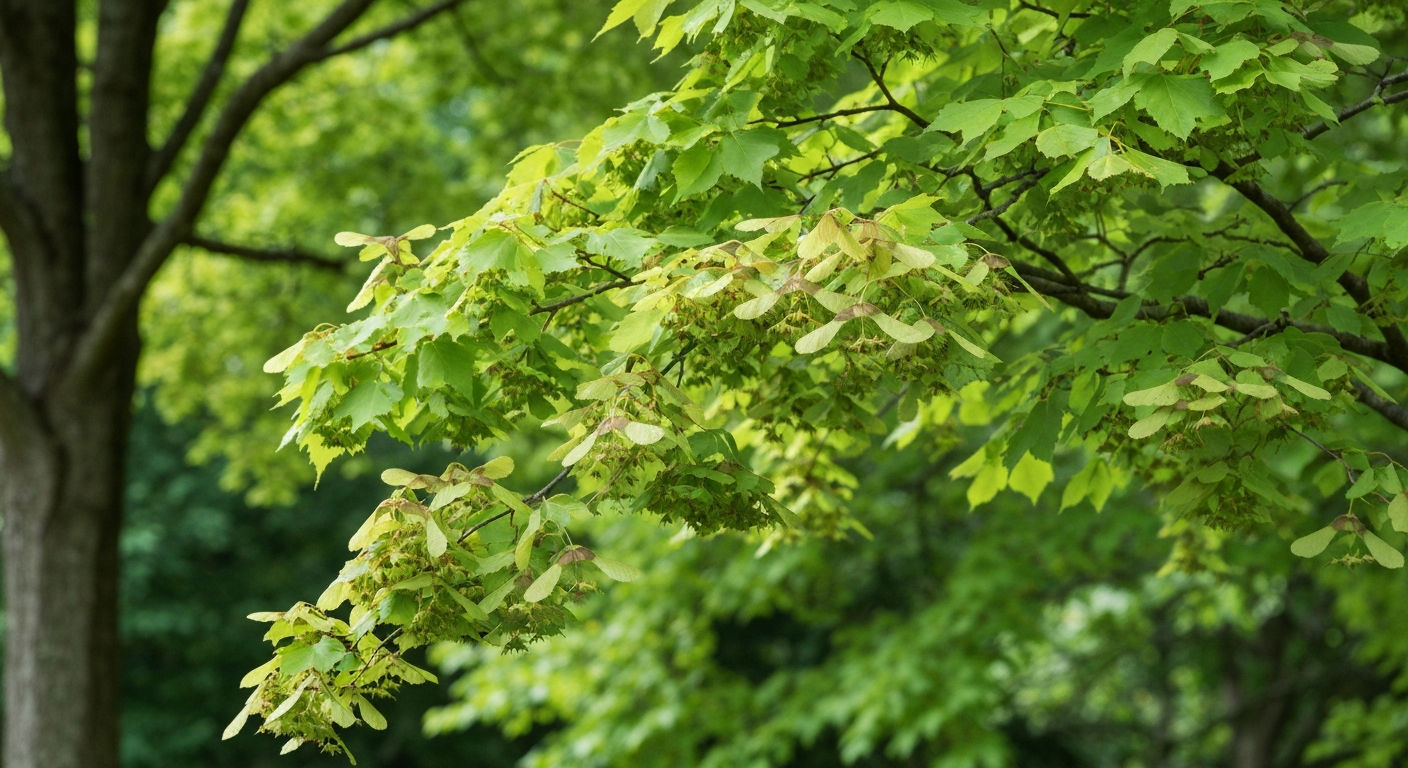
TL;DR: Acer tree identification means recognizing trees in genus Acer — the maples. Look for opposite leaf arrangement, usually palmately lobed simple leaves (except box elder), and paired winged samaras in spring and summer. Japanese maple (Acer palmatum) has deeply cut small leaves; field maple (Acer campestre) has rounded lobes and corky bark; sycamore maple (Acer pseudoplatanus) is a large European tree with peeling plate bark. Photograph leaves and samaras together and confirm with the Tree Identifier app. For North American natives, see our maple tree identification guide.
🍁 Acer tree identification in one line: opposite leaves + palmate lobes + helicopter seeds (samaras) = maple genus. Species ID adds lobe count, samara angle, and bark.
Understanding Acer — the maple genus
Maples belong to genus Acer in the soapberry family (Sapindaceae). Roughly 130 species span the Northern Hemisphere — North America, Europe, and East Asia hold the greatest diversity. People say acer tree when they mean the botanical genus; gardeners and arborists usually say maple. Both terms point to the same identification toolkit.
Acer tree identification matters because maples dominate urban plantings, autumn color tourism, syrup production, and ornamental horticulture. Japanese maple alone has hundreds of named cultivars. Misidentifying a maple as an oak or vice versa sends you down the wrong field guide path — oaks have alternate leaves and acorns, not samaras.
Genus-level traits that define Acer:
- Leaf arrangement: Opposite — two leaves per node, directly across the twig from each other.
- Leaf form: Usually simple and palmately lobed (veins radiate from one point like fingers from a palm). Box elder is the common exception with pinnately compound leaves.
- Fruit: Samaras — two seeds fused at the base, each with a papery wing. Maples produce them in paired clusters.
- Buds: Opposite, often pointed or conical, with overlapping scales.
- Sap: Many species exude clear or milky sap when twigs are cut; sugar maple sap is tapped for syrup.
- Fall color: Often outstanding — red, orange, or yellow depending on species and cultivar.
Once you confirm opposite palmate leaves, acer tree identification becomes a species-level puzzle. Lobe depth, margin teeth, samara angle, bark texture, and mature size separate Japanese maple from field maple from sycamore maple and the rest.
Opposite palmate leaves — the core ID character
Leaf architecture drives most acer tree identification. Palmate lobing means the blade divides into lobes that spread from a central point, like the fingers of an open hand. Lobes may be shallow (barely indented) or deep (almost to the leaf base).
Lobe count: Most maples show 3, 5, 7, or occasionally 9 lobes. Japanese maple cultivars often have 5 to 7 narrow lobes. Field maple typically has 3 to 5 rounded lobes. Sugar maple has 5 lobes with smooth U-shaped sinuses between them.
Lobe tips: Pointed lobes suggest red maple or Japanese maple lines. Rounded lobe tips point toward field maple or some Norway maple forms.
Margin: Entire (smooth) margins appear on some cultivars; most wild maples have serrated or toothed lobe edges.
Leaf size: Ornamental Japanese maples may have leaves under 3 inches. Sycamore maple leaves reach 6 to 8 inches — among the largest in the genus.
Photograph one leaf flat against a light background with the petiole visible. Opposite arrangement is confirmed by photographing the twig showing two leaves emerging from the same node. See Identify Trees by Leaf for opposite-vs-alternate photography tips.
Japanese maple (Acer palmatum)
Japanese maple is the ornamental star of acer tree identification in gardens worldwide. Native to Japan, Korea, and China, Acer palmatum and its cultivars appear in every climate zone that supports them.
Leaves: Deeply palmately lobed, often 5 to 7 lobes cut more than halfway to the base on dissected cultivars like 'Dissectum'. Standard forms have broader lobes with serrated margins. Leaf size is typically 2 to 4 inches — much smaller than native North American forest maples.
Form: Usually a small tree or large shrub, 10 to 25 feet, often multi-stemmed. Weeping cultivars cascade to the ground. Compact dwarf forms stay under 6 feet.
Bark: Smooth, thin, gray-brown — attractive in winter on mature specimens.
Samaras: Small, wings spreading at a wide angle (often 160 to 180 degrees). Red or green when young; ripen in fall.
Fall color: Signature feature — scarlet, crimson, orange, or gold depending on cultivar and sun exposure.
Lookalikes: Fullmoon maple (Acer japonicum) has broader, less deeply cut lobes and larger samaras. Vine maple (Acer circinatum) is a Pacific Northwest native with similar delicacy but grows in wild woods, not formal gardens.
Field maple (Acer campestre)
Field maple is Europe's hedgerow maple — the acer tree identification reference for British and continental field edges.
Leaves: Small, 2 to 4 inches, with 3 to 5 blunt rounded lobes — shallow sinuses compared to Japanese maple. Dark green above, paler and sometimes downy beneath.
Bark: Distinctive corky ridges developing on mature trunks — rough, fissured, dark gray. Young stems are smooth.
Samaras: Wings spread nearly horizontally (about 180 degrees), forming a straight line when viewed from the side. Fruits often hang in long drooping racemes.
Form: Small tree to 40 feet but commonly pruned as a dense hedge. Tolerates heavy cutting — classic component of UK mixed hedgerows with hawthorn and hazel.
Fall color: Yellow to golden — less dramatic than Japanese or sugar maple.
Field maple is planted in eastern North America as a street tree. Acer tree identification in the US often confuses it with Norway maple — check samara angle and corky mature bark on field maple.
Sycamore maple (Acer pseudoplatanus)
Sycamore maple causes naming confusion because "sycamore" means different trees in different countries. Acer pseudoplatanus is a true maple — not the American plane tree.
Leaves: Large, 5 to 8 inches, dark green with 5 lobes. Undersides are noticeably pale green with a fine pubescence — a key character when wind flips leaves.
Bark: On older trunks, bark breaks into rectangular plates that peel at the edges — somewhat like plane trees but on opposite-leaved maple architecture.
Samaras: Paired, wings spread at a moderate angle, hang in long pendulous clusters through summer.
Form: Large tree to 80 feet or more — among the biggest acers. Broad rounded crown.
Range: Native across Europe; widely naturalized in the Pacific Northwest, New Zealand, and other temperate regions. Can be invasive in sensitive habitats.
Never confuse sycamore maple with American sycamore (Platanus occidentalis) — plane trees have alternate leaves and round spiky ball fruit, not samaras. That single leaf-arrangement check ends the confusion.
Samaras — winged seeds for species-level ID
Maple samaras are the helicopter seeds children toss into the air. For acer tree identification, samara shape is as important as leaves.
Wing angle: Sugar maple (Acer saccharum) samaras have wings nearly parallel — a narrow V. Red maple (Acer rubrum) wings spread wider, roughly 60 to 90 degrees. Norway maple (Acer platanoides) has flat, wide-spreading samaras. Field maple wings are almost a straight line.
Size: Japanese maple samaras are tiny — under 1 inch total length. Sycamore maple samaras are larger, over 1.5 inches.
Timing: Samaras form in spring, ripen through summer, and spin to the ground in late summer or fall. Photograph clusters while still on the branch for best species clues.
Hairs: Some species have hairy seed bodies; others are smooth. Magnification or a macro photo helps.
Samaras persist on some species after leaves drop — useful for winter acer tree identification when buds are hard to see on tall street trees.
Ornamental acers beyond Japanese maple
Gardens and arboreta showcase dozens of Acer species. Common ornamental groups in acer tree identification:
Fullmoon maple (Acer japonicum)
Broader, less dissected leaves than A. palmatum — 7 to 11 shallow lobes. Excellent fall color. Samaras are larger and held upright on short stalks.
Paperbark maple (Acer griseum)
Cinnamon-colored peeling papery bark is the giveaway — leaves are trifoliate (three leaflets), unusual in the genus. Small tree, prized in specialty collections.
Snakebark maples (Acer pensylvanicum and allies)
Green-striped bark on young stems. Large soft leaves with 3 lobes. Striped maple or moosewood in eastern North American woods.
Norway maple (Acer platanoides)
Invasive in parts of North America but common as a landscape tree. Five lobes with milky sap when petiole is broken. Leaves are wider than sugar maple; samaras are flat.
Ornamental acer tree identification often requires cultivar tags at the nursery — but genus confirmation from opposite palmate leaves and samaras still applies everywhere.
Bark, buds, and winter identification
Winter acer tree identification uses bark and bud characters when leaves are absent:
Sugar maple bark: Dark gray, deeply furrowed into long vertical plates on old trees — the classic hardwood sawlog bark.
Red maple bark: Young trees smooth gray; older bark breaks into scaly plates. Often intermediate between smooth and blocky.
Field maple bark: Corky, rugged — distinctive among maples.
Paperbark maple: Exfoliating copper sheets — unmistakable.
Buds: Opposite, pointed, with visible scale pairs. Red maple buds are small and red; sugar maple buds are brown and pointed; Norway maple buds are plump and greenish.
For bark-focused workflows, pair this guide with Tree Bark Identification App Guide and Tree Anatomy Glossary for terminology.
Common Acer lookalikes and mistakes
Acer tree identification errors usually involve leaf arrangement or fruit type:
- Oaks: Alternate leaves, acorns — never samaras. Lobed oak leaves can resemble maple from a distance; check arrangement.
- Sweetgum: Alternate, star-shaped lobed leaves — five pointed lobes like maple but alternate and with spiky ball fruit.
- Plane trees (sycamores): Alternate leaves, ball fruit — not maples despite the name overlap.
- Box elder: Actually an Acer (Acer negundo) with compound leaves — the odd maple out. See our box elder identification guide.
- Horse chestnut: Opposite palmate leaves but large sticky buds and round spiky capsules — not samaras.
Opposite arrangement is the non-negotiable first test. If leaves are not opposite, you are not looking at Acer.
Using Tree Identifier for Acer species
Tree Identifier recognizes Japanese maple, field maple, sycamore maple, and North American native maples from leaf and samara photos.
Best photos: One leaf showing full lobe outline and petiole. One samara cluster with wings clearly visible. Include twig showing opposite leaves when possible.
Ornamental cultivars: Deeply dissected Japanese maples ID reliably at genus level; cultivar names may not appear — but confirming Acer is the field priority.
Similar species pairs: Sugar vs Norway maple benefits from samara angle and sap color (milky in Norway maple petiole break). Photograph both features for the app.
Acer tree identification rewards attention to small details — lobe sinuses, samara spread, bark plates — that become automatic after a few seasons of practice.
Frequently asked questions
How do you identify an Acer tree?
Identify Acer (maple) trees by opposite leaf arrangement, often palmately lobed leaves with 3 to 9 pointed lobes, and paired winged samaras (helicopter seeds). Bark varies from smooth gray on young stems to furrowed on mature sugar maple. Buds are opposite and often pointed. Count lobes, check samara angle, and note whether leaves are simple or compound to narrow species within the genus.
What is the difference between Acer and maple?
Acer is the scientific genus name; maple is the common English name for the same group of trees. All maples are in genus Acer (family Sapindaceae). When people search acer tree identification they mean identifying species within this genus — Japanese maple (Acer palmatum), field maple (Acer campestre), sycamore maple (Acer pseudoplatanus), sugar maple (Acer saccharum), and dozens of others worldwide.
How do you identify Japanese maple (Acer palmatum)?
Japanese maple has deeply palmately lobed leaves, often 5 to 7 narrow pointed lobes with serrated margins, typically 2 to 4 inches wide on garden cultivars. Bark is smooth gray-brown. Samaras are small with wings spreading at a wide angle. Form is usually a small tree or multi-stemmed shrub under 25 feet. Fall color is brilliant red, orange, or purple depending on cultivar.
What does field maple (Acer campestre) look like?
Field maple is a European species common in UK hedgerows and planted in North America. Leaves are small, 2 to 4 inches, with 3 to 5 rounded lobes — less deeply cut than Japanese maple. Bark becomes corky and fissured with age. Samaras are nearly horizontal. It tolerates pruning and forms dense hedges. Leaves turn yellow in fall.
How do you tell sycamore maple from American sycamore?
Sycamore maple (Acer pseudoplatanus) is a true maple with opposite palmate lobed leaves and paired samaras — not related to American sycamore (Platanus occidentalis), which has alternate large lobed leaves and round button-like fruit. Sycamore maple has green undersides with fine hairs, bark peels in small plates on older trunks, and samaras hang in long clusters.
What are maple samaras and how do they help ID?
Samaras are winged seeds — two seeds joined at the base with papery wings. Maple samaras spin when they fall. Wing angle helps species ID: sugar maple samaras are nearly parallel; red maple wings spread wider; Norway maple samaras are flat and wide. Size, hairiness, and cluster length also differ. Photograph samaras in late spring through summer for acer tree identification.
Can tree ID apps identify Acer species?
Yes, when photos show clear opposite palmate leaves or samaras. Apps distinguish Japanese maple from oaks and other lookalikes easily. Similar Acer species — Norway vs sugar maple — need good leaf and samara detail. Tree Identifier handles ornamental acers and native maples across North America and Europe when foliage or fruit is in frame.
Try Tree Identifier — free on iPhone
Photograph maple leaves or samaras and get an Acer species match in seconds.
Download on the App Store