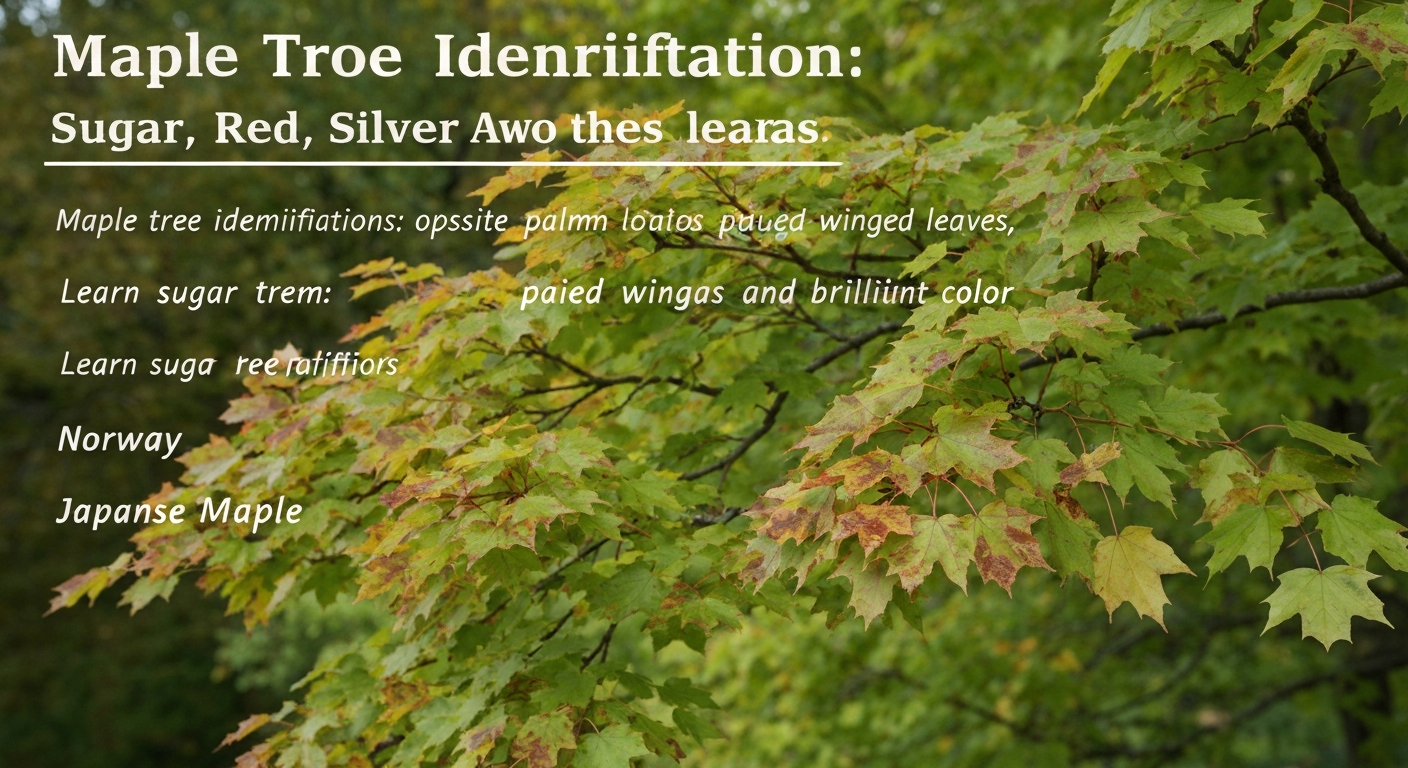
TL;DR: Maple tree identification rests on three reliable traits: opposite leaves (two at each node), palmately lobed leaf shape with veins spreading from one point, and paired samaras — winged seeds that helicopter to the ground. Sugar maple (Acer saccharum) has five lobes with smooth U-shaped sinuses and legendary orange-red fall color. Red maple (Acer rubrum) has sharper V-shaped sinuses and red samaras. Silver maple (Acer saccharinum) has deeply cut lobes and silvery leaf undersides. Norway maple (Acer platanoides) bleeds milky sap from broken petioles. Japanese maple (Acer palmatum) offers finely dissected ornamental leaves. Photograph one leaf plus a samara pair and confirm with the Tree Identifier app.
🍁 Maple tree identification shortcut: opposite + palmate lobes + helicopter seeds = maple. Species ID comes from sinus shape (U vs V), leaf underside color, bark texture, and fall foliage.
Understanding maples — genus Acer
Maples belong to genus Acer in the soapberry family (Sapindaceae). Roughly 130 species exist worldwide; North American yards and forests commonly hold sugar, red, silver, and boxelder maples, while Norway and Japanese maples dominate landscaping.
Maple tree identification matters because maples are among the most visible trees in temperate regions — street trees, sugar bushes, autumn tourism, and timber. They are also frequent lookalike traps: sweetgum has star-shaped leaves but alternate arrangement; sycamore has palmately lobed leaves but alternate arrangement and peeling bark.
Genus-level traits for maple species identification:
- Leaf arrangement: Opposite — always. This is non-negotiable for maple tree identification.
- Leaf shape: Palmately lobed or palmately compound (boxelder).
- Leaf margin: Entire, toothed, or doubly serrated depending on species.
- Fruit: Samaras — two seeds joined, each with a papery wing. Pairs often hang at an angle species-specific.
- Buds: Opposite, pointed, often with visible scales; red maple buds are small and red.
- Sap: Clear in native sugar maple; milky white in Norway maple when petiole breaks.
- Fall color: Sugar and red maples are autumn stars; Norway maple often yellows late.
Before diving into species, confirm opposite arrangement. Walk to a twig and look directly across the stem — two leaves or two buds face each other. If leaves alternate up the twig, you are not looking at a maple. See Identify Trees by Leaf for arrangement basics.
Maple leaf identification — lobes, sinuses, and margins
Maple leaf identification is the fastest field skill for id maple trees. The Canadian flag depicts a stylized sugar maple leaf — five lobes, but real leaves vary.
Lobe count: Most common maples show three to five lobes. Silver maple often appears five-lobed with very deep sinuses. Boxelder has compound leaves with three to seven leaflets — still opposite, but not a single palmate blade.
Sinus shape: The gap between lobes matters enormously.
- U-shaped sinuses (rounded bottom) → sugar maple, most Norway maples.
- V-shaped sinuses (sharp bottom) → red maple, silver maple.
- Deep narrow sinuses cut nearly to the petiole → silver maple signature.
Margin teeth: Sugar maple lobe tips are often smooth or minimally toothed with a drooping edge — the leaf looks soft. Red maple has serrated teeth on lobe tips. Norway maple margins are coarsely toothed all around.
Underside color: Silver maple flashes silvery white below — visible from a distance when wind blows. Red maple underside is pale green to whitish but not strongly silvery. Sugar maple is green below.
Photograph the leaf face-up and face-down on a flat surface. Include the petiole. For photography tips, see Best Photo for Tree ID.
Sugar maple tree identification
Sugar maple (Acer saccharum) is the syrup tree and a climax forest species across eastern North America.
Leaves: Three to five lobes, typically five on mature trees. Sinuses are U-shaped and relatively shallow compared to silver maple. Margin is smooth or faintly toothed; overall leaf outline is rounded, not spiky.
Bark: On young trees, gray-brown and smooth. Old sugar maples develop dark gray bark broken into long vertical plates that curl at the edges — handsome, rugged trunks in old-growth stands.
Samaras: Wings spread at a narrow angle — seeds hang almost parallel, like a mustache. Mature in fall.
Fall color: Orange, burnt orange, red, and gold — among the finest autumn displays. Sugar maple identification in October is often color-first, confirmed by U-sinuses and bark.
Habitat: Rich moist upland woods, not floodplains. Often mixed with beech and basswood.
Size: 60 to 80 feet tall, straight trunk, oval crown.
Red maple identification
Red maple (Acer rubrum) is the most widespread native maple in eastern North America — adaptable, fast-growing, and variable.
Leaves: Three to five lobes with V-shaped sinuses and sharp teeth on lobe tips. Leaves are smaller and more jagged than sugar maple. Petioles are often red.
Bark: Young bark is smooth, light gray, almost silvery — people confuse young red maple with beech. Older bark becomes dark gray with scaly plates.
Samaras: Bright red in spring on many trees; wings spread wider than sugar maple. Red maple often flowers before leaves in early spring — a red haze in wetlands.
Fall color: Brilliant red to yellow-red; reliable but can vary by individual.
Habitat: Extremely broad — swamps, dry ridges, suburban lots. Red maple tolerates wet soil better than sugar maple.
Red maple vs silver maple confuses many observers. Silver maple has deeper sinuses, shaggier bark, and silvery undersides. Red maple sinuses are V-shaped but not cut as deeply.
Silver maple identification
Silver maple (Acer saccharinum) is the floodplain maple — fast, large, and architecturally messy.
Leaves: Five deep lobes with long narrow sinuses — the classic "cut leaf" maple look. Underside is densely silvery pubescent, flashing white in breeze. Margin is doubly serrated.
Bark: Shaggy on mature trees — long peeling strips curl outward. Among the easiest maple bark identification characters.
Form: Massive spreading crown, often multi-trunked, limbs prone to breakage. Common in riparian zones and old farmyards near water.
Samaras: Large samaras with long wings; abundant.
Silver maple tree identification on a riverbank in summer: deep lobes + silver flash + shaggy bark = confident ID.
Norway maple — the street tree lookalike
Norway maple (Acer platanoides) was planted widely as a tough urban shade tree. It escapes cultivation and competes with native maples — knowing how to identify maple species includes recognizing this invasive in North America.
Milky sap test: Break a leaf petiole. Norway maple exudes white milky sap. Sugar maple and red maple sap is clear or watery. This single test splits Norway from sugar maple in summer.
Leaves: Broad, five-lobed, shallow sinuses, coarsely toothed margin. Darker green and leathery compared to sugar maple.
Fall color: Yellow, often late — leaves stay green while sugar maples turn orange around them.
Samaras: Wide angle between wings — almost flat horizontal spread.
Bark: Gray-brown, shallow furrows; less platy than old sugar maple.
If you wonder what type of tree is this on a city block, Norway maple is a leading candidate when leaves are large, dark, and milky-sapped.
Japanese maple identification
Japanese maple (Acer palmatum) and cultivars are ornamental staples — not native to North America but essential for maple species identification in gardens.
Leaves: Palmately lobed, often deeply dissected into narrow strap-like segments in dissectum cultivars. Lobes can be five to nine or more. Size is smaller than native forest maples — often 2 to 4 inches across.
Form: Small tree or shrub, 10 to 25 feet, layered branching, often multi-stemmed.
Bark: Smooth gray, becoming furrowed with age.
Fall color: Cultivar-dependent — crimson, orange, gold.
Japanese maple identification is usually context — Japanese gardens, nursery tags, dissected leaves. Wild seedlings occur near planted specimens.
Samaras — the helicopter key
Maple samaras are paired winged fruits. Maple tree identification improves when you photograph samaras against the sky.
Angle between wings:
- Sugar maple: narrow angle, nearly parallel.
- Red maple: medium to wide angle; often red when young.
- Silver maple: long wings, wide angle.
- Norway maple: very wide, almost 180-degree spread.
Samaras mature at different times; spring samaras on red maple can ID the tree before leaves fully expand. For general fruit ID context, see How to Identify Nut Trees — maples are not nuts, but comparison helps.
Bark and winter maple identification
Winter maple tree identification uses bark, buds, and opposite twig structure.
Opposite buds: Small pointed buds in pairs. Red maple buds are reddish and clustered at twig tips.
Leaf scars: Opposite crescent-shaped scars with vein bundle dots — classic maple.
Bark recap: Sugar maple — dark platy furrows. Red maple — smooth young, scaly old. Silver maple — shaggy peeling strips. Norway maple — gray, shallowly furrowed.
Bark alone is risky. Pair with twig structure. For bark-focused workflows, see Tree Bark Identification App Guide.
Fall color as a species clue
Autumn is peak maple identification season. Sugar maple hillsides in New England are orange-red. Red maple swamps glow crimson. Norway maple lines streets in late yellow. Silver maple often turns pale yellow-brown early.
Fall color varies by soil, drought, and individual genetics — use color as a hint, not a sole ID. Confirm with leaf sinus shape and sap test.
Common maple lookalikes
Sweetgum (Liquidambar styraciflua)
Star-shaped five-lobed leaves but alternate arrangement and spiky gum balls — not samaras.
Sycamore / planetree (Platanus)
Large palmate lobes, alternate leaves, mottled peeling bark.
Boxelder (Acer negundo)
Actually a maple — opposite compound leaves with three to seven leaflets, not lobed. Ash-like appearance confuses beginners. Still produces samaras.
Using Tree Identifier for maple
Tree Identifier recognizes common maple species from leaf, bark, and samara photos.
Best photos: One leaf top and bottom. One samara pair showing wing angle. Bark on mature trunk if species is unclear.
Tricky pairs: Red vs silver maple — include underside and sinus depth. Sugar vs Norway — break petiole for sap color or wait for fall color comparison on the same street.
Maple tree identification rewards practice — opposite arrangement alone eliminates most lookalikes, and samaras confirm the genus before you split species.
Frequently asked questions
How do you identify a maple tree?
Identify maple trees by opposite leaves — two leaves at each node, not alternating — and palmate lobed leaf shape with veins radiating from one point like fingers on a hand. Most maples produce paired winged seeds called samaras that spin when they fall. Bark varies by species: sugar maple is gray and platy; red maple is smooth gray becoming scaly; silver maple has shaggy peeling bark. Fall color is a strong clue — sugar and red maples turn orange to crimson.
What does a maple leaf look like?
A classic maple leaf is palmately lobed — three to nine pointed lobes with deep or shallow sinuses between them, like the Canadian flag emblem (sugar maple). Lobes may be smooth-edged or toothed. Leaf arrangement is always opposite on the twig. Japanese maple leaves are often deeply dissected into narrow segments. Silver maple leaves have five deep lobes with silvery undersides.
How do you tell sugar maple from red maple?
Sugar maple (Acer saccharum) has five lobes with smooth U-shaped sinuses between them and a drooping leaf margin — the leaf looks rounded, not sharply pointed. Red maple (Acer rubrum) has three to five lobes with V-shaped sinuses and sharper teeth on lobe tips. Sugar maple bark is dark gray with vertical plates; young red maple bark is smooth silvery gray. Sugar maple samaras have wings at a narrow angle; red maple samaras have wider-spreading wings.
What is the difference between Norway maple and sugar maple?
Norway maple (Acer platanoides) is a common street tree with milky white sap when you break a leaf petiole — sugar maple sap is clear. Norway maple leaves are broader with shallower lobes and more teeth; they stay green longer in fall, then turn yellow. Norway maple samaras spread at a wide flat angle. Sugar maple has deeper sinuses, superior fall color (orange to red), and is the native syrup species of eastern forests.
How do you identify silver maple?
Silver maple (Acer saccharinum) has deeply five-lobed leaves with narrow sinuses cut almost to the midrib — the lobes look long and finger-like. Leaf undersides are silvery white and flash in wind. Bark on mature trees is shaggy, peeling in long strips. Silver maple grows fast near water — floodplains, riverbanks, wet yards. Samaras are large with long wings. It is often confused with red maple but has deeper leaf cuts and shaggier bark.
Can you identify maple by bark alone?
Bark helps but rarely confirms maple tree identification alone. Sugar maple bark becomes dark gray with long vertical plates and furrows on old trees. Red maple bark is lighter gray, smoother when young, becoming flaky with age. Silver maple bark peels in curling shaggy strips. Norway maple bark is gray-brown with shallow fissures. Pair bark with opposite buds, leaf scars, and samaras for reliable ID.
Can tree ID apps identify maple species?
Yes, when photos show clear opposite palmate leaves, samaras, or distinctive bark. Apps may confuse red maple and silver maple in summer when leaves look similar — photograph leaf underside color and sinus shape. Fall foliage photos help separate sugar maple from Norway maple. Tree Identifier works well on single leaves laid flat and on samara pairs against sky.
Try Tree Identifier — free on iPhone
Photograph maple leaves or samaras and get a species match in seconds.
Download on the App Store