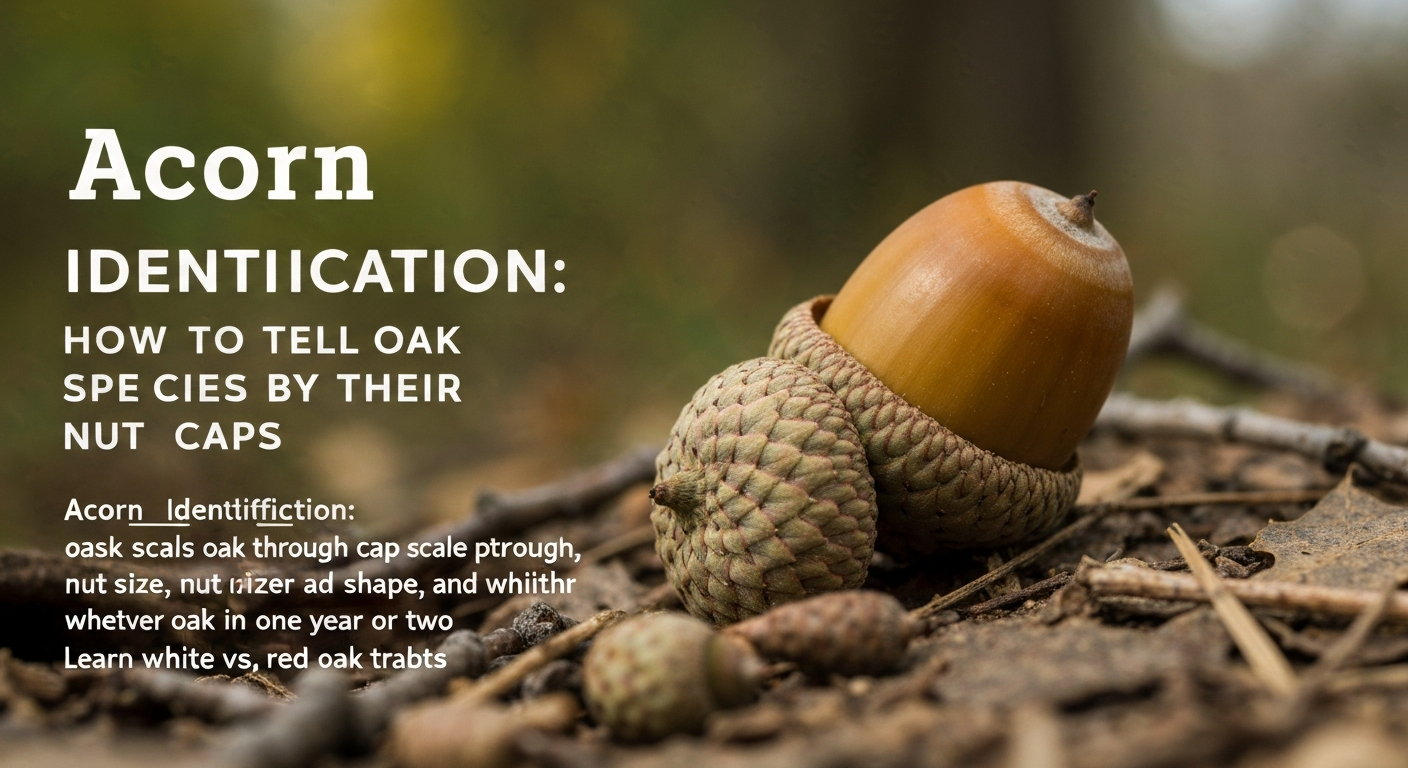
TL;DR: Acorn identification uses the nut's size and shape plus the cap (cupule) — how deep it sits, what the scales look like, and how much of the nut it covers. White oak acorns mature in one year; caps are often shallow with bumpy scales. Red oak acorns take two years; caps are often deeper with tighter scales. Species like bur oak have unmistakable fringed caps. Collect fallen acorns under the parent tree, photograph cap and nut in profile, and confirm with the Tree Identifier app. Pair with our oak tree identification guide for leaves and bark.
🌰 Acorn identification shortcut: cap depth + scale texture + nut size narrows oak species fast. White oak group = one-year acorns; red oak group = two-year acorns.
What is an acorn — structure for ID
An acorn is the fruit of an oak tree (Quercus species). Botanically it is a nut seated in a woody cup called the cupule — what most people call the cap. Acorn identification starts by naming the parts you are comparing.
Nut: The seed itself — oval, cylindrical, or rounded, with a pointed tip (apex) and a scar at the base where it attached to the cup. Color ranges from green when immature to brown or tan when ripe.
Cupule (cap): Scaly armor holding the nut. Scales may be flat, knobby, elongated, or fringed. The cup can be shallow (saucer-like) or deep (covering half the nut or more).
Stalk (peduncle): Some acorns hang on long stalks; others sit sessile (directly on the branch). Stalk length is a species character — pin oak has notably thin long stalks.
Oaks are divided into two major groups for acorn identification and leaf ID: the white oak group (subgenus Quercus) and the red oak group (subgenus Lobatae or Erythrobalanus). The groups differ in acorn maturation, chemistry, and often cap form.
White oak vs red oak acorns
The white oak vs red oak split is the foundation of acorn identification in North America.
White oak group acorns:
- Mature in one growing season — flower in spring, ripe acorn drops same fall.
- Often lower tannin — some were historically leached and eaten.
- Caps typically shallow, covering less than one-third of the nut.
- Scales may appear warty, knobby, or in loose irregular rows.
- Leaves usually have rounded lobes without bristle tips (exceptions exist).
Red oak group acorns:
- Mature in two growing seasons — flower in year one, ripe acorn drops year two.
- Higher tannin — bitter; wildlife still caches them.
- Caps often deeper, covering one-third to more than half the nut.
- Scales tighter, flatter, more uniform — sometimes resembling fish scales.
- Leaves typically have pointed lobes with bristle tips at lobe ends.
On the tree, two-year red oak acorns of different ages may appear on the same branch — small immature year-one acorns beside larger ripe year-two acorns. That alone signals red oak group.
Cap scale patterns — the detail that separates species
Cap scale pattern is where acorn identification gets species-specific. Study the cup from the side and top.
Scale texture: Smooth flat scales suggest many red oaks. Knobby or tuberculate scales point toward white oaks like white oak (Quercus alba) or post oak.
Scale fringe: Bur oak (Quercus macrocarpa) has a dramatic fringed margin — elongated loose scales hanging down the nut like a skirt. No other common oak matches it.
Cup depth: Measure roughly what fraction of the nut the cap covers. Overcup oak (Quercus lyrata) — name says it all — encloses most of the nut. Live oak acorns are often elongated with shallow cups.
Inner surface: When caps detach, the inside of the cup and the base scar on the nut can show hairiness or smoothness — useful for southern live oaks and willow oak.
Photograph one acorn on its side with cap fully visible, and one from above showing scale arrangement. See Best Photo for Tree ID for small-subject lighting tips.
Nut size and shape by common species
Acorn identification by size works when you know regional common species. Always compare multiple acorns — one nut can be stunted.
White oak (Quercus alba)
Medium nut, 0.5 to 1 inch long, oval to cylindrical. Shallow warty cap covers about one-quarter of the nut. Light brown when ripe.
Bur oak (Quercus macrocarpa)
Large nut, 1 to 2 inches, often oval. Fringed bur-like cap covers half or more. Iconic acorn identification species — unmistakable once seen.
Post oak (Quercus stellata)
Small to medium, often stubby. Cap has coarse knobby scales, covers about one-third. Common in dry uplands of the central and eastern US.
Northern red oak (Quercus rubra)
Medium, 0.75 to 1.25 inches, broadly oval. Cap is saucer-shaped, fairly flat, covering about one-quarter. Tight flat scales.
Pin oak (Quercus palustris)
Small, often under 0.75 inch, rounded. Very shallow cap. Thin long stalk — acorns look like they dangle on threads.
Willow oak (Quercus phellos)
Small, chestnut-brown, oblong — almost cylindrical like a large grain of rice. Shallow cup. Fits the narrow willow-like leaves of the tree.
Live oak (Quercus virginiana)
Dark elongated nut, often pointed, 0.5 to 1 inch. Shallow cap with fine scales. Produced on evergreen southern oaks — acorns drop in fall among glossy leaves.
Ground collection and habitat context
Acorn identification in the field means collecting from beneath the suspected parent tree.
- Stand under the canopy and look for fresh drops — caps and nuts scattered in leaf litter.
- Look up for branch architecture and any remaining leaves.
- Gather 3 to 5 acorns — compare average size, not the outlier.
- Note habitat: Wet bottomland favors pin oak and willow oak; dry ridges favor post oak; savannas favor bur oak.
- Check squirrel caches — middens sometimes hold identifiable caps.
Squirrels transplant acorns, so a lone nut on a lawn may not match the nearest ornamental tree. Priority goes to dense drop zones directly under a mature oak crown.
Immature vs ripe acorns
Early-season acorn identification requires caution. Green acorns in August may show final cap form but nut size is not full. Ripe acorns in September through November have brown nuts that detach cleanly from the cup.
Green acorns: Useful on the branch for cap shape study; size understates mature dimensions.
Ripe acorns: Best for nut length and color. Caps may separate on impact — collect caps from the ground too.
Predation damage: Squirrel-gnawed or weevil-holed acorns still show cap characters if the cup is intact.
Acorn identification without the tree present
Found a single acorn on a trail? Acorn identification is harder but not impossible.
Match cap and nut to a regional field guide or app. Fringed bur oak caps and rice-shaped willow oak nuts are distinctive anywhere in range. Generic medium oval acorns may only resolve to "white oak group" or "red oak group" without more context.
Add a photo of associated leaf litter — lobed leaves with bristle tips confirm red oak group; rounded lobes suggest white oak group. Our oak tree guide covers leaf and bark characters that pair with acorn ID.
For vocabulary on fruit types beyond acorns, see Tree Anatomy Glossary.
Regional and lesser-known acorns
Beyond the common eastern species, acorn identification extends to local natives:
- Chestnut oak (Quercus montana): Large sweetish acorn, bowl-shaped cap — overlaps bur oak in size but without fringed scales.
- Chinkapin oak (Quercus muehlenbergii): Small oval nut, often striped, very shallow thin cap.
- Black oak (Quercus velutina): Red oak group; cap covers about half the nut; inner surface of cap often woolly.
- Oregon white oak (Quercus garryana): Pacific Northwest; medium acorn, shallow knobby cap.
- Valley oak (Quercus lobata): California; large elongated acorns, shallow cap — can resemble bur oak without the fringe.
Local oak diversity rewards carrying a small ruler or coin in your pocket for scale in photos.
Acorns vs other tree nuts
Acorn identification means ruling out non-oak nuts:
- Hickory: Four-part husk splitting open — not a scaly cupule.
- Walnut and butternut: Green fleshy husk rots away to leave hard nut — no scaly oak cap.
- Beech: Small triangular nut in spiky bur — different architecture entirely.
- Chestnut (Castanea): Spiny bur enclosing multiple nuts — not a single acorn in a cup.
- Horse chestnut: Large round nut with pale scar — no scaly cup; toxic, not a true oak acorn.
The scaly cupule is the oak signature. If the "cap" is a husk or spiny bur, you are not doing acorn identification — you have a different fruit type.
Using Tree Identifier for acorn ID
Tree Identifier identifies oaks from acorn close-ups when cap detail is sharp.
Best photos: Side profile with cap and nut fully in frame. Top-down shot of cap scales. Add a fallen leaf from the same tree when possible.
Scale reference: Place a coin or finger beside the acorn for size calibration — helps separate similar species.
Limitations: Heavily gnawed or moldy acorns may fail. Photograph the best intact specimen under the tree.
Acorn identification turns autumn walks into detective work — caps litter the ground like clues, and every species writes its signature in scale and shape.
Frequently asked questions
How do you identify an acorn?
Identify acorns by the nut shape, size, and especially the cap (cupule) — scale texture, depth, and how much of the nut the cap covers. Note whether scales are knobby, smooth, or fringed. Measure nut length. Check if the acorn matures in one season (white oak group) or two (red oak group). Habitat and associated leaf litter help confirm species.
What is the difference between white oak and red oak acorns?
White oak acorns mature in one year and are often sweeter with less tannin. Caps are usually shallow, covering less than one-third of the nut; scales may look bumpy or warty. Red oak acorns take two years to mature, are bitter with more tannin, and caps often cover more of the nut with tighter overlapping scales. Red oak group leaves typically have pointed bristle-tipped lobes.
What do bur oak acorns look like?
Bur oak acorns are large — among the biggest North American acorns — often 1 to 2 inches long with a distinctive fringed bur-like cap covering half or more of the nut. The cap has loose scales that extend down the nut like a mossy skirt. Nuts are oval to cylindrical. Bur oak is a white oak, maturing acorns in one season.
Can you identify oak trees from acorns alone?
Often yes, with practice. Acorn size, cap depth, scale ornamentation, and nut shape are species-specific for many oaks. Combine acorn ID with bark, leaf shape from litter, and tree form for confidence. Some species overlap — photograph acorn next to a fallen leaf for app confirmation.
Why do some acorns have caps and some do not?
The cap (cupule) is the oak's fruit cup that holds the nut while it develops. When acorns fall, caps often detach — especially on red oaks. Finding caps still attached or caps littered under the same tree helps acorn identification. Cap attachment style varies by species.
When is the best time for acorn identification?
Late summer through fall when acorns drop. Early season green acorns on branches show cap form before squirrels harvest them. Winter searches under leafless oaks can find leftover nuts and caps on the ground. Spring is poor — last year's crop is gone and new acorns are tiny and immature.
Can tree ID apps identify oaks from acorn photos?
Yes, when photos show clear cap scale detail and nut profile. Apps work best with the acorn on a plain background and a leaf from the same tree if possible. Tree Identifier recognizes common North American oaks from acorn and cap close-ups across their native range.
Try Tree Identifier — free on iPhone
Photograph an acorn and cap and get an oak species match in seconds.
Download on the App Store