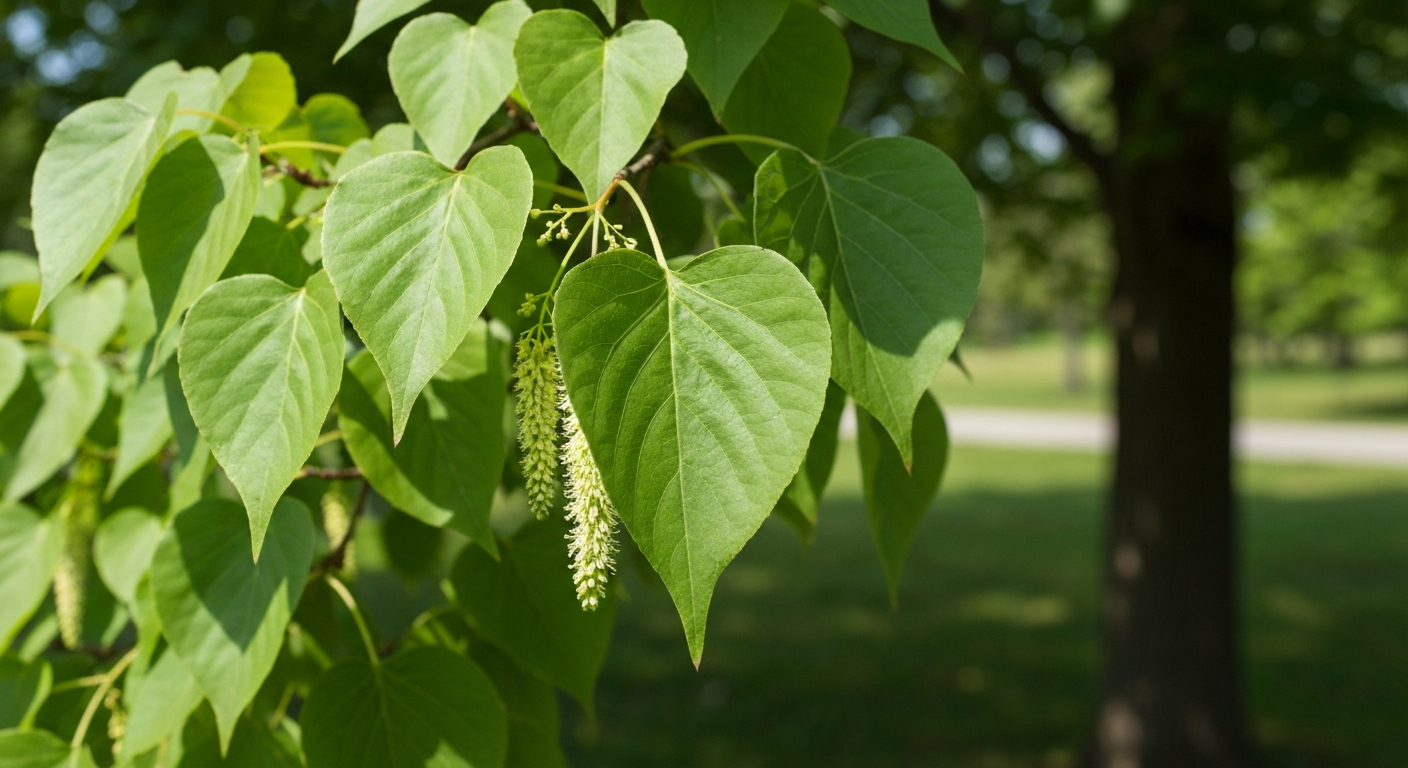
TL;DR: Basswood tree identification — also called American linden — relies on large heart-shaped leaves with an asymmetrical base (one side of the leaf bottom is larger than the other), fragrant creamy flowers in late June and July hanging from a long pale bract, and small woody nutlets that persist on the bract into fall. American basswood (Tilia americana) is a tall native tree of rich eastern forests, often growing with sugar maple and beech. Bark is gray and furrowed. Photograph a leaf showing the uneven base and a flowering bract, then confirm with the Tree Identifier app.
💛 Basswood tree identification in one season: June flowers smell like honey and hang from a ribbon-like bract. Off-season, the lopsided heart-shaped leaf is your best clue.
Understanding basswood — Tilia americana
Basswood belongs to genus Tilia, the lindens. American basswood (Tilia americana) and its varieties dominate eastern North American forests from Canada to the Gulf, west to the Great Plains. People call it basswood, bee tree, or linden — all refer to the same beloved honey plant.
Basswood tree identification matters because it is a major forest tree — soft light wood for carving, premium honey, and a canopy species in mesic hardwood stands. It is also planted as a street tree, sometimes as European littleleaf linden (Tilia cordata), which shares the genus traits but differs in leaf size and crown form.
Genus-level traits for Tilia:
- Leaves: Alternate, simple, heart-shaped to ovate, coarsely serrated margins.
- Leaf base: Often asymmetrical — one lobe of the heart extends lower on the petiole.
- Flowers: Fragrant, creamy, in clusters attached to a narrow pale bract.
- Fruit: Small hard nutlet, usually one per flower, still joined to the bract.
- Bark: Gray, ridged and furrowed on mature stems.
- Form: Tall straight trunk, domed crown, branches often slightly drooping.
Basswood is not opposite-leaved like maple — leaves are alternate. That single fact separates basswood from maple lookalikes with heart-shaped leaves (there are few). See Tree Anatomy Glossary for leaf arrangement terms.
Basswood leaf identification
Basswood leaf identification is the year-round skill when flowers are absent.
Shape: Broad ovate to cordate (heart-shaped), 4 to 8 inches long on mature trees, sometimes larger on vigorous shoots. Tip tapers to a long point (acuminate).
Asymmetrical base: The hallmark. Stand the petiole vertical — one side of the leaf blade extends noticeably lower than the other. The leaf looks lopsided, not symmetric like a valentine cutout. European linden leaves can be more symmetric; American basswood asymmetry is pronounced.
Margin: Coarsely serrated — large pointed teeth. Not deeply lobed.
Texture: Thin, soft, flexible — not leathery. Prominent pinnate veins; undersides often paler with tufts of hair in vein axils.
Petiole: Slender, often 2 to 4 inches long — leaves tremble in light wind like poplar.
Photograph one leaf with the base clearly visible against a light background. The asymmetry must show. See Best Photo for Tree ID for leaf photography.
Fragrant flowers and the bract
Summer basswood tree identification is easiest when trees bloom — you may smell the tree before you see it.
Timing: Late June through July, depending on latitude. Blooms after spring maple and oak flowering.
Flower clusters: 6 to 20 creamy yellow-white fragrant flowers hang together from a pale green-yellow bract — a modified leaf 3 to 5 inches long that looks like a narrow ribbon or tongue. The bract helps disperse the fruit cluster in wind later.
Fragrance: Intensely sweet — bees cover the canopy. Basswood honey is light and floral.
Where to look: Flowers emerge from leaf axils below the bract on new growth. Whole neighborhoods can smell sweet when street lindens bloom.
If you identify trees by season, basswood flowering week is the highest-confidence window for basswood tree identification.
Fruit — nutlets on bracts
After flowers, small round woody nutlets form — usually one per flower in the cluster, ¼ inch or so, hard-shelled. The bract dries to tan and carries the nutlet cluster into fall and winter.
Nutlets are not showy like acorns. They hang under the bract ribbon — a distinctive silhouette against sky in late summer. For comparison with other fruit types, see How to Identify Nut Trees — basswood nutlets are small and bract-borne, not true nuts in the culinary sense.
Bark and winter identification
Mature American basswood bark is thick, gray to brown-gray, with long vertical ridges separated by deep furrows. Young trees are smoother, silvery gray.
Winter basswood tree identification uses:
- Buds: Alternate, plump, reddish-brown, often lopsided or swollen on one side.
- Twigs: Slender, zigzag somewhat, reddish in sun.
- Leaf scars: Alternate, half-round with multiple bundle scars.
- Persistent bracts: Tan papery bracts with nutlets may still hang on twigs into winter.
Bark resembles ash or walnut from a distance — not blocky like ash, not dark chocolate like black walnut. Pair bark with buds and old bracts. For bark workflows, see Tree Bark Identification App Guide.
Form and habitat
American basswood grows 60 to 80 feet tall, occasionally taller in rich coves. Crown is domed, symmetrical, with drooping lower branches on open-grown specimens.
Habitat: Mesic hardwood forests — moist but well-drained slopes and bottomlands. Common associates: sugar maple, red oak, white ash, ironwood. Basswood seedlings tolerate shade.
Urban: European lindens (Tilia cordata, Tilia europaea hybrids) line streets — smaller leaves, denser crown, same flower-bract system.
American basswood vs European linden
Basswood tree identification in cities may mean separating native basswood from planted lindens.
American basswood (Tilia americana): Larger leaves (4 to 8 inches), strong asymmetrical base, tall forest tree.
Littleleaf linden (Tilia cordata): Smaller leaves (1 to 3 inches), rounder heart shape, common street tree, very fragrant.
Silver linden (Tilia tomentosa): Leaves white-fuzzy beneath — distinctive when visible.
All produce bracted fragrant flowers — genus confirmation is easy in June.
Lookalikes and confusion species
Large-leaved poplar and cottonwood
Alternate leaves, fluttering habit, but leaves are more triangular or ovate without strong asymmetrical heart base. No fragrant bracted flowers. Buds are resinous and sticky on balsam poplar.
Red mulberry (Morus rubra)
Alternate leaves can be heart-shaped or lobed; sap milky when broken. Fruit is aggregate blackberry-like, not nutlets on bracts.
American elm
Asymmetrical leaf bases occur in elms too — but elm leaves are doubly serrated and smaller, with a different bark (often vase-shaped crown on American elm, though Dutch elm disease removed many).
Hop-hornbeam and ironwood
Much smaller leaves, shaggy or muscle-like bark — not tall straight basswood form.
Uses and why people search basswood
Basswood wood is soft, light, and fine-grained — classic for woodcarving, model building, and crates. Native peoples used fibrous inner bark (bast) for cordage — the "bass" in basswood may derive from bast.
Beekeepers track basswood bloom for honey flows. Homeowners search basswood tree identification when mysterious June fragrance fills the yard.
Using Tree Identifier for basswood
Tree Identifier recognizes American basswood and common lindens from leaves and flowering branches.
Best photos: One leaf with asymmetrical base visible. One flowering cluster showing bract and creamy blooms. Bark on mature trunk as backup.
Season tips: June-July flower photos are highest confidence. Fall leaf color is pale yellow — not distinctive alone.
Basswood tree identification rewards attention to leaf base symmetry — a small detail that locks in a beautiful forest giant.
Frequently asked questions
How do you identify a basswood tree?
Identify basswood (American linden, Tilia americana) by large heart-shaped leaves with an asymmetrical base — one side of the leaf base is larger than the other. Leaves are alternate, coarsely toothed, and 4 to 8 inches long. In early summer, clusters of fragrant creamy flowers hang from a long pale green bract that acts like a ribbon. Fruit is a small woody nutlet attached to the same bract. Bark is gray and deeply furrowed on mature trees.
What does a basswood leaf look like?
A basswood leaf is broad, ovate to heart-shaped, with a pointed tip and serrated margin. The distinctive character is the uneven or lopsided base where the leaf meets the petiole — one side extends farther down the stem than the other. Leaves are soft and thin with prominent veins. They flutter in wind on long slender petioles. Basswood leaves resemble mulberry or some poplar leaves but have the asymmetrical base and alternate arrangement.
What is the difference between basswood and linden?
Basswood and linden are common names for the same genus Tilia. American basswood (Tilia americana) is the native eastern North American species. European linden (Tilia cordata, Tilia platyphyllos) is planted as an ornamental street tree. All share heart-shaped leaves, fragrant flowers on bracts, and nutlet fruit. European linden leaves are often smaller and more perfectly heart-shaped with less asymmetry.
When do basswood trees flower?
American basswood flowers in late June through July in most of its range — after many spring bloomers finish. Creamy yellow-white flowers cluster on a pale leaf-like bract 3 to 5 inches long. The fragrance is strong and honey-sweet, attracting bees from great distances. Basswood honey is prized. Flower identification is the easiest basswood tree ID moment of the year.
What does basswood bark look like?
Young basswood bark is smooth gray-green. Mature bark is thick, gray to brown, with long vertical ridges and deep furrows — somewhat like ash or walnut from a distance but without the diamond pattern of ash. Basswood trunks are straight and tall with a domed crown. Bark alone is not definitive; pair with leaves or summer flowers.
How do you tell basswood from mulberry or poplar?
Mulberry has alternate leaves but often lobed shapes and milky sap when broken; fruit is blackberry-like, not nutlets on bracts. Poplar and aspen leaves are more triangular or rounded, not strongly heart-shaped with asymmetrical bases, and they do not produce fragrant bracted flower clusters. Basswood leaves are larger and softer than most poplar leaves on similar-sized trees.
Can tree ID apps identify basswood?
Yes, especially with flower-and-bract photos in June or July. Leaf photos work when the asymmetrical heart shape and coarse teeth are clear. Apps may confuse basswood with linden cultivars or large-leaved poplar — include flowers or fruit bracts when possible. Tree Identifier handles basswood well on full leaf and flowering branch photos.
Try Tree Identifier — free on iPhone
Photograph basswood leaves or flowering bracts and get a species match in seconds.
Download on the App Store