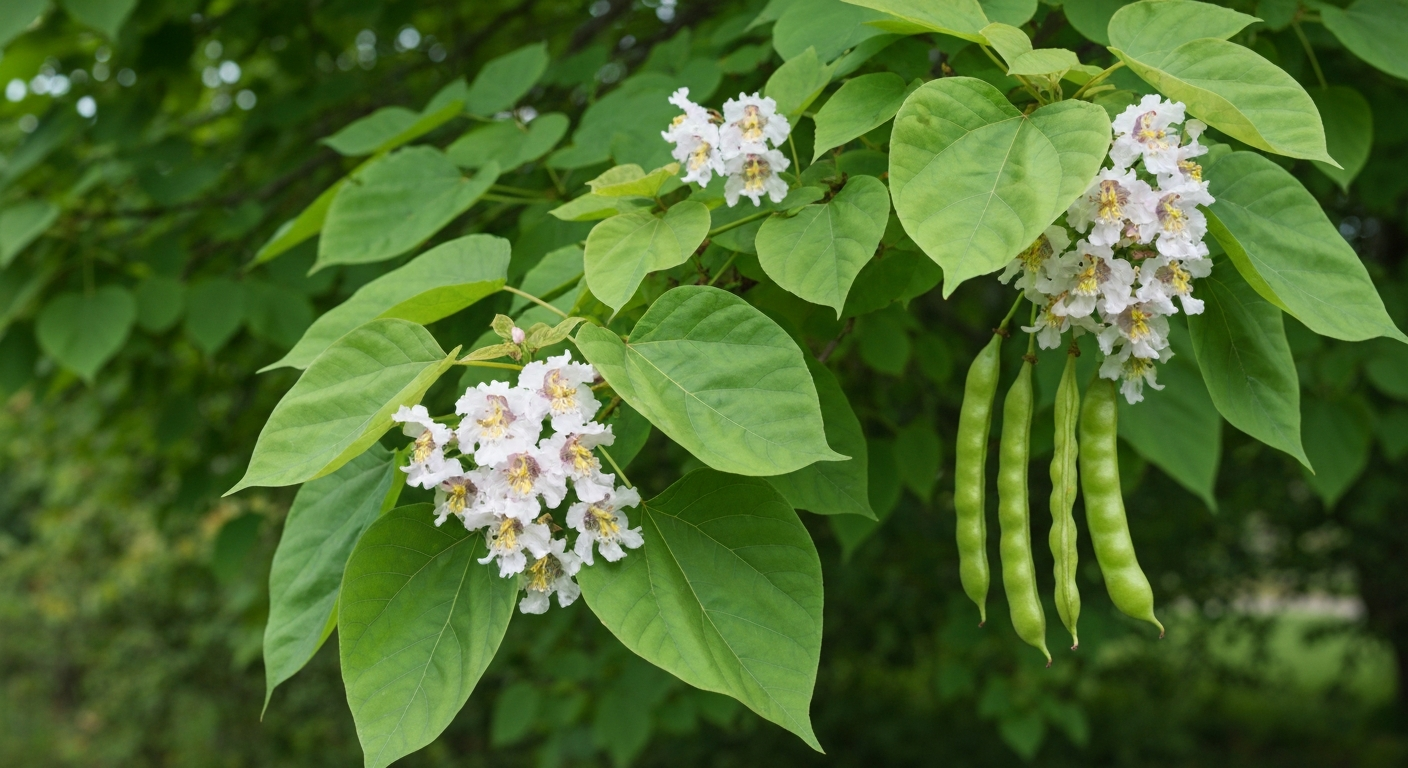
TL;DR: Catalpa tree identification is easy once you stack three traits: oversized heart-shaped leaves (often in whorls of three), orchid-like white flowers with purple and yellow interior markings, and long slender bean-like seed pods that hang through winter. Northern catalpa (Catalpa speciosa) and southern catalpa (Catalpa bignonioides) share this look. Photograph a full leaf and a pod cluster, then confirm with the Tree Identifier app.
🫘 Catalpa tree identification in one line: giant heart leaves + orchid flowers + foot-long “beans”. No other common US yard tree owns that combination.
Meet the catalpas — family and native range
Catalpas belong to the trumpet-creeper family (Bignoniaceae). Two species dominate North American plantings and fencerows: northern catalpa (Catalpa speciosa) and southern catalpa (Catalpa bignonioides). Both produce the signature leaf–flower–pod suite used in catalpa tree identification.
Northern catalpa is native to a restricted Midwestern river-bottom corridor and widely planted farther east and north for its cold hardiness. Southern catalpa is native farther south and planted as a street and yard tree across the Southeast and Mid-Atlantic. Outside native zones, both persist as volunteers and escapees near old farms — “catalpa lanes” with beans hanging in winter are a cultural landscape of the Midwest and South.
People also say “catawba tree” or “Indian bean tree.” Those folk names refer to the same genus. For general leaf method before species pages, see identify trees by leaf; for term definitions, use the tree anatomy glossary.
Leaf traits for catalpa tree identification
Shape and size: Leaves are simple — one blade per petiole — and dramatically large for a temperate deciduous tree. A typical mature leaf measures 6 to 12 inches long and 4 to 8 inches wide, sometimes larger on vigorous sprouts. The base is cordate (heart-shaped); the tip is abruptly pointed. Margins are entire or only vaguely wavy — not sharply toothed like birch or elm.
Texture and color: Upper surfaces are medium to dark green and somewhat soft or dull, not high-gloss like southern magnolia. Undersides are paler. Crushed leaves may smell faintly unpleasant to some noses; scent is secondary to shape.
Arrangement — the whorl clue: Catalpa frequently places leaves in whorls of three at a node. Opposite pairs also occur. Whorled leaves are rare among common yard trees; if you see three large heart blades radiating from one point on a twig, catalpa tree identification is almost finished before you look for pods.
Compare with lookalikes: Eastern redbud also has heart-shaped leaves, but they are much smaller (2–5 inches), alternate (not whorled), and paired with magenta spring flowers and flat short pods — not foot-long beans. Princess tree (Paulownia tomentosa) has large heart leaves and is a real lookalike; its flowers are lavender foxgloves-on-a-stick in early spring, and seed capsules are egg-shaped, not long beans. Always check fruit.
Photograph one leaf flat against sky or pavement so the heart base shows clearly — tips from best photo for tree ID.
Flowers — orchid-like pansicles
Catalpa flowers appear after leaves unfold, usually late May into June depending on latitude. They form large panicles — branched clusters — of tubular white blossoms. Each flower has a frilled lip and interior purple stripes plus yellow nectar guides, giving the orchid or foxglove comparison people use in field notes.
The bloom period is short, often one to two weeks at peak spectacle. Bees and other pollinators mob the trees. If you are present during bloom, catalpa tree identification needs almost no other trait — photograph the panicle and move on to species vs lookalike checks.
Princess tree blooms earlier, often before or with early leaf flush, in upright purple clusters. Do not confuse early paulownia bloom for catalpa; wait for pods later in the year if unsure.
Fruit — the famous catalpa beans
After flowering, catalpas set elongated capsules commonly called beans or Indian beans. They are not legumes. Pods grow slender and cylindrical, commonly 8 to 20 inches long on northern catalpa and somewhat shorter on southern catalpa. Green through summer, they mature brown, persist into winter, and eventually split lengthwise to release flat, oblong, winged seeds.
Winter silhouettes with dangling brown pods against bare twigs are classic Midwestern farm road scenery — and the easiest catalpa tree identification season for drivers. Fallen pods under snow still identify the tree when leaves are gone.
Compare with honey locust pods: locust pods are flatter, broader, twisted, and accompany tiny compound leaflets, not giant heart leaves. Redbud pods are short, flat, and pealike. Kentucky coffee tree pods are thicker and shorter with different leaflets. Leaf structure eliminates confusion quickly.
Bark, form, and size
Bark: Mature catalpa bark is gray to reddish-brown with irregular ridges and shallow furrows. It lacks the dramatic peeling of sycamore or river birch. Young bark is smoother. Bark alone rarely IDs catalpa without leaf or pod context — use bark methods as a confirmation layer, not the first clue.
Form: Irregular, spreading crown; often short trunk with heavy limbs. Northern catalpa can reach 40–70 feet; southern catalpa is frequently smaller. Suckering and broken limbs after storms are common — wood is relatively weak.
Twigs: Stout, with large leaf scars. Whorled scars remain visible in winter and help catalpa tree identification when pods have dropped.
Northern vs southern catalpa
| Trait | Northern (C. speciosa) | Southern (C. bignonioides) |
|---|---|---|
| Hardiness | Hardier; Midwest and north plantings | Warmer Southeast preference |
| Height | Often taller (to ~70 ft) | Often smaller / broader |
| Pods | Typically longer, thicker | Typically shorter, more slender |
| Leaf arrangement | Whorls less consistent | Whorls of three more regular |
| Flowers | Slightly larger on average | Slightly smaller clusters often |
Beginners rarely need precise species for yard talk — “catalpa” is enough. Foresters and nurseries separate them by hardiness zone and provenance. Apps often return “northern catalpa” or “southern catalpa” based on photo plus location; trust location when leaf traits overlap.
Habitat and cultural context
Catalpas prefer moist, fertile soils but tolerate urban plantings, roadsides, and farmyards. They are sun-loving. Historically planted for fence posts, shade, and ornamental bloom. The catalpa sphinx moth uses leaves as host plants — caterpillars appear in midsummer and can defoliate branches; that insect association is itself a soft field clue when you find large green hornworms on huge heart leaves.
If your site is a typical suburban lawn among oaks and maples, catalpa still appears as a legacy planting. Cross-check neighbors with common backyard trees so you do not force every large leaf into the catalpa slot — size alone is not enough without heart shape and pods.
Seasonal calendar for ID
- Early spring: Stout buds and thick twigs; last year’s pods may still hang.
- Late spring / early summer: Leaves expand; orchid-like flowers peak — best photo season.
- Summer: Giant leaves dominate the silhouette; green pods elongate.
- Fall: Leaves yellow and drop early in some climates; brown pods persist.
- Winter: Pods and large leaf scars sell catalpa tree identification from the sidewalk.
For foliage-season technique across species, see how to identify tree foliage.
Lookalikes checklist
- Paulownia (princess tree): Large heart leaves; purple early flowers; oval capsules — not long beans.
- Eastern redbud: Small hearts; magenta cauliflory; short flat pods.
- Linden / basswood: Heart-ish leaves but smaller, toothed, with asymmetrical bases and fragrant summer flowers on wing-bracts — no long pods.
- Mulberry: Variable lobed or unlobed leaves — never truly catalpa-giant; blackberry-like fruit.
When someone texts a blurry canopy shot asking “what type of tree is this?”, ask for one leaf and one pod photo — that pair resolves catalpa faster than any silhouette. See what type of tree is this for photo-first triage.
Using Tree Identifier for catalpa
Tree Identifier recognizes catalpa from leaf and pod photos with high confidence when the heart base and leaf size are visible. Best practice: one leaf filling the frame, one photo of hanging pods, optional flower panicle. Include a hand or notebook for scale — size is part of catalpa tree identification and helps separate redbud.
If the app offers paulownia as an alternate, check fruit: long beans = catalpa; rounded capsules = paulownia. Geography helps — paulownia is a common invasive in the Appalachians and Mid-Atlantic; catalpa is common near Midwest farmsteads.
For choosing among mobile tools, see app to identify trees.
Care and caution notes (identification adjacent)
Catalpa wood is brittle; storm damage creates hanging hazards. Litter annoyance is real. None of that changes ID. Do not confuse catalpa pods with edible beans — they are ornamental/seed capsules, not food crops. Spotted leaves late in summer often reflect catalpa sphinx feeding, not a different species.
Catalpa tree identification rewards beginners because the traits are bold. Once you ID one tree on a rural road, you will see them everywhere pods dangle against winter sky.
Frequently asked questions
How do you identify a catalpa tree?
Catalpa tree identification rests on three traits: very large heart-shaped leaves, showy white orchid-like flowers with purple and yellow markings in late spring or early summer, and long slender bean-like seed pods that hang into fall and winter. Leaves are often arranged in whorls of three. Bark is gray-brown and ridged on mature trunks. No other common backyard tree combines giant heart leaves with foot-long pods.
What is the difference between northern and southern catalpa?
Northern catalpa (Catalpa speciosa) is hardier, typically taller, with slightly longer pods and leaves that are often less densely whorled. Southern catalpa (Catalpa bignonioides) is smaller, more shrubby in form sometimes, with shorter pods and leaves more consistently in whorls of three. Flowers are similar — white tubular bells with purple and yellow interior spots. Range and hardiness separate them more than beginner leaf traits.
What do catalpa leaves look like?
Catalpa leaves are simple, heart-shaped to broadly ovate, often 6 to 12 inches long and nearly as wide, with a pointed tip and smooth or slightly wavy margins. Surfaces are soft and dull green above, paler beneath. Arrangement is commonly whorled — three leaves at a node — which is rare among yard trees and a strong catalpa tree identification clue.
What are the long beans hanging from catalpa trees?
They are seed pods — elongated capsules, not true beans. Pods can grow 8 to 20 inches long, slender, green in summer and turning brown in fall. They split to release flat winged seeds. Persistent winter pods are classic catalpa tree identification markers along streets and farmyards.
When do catalpa trees flower?
Catalpas flower in late spring to early summer — typically May to June depending on region — in large upright to spreading panicles. Each flower is white, tubular, and orchid-like with purple stripes and yellow blotches inside. Flower display is brief but unmistakable for catalpa tree identification.
Are catalpa trees messy?
Homeowners often call them messy because large leaves, spent flowers, and long pods drop over a long season. From an identification standpoint, that litter is useful: fallen heart leaves and bean pods under the canopy confirm catalpa even when flowers are gone. Plant away from sidewalks if litter bothers you.
Can a tree ID app identify catalpa?
Yes — giant heart leaves and long pods are distinctive training features. Photograph a full leaf showing the heart base and tip, a pod cluster if present, and flowers in season. Tree Identifier handles both northern and southern catalpa well when leaf size and shape are clear in the frame.
Try Tree Identifier — free on iPhone
Photograph catalpa’s giant heart leaves or dangling bean pods and get a species match in seconds.
Download on the App Store