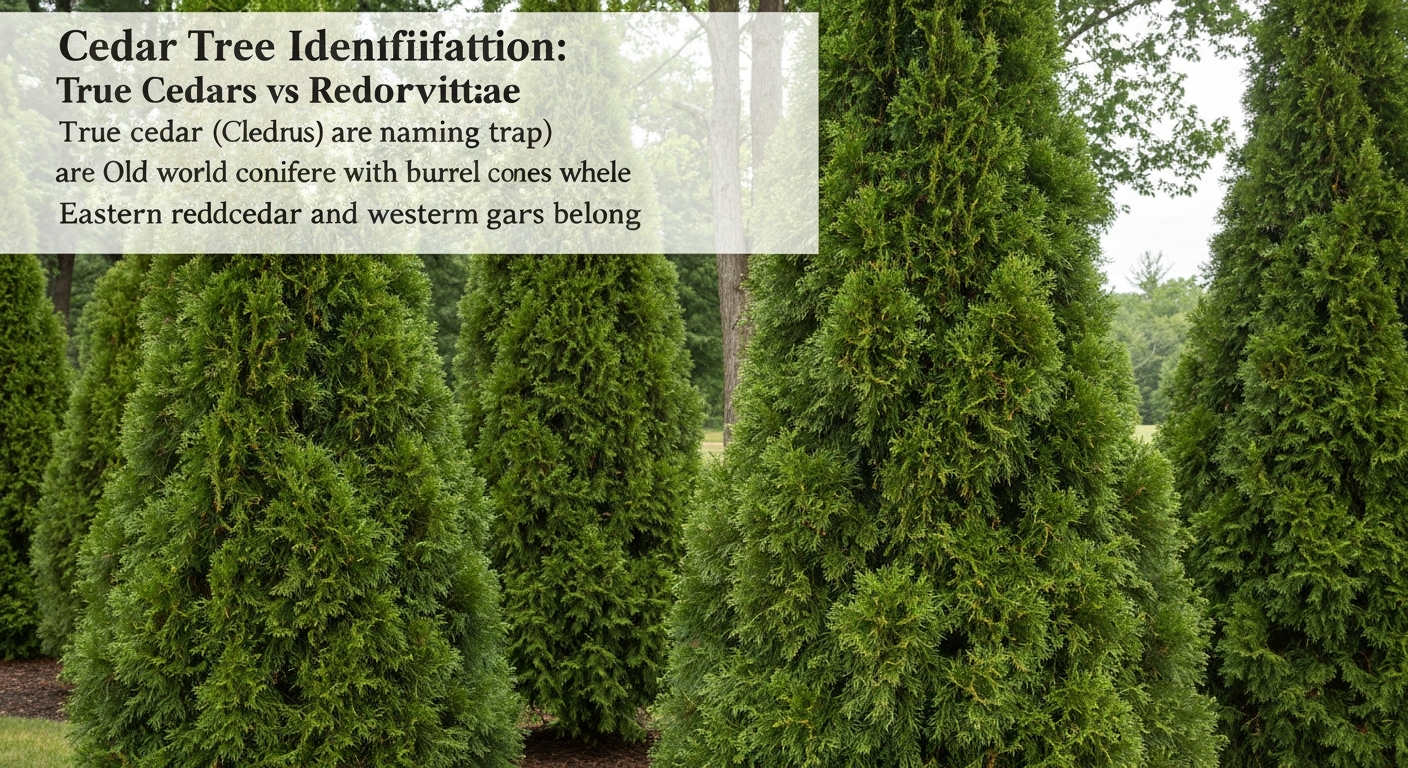
TL;DR: Cedar tree identification in North America means three different plant groups: true cedars (Cedrus — needles in clusters, large upright barrel cones), eastern redcedar (Juniperus virginiana — juniper with scale leaves and blue berry-cones), and western redcedar (Thuja plicata — flat aromatic scale sprays, shreddy bark, tiny woody cones). The word cedar is shared; the botany is not. Photograph foliage type and cones, note your region, and confirm with the Tree Identifier app.
🌲 Cedar naming trap: If cones are blue and berry-like → juniper (eastern redcedar). If cones are huge barrels on upper branches → true Cedrus. If foliage is flat fan sprays with cedar scent → Thuja arborvitae.
Why cedar identification is confusing
English plant names recycle "cedar" for any aromatic evergreen with scale-like or needle foliage. Cedar tree identification therefore starts with taxonomy, not aroma alone.
Three groups dominate cedar searches in North America:
- True cedars (Cedrus): Old World pines-family relatives planted in parks and yards — Lebanon cedar, deodar cedar, Atlas cedar.
- Eastern redcedar (Juniperus virginiana): Native juniper across eastern and central US — fence-row colonist, cedar chest wood source.
- Western redcedar / arborvitae (Thuja): Thuja plicata in the Pacific Northwest; Thuja occidentalis (northern white-cedar) in wet northeastern forests and as landscape hedges.
Cedar identification errors send hikers to the wrong field guide page — junipers and arborvitae are in the cypress family (Cupressaceae); true cedars sit with pines in Pinaceae. Leaf architecture and cedar cones identification split them in one minute with a good photo.
True cedars — genus Cedrus
True cedars are native to the Mediterranean and Himalayas, widely planted as ornamentals in North America. Cedar tree id for Cedrus uses needles and cones — not scales.
Needles and shoots
Cedrus bears short, stiff, dark green needles on woody spur shoots — clusters that look like short bottle brushes on older branches. Needles are single and not flattened into overlapping scales. From a distance, true cedars look looser and more open than arborvitae hedges.
Cedar cones identification — Cedrus
The signature of true cedars: large woody barrel cones 3 to 5 inches long, often upright on upper branches, resembling fat candles. Cones disintegrate on the tree while still attached — scales and winged seeds fall over months. Find cone debris under the tree year-round in plantings.
Common true cedar species in landscapes
Deodar cedar (Cedrus deodara): Drooping branch tips, blue-green needles, graceful habit — common in southern and western US parks.
Atlas cedar (Cedrus atlantica): Blue Atlas cultivars are popular — silvery blue needles, level or slightly ascending branches.
Lebanon cedar (Cedrus libani): Wide flat crown in maturity; horizontal branching; planted in arboreta and estates.
Bark: Dark gray, furrowed on old trunks — less diagnostic than cones. True cedar bark does not shred in long fibrous strips like Thuja.
Eastern redcedar — Juniperus virginiana
Eastern redcedar is the default cedar tree identification answer for most of the eastern United States. It is a juniper — cedar tree id here means juniper ID.
Leaves — awl vs scale
Juvenile eastern redcedar and shaded lower branches carry sharp awl-shaped needles, prickly to touch. Mature sun-exposed foliage shifts to overlapping scale leaves pressed tight to the twig — like miniature cypress scales. Both forms often coexist on one tree — a hallmark of juniper cedar identification.
Cones — blue berries
Eastern redcedar does not produce woody pine cones. Cedar cones identification for this species means fleshy blue-gray berry-like galbuli — round, waxy bloom, ¼ inch, eaten by cedar waxwings and robins. Female trees bear berries; males produce pollen cones in spring (yellow dust).
Bark and form
Bark is reddish-brown, fibrous, shreddy in long vertical strips — aromatic when rubbed. Crown is often narrow and columnar in open sun, broader in forest shade. Old fields converted to forest show even-age redcedar stands — classic succession species.
Range and habitat
Native from Maine to Florida, west to Texas and the Dakotas. Tolerates drought, limestone, and poor soil. Common in fence rows, limestone glades, and abandoned pasture.
Lookalikes
Other junipers — Ashe juniper, Rocky Mountain juniper — overlap in the West. Eastern redcedar dominates east of the Great Plains. Compare berry color, scale leaf density, and range maps.
Western redcedar — Thuja plicata
Western red cedar identification targets Thuja plicata, a massive arborvitae of Pacific Northwest rain forests — not a Cedrus, not a Juniperus.
Foliage — flat sprays
Leaves are tiny scales in opposite flattened sprays — glossy green above, often stomatal bloom stripes beneath. Branchlets droop at tips. Crush foliage — strong sweet cedar-aromatic scent, the smell of cedar chests and closets. This scent is central to western red cedar identification in the field.
Cones
Small woody cones, roughly ½ inch long, oblong, with 8 to 12 scales — nothing like Cedrus barrels or juniper berries. Cones sit upright on branch tips, mature brown in fall.
Bark
Fibrous, stringy, reddish-brown to gray — pulls apart in long vertical strips. Native peoples harvested bark for cordage and roofing. Bark texture resembles northern white-cedar but trunk size far exceeds eastern Thuja occidentalis.
Size and habitat
Grows to 200 feet in coastal British Columbia and Washington — among the largest cypress-family trees. Moist valleys, river bottoms, coastal fog zones. Often associates with Douglas-fir and western hemlock. See Hemlock Tree Identification for the flat-spray conifer comparison — hemlock has tiny peg-like needles, not flat scales, and lacks cedar scent.
Northern white-cedar — Thuja occidentalis
The eastern arborvitae — called white-cedar in the Great Lakes and New England. Same genus as western redcedar, different species and scale.
Foliage: Flat scale sprays like Thuja plicata but on a smaller tree — often swamp-dwelling.
Cones: Tiny woody cones similar to western redcedar but on trees rarely exceeding 60 feet.
Habitat: Calcareous swamps, lake shores, rocky cliffs — Thuja occidentalis is a wetland cedar identification specialist in the Northeast.
Landscape: Countless cultivars ("Green Giant," pyramidal hedges) blur wild-type ID — check planting context.
Scale leaves vs needles — field comparison
Cedar tree identification often boils down to leaf type:
| Feature | True Cedrus | Juniperus redcedar | Thuja arborvitae |
|---|---|---|---|
| Leaf form | Needles on spur shoots | Awl needles + scale leaves | Flat opposite scales in sprays |
| Cone type | Large woody barrels | Blue berry-like | Small woody ½-inch cones |
| Crush scent | Resinous, mild | Sharp juniper gin | Strong cedar chest aroma |
| Native range (US) | Planted ornamental | Eastern / central native | PNW (plicata); NE swamps (occidentalis) |
Photograph a spray against the sky — backlight shows flat vs needle structure clearly. See Pine Tree Identification for needle clusters on true pines, which differ from Cedrus spur shoots.
Bark and winter cedar tree id
Winter cedar identification leans on bark and silhouette when cones are absent:
Eastern redcedar: Columnar crown, shreddy red bark, often in open fields. May still hold blue berries through winter on female trees.
Thuja plicata: Massive fluted trunk, stringy bark, drooping sprays visible even in winter — evergreen.
Cedrus: Open evergreen crown with visible spur shoots; large cone stubs or debris under tree in plantings.
For bark texture vocabulary, see Identify Trees by Bark.
Incense cedar and other "cedars"
California incense cedar (Calocedrus decurrens) adds another name collision — scale leaves in four-ranked sprays, cinnamon-red bark, small woody cones. Native to Sierra Nevada and Oregon. Cedar identification in the West may mean Calocedrus on dry slopes and Thuja in wet forests.
Port-Orford-cedar (Chamaecyparis lawsoniana) and Alaska yellow-cedar (Callitropsis nootkatensis) are additional cypress-family "cedars" — scale foliage, small cones, regional ranges. Build regional cedar tree id lists rather than one national rule.
Using Tree Identifier for cedar tree identification
Tree Identifier separates eastern redcedar, Thuja species, and ornamental true cedars from foliage and cone photos.
Best photos: One branch showing leaf type (scale spray vs needle cluster). One cone or berry close-up. Whole-tree form if columnar vs broad conical.
Scent note: Apps do not smell — write "crushed leaves smell like cedar chest" in your field notes and use that to pick Thuja over hemlock.
Landscape context: Deodar cedar in a suburban yard vs wild redcedar in a pasture — both valid cedar tree identification targets.
Pair app results with Best Photo for Tree ID for conifer close-ups and App to Identify Trees for multi-feature workflows.
Cedar wood, wildlife, and ecology
Eastern redcedar provides cedar waxwing food — blue berries persist into winter. Redcedar also hosts cedar-apple rust on apples when junipers stand near orchards — landscape planning issue, not ID issue.
Western redcedar is a keystone species in coastal forests — rot-resistant wood, canopy shade for salmon streams. Thuja occidentalis creates deer winter yard habitat in northern swamps.
True cedars in arboreta are cultural symbols — Lebanese cedar on flags and seals — far from their native mountains but familiar in cedar identification quizzes worldwide.
Cedar in lumber and craft
Cedar identification connects to woodworking vocabulary — eastern redcedar is the aromatic cedar of closet liners and chests; western redcedar is the rot-resistant siding and shingle wood of the Pacific Northwest. True Cedrus appears in bonsai and estate plantings. Knowing which cedar you stand beside explains scent, decay resistance, and whether blue berries or barrel cones should appear at your feet.
When buying cedar lumber, species abbreviations on tags — THU for Thuja, JUN for juniper — reward accurate cedar tree id in the field before you ever reach a sawmill.
Frequently asked questions
How do you identify a cedar tree?
Cedar tree identification depends on which cedar you mean. True cedars (Cedrus) have short needles in clusters on short shoots and large upright barrel-shaped cones on the upper branches. Eastern redcedar (Juniperus virginiana) has scale-like juvenile and adult leaves, shreddy reddish bark, and blue berry-like cones. Western redcedar (Thuja plicata) has flat fan-like sprays of scale leaves, aromatic cedar scent when crushed, and small woody cone scales. Start with range, leaf type, and cone structure.
What is the difference between a cedar and a redcedar?
True cedars are genus Cedrus — Atlas cedar, Lebanon cedar, deodar cedar — with needle clusters and large barrel cones. Eastern redcedar is Juniperus virginiana, a juniper with scale leaves and blue juniper berries, not a Cedrus. Western redcedar is Thuja plicata, an arborvitae with flattened sprays. All three are called cedar in common English, but cedar identification requires separating these unrelated lineages.
What do cedar leaves look like?
True Cedrus cedars have short dark green needles, often in groups on spur shoots, not flat scales. Eastern redcedar has sharp juvenile awl-shaped needles on young plants and overlapping scale leaves on mature trees — both may appear on one tree. Western redcedar and northern white-cedar have flat, fan-shaped sprays of tiny scale leaves in opposite pairs — crush them for a strong cedar-aromatic scent.
How do you identify cedar cones?
Cedar cones identification differs by group. True Cedrus cedars produce large woody barrel cones 3 to 5 inches long, sitting upright on upper branches like fat candles — they break apart while attached. Eastern redcedar produces fleshy blue-gray berry-like cones (gymnosperm seeds covered in blue wax) eaten by birds. Thuja western redcedar has tiny oblong woody cones about half an inch long with 8 to 12 scales, often on branch tips.
What does western red cedar look like?
Western red cedar identification (Thuja plicata): tall conical tree to 200 feet in the Pacific Northwest; flattened aromatic scale-leaf sprays; fibrous reddish-brown bark that strips in long vertical shreds; tiny woody cones; drooping branch tips with glossy green foliage. Bark and crushed leaves smell distinctly of cedar chests. Often grows with Douglas-fir and western hemlock in moist forests.
Is eastern redcedar a real cedar?
No — eastern redcedar (Juniperus virginiana) is a juniper in the cypress family. It was named redcedar by early colonists who saw aromatic rot-resistant wood similar to Old World cedars. Cedar tree id in the eastern US usually means this juniper: scale foliage, blue berries, shreddy red bark, often in old fields and fence rows.
Can tree ID apps identify cedar trees?
Yes — apps distinguish eastern redcedar, western redcedar, and ornamental true cedars when foliage or cones are visible. Photograph scale-leaf sprays, blue juniper berries, or large Cedrus barrel cones. Whole-tree silhouette helps — columnar redcedar vs massive Thuja crown. Tree Identifier handles cedar tree identification across North American native and landscape species.
Try Tree Identifier — free on iPhone
Photograph cedar foliage or cones and get a species match in seconds.
Download on the App Store