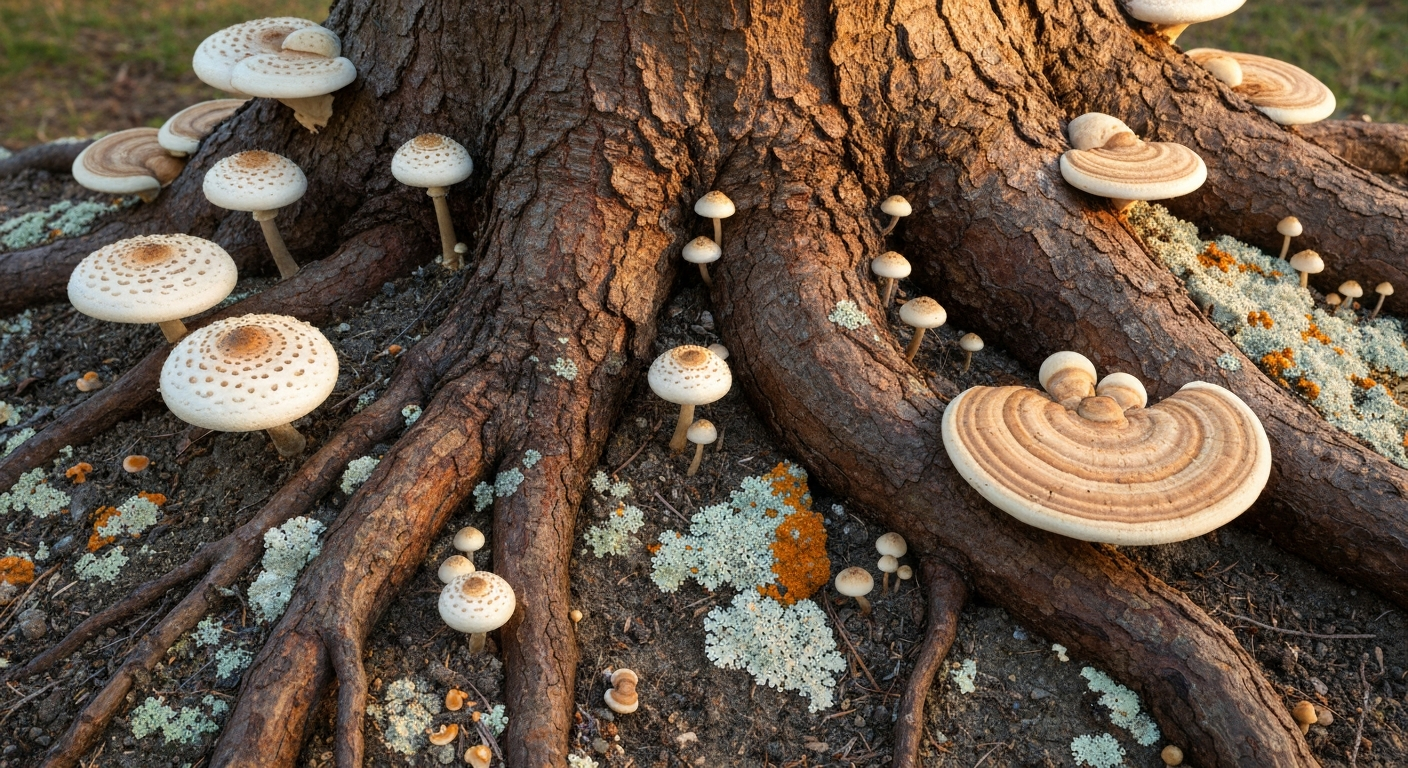
TL;DR: Morel tree identification is not about identifying morels on trees — morels fruit from the ground. The skill is recognizing host trees morels associate with: dying American elm, ash (especially white ash), old apple trees, cottonwood, and tulip poplar. Learn these trees in summer and fall, mark locations, then search the soil within 10 to 30 feet of the trunk in spring when soil warms past roughly 50°F. Use the Tree Identifier app to confirm host trees before mushroom season.
🍄 Morel hunting rule: Identify the tree first — then scan the ground slowly. Random woods walking without host-tree targets wastes spring mornings.
What morel tree identification actually means
Search volume for "morel tree identification" comes from mushroom hunters, not arborists. Morels (Morchella species) are edible spring mushrooms that fruit from soil — never from branches. The tree connection is ecological: morels form relationships with tree roots as mycorrhizal partners or exploit decaying root systems of stressed and dying trees.
Morel tree identification therefore means:
- Recognize host tree species by bark, leaves, and form.
- Prioritize stressed or dead individuals — especially dying elm and ash.
- Search the ground on the correct aspect and timing near those trunks.
- Return yearly — morels often recur near the same tree roots for several seasons.
This guide covers tree ID for mushroom hunting — not morel mushroom morphology. Always confirm mushrooms with an expert or authoritative field guide; false morels exist.
Spring timing and soil temperature
Host tree ID is useless without timing. Morels fruit when:
- Soil temperature reaches roughly 50 to 55°F (10 to 13°C) at 4 inches depth.
- Daytime highs consistently reach 60s°F with cool nights.
- Moisture follows rain — dry springs disappoint even under perfect trees.
- Aspect: South-facing slopes warm first; north-facing slopes extend season later.
Mark host trees in summer with GPS. Return the following April–May. Morel tree identification is a year-round prep habit.
Dying American elm — classic morel tree
The strongest cultural link in Midwest and Northeast morel lore: dying and dead American elm (Ulmus americana) from Dutch elm disease.
Why elm?
As elm roots decay after disease kills the cambium, soil chemistry and fungal networks shift — morels fruit in response. Freshly dead elms — vase-shaped skeletons still standing with bark falling — outperform ancient rotted stumps.
Morel tree identification — American elm
Form: Iconic vase-shaped crown even when dead — arching branches like a fountain frozen mid-spray.
Bark: Gray, deep furrows, flat interlacing ridges — see Elm Tree Identification for full elm bark identification detail.
Leaves (if any remain on shoots): Asymmetrical base, doubly serrate margin — unique among eastern hardwoods.
Habitat: Floodplains, river terraces, bottomland woods — where elms grew before DED.
Hunting tactic
Circle the trunk at 10 to 30 feet, scanning leaf litter slowly. Check south-facing side first. Dead elms with bark slipping and sapwood exposed are prime. Standing gray ghosts in April fog are morel waypoints.
White ash — emerald ash borer era
Ash (Fraxinus species), especially white ash, is the second pillar of morel tree identification in eastern North America. Emerald ash borer (EAB) kills millions of ashes — creating new dying-root habitat echoing the elm story.
Identify ash for morel hunting
Leaves: Compound, 5 to 9 leaflets, opposite on twig — not alternate like elm.
Bark: Gray, tight diamond-pattern furrows on mature trunks.
Samaras: Paddle-shaped, seed at wing tip — litter the ground in spring.
Form: Straight trunks, opposite branching pattern visible in winter.
Mark ash showing crown dieback — thinning canopy, epicormic sprouts, woodpecker flecking on bark. Hunt morels near roots as the tree declines over 2 to 5 years.
Tulip poplar — Appalachian and Mid-Atlantic favorite
Tulip poplar or yellow poplar (Liriodendron tulipifera) — a magnolia relative, not a true poplar — anchors morel tree identification in much of the eastern US forest.
Tree ID characters
Leaves: Distinctive four-lobed outline — looks like a tulip silhouette or cat face with pointed ears. Alternate on twigs.
Flowers: Tulip-shaped, greenish-yellow with orange bands — high in canopy, easy to miss.
Bark: Gray, moderately furrowed on old trunks; younger trees have smooth gray bark with pale stripes.
Form: Tall, straight, fast-growing — dominant in Appalachian coves and Piedmont slopes.
Hunting tactic
Find tulip poplar on north- and east-facing slopes where moisture persists. Morels under tulip poplar often fruit slightly later than lowland elm morels at the same latitude. Grid-search uphill from creek bottoms where tulip poplar dominates the canopy.
Apple trees — orchard morels
Old apple trees (Malus domestica) and abandoned homestead orchards produce reliable morel patches across temperate regions — independent of forest type.
Morel tree identification — apple
Form: Gnarled, short, wide scaffold branches — orchard architecture even when wild from seed.
Bark: Scaly gray-brown, often with lichen on old trees.
Leaves: Oval, serrated, alternate — generic alone; context of old homestead, stone walls, and remnant fruit confirms.
Clues: Fallen apples or cores, mower-scattered trees in old fields, cellar holes nearby.
Hunting tactic
Walk the drip line — the circle under the outer branches. Orchard rows create linear morel trails hunters revisit for decades. Apple morels may peak a week after elm morels in the same county.
Cottonwood — river bottom morels
Eastern cottonwood (Populus deltoides) and other poplars anchor morel tree identification in Great Plains river bottoms and Midwest floodplains.
Tree ID characters
Leaves: Large triangular (deltoid) leaves with toothed margins, flutter in wind on flattened petioles.
Bark: Gray, deeply furrowed on old trees; yellowish-green smooth bark on younger trunks.
Habitat: Floodplains, sandbars, levees, irrigation ditches — wherever cottonwood colonizes disturbed wet soil.
Form: Massive trunks, often leaning over water.
Hunting tactic
Search sand and leaf litter within root zone after spring floods recede. Cottonwood morels tie to river phenology — water table and soil warmth together.
Sycamore and other regional hosts
American sycamore (Platanus occidentalis) — mottled peeling camouflage bark, large palmate leaves — hosts morels in some Ohio River and Mississippi River corridors. Morel tree identification here overlaps cottonwood bottomland walks — identify sycamore by bark before scanning soil.
Other regional associations reported by hunters include:
- Black cherry on limestone slopes in some Appalachian reports.
- Hickory — occasional, less reliable than elm or tulip poplar.
- Burn sites — not a tree, but morels fruit after disturbance; tree ID still helps orient in regrowing woods.
Build a local list — morel tree identification is regional folklore backed by repeated tree-mushroom pairings.
How to mark host trees year-round
Serious hunters practice morel tree identification off-season:
- Summer leaf ID: Photograph leaves and bark; run through Tree Identifier; save GPS pin with species label.
- Winter bark walks: Identify elm vase skeletons and ash diamond bark without leaves — see Identify Trees by Bark.
- Fall scouting: Find old apple trees with fruit on ground; mark for spring.
- Maps: Private map layers with color codes — red pins elm, blue ash, green tulip poplar.
Morel tree identification is cumulative — each marked tree is a future hunt coordinate.
Ground search technique near identified trees
After confirming the host tree:
- Scan pattern: Slow eyes 5 to 15 feet ahead, not at feet — morels are camouflaged.
- Distance: Most morels within one tree height of trunk — focus on root zone.
- Aspect: Warm side first on cool springs; all sides on warm weeks.
- Disturbance: Leaf litter, flood debris, burn ash — edges matter.
- Ethics: Pinch and carry in mesh — spores disperse; do not rake forest floor bare.
Tree ID gets you to the right microhabitat; patience finds the mushroom.
Elm and ash decline — reading tree stress
Morel tree identification prioritizes declining trees:
Elm: Dead vase form, bark shedding, no full canopy — DED legacy woods.
Ash: Crown thinning, dieback from top, D-shaped exit holes from EAB, sucker sprouting on trunk.
Healthy vigorous trees of the same species produce fewer morels than stressed neighbors in many hunter reports — the decaying root hypothesis drives site selection.
Learn elm in depth: Elm Tree Identification. Compare bark patterns: Tree Bark Identification App.
Safety and mushroom ID disclaimer
Morel tree identification does not replace mushroom identification training. False morels (Gyromitra and others) can poison. Only harvest mushrooms you identify positively as Morchella species with expert sources.
Tree ID apps identify trees, not fungi. Use mushroom field guides, local mycological societies, and spore prints for mushrooms. This article covers which trees to find morels near — not how to eat them.
Regional quick reference
| Region | Priority host trees | Peak season cue |
|---|---|---|
| Upper Midwest | Dying elm, ash, apple orchards | May after first warm rain |
| Appalachia | Tulip poplar, ash, cherry on limestone | Late April through May by elevation |
| Great Plains | Cottonwood river bottoms, elm | After flood recession |
| Pacific Northwest | Different morel ecology — burn morels common; host trees vary | Spring after fire, distinct rules |
| Northeast | Elm, ash, apple, tulip poplar south | Soil 50°F+ |
West Coast burn morels follow different ecology — tree host lists from eastern hunting do not fully transfer. Local morel tree identification lists should respect bioregion.
Using Tree Identifier for morel prep
Tree Identifier supports morel tree identification workflows:
Summer scouting: Photograph bark and leaves of candidate elms, ashes, tulip poplars; confirm species; save location.
Winter: Bark-only photos of elm and ash — see Best Photo for Tree ID.
Orchard: Apple ID from leaves and form when fruit present.
General app guide: App to Identify Trees. Leaf basics: Identify Trees by Leaf. Foliage detail: Tree Foliage Identification.
Putting it together — a spring morning
Imagine an April morning in southern Wisconsin:
- You marked three dying American elms last August with GPS — vase forms visible from the road.
- Soil thermometer read 52°F yesterday after rain.
- You circle the first elm — asymmetrical leaf shoots confirm ID from last year.
- At 15 feet south of the trunk, a honeycomb cap rises from leaf litter — morel.
- The tree ID did the work; the mushroom was never on the tree.
That is morel tree identification in practice — trees as coordinates, mushrooms as reward.
Frequently asked questions
What trees do morels grow near?
Morels grow near specific host trees depending on region: dying American elm, ash (especially white ash), apple and other old orchard trees, cottonwood and poplar species, tulip poplar (yellow poplar), and sycamore in some areas. Morel tree identification means recognizing these trees first — then searching the ground within roughly 10 to 30 feet of the trunk, especially on south-facing slopes in spring after soil warms.
Why do morels grow near dying elm trees?
Morels have a mycorrhizal or saprotrophic relationship with tree roots — dying American elms (Dutch elm disease victims) release nutrients as roots decay, triggering morel fruiting in spring. Hunters search dead vase-shaped elm skeletons in bottomlands. Morel tree identification for elm: asymmetrical leaf bases on any remaining shoots, vase form, gray furrowed bark. Focus on recently dead elms, not rotted stumps years old.
Do morels grow under tulip poplar trees?
Yes — in the eastern US, tulip poplar (Liriodendron tulipifera) is a premier morel host. Morel tree identification for tulip poplar: four-lobed leaves, tulip-shaped flowers, straight tall trunks with furrowed gray bark. Hunt on north- or east-facing slopes under tulip poplar in late April through May when soil temperature reaches roughly 50 to 55 degrees Fahrenheit.
Do morels grow near apple trees?
Old abandoned apple orchards and wild apple trees produce morels reliably in many regions. Morel tree identification for apple: oval serrated leaves, gnarled trunk, horizontal scaffold branches, remnant fruit. Search around the drip line of aging orchard trees. Apple morels often fruit slightly later than elm morels in the same latitude.
What is the best tree for finding morels?
No single best tree — it is regional. Midwest and Northeast: dying elm and ash dominate lore. Appalachia and Mid-Atlantic: tulip poplar and ash. Great Plains river bottoms: cottonwood. Old orchards: apple anywhere apples persist. Morel tree identification strategy: learn two or three dominant host trees in your area, then grid-search the ground near those trunks in spring.
How do you identify ash trees for morel hunting?
White ash (Fraxinus americana) for morel hunting: compound leaves with 5 to 9 leaflets, opposite branching, diamond-pattern furrowed gray bark, paddle-shaped samaras with seed at the wing tip. Ash dieback from emerald ash borer creates new dying-root habitat similar to elm. Identify ash bark and opposite twigs in winter, mark trees, return in spring for morels.
Can tree ID apps help with morel tree identification?
Yes — identify host trees before mushroom season. Tree Identifier recognizes elm, ash, tulip poplar, cottonwood, apple, and sycamore from bark and leaf photos. Mark GPS locations of dying elms and old apples in summer; hunt morels at those coordinates the following spring. Apps do not identify morel mushrooms themselves — learn separate mushroom ID from a field guide or expert.
Try Tree Identifier — free on iPhone
Identify morel host trees in summer — mark the spot, hunt mushrooms in spring.
Download on the App Store