TL;DR: Elm tree identification starts with the leaf base: asymmetrical — one side longer than the other — plus doubly serrate margins (two sizes of teeth). American elm (Ulmus americana) forms iconic vase-shaped street trees with gray furrowed bark. Slippery elm / red elm (Ulmus rubra) has larger sandpapery leaves and mucilaginous inner bark. Fruit is a flat oval samara with the seed in the center. Photograph the leaf base in focus and confirm with the Tree Identifier app.
🍃 Elm leaf test: Fold the leaf along the midrib mentally — the two halves at the base do not match. Symmetrical base = not elm.
Why elm tree identification matters
Elms once defined American main streets — arching vase canopies over roads before Dutch elm disease (DED) removed millions of American elms in the 20th century. Elm tree identification today finds survivors in floodplains, younger resistant cultivars in cities, and slippery elm on rocky slopes.
Elms also anchor ecosystems — morel mushroom foragers search near dying elms (see Morel Tree Identification). Woodworkers seek elm grain. Botanists track disease-resistant breeding programs.
Genus Ulmus in eastern North America includes several native species — American elm, slippery elm (red elm), winged elm, cedar elm — plus European elms in old plantings. This guide focuses on the three most searched: American, slippery/red, and elm bark identification across them.
American elm — Ulmus americana
American elm is the classic vase-shaped street and riparian tree — when healthy, among the most graceful silhouettes in eastern forests.
Leaf identification
Leaves 3 to 6 inches, oval to elliptic, with the signature asymmetrical base — one side of the leaf blade extends further down the petiole than the other. Margin is doubly serrate — fine teeth bearing coarser teeth, visible with a hand lens or sharp photo.
Upper surface dark green, rough to the touch. Lower surface paler with soft hairs on veins. Leaves alternate on twigs — never opposite like maple or ash.
Slippery elm leaf identification differs — American elm leaves are smaller and less extremely sandpapery, though still rough compared to beech.
Form and bark
Crown spreads into a high arching vase — main branches like fountain jets. In open-grown street settings, the silhouette is unmistakable from a block away.
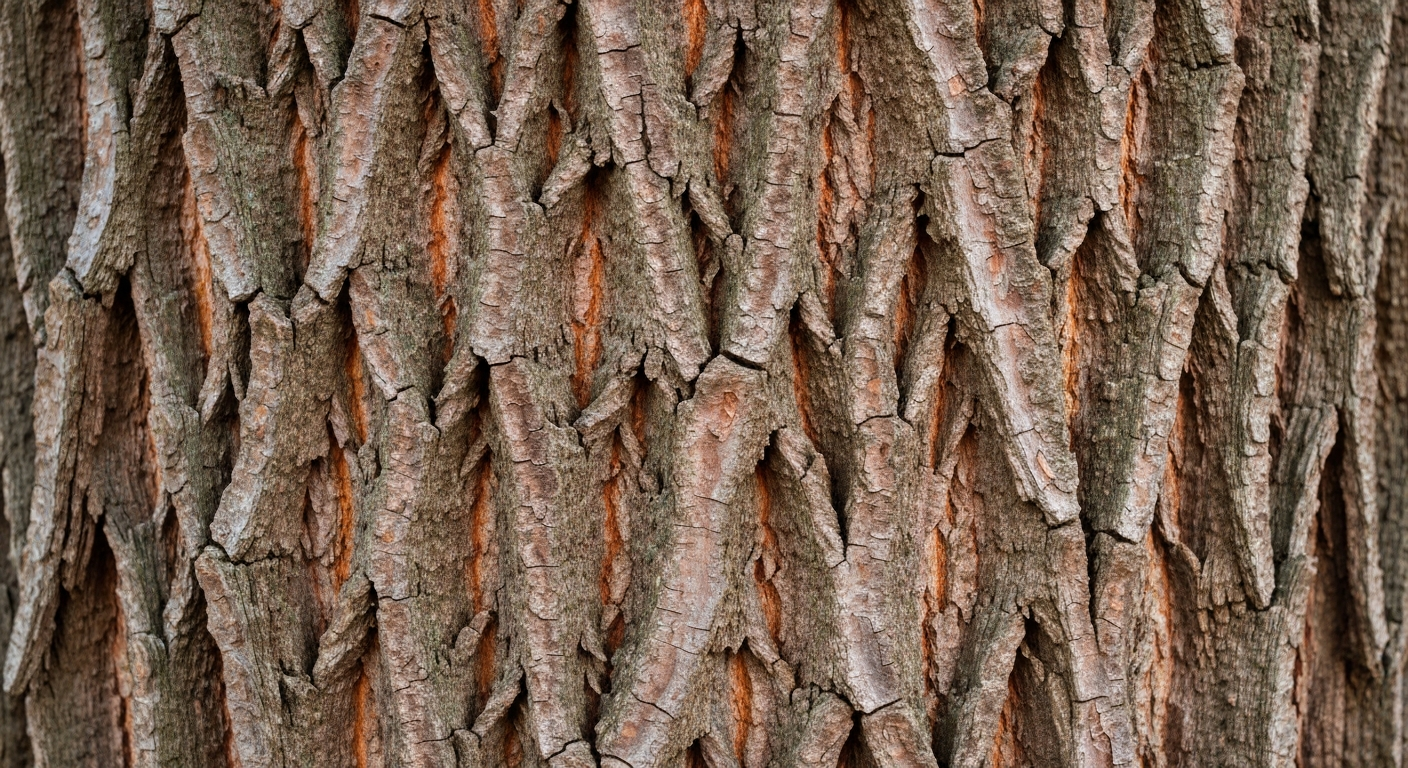
Elm bark identification (American): Gray-brown, deep vertical furrows separating flat-topped ridges that interlace — sometimes described as "washboard" or diamond-blocky on mature trunks. Not shaggy, not smooth.
Fruit — samaras
Flat oval samaras, notched at the top, hairy on the edges, with the seed centered in the wing — not at the wing tip like ash samaras. Ripen and fall in spring, often before leaves fully expand.
Range and habitat
Native across eastern North America — floodplains, river terraces, bottomlands, and historically urban plantings. Tolerates wet feet better than many street trees.
Slippery elm — Ulmus rubra (red elm)
Slippery elm tree identification answers searches for "red elm" — the same species, two common names.
Leaves
Larger than American elm — up to 7 inches — thick, stiff, very rough above like sandpaper or felt. Underside densely hairy, paler. Asymmetrical base and doubly serrate margin still apply — universal elm leaf ID rules.
Slippery elm leaf identification field test: Scrape inner bark from a small twig — mucilage becomes slippery when chewed or rubbed with water. Traditional throat medicine source. Do not strip bark from living park trees — use fallen twigs.
Bark — red elm tree identification
Outer bark darker brown-gray than American elm. When furrows split, reddish-orange inner bark shows — the "red elm" name. Elm tree bark identification uses this color when species split is needed on bark alone — confirm with leaves.
Form
Smaller and less extreme vase than American elm — often shorter, stockier, on upland slopes and rocky woods rather than only floodplains.
Range
Eastern US, overlapping American elm — Maine to Florida, west to Texas and North Dakota.
Winged elm — Ulmus alata
Southeastern species with corky wings on twigs — ridges of bark extending from the stem. Leaves smaller, also asymmetrical and doubly serrate. Useful when elm tree identification encounters winged stems in Alabama, Georgia, and the Carolinas.
Asymmetrical leaf base — the key character
Among common eastern hardwoods, asymmetrical leaf bases are strongly associated with elm (and some hackberries — check venation and fruit).
How to photograph for elm tree identification:
- Pick one leaf and lay it flat, underside up, petiole toward you.
- Shoot straight down so both base lobes are visible.
- Include margin teeth in focus — doubly serrate pattern confirms.
- Photograph samara if on ground in spring.
Compare symmetrical bases on beech, cherry, and apple — elm stands out immediately once you train your eye. See Identify Trees by Leaf for margin terminology.
Doubly serrate margins explained
Doubly serrate means each coarse tooth along the leaf edge carries smaller teeth — a fractal-like edge under magnification. Single serrate margins (one size of tooth) rule out elm on margin alone, though always check base asymmetry — some cherries are singly serrate with symmetrical bases.
Elm margins feel rough when dragged across a finger — slip directionally.
Elm bark identification in depth
Elm tree bark identification without leaves is moderate difficulty — furrowed gray bark describes ash, oak, and walnut too.
American elm bark: Light to medium gray, flat ridges between vertical fissures, interlacing pattern on old trunks. Often on large floodplain trees — check canopy form for vase arch.
Slippery elm bark: Darker, with red inner bark in splits. Bark was historically stripped for medicine — scars on wild trees are common.
Winter pairing: Photograph bark and a twig with buds — elm buds are small, reddish, alternate, with only one or two visible scales. Compare to ash opposite buds.
Full bark texture guide: Identify Trees by Bark. App-focused tips: Tree Bark Identification App.
Elm samaras vs ash samaras
Both drop winged seeds in spring — confusion is common:
- Elm samara: Oval, hairy on edges, seed in center of wing, notched tip.
- Ash samara: Paddle-shaped, seed in wing tip, not notched like elm.
Find samaras under the tree in April–May for elm tree identification when leaves are small.
Dutch elm disease — context for field ID
Dutch elm disease changed the landscape but not the ID characters. Caused by Ophiostoma ulmi and O. novo-ulmi, spread by elm bark beetles and root grafts.
Symptoms: One branch flagging yellow and wilting in summer while rest of crown looks green; brown leaves may curl and cling. Streaking brown in sapwood under bark when peeled — diagnostic for arborists, not casual foragers.
Field impact: Dead and dying American elms stand as skeleton vases — bark and form still read as elm. Morel foragers note dying roots. Resistant cultivars ('Valley Forge', 'Princeton') restore street plantings with American elm look.
DED does not make slippery elm rare — Ulmus rubra is less affected than American elm in many regions.
European and Siberian elms
Ulmus pumila (Siberian elm) and Ulmus parvifolia (lacebark elm) appear in landscaping and weed situations — especially Siberian elm in the Great Plains. Leaves still asymmetrical but often smaller; Siberian elm is brittle and weedy. Lacebark elm has exfoliating bark patches — ornamental ID specialty.
Lookalikes
Hackberry (Celtis): Asymmetrical leaf bases sometimes — but leaves are narrower, bases less dramatically uneven, fruit is orange-red sweet drupe, not samara. Bark often warty.
Cherry: Singly serrate, symmetrical base, lenticels on twigs — not elm.
Beech: Smooth bark, symmetrical leaves with parallel lateral veins — see Beech Tree Identification.
Using Tree Identifier for elm tree identification
Tree Identifier recognizes American elm, slippery elm, and winged elm from leaf photos when the asymmetrical base is visible.
Best photos: Leaf underside showing base asymmetry; doubly serrate margin close-up; samara on pavement in spring.
Whole tree: Vase silhouette distinguishes American elm from slippery elm in open settings — upload a second image if the app asks.
Workflow tips: Best Photo for Tree ID, App to Identify Trees, and What Type of Tree Is This?
Elm in urban forestry today
Street tree inventories still list "elm" decades after plantings peaked. Elm tree identification on city sidewalks means checking cultivar tags on resistant plantings vs volunteer seedlings in tree wells. Resistant American elm cultivars restore the vase streetscape in cities that lost canopy — look for nursery labels and uniform age cohorts along boulevards.
Slippery elm remains a woodland species — less common as a street tree but frequent on hiking trails in the Appalachians and Ozarks. Red elm tree identification on trail margins helps foragers and herbalists find sustainable bark sources on downed wood rather than stripping live trunks.
Conservation and planting
Elm tree identification supports choosing disease-resistant American elm cultivars for new plantings — preserving the vase form without repeating DED losses. Slippery elm harvest for bark medicine should be sustainable — prefer windfall branches.
Riparian American elms still seed into floodplains — young asymmetrical-leaf seedlings confirm the species regenerating despite disease pressure. Photograph seedlings in summer — asymmetrical leaf bases on knee-high plants prove elm regeneration when mature vase forms are rare.
Frequently asked questions
How do you identify an elm tree?
Identify elm trees by oval leaves with asymmetrical bases — one side of the leaf base is longer than the other — and doubly serrate margins with two sizes of teeth. Leaves are rough-textured above, often sandpapery on slippery elm. Bark is deeply furrowed gray-brown with interlacing ridges. Crown is vase-shaped or arching in American elm. Fruit is a flat oval samara with the seed in the center, not at the tip like ash.
What does an American elm leaf look like?
American elm (Ulmus americana) leaves are 3 to 6 inches long, oval to elliptic, with a distinctly asymmetrical base and doubly serrate edges. Upper surface is dark green and rough; underside is paler and hairy on veins. Leaves alternate on twigs. The asymmetrical base is the single best elm leaf identification character — compare to symmetrical bases on beech and hazel.
How do you tell slippery elm from American elm?
Slippery elm (Ulmus rubra) leaves are larger, thicker, and very rough above — like sandpaper. Twigs and leaf undersides are hairy. Slippery elm leaf identification: scrape inner bark — it is mucilaginous and slippery when chewed (hence the name). American elm leaves are smaller and less harshly rough. Slippery elm bark has reddish inner layers when split; American elm bark is more uniformly gray.
What is red elm tree identification?
Red elm is another common name for slippery elm (Ulmus rubra) — red refers to inner bark color. Red elm tree identification uses large sandpapery leaves, hairy twigs, mucilaginous inner bark, and smaller vase form than American elm. Winged elm (Ulmus alata) is a different species with corky wings on twigs, common in the Southeast.
What does elm bark look like?
Elm bark identification: mature trunks show deep vertical furrows with flat interlacing ridges — classic gray elm bark on American elm. Slippery elm bark is darker brown-gray with reddish inner bark visible in splits. Bark alone overlaps with other hardwoods — combine elm tree bark identification with asymmetrical leaves or samaras.
How does Dutch elm disease affect identification?
Dutch elm disease (Ophiostoma fungi spread by elm bark beetles) kills American elms — flagging yellow wilted branches in summer, brown leaves clinging, then dead vase-shaped skeletons in forests and streets. Diseased trees still show elm leaf shape on surviving shoots. DED does not change ID characters but explains why large American elms are rare compared to historical photos.
Can tree ID apps identify elm trees?
Yes — photograph the asymmetrical leaf base clearly and doubly serrate margin. Apps distinguish American elm, slippery elm, and winged elm when leaves or samaras show. Whole-tree vase form helps. Tree Identifier handles elm tree identification across eastern North American species when diagnostic leaf features are in frame.
Try Tree Identifier — free on iPhone
Photograph elm leaves showing the asymmetrical base and get a species match in seconds.
Download on the App Store