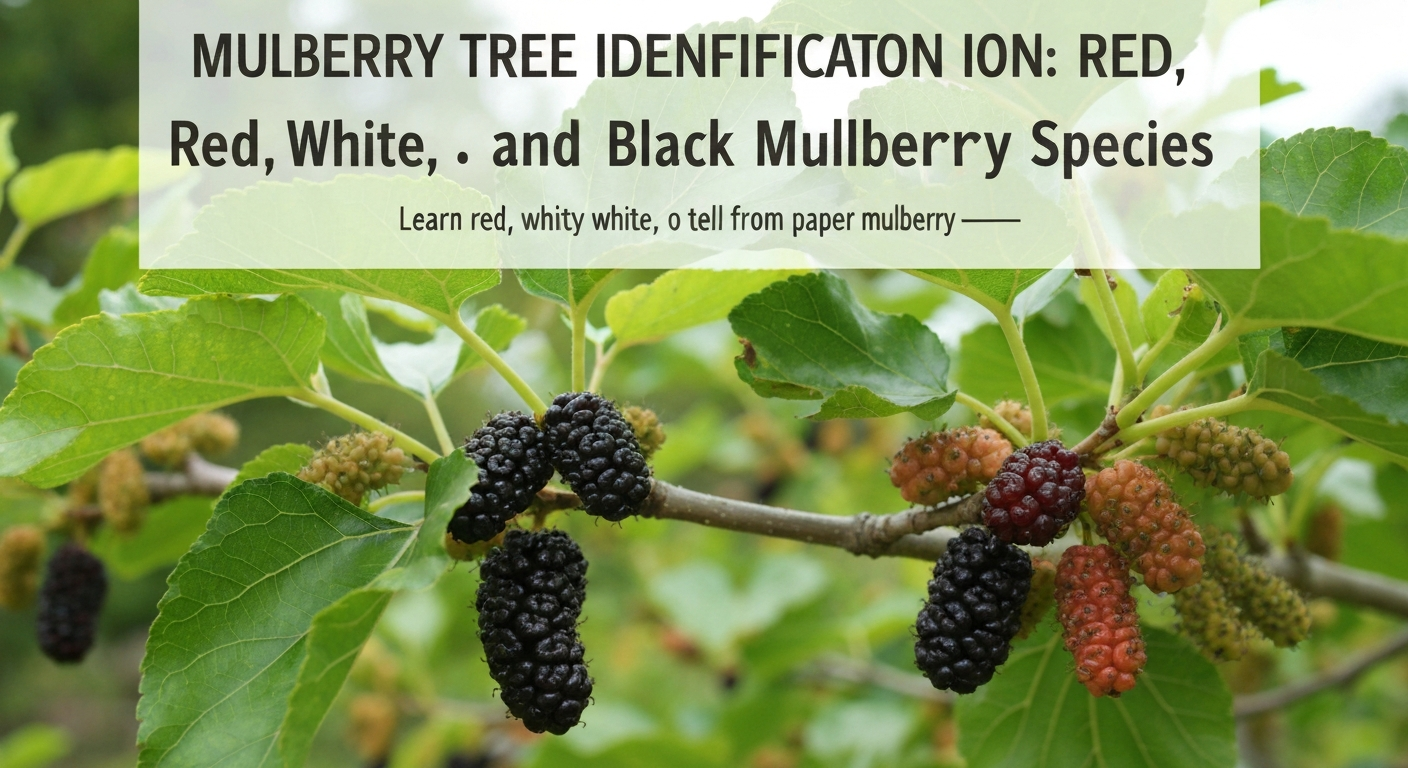
TL;DR: Mulberry tree identification starts with alternate simple leaves that may be unlobed or deeply lobed on the same tree, milky white sap when you break a leaf stalk, and sweet aggregate fruit like elongated blackberries in late spring and summer. Red mulberry (Morus rubra) is native to eastern North America with rough sandpapery leaves. White mulberry (Morus alba) is a common weedy import. Black mulberry (Morus nigra) is planted for dark fruit. Do not confuse true mulberries with paper mulberry (Broussonetia papyrifera), which lacks milky sap. Photograph leaves, fruit, and bark, then confirm with the Tree Identifier app.
🍇 Mulberry tree identification shortcut: break a leaf petiole — milky white sap plus blackberry-like fruit clusters = true mulberry (Morus). No milky sap = look elsewhere, possibly paper mulberry.
Understanding mulberry — genus and family
Mulberries belong to the mulberry family (Moraceae), alongside figs, osage orange, and hops. Genus Morus includes roughly a dozen species worldwide; three matter most in North America for mulberry tree identification: red mulberry, white mulberry, and black mulberry.
Mulberries are deciduous trees or large shrubs, often 30 to 50 feet at maturity, though yard trees are frequently smaller. They tolerate poor soil, urban heat, and drought once established — which is why white mulberry spreads along fencerows and vacant lots across the continent.
Key genus-level traits for Morus:
- Leaves: Simple, alternate, highly variable — unlobed to multi-lobed on the same individual.
- Sap: Milky latex in leaves, twigs, and unripe fruit — a defining Morus character.
- Fruit: Aggregate of small drupes fused into an elongated cluster — botanically a syncarp, not a true berry.
- Bark: Gray-brown, becoming furrowed with age; orange inner bark visible on fresh cuts.
- Buds: Small, alternate, often pressed close to the twig; white mulberry buds are particularly tiny.
- Habitat: Floodplains, fencerows, old fields, yards, and urban waste ground.
Mulberry species identification requires combining leaf texture, fruit color at ripeness, and bark — no single character splits every case because white mulberry fruit can darken to purple and leaves on young red mulberry shoots may look nearly smooth.
Red mulberry tree identification
Red mulberry (Morus rubra) is the only mulberry native to much of eastern and central North America. It is the species conservationists want you to recognize before white mulberry hybridizes it out of existence in some regions.
Leaves: Rough, sandpapery upper surface — rub a leaf and it feels like fine-grit paper. Underside is softly hairy, pale green to yellow-green. Margins are coarsely toothed. Lobing is common: some leaves are entire and ovate; others show one or two deep lobes like a mitten or three-lobed maple mimic.
Fruit: Ripens dark purple to nearly black, sweet, 1 to 1.5 inches long. Clusters may be sparse compared to heavy-bearing white mulberry trees.
Bark: Gray-brown, scaly or ridged on older trunks. Freshly exposed wood shows orange-brown heartwood.
Form: Often a medium tree with a broad rounded crown. Native specimens appear in moist woods and stream banks as well as fencerows.
Range: Eastern US from New England to Florida, west to Texas, Kansas, and Minnesota.
Red mulberry tree identification is strongest when you combine sandpapery leaf texture with hairy leaf undersides and native woodland or rich floodplain context — though escaped yard trees blur habitat cues.
White mulberry identification
White mulberry (Morus alba) arrived from Asia for silkworm culture in colonial America. It naturalized aggressively and now dominates many urban and suburban mulberry encounters.
Leaves: Smoother and often shinier above than red mulberry — less sandpapery. Underside may be hairless or only slightly hairy. Lobing is equally variable; some cultivars bear deeply cut leaves. Leaf size can be larger on vigorous water sprouts.
Fruit: Named for fruit that ripens white to pink on some trees, but many white mulberry individuals produce dark purple fruit indistinguishable from red mulberry at a glance. Taste is often sweeter but less complex; trees bear heavily.
Buds and twigs: Buds are small, brown, and sit nearly flush with the twig — a useful winter character. Twigs are slender and may be somewhat zigzag.
Habitat: Disturbed ground, alleys, parking lot islands, fencerows — classic weed-tree ecology.
Mulberry tree id at species level between red and white mulberry often needs leaf texture under a hand lens or genetic testing when hybrids are suspected. For field purposes, rough hairy leaves favor red mulberry; glossy smoother leaves favor white mulberry.
Black mulberry
Black mulberry (Morus nigra) is native to southwestern Asia and planted in warmer climates for intensely flavored dark fruit. In the US it appears mainly in California, the South, and as occasional yard trees elsewhere.
Leaves: Thick, coarse, often broadly heart-shaped with rounded teeth. Less dramatically lobed than white mulberry on average — many leaves are simply ovate.
Fruit: Large, juicy, dark purple to black, staining badly. Among the best-tasting mulberries — reason for planting.
Form: Low, wide-spreading habit; tree may look shrubby. Slow-growing compared to white mulberry.
Black mulberry is the easiest mulberry species identification when you know it was planted — fruit quality and leaf thickness stand out. Wild seedlings are rare outside mild regions.
Mulberry leaf identification in detail
Mulberry leaf identification frustrates beginners because one tree displays multiple leaf shapes simultaneously. This heterophylly is normal — not a sign you are looking at two different trees.
- Confirm simple alternate leaves: One blade per petiole, alternating along the twig — not opposite like ash or maple.
- Check for lobes: Zero, one, two, or three lobes may appear on the same branch. Lobes are often uneven — one deep sinus on one side like a mitten.
- Examine margin teeth: Coarse serrations, not smooth edges.
- Test sap: Snap the petiole — milky latex confirms Morus.
- Feel texture: Sandpapery above = likely red mulberry; smoother glossy above = likely white mulberry.
- Flip the leaf: Hairy pale underside favors red mulberry; glabrous underside favors white mulberry.
Photograph two or three leaves from the same twig showing different shapes — mulberry tree identification pictures with lobed and unlobed leaves together are diagnostic. See Identify Trees by Leaf for general leaf photography technique.
Paper mulberry — the critical lookalike
Paper mulberry (Broussonetia papyrifera) is invasive in the Southeast and mid-Atlantic. From a car window the lobed leaves resemble mulberry — mulberry tree identification errors are common.
Sap: No milky latex. Break a petiole — clear or watery, not white milk.
Leaves: Often very fuzzy on both surfaces, especially when young. Lobes can be deep and irregular.
Fruit: Round orange syncarp balls, not elongated blackberry-like clusters.
Bark: Smooth gray with conspicuous lenticels; older bark peels in thin papery sheets — the name source.
Habitat: Roadsides, forest edges, disturbed woods in the Southeast. Spreading north with climate change.
Never forage fruit from a lobed-leaf tree until milky sap and aggregate purple fruit confirm true mulberry. Paper mulberry is not a safe edible substitute.
Fruit, flowers, and seasonal cues
Mulberry flowers are inconspicuous catkins — greenish spikes appearing in spring before or with leaves. You rarely notice them; fruit is the seasonal star.
Immature fruit: Green finger-like clusters, still exuding milky sap when cut.
Ripening: Transitions through white, pink, or red stages depending on species, ending dark purple to black.
Mess factor: Ripe fruit drops constantly, staining concrete and car paint. Purple sidewalks beneath overhanging branches are a mulberry tree identification pictures clue in June.
Wildlife: Birds spread seeds; raccoons and squirrels strip branches. Heavy bird traffic in a fruiting tree supports mulberry ID.
For broader fruit-tree context, see How to Identify Nut Trees — mulberry is not a nut tree, but the comparison helps when sorting backyard edibles.
Bark and winter identification
Winter mulberry tree identification uses bark and bud arrangement when leaves and fruit are absent.
Bark: Gray-brown, irregular furrows on mature trunks. Not shaggy like birch, not blocky like oak. Young trees show smoother gray bark with lenticels.
Buds: Small, pointed, alternate. White mulberry buds are notably tiny — use a finger for scale in photos.
Twig: Moderately stout, zigzag on some specimens. Pith is continuous — not chambered like walnut.
Silhouette: Rounded, somewhat messy crown; multi-stemmed forms occur when trees were cut back repeatedly.
Bark alone rarely splits red from white mulberry — pair bark photos with last season's fruit stains on pavement below. For bark-focused methods, see Tree Bark Identification App Guide.
Using Tree Identifier for mulberry
Tree Identifier recognizes mulberry species from leaf, fruit, and bark photos across North America.
Best photos: Ripe fruit cluster filling the frame. Two leaves from the same twig showing different lobing. Fresh petiole break showing milky sap if you can capture it safely on camera.
Challenges: Leaf-only photos on sterile shoots may return generic mulberry without species — add texture detail or fruit. Fallen fruit on pavement makes excellent ground-level shots.
Hybrids: Red × white mulberry hybrids exist where ranges overlap. App results may list mulberry at genus level — leaf texture still hints at parentage.
Mulberry tree identification is one of the most rewarding summer IDs — sweet fruit, wildlife drama, and unmistakable sap once you know the paper mulberry split.
Frequently asked questions
How do you identify a mulberry tree?
Identify mulberry trees by alternate simple leaves that are often heart-shaped with zero to several lobes on the same tree, milky sap when a leaf or twig is broken, and sweet aggregate fruit resembling elongated blackberries in summer. Bark on mature trees is gray-brown with narrow ridges. Red mulberry (Morus rubra) is native; white mulberry (Morus alba) is common and weedy; black mulberry (Morus nigra) is planted for dark fruit.
What do mulberry leaves look like?
Mulberry leaves are simple, alternate, and highly variable — unlobed ovate leaves on some shoots and deeply lobed mitten-shaped or three-lobed leaves on others, often on the same branch. Margins are usually toothed. Upper surface is dull green; underside may be hairy on red mulberry. Milky white latex exudes from the petiole when snapped. This mulberry leaf identification variability confuses beginners until you notice the fruit and sap.
How do you tell red mulberry from white mulberry?
Red mulberry (Morus rubra) has rough sandpapery upper leaf surfaces, hairy undersides, and dull black to purple fruit. White mulberry (Morus alba) has smoother, often glossy leaves, may be hairless below, and fruit ripens white, pink, or dark purple. White mulberry buds are smaller and more closely pressed to the twig. Red mulberry is native to eastern North America; white mulberry is an Asian import that spreads aggressively.
What is the difference between mulberry and paper mulberry?
Paper mulberry (Broussonetia papyrifera) is a different genus — not a true mulberry. It has fuzzy leaves, no milky sap, and orange syncarp fruit unlike mulberry aggregate berries. Paper mulberry bark is smooth with pale lenticels and peels in papery strips on older stems. True mulberry (Morus) exudes milky latex and produces blackberry-like clusters. Paper mulberry is invasive in the Southeast; do not confuse it for edible mulberry.
When does mulberry fruit ripen?
Mulberry fruit ripens from late spring through early summer depending on species and latitude — often May through June in the South, June through July farther north. Fruit starts green, turns red on some species, then dark purple to nearly black when fully ripe. Ripe fruit falls easily and stains sidewalks. Mulberry tree identification pictures often show purple-stained pavement beneath overhanging branches.
Is mulberry fruit safe to eat?
Yes — ripe mulberry fruit from Morus species is edible and sweet. Red, white, and black mulberries are all eaten fresh or in jams. Only harvest after positive mulberry tree identification — confirm milky sap, lobed leaves, and aggregate berry structure. Unripe fruit can cause stomach upset. Never eat fruit from paper mulberry or unknown lookalikes.
Can tree ID apps identify mulberry?
Yes, when photos show lobed leaves, fruit clusters, or bark on mature trees. Apps may struggle with leaf-only shots because mulberry leaves vary so much — include fruit or a twig showing milky sap when broken. Tree Identifier handles mulberry tree identification well across North America when fruit or characteristic foliage is visible.
Try Tree Identifier — free on iPhone
Photograph mulberry leaves, fruit clusters, or bark and get a species match in seconds.
Download on the App Store