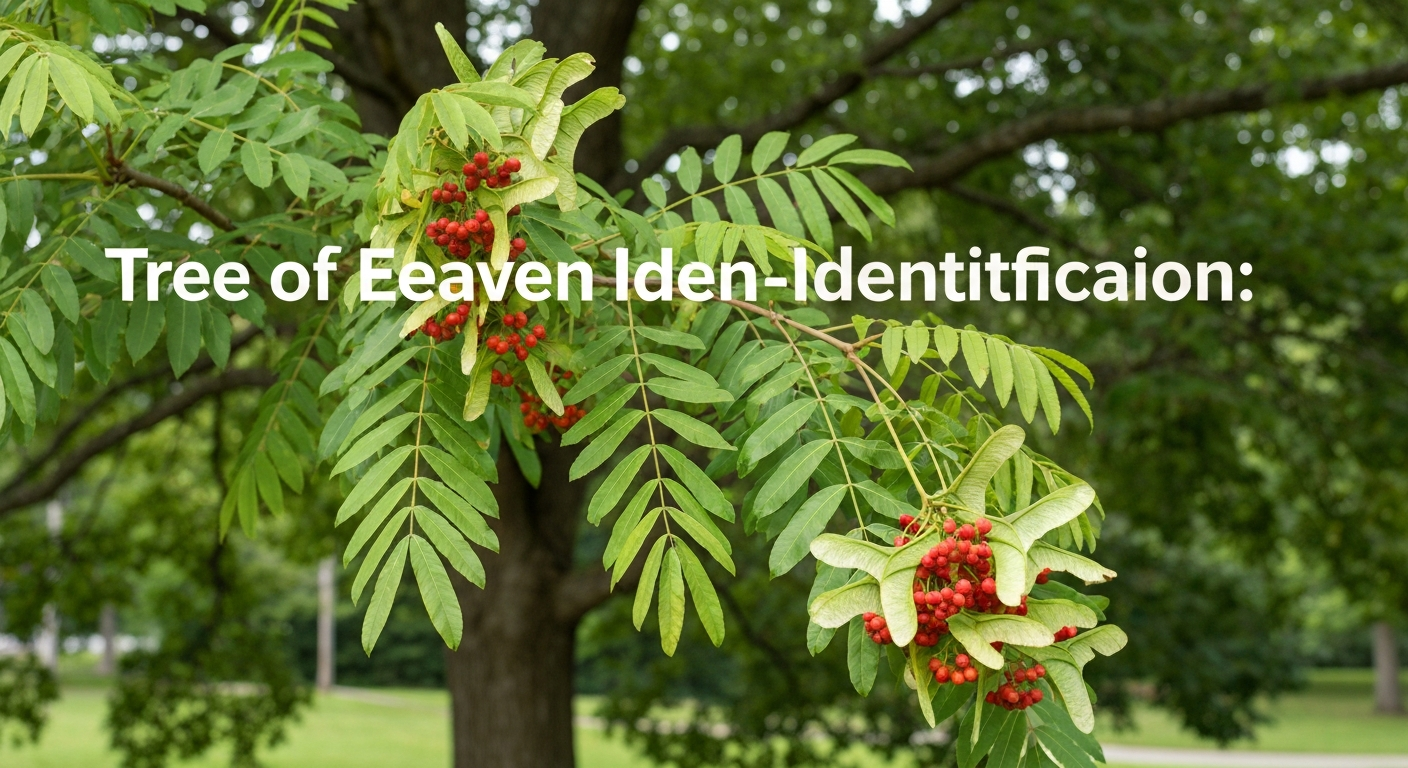
TL;DR: Tree of heaven identification (Ailanthus altissima) starts with oversized pinnately compound leaves — often 2 feet long — with one or two gland-tipped teeth at the base of each leaflet. Crush a leaflet: a rank, peanut-butter or burnt-rubber smell confirms it. Female trees shower pink-tan twisted samaras in late summer; there are no red berry cones. Smooth gray bark with pale vertical streaks marks older trunks. This fast invasive colonizes cities, fence rows, and riparian edges nationwide. Photograph leaflet bases and samaras, then confirm with the Tree Identifier app.
⚠️ Tree of heaven is a serious invasive — but tree of heaven identification saves you from confusing it with edible sumac or valuable black walnut. Smell + samaras + basal leaf teeth beat guesswork from the highway.
Why tree of heaven matters
Ailanthus altissima — tree of heaven, stinking sumac (misnamed), or ghetto palm — is native to China and was introduced to North America in the 1780s as an ornamental. It escaped immediately. Today it ranks among the worst urban and riparian invaders on the continent because it grows fast, seeds heavily, and resprouts furiously from roots and stumps.
Accurate tree of heaven identification matters for land managers removing invasives, homeowners wondering what seeded into the driveway crack, and foragers who must not confuse it with staghorn sumac. It also hosts the invasive spotted lanternfly in its native range expansion — another reason to recognize and report dense stands where local guidance asks.
Botanical placement: family Simaroubaceae, not true sumac (Anacardiaceae) or walnut (Juglandaceae). The common name "stinking sumac" reflects leaf shape, not kinship.
Tree of heaven leaf identification
Tree of heaven leaf identification is the fastest summer skill. Leaves are pinnately compound — one long petiole with many leaflets arranged along a central rachis.
Size: Among the largest compound leaves you will see on a city weed tree. Mature leaves commonly reach 18 to 36 inches; vigorous water sprouts may exceed 3 feet. From a car, the crown looks lush and tropical.
Leaflet count: Typically 11 to 41 leaflets per leaf, more on vigorous shoots. Leaflets are lance-shaped, 3 to 5 inches long, with long tapered tips.
The basal teeth — critical ID feature: Leaflet margins are mostly smooth — unlike sumac's evenly serrated edges. Near the base of each leaflet, one or two coarse teeth protrude. Each tooth bears a tiny gland — a dark dot that may exude sticky fluid. Magnification helps; a phone macro photo of the leaflet base is ideal.
Leaflet arrangement: Leaflets attach alternately along the rachis, sometimes with one terminal leaflet. Rachis is stout and may be slightly reddish.
Comparison to black walnut: Black walnut (Juglans nigra) leaflets are narrower, more numerous, and finely serrated along the entire margin — no isolated basal gland teeth. Crushed walnut leaf smells spicy, citrusy, or clean — not foul.
Comparison to staghorn sumac: Sumac leaflets are toothed throughout and smaller in overall leaf length on shrub stems. Sumac produces red upright berry clusters, not samaras. Sumac twigs are fuzzy on staghorn species; tree of heaven twigs are smooth and stout.
Comparison to Kentucky coffee tree: Coffee tree leaves are twice compound (bipinnate) — leaflets on side branches off the main rachis. Tree of heaven is once pinnate only. See our Kentucky coffee tree identification guide for bipinnate distinction.
The smell test — tree of heaven's signature
No other common street tree smells like tree of heaven when bruised. Glandular tissue at leaflet base teeth releases volatile sulfur and organic compounds. Field descriptions include:
- Rancid peanut butter
- Burnt peanut or popcorn
- Cat urine or skunk
- Sour burnt rubber
Protocol: detach one leaflet, crush it between fingers away from your face, and sniff. Strong foul odor = strong evidence for Ailanthus altissima. No smell on a dry leaf? Try a fresh leaflet from a shaded branch or wait until after rain.
Caution: smell is diagnostic but subjective. Combine with leaf architecture and fruit. Some people detect the odor faintly on tree of heaven samaras piled on sidewalks in September.
Samaras — winged seeds of tree of heaven
Tree of heaven reproduction depends on prolific samaras — flat, twisted, winged seeds that spin downwind.
Timing: Clusters form in late summer and persist into fall. Each samara is papery, pink-tan to greenish, 1 to 2 inches long, with the seed offset in a twisted pod — unlike elm's smooth oval samaras or maple's paired helicopter wings.
Dioecious trees: Individual trees are usually male or female. Female (and some polygamous) trees produce the heavy samara crops that blanket alleys and clog gutters. Male trees flower with foul-smelling panicles but produce no samaras — still invasive via suckers.
Seedling ID: First-year seedlings show opposite or sub-opposite compound leaves on thin stems. Basal teeth appear early — crush-test seedlings before pulling if you are unsure.
Samaras distinguish tree of heaven from sumac decisively: sumac has fleshy red drupes, never papery wings.
Tree of heaven bark identification
Tree of heaven bark identification strengthens winter and mature-trunk IDs when leaves are absent.
Young bark: Smooth, greenish-brown to bronze, with prominent lenticels. Twigs are thick, hollow or spongy pith in cross-section — walnut twigs have solid brown pith.
Mature bark: Smooth gray developing shallow vertical fissures with age. Pale vertical streaks and patches — lenticel lines — are a useful pattern on trunks 8 inches diameter and up.
Leaf scars: Large heart-shaped or shield-shaped leaf scars encircle buds — bigger than walnut scars on comparable diameter wood.
Root suckers: Cut or mowed stumps send up clusters of uniform water sprouts with giant leaves — a classic tree of heaven signature in vacant lots.
Bark alone overlaps with smooth-barked natives. Always pair tree of heaven bark identification with leaf scars, sucker habit, or samara litter on the ground below.
Growth form and habitat
Tree of heaven grows 40 to 80 feet tall with a narrow to spreading crown. Trunks are often straight on open sites; multi-stemmed clumps arise from root suckers. It is a sun-loving pioneer — first into bulldozed soil, railroad gravel, alley pavement cracks, and flood-deposited sandbars.
Range: Widespread in the continental US except upper Rocky Mountain dry basins and far northern boreal fringe. Thrives in pollution and heat islands — why it dominates some downtown blocks.
Ecological impact: Allelopathic chemicals in roots and leaves may suppress competitors. Dense stands reduce native tree regeneration along streams. Control often requires cut-stump herbicide treatment because mechanical cutting triggers sprouting.
Invasive status and management basics
Ailanthus altissima appears on federal and state invasive lists across the Northeast, Mid-Atlantic, Midwest, West Coast, and Southeast. It is prohibited for sale in some jurisdictions.
If you confirm tree of heaven identification on property you manage:
- Document with photos (leaf base, samaras, bark) for records or reporting apps your state uses.
- Small seedlings pull easily when soil is moist.
- Larger stems usually need cut-stump or basal bark herbicide — consult your extension office for legal products and timing.
- Do not compost seed-bearing material; samaras remain viable.
Identification precedes control. Misidentifying a black walnut as tree of heaven would be an expensive mistake.
Lookalike summary table (field memory)
Use multiple characters — never one alone:
- Tree of heaven: Huge once-pinnate leaves, basal gland teeth, foul smell, twisted samaras, root suckering, smooth gray bark streaks.
- Staghorn / smooth sumac: Shrub colonies, fully toothed leaflets, upright red berries, no foul crush smell.
- Black walnut: Finely serrated leaflets, round walnuts in husks, spicy crush smell, solid pith.
- Tree of heaven vs walnut quick test: Smell leaflet, then check teeth location — basal only vs full margin.
Using Tree Identifier for tree of heaven
Tree Identifier recognizes Ailanthus altissima from leaf, samara, and whole-tree photos across its US range.
Best photos: One compound leaf laid flat showing full rachis and several leaflet bases with gland teeth. One cluster of samaras on the branch or piled on pavement. Optional: trunk bark with pale streaks.
Common app mistakes: Mid-leaflet close-ups without base teeth can suggest walnut. Include context — samaras or a crushed-leaf note in your field journal helps you trust the match.
Tree of heaven identification is a core urban forestry skill — fast growth, unmistakable smell, and winged seeds separate it from the sumac and walnut lookalikes that share our roadsides.
Frequently asked questions
How do you identify tree of heaven?
Identify tree of heaven (Ailanthus altissima) by very large pinnately compound leaves 1 to 3 feet long with 11 to 41 leaflets, each leaflet bearing one or two glandular teeth near the base. Crushed leaves smell rank — like rancid peanut butter or burnt rubber. Female trees produce masses of pink-tan winged samaras in late summer, not berries. Bark on mature trees is smooth gray with pale vertical streaks. It grows fast in cracks, alleys, and disturbed soil across most of the US.
What does tree of heaven leaf identification look like?
Tree of heaven leaf identification focuses on size and teeth. Leaves are among the largest compound leaves on urban weeds — often 2 feet long. Leaflets are lance-shaped with smooth margins except for one or two coarse teeth at the base, each tooth with a tiny gland dot. Leaflets attach alternately along the rachis. From a distance the crown looks tropical and fern-like, unlike native walnut or sumac once you learn the base-teeth trick.
How do you identify tree of heaven bark?
Tree of heaven bark identification on older trunks shows smooth to slightly furrowed gray bark with distinctive pale vertical lenticel streaks — like chalk lines on gray skin. Young stems are stout, greenish to reddish-brown, with large heart-shaped leaf scars and a spongy pith. Bark alone is weak ID; combine with leaf scars, samaras, or the crushed-leaf smell test for confident Ailanthus altissima identification.
Why does tree of heaven smell bad when crushed?
Tree of heaven produces volatile oils and sulfur compounds in leaf glands — especially at the base teeth — that release a foul odor when bruised. Descriptions vary: rancid peanut butter, cat urine, burnt peanut, or skunk. The smell is a reliable field test. Native lookalikes like black walnut smell spicy-citrus when crushed; staghorn sumac smells mild or slightly tart. Always sniff a single leaflet away from your face.
Is tree of heaven invasive?
Yes. Ailanthus altissima is one of the most aggressive invasive trees in North America. It spreads by prolific wind-blown samaras and vigorous root suckering — one cut stump can sprout dozens of shoots. It tolerates pollution, poor soil, and drought, outcompeting natives in cities, riparian zones, and old fields. Many states list it as a noxious or prohibited weed. Report and remove where local programs request it.
What is the difference between tree of heaven and sumac?
Tree of heaven is a tall single-trunk or few-trunk tree to 80 feet with winged samaras and foul-smelling leaves with basal gland teeth. Staghorn and smooth sumac are smaller colony shrubs with upright red fuzzy berry clusters and toothed leaflets without basal glands. Sumac leaflets have serrated margins throughout; tree of heaven leaflets are mostly smooth with one or two teeth at the base. Habitat overlap on roadsides causes confusion — check fruit type and smell.
Can tree ID apps identify tree of heaven?
Yes, when photos show compound leaves with basal gland teeth, samara clusters, or the whole crown shape. Apps may confuse young tree of heaven with walnut or sumac if only mid-leaflet photos are submitted. Include a leaflet base close-up or samaras for best results. Tree Identifier handles Ailanthus altissima well across its introduced range when images are sharp and well lit.
Try Tree Identifier — free on iPhone
Photograph tree of heaven leaves or samaras and confirm Ailanthus altissima in seconds.
Download on the App Store