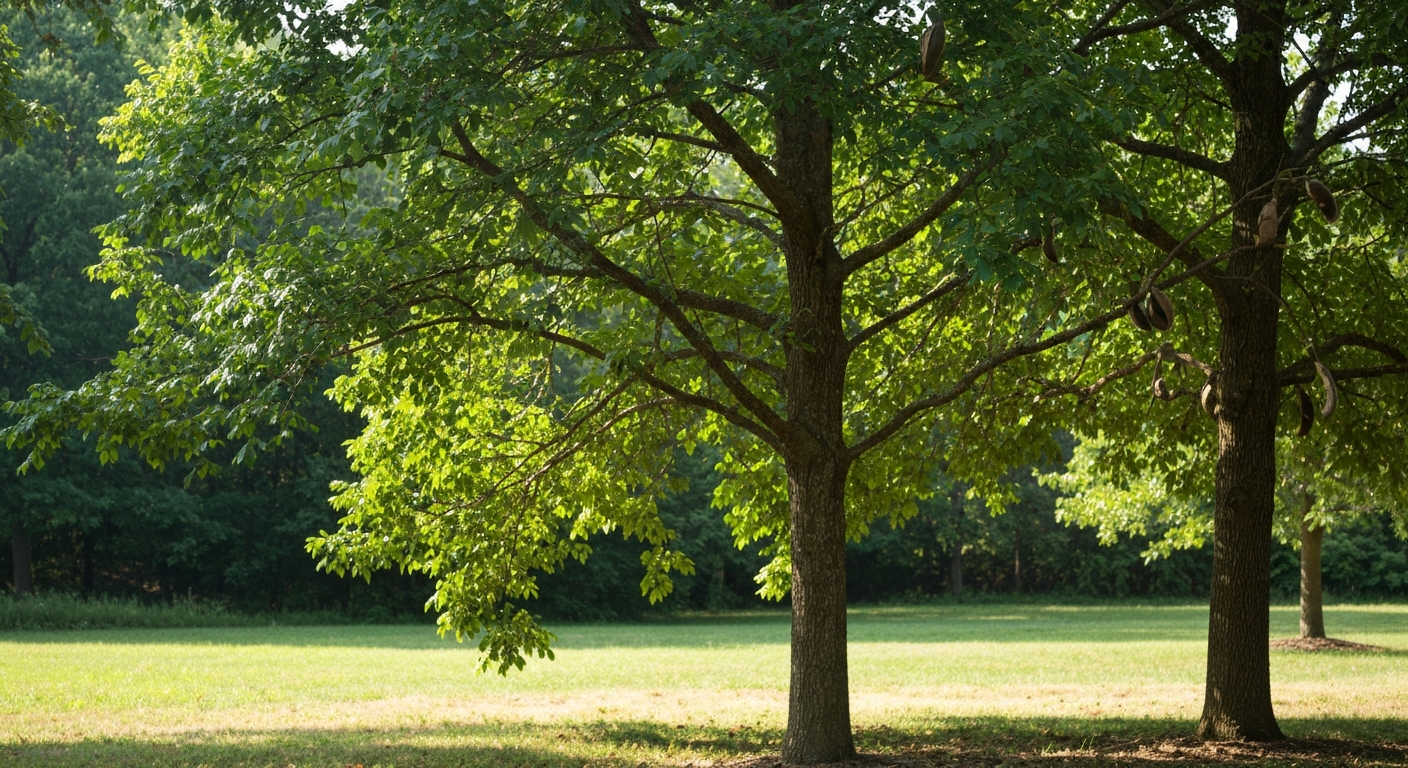
TL;DR: Kentucky coffee tree identification (Gymnocladus dioicus) is built on huge bipinnate leaves — twice-compound, fern-like fronds up to 3 feet long — and thick leathery seed pods on female trees. Winter Kentucky coffee tree bark is dark gray-brown with scaly ridges; twigs are stout with oversized triangular leaf scars and tiny buds. The crown looks open and sparse even in summer. Photograph the full leaf architecture or a hanging pod cluster, then confirm with the Tree Identifier app.
☕ Kentucky coffee tree identification trick: if the compound leaf is twice divided (leaflets on side branches off the main stalk), you are not looking at walnut or ash — you are likely in Gymnocladus territory.
Why Kentucky coffee tree stands out
Kentucky coffee tree is one of the boldest silhouette trees in eastern North America — yet many people walk past it without a name. It belongs to the legume family (Fabaceae), related to black locust and honey locust, not to true coffee (Coffea). Native Americans and settlers roasted the large seeds as a coffee substitute — hence the common name — but raw seeds are toxic and roasting requires expert knowledge. Kentucky coffee tree identification is about morphology, not beverage prep.
Ecologically, it was scarce in presettlement forest — often confined to river margins and disturbed openings. Today it is a popular urban street tree because mature specimens tolerate heat, drought, and compacted soil, and the sparse crown casts light shade below.
Botanical name Gymnocladus dioicus: Greek gymnos (naked) + klados (branch) — referring to the long bare winter twigs.
Kentucky coffee tree leaf identification — bipinnate architecture
Kentucky coffee tree leaf identification hinges on bipinnate compound structure — the rarest large-tree leaf form in many neighborhoods.
Once pinnate vs bipinnate: Black walnut and ash are once pinnate — leaflets attach directly along one central rachis. Kentucky coffee tree is twice pinnate — the main rachis bears side branches (pinnae), and leaflets attach along each pinna. One leaf can look like a fern frond the size of a coffee table.
Size: Leaves commonly 18 to 36 inches long and equally wide — among the largest leaves on any North American hardwood.
Leaflets: 40 to 100 or more per leaf, each oval to oblong, 1 to 2 inches long, with entire smooth margins — no teeth. Color is blue-green or gray-green, giving a muted crown tone.
Phenology: Leaves emerge late — often May when maples are fully green. They drop early — sometimes yellowing and falling by late September while oaks remain dark green. Spring and fall weeks, Kentucky coffee tree looks oddly bare beside neighbors.
Photography: Step back and capture the entire leaf held against sky or pavement — bipinnate branching must be visible. Close-ups of single leaflets alone are weak Kentucky coffee tree identification photos.
Seed pods — definitive Kentucky coffee tree identification
Gymnocladus dioicus is dioecious — separate male and female trees, though some trees may bear imperfect flowers.
Female trees: Produce bold seed pods in fall — thick, leathery, 3 to 10 inches long, about 2 inches wide, dark red-brown to purple-black. Pods hang in clusters and persist on the tree through winter, rattling in wind.
Pod interior: Large hard seeds embedded in sweet sticky pulp — attractive to livestock historically, toxic if eaten raw in quantity.
Male trees: Produce fragrant white flower panicles in late spring but set no pods. Male clones are preferred for street planting to avoid sidewalk pod litter — so many boulevard trees never show pods.
When pods are present, Kentucky coffee tree identification is immediate. No other large eastern street tree combines bipinnate leaves with thick legume pods of this size except honey locust — which has very different once-pinnate or bipinnate fine leaflets and twisted flat pods, not thick leather sausages.
Kentucky coffee tree bark and winter ID
Kentucky coffee tree winter bark and twig characters carry identification when leaves are absent for half the year.
Bark on mature trunks: Dark gray-brown, broken into narrow scaly ridges with age — somewhat like black cherry but heavier twigs and different leaf scars.
Twigs: Very stout, often pale gray with a waxy bloom. Nodes are swollen.
Leaf scars: Large, raised, triangular or shield-shaped — occupy much of the node face. Multiple bundle scars visible inside the scar outline.
Buds: Tiny — nearly hidden beneath the leaf scar apex. Compare to black locust's obvious sunken bud nested in scar.
Winter silhouette: Few heavy branches, coarse twig tips, optional pod clusters — the tree looks sculptural and slightly alien in a row of finer-branched maples.
For winter bark photography tips, see Tree Bark Identification App Guide.
Growth form and size
Kentucky coffee tree grows 60 to 80 feet tall with a narrow to rounded open crown. Trunk diameter reaches 2 to 3 feet on old specimens. Branching is sparse — large gaps between major limbs let grass grow beneath, a trait landscapers value.
Bark on young planted trees is smoother gray with lenticels — winter bark characters intensify after twenty years.
Native range and planting context
Native Kentucky coffee tree range spans the central Mississippi and Ohio river systems — Illinois, Indiana, Ohio, Kentucky, Tennessee, Missouri, Iowa, Kansas, and neighboring states. Historically scattered in riparian woods and after disturbance — not continuous forest canopy dominant.
Planted well beyond native counties in Canada, the Northeast, and Rocky Mountain cities. Kentucky coffee tree identification in Denver or Montreal is often a cultivated street tree, still the same species.
Conservation note: wild native populations are fragmented; the species relies partly on planting programs. Recognizing planted vs wild origin does not change ID characters.
Lookalikes and how to exclude them
Honey locust (Gleditsia triacanthos)
Also Fabaceae, often planted on the same streets. Honey locust leaves may be once or twice pinnate but leaflets are much smaller and more numerous — fine, feathery texture. Pods are flat, twisted legume straps, not thick leather. Trunks may have thorns on wild types; thornless cultivars are common.
Black locust (Robinia pseudoacacia)
Once-pinnate leaves with oval leaflets; paired spines at nodes; white pea flowers in spring; thin pea pods. Not bipinnate giants.
Tree of heaven (Ailanthus altissima)
Once-pinnate with basal gland teeth and foul smell — see tree of heaven identification. Samaras, not legume pods.
Devil's walking stick (Aralia spinosa)
Shrub or small tree with twice-compound leaves — but prickly stems and umbel flowers, not thick pods. Shrub scale, not 60-foot boulevard tree.
Historical coffee substitute — identification only
Settlers roasted Kentucky coffee tree seeds as a coffee substitute during shortages. Modern foragers should not experiment — seeds contain cytisine-related alkaloids toxic raw. Kentucky coffee tree identification for heritage and ecology does not require consuming seeds. Appreciate pods on the tree or in winter wreaths — not in your mug.
Using Tree Identifier for Kentucky coffee tree
Tree Identifier recognizes Gymnocladus dioicus from architecture photos across its native and planted range.
Best photos: Entire bipinnate leaf against sky. Cluster of thick pods on branch. Winter twig close-up showing triangular leaf scar and tiny bud.
Avoid: Single leaflet macro — apps may suggest honey locust or ash. Include pinnae branching in frame.
Seasonality: Late spring through summer for leaves; fall through winter for pods and bark. Early spring bare twigs work with scar photos.
Kentucky coffee tree identification rewards one good architecture photo — the bipinnate leaf and thick pod are unlike almost anything else on the block.
Frequently asked questions
How do you identify a Kentucky coffee tree?
Identify Kentucky coffee tree (Gymnocladus dioicus) by huge bipinnate compound leaves — leaflets arranged on side branches off a main stalk, often 2 feet long and 2 feet wide. Female trees bear thick leathery pods 3 to 10 inches long that persist into winter. Winter bark is dark gray-brown with scaly ridges; twigs are stout with large triangular leaf scars and tiny buds. Crown is open and sparse — few branches compared to maples or oaks. Native to Midwestern river valleys, widely planted as a street tree.
What do Kentucky coffee tree leaves look like?
Kentucky coffee tree leaves are bipinnately compound — twice divided. A central rachis bears side branches (pinnae), each pinna carrying multiple oval leaflets. Total leaf may have 40 to 100 or more leaflets. Leaflets are blue-green, 1 to 2 inches, with entire smooth margins. The overall effect is tropical and fern-like, unlike once-pinnate walnut or ash. Leaves emerge late in spring and drop early in fall — the tree can look bare while neighbors are in full leaf.
How do you identify Kentucky coffee tree pods?
Kentucky coffee tree pods are thick, leathery, reddish-brown to dark purple pods 3 to 10 inches long and about 2 inches wide. They hang in clusters on female trees in fall and often remain on branches through winter. Inside are large hard seeds in sticky pulp — historically roasted as a coffee substitute (with caution; raw seeds are toxic). Male trees produce flower clusters but no pods. Pod presence is definitive Kentucky coffee tree identification when leaves are gone.
What does Kentucky coffee tree bark look like in winter?
Kentucky coffee tree winter bark is dark gray to brown with narrow scaly ridges — not shaggy like hickory, not smooth like beech. Twigs are very stout; leaf scars are large, raised, and triangular or shield-shaped on swollen nodes. Buds are tiny relative to the scar — almost hidden. The sparse winter silhouette with thick twigs and hanging pod remnants is distinctive in city parks and boulevards across the eastern US.
Is Kentucky coffee tree the same as coffeetree or gymnocladus?
Yes. Gymnocladus dioicus is the scientific name; Kentucky coffee tree is the standard common name. An older synonym is Gymnocladus canadensis. Do not confuse with eastern redbud (Cercis) or black locust (Robinia) — different leaf forms and fruit. The genus name Gymnocladus means naked branch, referring to the bare winter appearance.
Where does Kentucky coffee tree grow?
Native range centers on the Midwest — Ohio River valley, southern Michigan, Iowa, Kansas, and south to Tennessee and Oklahoma — often on floodplains and limestone soils. Planted widely as an urban street tree because it tolerates drought and pollution once established. You will see Kentucky coffee tree identification opportunities in Chicago, Denver, Toronto plantings, and campus arboreta beyond strict native range.
Can tree ID apps identify Kentucky coffee tree?
Yes, when photos show bipinnate leaf structure, pods, or the stout twig and leaf scar pattern. Apps may confuse it with honey locust (also compound but often once-pinnate with smaller leaflets and different pods) if only a leaflet close-up is submitted. Photograph the full leaf architecture or a pod cluster for best Gymnocladus dioicus matches in Tree Identifier.
Try Tree Identifier — free on iPhone
Photograph bipinnate leaves or seed pods and confirm Kentucky coffee tree in seconds.
Download on the App Store