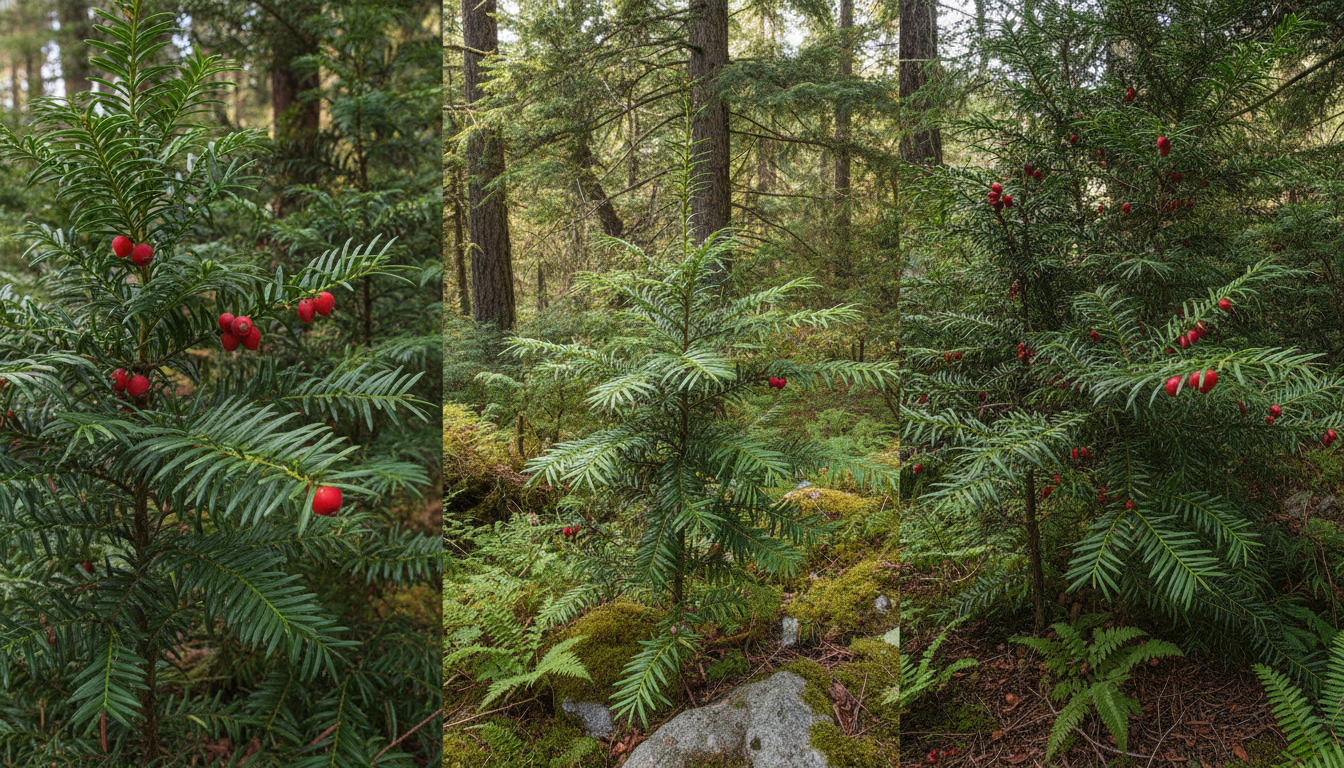
TL;DR: Yew tree id means recognizing soft, flat evergreen needles in a two-ranked spray and — on female plants — bright red fleshy cups (arils) around a hard toxic seed. English yew (Taxus baccata), Japanese yew (Taxus cuspidata), and hybrids fill hedges and yards; Pacific yew (Taxus brevifolia) is a western forest understory tree. All parts are toxic except that the aril pulp is sometimes called less toxic — still do not eat any part. Tell yew from hemlock and fir by fruit type and underside needle markings. Photograph needles and arils and confirm with the Tree Identifier app.
⚠️ Yew identification includes a hard safety rule: red "berries" are arils with a poisonous seed inside. Leaves, bark, and wood contain taxine alkaloids. Never forage yew — ID for recognition and livestock safety only.
Understanding yew — genus Taxus
Yews belong to the family Taxaceae, genus Taxus — ancient evergreen conifers with a unique fruit structure. Unlike pines, firs, and hemlocks that produce woody cones, female yews surround each seed with a fleshy, open-ended red cup called an aril. That single trait is the fastest field confirmation when fruit is present.
People search yew tree id because cultivated yews look like dense shrubs, while Pacific yew can reach tree size in western forests. Botanically they are woody gymnosperms — related to conifers — whether trimmed into a three-foot foundation hedge or growing twenty feet tall under Douglas-fir.
Key genus-level traits for yew identification:
- Needles: Flat, soft, linear, usually 0.5 to 1.5 inches, dark green above, paler beneath, arranged in two ranks along the twig (a flat spray).
- Attachment: Needles attach singly — not in bundles of two or five like pine.
- Fruit: Bright red aril enclosing (but not fully sealing) a hard olive-brown seed on female plants.
- Sex: Most yews are dioecious — separate male and female plants. Only females bear arils.
- Bark: Thin, reddish to purple-brown, peeling in thin flakes or scales on older trunks.
- Wood: Dense, elastic, historically prized for longbows; toxic alkaloids throughout.
Yew tree id at the genus level is reliable once you see arils. Without fruit, you separate Taxus from lookalike evergreens by needle softness, underside color, and the absence of woody cones. For needle vocabulary — stomatal bands, ranks, petioles — see the Tree Anatomy Glossary.
English yew identification
English yew (Taxus baccata) is the European species of churchyards, formal gardens, and ancient hedges. In North America it appears mostly as a planted ornamental, not a wild forest tree.
Needles: Soft, flat, dark green, typically about 0.5 to 1.2 inches long, with a slightly pointed but not piercing tip. Undersides are lighter green without the bold double white lines of eastern hemlock.
Arils: Classic scarlet cups in late summer and fall — the image people associate with yew tree id. Birds swallow the aril and seed; the seed often passes intact. Humans must never copy that habit.
Form: Can become a broad, multi-stemmed tree over centuries in Europe; in US landscapes it is usually kept as a dense shrub or columnar hedge (many cultivars).
Bark: Reddish-brown, flaky; old English yews develop massive, irregular trunks.
Range in landscape use: Temperate yards, cemeteries, and parks across much of the US and Canada where winters are not extreme desert heat. English yew identification outdoors in North America almost always means "planted," not "native forest volunteer."
Pacific yew tree identification
Pacific yew (Taxus brevifolia) is the native western species — and the one people mean when they search pacific yew tree identification or pacific yew identification in forest contexts.
Habitat: Moist, shady understory of Pacific Northwest and inland Northwest forests — often under Douglas-fir, western hemlock, or mixed conifers — from coastal Alaska and British Columbia through Washington, Oregon, and northern California, inland to Idaho and Montana. It thrives in cool, humid sites, streamside woods, and north-facing slopes.
Needles: Short and flat — often under one inch — yellowish-green to dark green, arranged in flat sprays. Tips are pointed but soft to the touch compared with spruce.
Bark: Distinctive thin, purplish to reddish-brown bark that peels in papery flakes — a strong pacific yew identification character on larger stems.
Form: Small tree or large shrub, often leaning, irregular, or multi-stemmed; rarely a straight dominant canopy tree. Heights commonly 15 to 40 feet in good sites; older individuals can be larger but remain understory specialists.
Arils: Same red fleshy cups as other yews when female trees fruit. Fruit is less often noticed than on clipped hedges because Pacific yew grows scattered in deep shade.
Historical note: Bark of Pacific yew was the original natural source of paclitaxel (Taxol), used in cancer chemotherapy. Wild harvest is tightly regulated; do not strip bark from wild trees. Pacific yew tree identification for conservation and respectful photography matters more than collection.
If you are hiking west of the Rockies and find a soft-needled evergreen with flaky red-purple bark and no woody cones, run pacific yew identification against western hemlock before assuming fir or spruce.
Japanese yew and landscape hybrids
Japanese yew (Taxus cuspidata) and the hybrid Taxus × media (English × Japanese) dominate US and Canadian landscaping. When a homeowner asks for yew tree id of a foundation plant, the answer is usually one of these cultivars — not Pacific yew.
Needles: Similar flat soft needles; Japanese yew needles may appear slightly broader or more abruptly tipped than English yew. Color ranges from deep green to gold-variegated cultivars.
Habit: Dense, often wider than tall unless trained; popular for privacy hedges, topiary, and shaded north walls where many flowering shrubs fail.
Arils: Same red cups — highly visible against dark foliage in autumn, which is when children and pets are most at risk of tasting "berries."
Hardiness: Many Japanese yew cultivars tolerate colder Midwestern winters better than English yew, which is why they appear so widely in suburban plantings.
Yew identification at species level among cultivars is often less important than confirming genus Taxus for toxicity awareness. Nursery tags and growth form (upright vs spreading) help; wild Pacific yew context does not apply to a clipped yard hedge.
Yew vs hemlock vs fir
Flat soft needles create the main confusion cluster in evergreen yew tree id.
Yew vs hemlock (Tsuga)
Eastern and western hemlock needles are flat and soft like yew, but:
- Hemlock undersides show two pale white stomatal lines — usually obvious in a close photo.
- Hemlock produces small hanging woody cones, not red arils.
- Hemlock branch tips often droop; leaders of young trees nod.
- Hemlock is a forest canopy or co-dominant tree; cultivated yews are usually hedges.
Full hemlock details — including the deadly name collision with poison hemlock herbs — are in Hemlock Tree Identification. For pacific yew identification next to western hemlock, check for arils vs cones and bark flake color.
Yew vs fir (Abies)
Fir needles are also soft and flat-ish, but they typically attach with a suction-cup base and leave a smooth circular scar on the twig when pulled. Fir cones stand upright on branches and shatter when mature — you rarely find intact fallen fir cones. Yew never makes large upright cones. Fir needles often have two white lines beneath (like hemlock), while many yews look more uniformly pale green below.
Yew vs spruce and pine
Spruce needles are sharp, four-sided, and roll easily between fingers — painful to grab. Pine needles grow in bundles (fascicles). If needles come off the twig in twos or fives, it is not yew. Soft flat singles plus red arils = Taxus.
For broader leaf and needle sorting methods, see Identify Trees by Leaf and Tree Foliage Identification Guide.
Bark, winter form, and landscape clues
Winter yew tree id is easier than for deciduous trees because needles persist.
Bark: Look for thin reddish, cinnamon, or purple-brown flakes on trunks thicker than a few inches. Smooth gray young stems become flaky with age — especially useful for pacific yew tree identification on forest stems.
Buds and twigs: Green to brown twigs with small buds; needles remain flexible in cold weather (though they can bronze in winter sun on some cultivars).
Hedge geometry: Sharp rectangular or rounded clipped outlines in yards almost always signal English or Japanese yew cultivars, not Pacific yew.
Forest context: Scattered understory evergreen with flaky bark west of the Continental Divide favors Pacific yew over ornamental species.
Photograph bark plus a needle close-up when arils are absent. Guidance on which plant parts photograph best is in Best Photo for Tree ID.
Toxicity and safety — do not eat
Yew identification is partly a public-safety skill. Taxine alkaloids in needles, bark, wood, and seeds affect the heart. Livestock deaths from browsing ornamental yews are well documented. Human poisoning from chewing needles or swallowing seeds is rare but serious.
Arils: The red fleshy pulp is often described as the only part that is relatively low in taxines, and birds consume it readily. The seed inside is toxic. Because children may swallow seed and pulp together, and because pulp amounts vary, the practical rule is: do not eat any part of a yew. Do not make tea from needles. Do not burn large amounts of yew wood in poorly ventilated spaces.
Pets: Dogs and cats may play with fallen arils; keep yard yews cleaned up in fruiting season if pets chew plant debris.
ID, not foraging: This guide is for recognition — landscape, forest, and safety ID — never for food use. If someone has ingested yew material, contact poison control; do not wait for home remedies.
Step-by-step yew tree id in the field
- Confirm evergreen flat needles: Soft, not sharp like spruce; attached singly, not in pine bundles.
- Check arrangement: Two-ranked flat spray along the twig is classic Taxus.
- Look for arils: Red open cups with a visible seed = female yew. No arils does not rule out male plants or off-season females.
- Inspect underside: Lack of bold hemlock-style white bands supports yew over Tsuga.
- Note bark and setting: Flaky red-purple bark in a western forest understory → pacific yew identification. Clipped hedge in a suburb → English/Japanese/hybrid landscape yew.
- Rule out cones: Woody hanging cones point to hemlock; upright shattering cones point to fir.
If you are stuck at "evergreen with soft needles," photograph needles from above and below, any fruit, and the whole plant habit, then ask What Type of Tree Is This? style questions — or use an app.
Using Tree Identifier for yew
Tree Identifier matches English, Japanese, hybrid, and Pacific yew from clear needle and aril photos.
Best photos: One close-up of the flat needle spray filling the frame. One underside shot if possible. One aril cluster when fruit is present — the red cups are highly distinctive. For Pacific yew, include flaky bark on a larger stem and a habitat shot showing forest understory.
Common app confusion: Without arils, results may list hemlock or fir. Add a second photo of bark or whole-plant form. Note your region in the caption mentally — Pacific Northwest forest vs Midwestern foundation planting — before accepting a species name.
Safety photography: You do not need to handle arils or crush needles. Zoom from a short distance; wash hands after any contact before touching your face.
Yew tree id rewards careful observation: soft flat needles, red arils, flaky bark, and a strict no-foraging rule. Once you separate Taxus from hemlock and fir, English yew hedges, Japanese landscape cultivars, and wild Pacific yew each fall into place.
Frequently asked questions
How do you identify a yew tree?
Yew tree id starts with soft, flat evergreen needles arranged in two ranks along the twig, dark green above and paler beneath, with no sharp tip like spruce. In late summer and fall, female plants produce bright red fleshy cups (arils) around a hard dark seed. Bark is thin, reddish-brown, and peels in flakes on older trunks. Yews are shrubs or small trees, often densely branched, in the genus Taxus. Needles attach singly — not in bundles like pine — and lack the white underside lines typical of hemlock.
What is Pacific yew tree identification?
Pacific yew (Taxus brevifolia) is a native western North American tree or large shrub of moist forests from Alaska to California and inland to the Rockies. Pacific yew tree identification uses short flat needles, often under one inch, reddish-purple flaky bark, and small red arils on female trees. It grows in the understory — shade-tolerant, often leaning or multi-stemmed — not as a formal hedge like cultivated English or Japanese yew. Pacific yew identification is important historically because bark was the original source of paclitaxel (Taxol).
Are yew berries poisonous?
The fleshy red aril pulp around the seed is often described as the least toxic part and is eaten by birds, but the hard seed inside is highly toxic, and leaves, bark, and wood contain taxine alkaloids that can be fatal to humans and livestock. Safety rule for yew identification: treat all parts as poisonous — do not eat arils, chew needles, or burn yew wood in open fires where smoke is inhaled. Children and pets should be kept away from ornamental yews with red "berries."
How do you tell yew from hemlock?
Both have flat soft needles, so beginners confuse them. Eastern hemlock (Tsuga) needles show two distinct pale white stomatal bands on the underside and hang small woody cones from branch tips. Yew needles are usually darker, lack those bold white lines, and female yews produce red fleshy arils — never woody cones. Hemlock branch tips droop gracefully; many cultivated yews are clipped into dense hedges. Habitat and fruit type settle Pacific yew identification vs western hemlock in the Pacific Northwest.
What is the difference between English yew and Japanese yew?
English yew (Taxus baccata) is the classic European species — dark needles, red arils, often used in churchyards and formal hedges. Japanese yew (Taxus cuspidata) and hybrids (Taxus × media) dominate North American landscaping; needles may be slightly broader or more abruptly pointed, and growth habit is often denser for foundation plantings. Both share genus-level yew identification traits: flat needles, red arils, toxic seeds. Cultivar labels and landscape context matter more than wild range when ID'ing planted yews.
Is yew an evergreen?
Yes. All common Taxus species are evergreen — they keep needles year-round. Winter yew tree id relies on needle arrangement, bark flakes, and any persistent arils. Unlike deciduous shrubs that drop leaves, yew stays green through winter, which is why it is popular for privacy screens and topiary.
Can tree ID apps identify yew?
Yes, Tree Identifier recognizes English, Japanese, and Pacific yew when photos show flat needle sprays and especially the distinctive red arils. Photograph a close-up of needles from above and below, plus any fruit. Without arils, apps may confuse yew with hemlock or fir — add a bark photo and note whether the plant is a clipped hedge or a forest understory tree to improve Pacific yew identification.
Try Tree Identifier — free on iPhone
Photograph yew needles or red arils and get a species match in seconds.
Download on the App Store