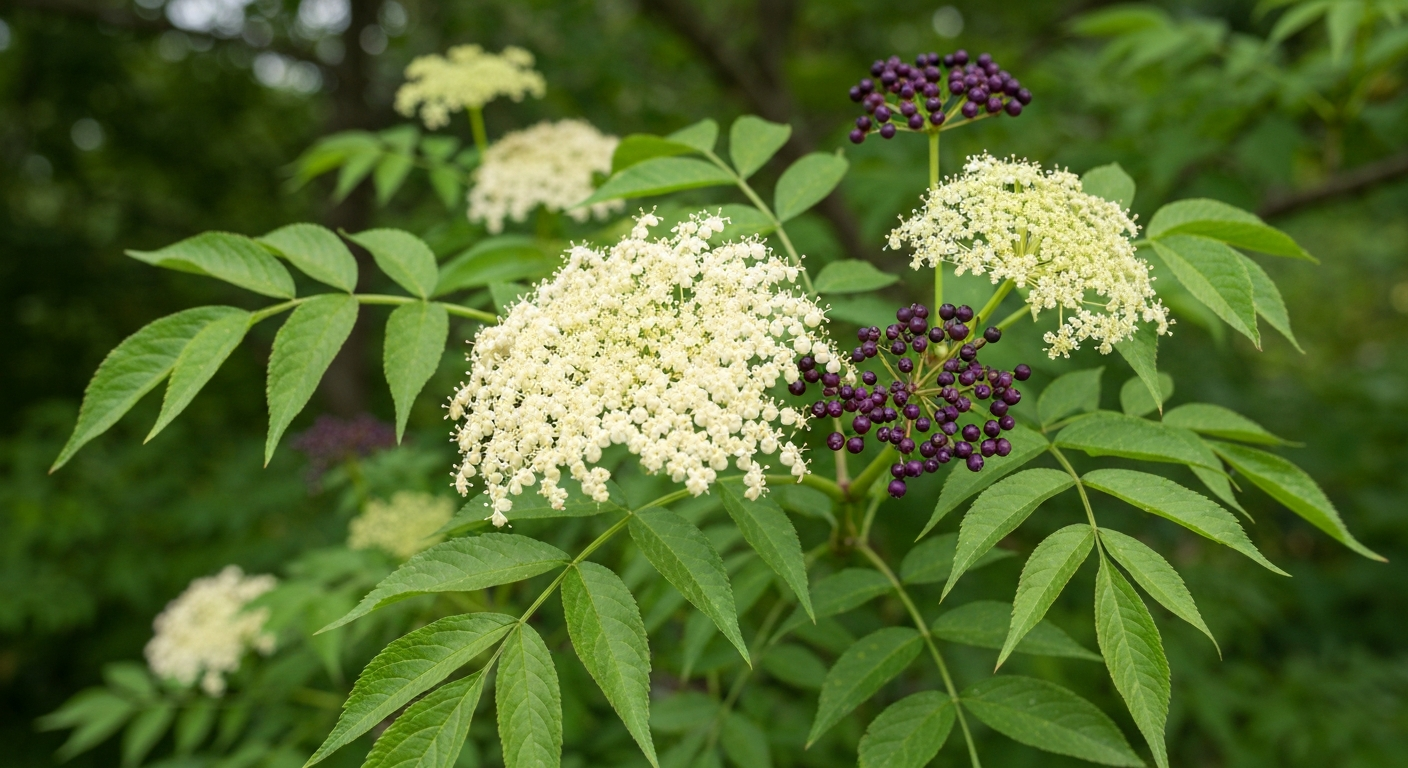
TL;DR: Identification of elderberry tree leaves requires opposite pinnately compound leaves — 5 to 9 serrated leaflets per leaf, two compound leaves per node — on a woody shrub or small tree. American elderberry (Sambucus canadensis) and black elder (Sambucus nigra) produce flat creamy flower umbels in summer and purple-black berry clusters in fall. Critical safety split: poison hemlock and water hemlock are herbaceous with alternate leaves and are deadly poisonous. Never harvest from plants without confirming woody Sambucus and ruling out hemlock. Photograph leaves showing opposite arrangement plus stem woodiness, then confirm with the Tree Identifier app.
⚠️ Identification elderberry tree leaves safety rule: woody shrub + opposite compound leaves = possible elderberry. Herbaceous hollow stem + alternate leaves = hemlock — walk away.
Understanding elderberry — genus Sambucus
Elderberries belong to genus Sambucus in the moschatel family (Adoxaceae). American elderberry (Sambucus canadensis, sometimes treated as Sambucus nigra subspecies) grows across eastern North America in moist open habitats. European black elder (Sambucus nigra) is planted and naturalized in parts of North America. Blue elder (Sambucus cerulea) dominates western North America with a glaucous berry coating.
People search identification elderberry tree leaves because elderberry syrup, wine, and jam drive foraging interest — but toxic lookalikes grow in the same ditches and stream edges. Leaf ID is the first gate in a safety workflow, not the final foraging approval.
Genus-level traits:
- Growth form: Woody multi-stemmed shrub or small tree — not herbaceous.
- Leaves: Opposite, pinnately compound, 5 to 11 serrated leaflets.
- Leaflets: Lanceolate, acuminate tips, serrated margins, often asymmetric base.
- Flowers: Large flat-topped to rounded creamy white umbels, summer.
- Fruit: Small purple-black drupes in heavy drooping clusters (blue-white on blue elder).
- Odour: Crushed leaves and stems smell sharp, unpleasant — some say rank or catty.
- Pith: Stem pith is soft and white in young growth — unlike solid woody twigs of many trees.
Elderberry is not a large forest canopy tree — it is a thicket-forming shrub people colloquially call elderberry tree when stems grow tall.
Elderberry leaf identification in detail
Identification elderberry tree leaves starts with arrangement and leaflet architecture.
Opposite arrangement: Two compound leaves attach at each node directly across from each other. Run your hand down the stem — leaves alternate side to side = not elderberry. Opposite pairs = elderberry, ash, or a few other shrubs.
Compound structure: One petiole carries 5 to 9 leaflets (occasionally 3 or 11 on vigorous shoots). One terminal leaflet at the tip plus paired lateral leaflets.
Leaflet shape: Lanceolate to ovate-lanceolate, 2 to 5 inches long, 1 to 2 inches wide. Tip long-pointed. Base often uneven (asymmetric) on lateral leaflets.
Margin: Coarsely serrated — sharp forward-pointing teeth. Not smooth-edged like poison hemlock leaflet margins from a distance — hemlock is more feathery overall.
Texture: Thin, soft. Upper surface green; underside paler, sometimes hairy on veins.
Odour: Crush a leaflet — elder has a sharp, unpleasant smell. Not the musty parsley smell of poison hemlock.
Photograph one full compound leaf with the node above and below visible to prove opposite arrangement. See Identify Trees by Leaf for arrangement photography.
American elderberry vs black elder
North American and European elders overlap in cultivation.
American elderberry (Sambucus canadensis): Shrub 5 to 12 feet, often taller in the South. Leaflets 5 to 9, serrated. Flower umbels 6 to 10 inches broad, creamy white. Berries purple-black on pinkish peduncles. Common in moist ditches, pond edges, old fields.
Black elder (Sambucus nigra): European species and cultivars ('Black Lace', 'Lemony Lace'). Similar opposite compound leaves. Often more tree-like to 20 feet. Cultivars may have purple or yellow foliage — leaf shape still pinnate opposite.
Blue elderberry (Sambucus cerulea): Western species — similar leaves, berries covered in white waxy bloom (blue appearance).
Identification elderberry tree leaves at species level within Sambucus is less critical than genus confirmation and hemlock exclusion.
Flower umbels — summer confirmation
Elderberry flowers remove doubt when in season.
Structure: Large compound umbels — many tiny five-petaled creamy white flowers in a flat or slightly convex plate, 4 to 10 inches across.
Timing: June through July in most US regions, after many spring bloomers.
Fragrance: Sweet, musky — attracts insects. Different from leaf crush smell.
Stems: Flower stalks often pinkish or gray-pubescent.
Poison hemlock flowers are white umbels too — similar from a car — which is why leaf and stem characters matter before any harvest. Hemlock umbels lack woody shrub structure below.
Berry clusters — fall identification
Ripe elderberries are among the heaviest fruit clusters in temperate shrubs.
Color: Purple-black, glaucous bloom sometimes visible. Blue elder has white-blue berries.
Form: Drooping cluster of many small drupes, each with 3 to 5 seeds.
Timing: Late summer through fall.
Stems: Fruit stalks often reddish.
Unripe green berries are toxic. Identification elderberry tree leaves plus confirmed Sambucus woody growth is mandatory before berry collection. For general fruit context see How to Identify Nut Trees — elderberry is a soft drupe, not a nut.
Poison hemlock — the deadly lookalike
Poison hemlock (Conium maculatum) kills. It grows in the same moist disturbed habitats as elderberry — roadsides, ditches, stream banks.
Life form: Herbaceous biennial — no persistent woody trunk. First year rosette, second year tall flowering stalk that dies back.
Stems: Hollow, green with purple blotches or streaks — the classic ID character. Elderberry stems are woody gray-brown without purple spots.
Leaves: Alternate, not opposite — compound with many finely divided leaflets, fern-like and lacy. Leaflets much more dissected than elderberry's simple lanceolate serrate leaflets.
Smell: Musty, mousy, unpleasant — described as rank parsley or urine. Not the sharp elder leaf smell.
Flowers: White umbels — dangerously similar to elderberry flowers from distance. Approach ID from leaves and stem woodiness first.
Rule: If the plant is a tall soft herb with purple-streaked hollow stem and alternate feathery leaves, it is hemlock — not elderberry.
Water hemlock — wetland danger
Water hemlock (Cicuta maculata and related species) is North America's most violently toxic native plant.
Life form: Herbaceous perennial in wet meadows, marshes, stream edges — elderberry's wet habitat overlap.
Leaves: Alternate, pinnately compound with numerous narrow lanceolate leaflets. Veins often terminate in notches between teeth — a technical character under magnification.
Stems: Hollow, purplish, chambered rootstock — even handling roots has caused poisoning.
vs elderberry: Elderberry is woody shrub with opposite broader leaflets. Water hemlock is soft herbaceous with alternate leaves. Side-by-side, leaflet width and arrangement split them clearly — confusion happens when observers grab one leaflet without checking arrangement or woodiness.
Other shrubs with opposite compound leaves
Opposite compound leaves narrow the field beyond hemlock:
Ash (Fraxinus): Opposite compound leaves but leaflets usually entire or barely toothed — not coarsely serrated like elder. Ash is a tree with solid bark architecture, not a soft pithy shrub. No elder-style flower umbels or purple berry masses.
Viburnum: Some species have opposite lobed or toothed leaves — simple or three-lobed, not elder's many narrow leaflets. Different fruit (drupes in smaller clusters).
Honeysuckle shrubs: Opposite simple leaves — not compound.
Bark, stems, and winter ID
Winter identification elderberry tree leaves uses stem architecture:
- Woodiness: Gray-brown bark on stems persisting year-round. Elderberry does not die back to ground like hemlock.
- Form: Multi-stemmed thicket from root suckers. Large lenticels (pores) on young stems.
- Buds: Opposite, plump, with multiple scales.
- Pith: Large white spongy pith in young branches — distinctive but do not confuse with hollow hemlock stem; elder wood is solid with soft pith inside, hemlock stem is a hollow tube.
- Persistent fruit stalks: Old umbel stalks may remain.
For bark photo techniques, see Tree Bark Identification App Guide.
Safe foraging workflow
Identification elderberry tree leaves is step one in a longer safety chain:
- Confirm woody Sambucus shrub — not herbaceous hemlock.
- Confirm opposite compound leaves with serrated lanceolate leaflets.
- Confirm flower umbels or purple-black berry clusters on the same plant architecture.
- Harvest flowers or fully ripe berries only — not leaves, stems, or green fruit.
- Cook berries before consumption per trusted food-safety guidance.
When in doubt, do not harvest. Hemlock mistakes are fatal. Apps and guides assist — they do not replace multiple confirming characters.
Using Tree Identifier for elderberry
Tree Identifier recognizes American elderberry from leaves, flowers, and berry cluster photos.
Best photos: One compound leaf pair showing opposite arrangement at the node. One flower umbel or berry cluster. Lower stem showing woody bark if near water where hemlock grows.
High-risk sites: Wet ditches may hold hemlock nearby — photograph arrangement on the specific plant you are evaluating, not a neighbor stem.
Identification elderberry tree leaves opens the door to one of foraging's most useful shrubs — but only when hemlock is definitively ruled out.
Frequently asked questions
What do elderberry tree leaves look like?
Elderberry leaves (Sambucus species) are pinnately compound and opposite on the stem — two compound leaves per node. Each leaf has 5 to 9 leaflets (sometimes 11) arranged along a central rachis with one terminal leaflet. Leaflets are lance-shaped, 2 to 5 inches long, with serrated margins and pointed tips. Leaflets are often asymmetric at the base. Crushed foliage has an unpleasant sharp smell. American elderberry (Sambucus canadensis) and black elder (Sambucus nigra) are the common species.
How do you identify elderberry leaves vs poison hemlock?
Elderberry is a woody shrub or small tree with opposite compound leaves and bark on mature stems. Poison hemlock (Conium maculatum) is an herbaceous biennial with alternate compound leaves, no woody trunk, and purple-spotted hollow stems. Hemlock leaflets are more finely divided and fern-like. Elderberry leaflets are broader with coarser teeth. Hemlock smells musty, not rank like elder. Never confuse them — hemlock is deadly poisonous.
Is elderberry opposite or alternate?
Elderberry leaves are opposite — two compound leaves attach at the same node on opposite sides of the stem. This is a key identification elderberry tree leaves character. Poison hemlock and water hemlock have alternate leaves. Opposite compound leaves narrow the field to elderberry, ash, and a few shrubs — elderberry has serrated leaflets and large flat flower heads unlike ash.
How do you identify American elderberry?
American elderberry (Sambucus canadensis) is a multi-stemmed shrub 5 to 12 feet with opposite pinnate leaves of 5 to 9 serrated leaflets. Flat-topped creamy white flower clusters (umbels) bloom in summer, followed by purple-black berry clusters on reddish stems. Bark on older stems is gray and warty. Grows in moist ditches, roadsides, and field edges across eastern North America.
What is the difference between elderberry and water hemlock?
Water hemlock (Cicuta species) has alternate compound leaves and herbaceous hollow stems — not woody elderberry shrubs. Water hemlock leaflets are narrow with numerous small teeth; veins often end in notches between teeth. Elderberry leaflets are broader and fewer per leaf. Water hemlock grows in wet meadows and stream edges; all parts are extremely toxic. Elderberry flowers and cooked ripe berries are used for food — positive woody-shrub ID required before any harvest.
Are elderberry leaves poisonous?
Elderberry leaves, stems, bark, roots, and unripe berries contain cyanogenic glycosides and should not be eaten. Ripe cooked berries and flowers are traditionally used in syrups and wine after processing. Identification elderberry tree leaves is step one for safe foraging — confirm Sambucus, rule out hemlock, harvest only flower umbels or fully ripe purple berry clusters from known plants.
Can tree ID apps identify elderberry from leaves?
Yes when photos show opposite compound leaves with serrated leaflets and ideally flower or berry clusters. Apps may struggle with leaf-only photos near water where hemlock grows — photograph the woody stem base and leaf arrangement. Tree Identifier recognizes American elderberry with clear leaf and inflorescence photos.
Try Tree Identifier — free on iPhone
Photograph elderberry leaves showing opposite arrangement and get a species match in seconds.
Download on the App Store