TL;DR: Boxelder tree identification targets the one-word spelling searchers use for Acer negundo — a true maple that grows compound leaves. Confirm opposite buds year-round, then either three-to-seven leaflets in summer or paired V-shaped samaras and boxelder bugs from fall through winter. Separate it from ash by fruit type and leaflet shape, and from poison ivy by opposite vs alternate leaf arrangement. Photograph buds, leaves, and seeds with Tree Identifier when you want a fast double-check.
🔴 Quick filter: opposite buds + compound leaflets (or maple helicopter seeds) = boxelder almost every time in eastern and central North America. Opposite buds + single paddle seeds = ash. Three leaflets on alternate stems = treat as poison ivy until proven otherwise.
Why “boxelder” as one word matters for searchers
Plenty of guides write “box elder” as two words. Many field keys and regional floras also accept boxelder as a single word. Search data shows both forms — and people typing boxelder tree identification often want the same species: Acer negundo, native across much of North America and planted widely along streets, creeks, and windbreaks.
The name itself misleads. Boxelder is not an elder (Sambucus). It is a maple that abandoned the classic palmate leaf for a compound arrangement rare among maples. That oddness creates the two lookalike traps this guide emphasizes: ash trees with opposite compound leaves, and young three-leaflet shoots that echo poison ivy.
If you already read a general Acer negundo overview, treat this article as the winter–lookalike companion: how to finish boxelder tree identification when foliage is gone, how insects tip the ID, and how to use a short field checklist under pressure.
Opposite compound leaves — the summer signature
In leaf season, boxelder tree identification starts with arrangement, then leaflet count.
- Opposite: Leaves and buds sit in pairs across the stem. Maples, ashes, and dogwoods share opposite arrangement; oaks, elms, and walnuts do not.
- Compound: Each leaf is made of leaflets. Boxelder usually shows three to seven leaflets — often three on shade shoots and five to seven on vigorous sun shoots.
- Leaflet shape: Coarsely toothed, sometimes irregularly lobed on the terminal leaflet. The terminal leaflet can look almost maple-like itself.
- Smell: Crushed foliage often smells slightly sour or unpleasant compared with many sugar maples.
Photograph one full compound leaf flat against a notebook, plus a close-up of the node showing the opposite pair. For compound-leaf photo tips, see Best Photo for Tree ID.
Boxelder leaves contrast with typical maple foliage covered in the maple tree identification guide — so do not rule out maple simply because the leaf is compound.
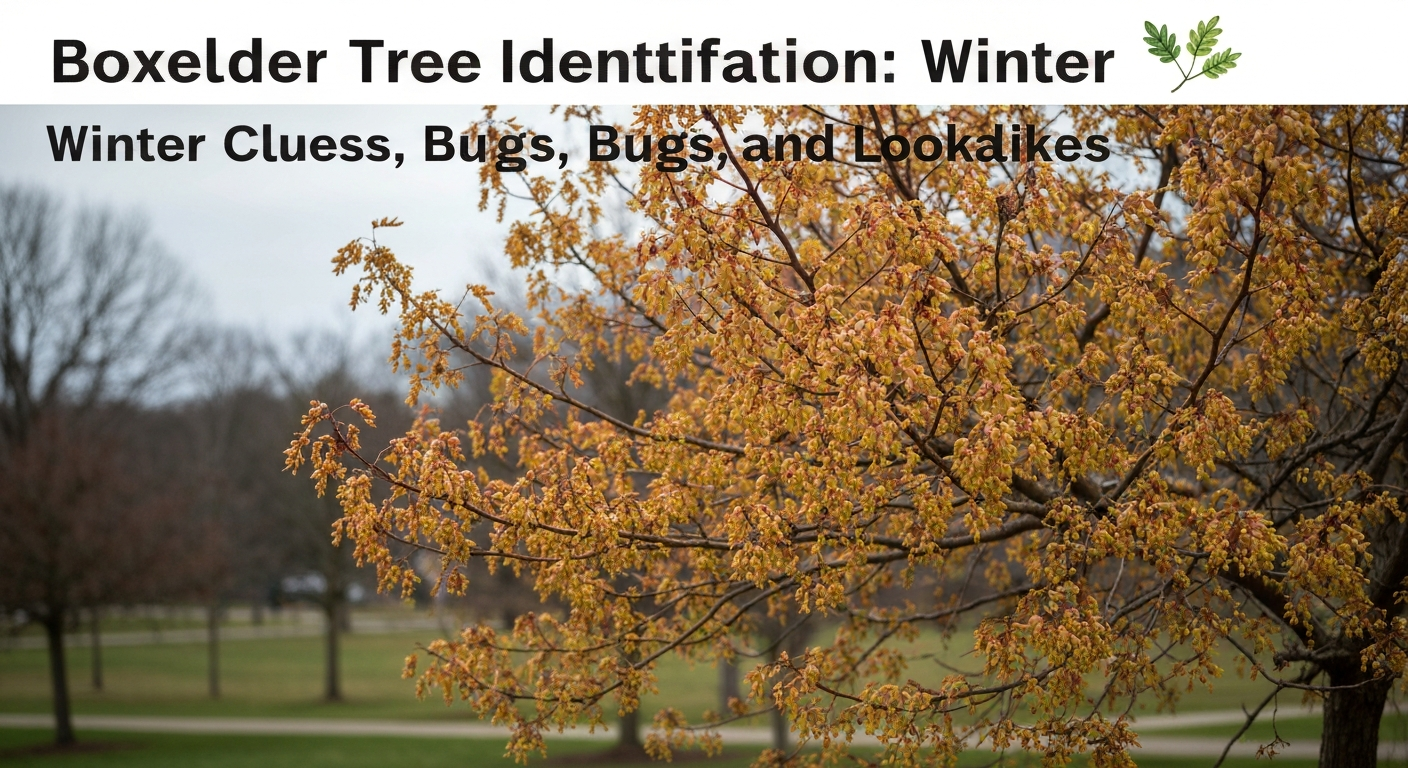
Winter boxelder tree identification
Winter is when one-word searchers often recheck the tree after leaves drop and insects appear on house walls. Boxelder stays identifiable without green tissue.
Buds and twigs
Buds are opposite, fairly plump, and often greenish, pinkish, or purple on young growth. Twigs can look glossy or slightly glaucous; young shoots are softer and more brittle than ash. Leaf scars are opposite and roughly V-shaped to horseshoe-shaped with bundle scars inside.
Walk the lower canopy with binoculars if needed. If every node shows a paired bud, you are in the maple–ash–dogwood group — then use fruit, bark, and insects to choose among them.
Samaras that persist
Like other maples, boxelder produces paired winged seeds (samaras). Wings often spread in a V or U. Clusters may hang late into winter on female trees. Finding helicopter seeds still attached is one of the cleanest winter proofs for boxelder tree identification.
Ash fruits are single samaras — one wing per seed — not paired maple “helicopters.” That fruit split ends most ash vs boxelder arguments outdoors. Read more on ash fruit and bark in Ash Tree Identification.
Bark and form
Young boxelder bark is smoothish and pale gray-brown; older trunks develop shallow furrows and ridges that look looser and lighter than classic diamond-furrowed ash. Form is frequently irregular and multi-stemmed, especially on floodplains and fence lines. Broken limbs and “weed tree” architecture are common — boxelder is fast-growing and short-lived relative to oaks.
For bark photography in snow or low light, the approaches in Identify Trees by Bark still apply: shoot dry bark at mid-trunk and include a close-up of a living twig tip.
Boxelder bugs as a field clue
Boxelder bugs (Boisea trivittata) are black with red markings and red wing veins. In late summer through fall they feed on developing seeds of Acer negundo, then mass on sunny south-facing walls, fences, and window frames near host trees. Homeowners often notice the insects first and only later ask about boxelder tree identification.
Use bugs as supporting evidence, not as a standalone key:
- Strong support: Bugs swarming a tree that also shows opposite buds and maple samaras.
- Weak alone: Bugs on a house wall with no host tree yet found — they can wander from a neighbor’s boxelder.
- Not diagnostic for ash: Emerald ash borer damage and ash seed crops do not produce classic boxelder bug massing on Acer.
Bugs do not usually sting people; they mainly annoy with indoor fall invasions. Their presence is still one of the most practical autumn ID shortcuts for this species.
Lookalike #1 — ash (opposite compound leaves)
Ash and boxelder share opposite compound foliage. That is the confusion driving many mis-IDs along streams and urban margins.
Leaflet differences: Ash leaflets tend to be more regularly oval with finer teeth and smoother overall outline. Boxelder leaflets look “messy” — coarser teeth, lobing on the tip leaflet, variable leaflet count shoot to shoot.
Fruit differences: Ash = single samaras. Boxelder = paired maple samaras. Collect a fallen seed cluster if the canopy is high.
Bark differences on mature trees: White and green ash often show tight interlacing furrows. Boxelder looks softer, lighter, and less neatly diamond-patterned.
Ecological note: Emerald ash borer has killed many ashes; remaining live opposite-compound trees in some yards turn out to be boxelder when checked carefully. Do not assume every dying opposite-leaf tree is ash — confirm fruit when possible.
Lookalike #2 — poison ivy (three leaflets)
Boxelder seedlings and shaded lateral shoots with three leaflets are the poison-ivy lookalike. Rash risk makes this the safety-critical split.
Arrangement on the woody stem:
- Boxelder: leaves/buds opposite.
- Poison ivy: leaves alternate.
Growth form: Boxelder becomes a tree with opposite branching architecture. Poison ivy climbs as a vine with hairy aerial roots or stays as a trailing shrub. A woody opposite twig system above head height is not poison ivy.
Field rule: Until opposite vs alternate is certain, do not handle three-leaflet foliage. Photograph from a short distance, crop tightly later, and let an app suggest candidates — then verify arrangement yourself. For vine vs tree foliage basics, see Tree Foliage Identification Guide.
Quick field checklist for boxelder tree identification
- Buds / leaf scars opposite? If no, stop — not boxelder.
- Leaves present? Compound with 3–7 leaflets, often irregular tip leaflet → continue. Simple palmate leaf → other maple.
- Fruit present? Paired V/U samaras → maple group; single paddle → ash.
- Insects? Red-and-black bugs on tree or sunny walls nearby → supporting clue for boxelder.
- Three leaflets only? Confirm opposite arrangement before touching.
- Habitat? Floodplains, moist yards, fence rows, urban waste ground — all common for Acer negundo.
- Photo set: Opposite node + full compound leaf (or winter twig) + fruit if available.
Run this checklist in under two minutes once you practice opposite vs alternate on living twigs.
Range, habitat, and what “weedy maple” means
Boxelder grows from coast to coast in North America, favoring moist soils but tolerating dry urban sites. It sprouts quickly after disturbance, colonizes riverbanks, and seeds aggressively. Soft wood and ice-storm breakage earn a “weed tree” reputation, yet wildlife uses the seeds and the canopy provides fast shade.
Sexes are usually on separate trees (dioecious). Only seed-bearing trees produce the clusters of samaras that insects and birders associate with heavy crops. Male trees still show opposite buds and compound leaves — do not wait for fruit if the leaf characters are clear.
Related maple context appears in Acer tree identification and backyard commonness lists like common backyard trees in the US.
Using Tree Identifier when winter photos are sparse
Tree Identifier helps most when you feed it the right organs. For boxelder tree identification:
- Best summer set: Full compound leaf + opposite node + optional samara cluster.
- Best winter set: Twig tip with opposite buds + mid-trunk bark + any hanging samaras.
- Bug photos: Helpful for your notes, but the app needs plant organs for species matches.
Offline fieldwork works when the model is already on your phone — useful on creek walks without reception. Cross-check lookalikes manually with the ash vs boxelder fruit rule even when the app returns a high confidence score.
Boxelder tree identification gets easier every season once opposite buds become automatic. Add winter silhouettes and insect cues, and the same tree stays recognizable from ice to leaf-out.
Frequently asked questions
How do you do boxelder tree identification in one step?
Confirm opposite branch buds, then check for compound leaves with three to seven leaflets in season, or clustered V-shaped maple samaras and boxelder bugs when leaves are gone. Acer negundo is the only common maple with compound leaves — that combination almost always settles boxelder tree identification.
Is boxelder spelled as one word or two?
Both are used. Field guides often write boxelder as one word; many people search box elder as two. Botanically it is Acer negundo either way. This guide targets one-word boxelder tree identification searches with the same species characters.
How do you identify boxelder in winter?
Use opposite buds, greenish or purple twigs on young shoots, persistent paired samaras if any remain, pale furrowed bark on older trunks, and irregular multi-stem form. Boxelder bugs congregating on sunny walls near the tree are a strong winter–fall clue. Leaf scars are opposite and fairly large.
Are boxelder bugs a reliable ID clue?
Yes as supporting evidence. Boxelder bugs (Boisea trivittata) feed mainly on Acer negundo seeds and often swarm the host or nearby buildings in autumn. Bugs alone are not proof, but bugs plus opposite buds and maple samaras make boxelder tree identification very confident.
How is boxelder different from ash?
Both have opposite compound leaves. Boxelder leaflets are often coarsely toothed or unevenly lobed; ash leaflets are typically smoother ovals with fine teeth. Boxelder drops paired maple samaras; ash drops single paddle samaras. Boxelder wood and twigs are softer; mature ash bark shows tighter diamond furrows.
Can boxelder look like poison ivy?
Young boxelder shoots with three leaflets can mimic poison ivy. Check the stem: boxelder leaves are opposite; poison ivy leaves are alternate. Boxelder is a tree or large shrub with woody opposite twigs; poison ivy is a vine or low shrub. Never touch three-leaflet plants until opposite vs alternate is confirmed.
Can a tree ID app confirm boxelder?
Yes when photos show opposite compound leaves or samaras clearly. In winter, photograph opposite buds, twigs, and any remaining fruit. Tree Identifier on iPhone handles Acer negundo foliage and fruit well across a wide North American range.
Try Tree Identifier — free on iPhone
Photograph boxelder leaves, samaras, or winter buds and get a species match in seconds.
Download on the App Store