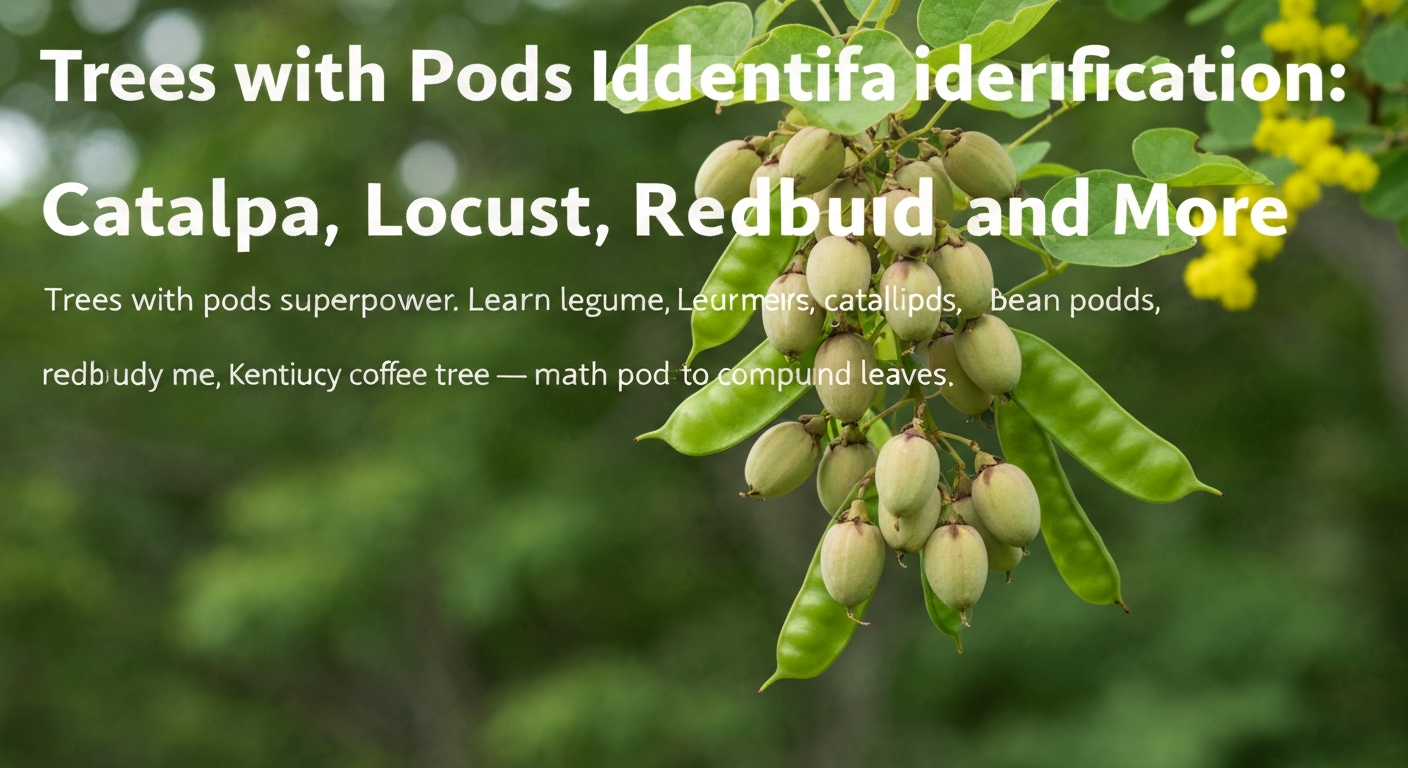
TL;DR: Trees with pods identification means matching seed pods to leaf architecture. Catalpa hangs foot-long skinny beans under huge heart-shaped leaves. Honey locust and Kentucky coffee tree drop long legumes beneath bipinnate compound canopies — coffee tree pods thick and leathery, honey locust often twisted. Black locust and redbud cast shorter peapods; mimosa adds flat pods under ferny twice-compound leaves and pink puffball flowers. Measure the pod, check thorns vs no thorns, then photograph leaf + pod together in the Tree Identifier app.
🫘 Pod length quick sort: 8–20 inch skinny pencils = catalpa. Long twisted/flattish sweets = honey locust. Thick leathery boats = Kentucky coffee tree. Short peapods on thorn trees = black locust. Tiny flat pods on pink spring bloomers = redbud. Flat pods under pink summer puffs = mimosa.
How trees with pods identification works
Many backyard trees fruit as capsules or legumes people casually call pods. Late summer through winter, those pods litter sidewalks and become the only ID cue when leaves are gone. Trees with pods identification is a skill: treat the pod as evidence, then corroborate with leaves, thorns, bark, and flower history.
Most common eastern and midwestern pod trees belong to two stories:
- Catalpa (Bignoniaceae): Long cylindrical capsules — not true legumes — hanging like green beans then drying brown.
- Legume family (Fabaceae): Locusts, redbud, Kentucky coffee tree, mimosa — pealike fruits from pea-family flowers.
Start every trees with pods identification session with the same checklist: pod length, cross-section (round vs flat vs inflated), surface (smooth, wrinkled, sticky), attachment (hanging strings vs clusters along twigs), and accompanying foliage (simple vs once-compound vs bipinnate).
For a deeper pod-by-pod photo method, see How to Identify Tree Seed Pods.
Catalpa — the giant Indian bean
If someone asks which tree drops the longest yard beans, catalpa is the answer. Northern catalpa (Catalpa speciosa) and southern catalpa (Catalpa bignonioides) produce slender pods commonly 8 to 20 inches long. Green in summer, they dry to brown and split to release winged seeds.
Leaves: Enormous heart-shaped simple leaves, often 6 to 12 inches across, arranged opposite or in whorls of three — not compound. Soft, sometimes fuzzy undersides. Large white orchid-like flowers with purple and yellow markings in early summer.
Trees with pods identification tip: Long skinny pod + dinner-plate heart leaf = catalpa. No other common street tree combines those two traits. People call them cigar trees or Indian bean trees for the hanging fruit strings.
Winter: Pods persist into cold weather. Twigs are stout; leaf scars are large and circular. Bark on mature trunks is rough and gray-brown with flaky ridges.
Honey locust — long twisted legumes
Honey locust (Gleditsia triacanthos) is a classic trees-with-pods identification target in pastures, roadsides, and urban cultivars (often thornless).
Pods: Flattened, often twisted or curved, frequently 8 to 18 inches, dark reddish-brown when ripe. Wild-type pods may contain sweet pulp between seeds — the honey in the name. Urban thornless cultivars still drop pods unless they are fruitless varieties.
Leaves: Pinnately or bipinnately compound with many small leaflets — ferny canopy. Leaflets are much smaller than black locust leaflets.
Thorns: Wild trees carry alarming branched thorns on trunks and limbs; many street trees are thornless selections. Do not rely on thorns alone — check leaf and pod form.
Honey locust vs black locust confusion is common. Honey locust pods are longer and more twisted; black locust pods are shorter peapods.
Black locust — short peapods and spines
Black locust (Robinia pseudoacacia) produces dark, flattened legumes usually 2 to 4 inches long — much shorter than catalpa or honey locust. Pods hang in clusters and rattle with hard seeds when dry.
Leaves: Once-pinnate compound with rounded leaflets and a distinct terminal leaflet. Soft blue-green canopy.
Spines: Paired stipular spines at leaf bases on vigorous shoots. Bark on older trunks is deeply furrowed and ropey.
Flowers: Fragrant white pea flowers in hanging racemes — a May–June show that helps trees with pods identification when you remember last spring’s bloom under the pod litter.
For more locust-family bark and leaf splits, see How to Identify Locust Trees.
Redbud — tiny pods after pink bloom
Eastern redbud (Cercis canadensis) is a small understory or yard tree. Fruits are flat peapods about 2 to 3 inches, thin, light brown, often persisting into winter along zig-zag twigs.
Leaves: Simple, heart-shaped, alternate — much smaller than catalpa hearts. Entire margins.
Flowers: Magenta-pink pea flowers erupt directly on older branches in early spring before leaves — the ID memory most people keep. Pods arrive later and mark the same twigs.
Trees with pods identification for redbud fails only when people expect huge pods. Redbud pods are petit. Match small heart leaves + leftover pink-flower stories + thin short pods.
Kentucky coffee tree — thick leathery boats
Kentucky coffee tree (Gymnocladus dioicus) drops thick, dark, leathery pods 5 to 10 inches long. Seeds are large, hard, and embedded in sticky pulp historically roasted as a coffee substitute (not a modern recommendation without guidance).
Leaves: Huge bipinnately compound leaves — among the largest of any temperate deciduous tree, sometimes two feet long. Early summer canopies look tropical; late autumn trees go bare early, looking dead to homeowner eyes.
Twigs: Extremely stout, no thorns, with large fish-scale buds. Sexes are often separate — female trees fruit, males do not.
Coffee tree vs honey locust: coffee pods are chunkier and less twisted; leaves are grander; twigs more clubby; thorns absent. Dedicated coffee-tree notes live at How to Identify Kentucky Coffee Tree.
Mimosa — flat pods under pink puffballs
Mimosa or silk tree (Albizia julibrissin) is a southern and mid-Atlantic ornamental (sometimes naturalized). Pods are flat, strap-like legumes several inches long, often hanging in clusters after the pink filament flowers of summer.
Leaves: Twice-pinnate (bipinnate) with tiny leaflets that fold at night — the ferniest common pod-tree canopy. Flowers look like pink powder puffs.
Trees with pods identification here: flat short-to-medium pods + tiny bipinnate leaflets + pink summer puffs. See also How to Identify Mimosa Tree.
Do not confuse mimosa with honey locust: mimosa leaflets are smaller and denser; flowers are showy pink; trunks are smoother and often multi-stemmed with mottled bark.
Field method — match pods to species
Use this trees with pods identification workflow when you hold a pod on a walk:
- Measure length. Over 10 inches and pencil-thin → catalpa first. Long but flattened/twisted → honey locust. Thick boat → coffee tree. Under 4 inches → black locust, redbud, or mimosa.
- Check leaf type overhead. Huge simple hearts → catalpa. Small hearts → redbud. Once-compound with medium leaflets → black locust. Fine ferny bipinnate → honey locust or mimosa/coffee tree — then sort by pod thickness and flowers.
- Look for thorns or spines. Branched trunk thorns suggest wild honey locust. Paired leaf-base spines suggest black locust. None suggests coffee tree, catalpa, redbud, or thornless honey locust cultivars.
- Note season and flowers remembered. Pink spring twigs → redbud. White pea racemes → black locust. Orchid catalpa flowers → catalpa. Pink puffballs → mimosa.
- Photograph pod + leaf + trunk in one series. Apps and human guides all improve with stacked evidence.
Practice leaf arrangement vocabulary in Identify Trees by Leaf and photo framing in Best Photo for Tree ID.
Winter pods and lookalike litter
Winter trees with pods identification still works because many legumes and catalpa capsules cling to branches or carpet lawns. Catalpa pods look like brown pencils. Honey locust pods curve dark across snow. Coffee tree boats stay leathery. Redbud pods rattle on zig-zag twigs.
Lookalike litter mistakes:
- Ash and maple: Winged samaras, not pods — do not force them into legume ID.
- Oak: Acorns and caps, never pods.
- Sweetgum: Spiky balls, not legumes.
- Magnolia: Cone-like aggregates with red seeds — different architecture.
If the fruit is hard-shelled and round rather than a pod, you may be looking at a nut tree instead — see How to Identify Nut Trees.
Urban cultivars and missing fruit
Cities plant fruitless honey locusts and male Kentucky coffee trees that never drop pods. Trees with pods identification cannot work without fruit on those individuals — shift to leaf, bark, and form. Conversely, catalpa and wild-type locusts fruit heavily and dominate sidewalk complaints.
Also note: some shrubs (baptisia, false indigo) and vines (wisteria) make peapods. Confirm woodiness and canopy size so you do not call a vine a tree.
Using Tree Identifier for pod trees
Tree Identifier recognizes the major pod trees when the fruit is distinctive — catalpa strings and honey locust twists especially. For short peapods, always add a leaf photo: black locust, redbud, and mimosa share family traits that photograph similarly when only the pod fills the frame.
Best capture plan:
- One whole pod with a coin or finger for scale.
- One close surface texture shot.
- One leaf spray showing arrangement.
- One trunk or thorn detail if present.
Trees with pods identification rewards patience. Once you link each pod shape to its leaf story, late-summer sidewalks become a walking quiz you can score with near-perfect accuracy — and an app confirms the ones that still stump you.
For more seed-pod galleries and edge cases, continue with tree seed pod identification and general backyard context in common backyard trees.
Frequently asked questions
What trees have long seed pods?
Catalpa has the longest common yard pods — skinny bean-like capsules 8 to 20 inches hanging in autumn. Honey locust and Kentucky coffee tree also produce long flattened or thick pods. Black locust pods are shorter legumes, often 2 to 4 inches. Trees with pods identification starts by measuring pod length and checking whether leaves are simple or compound.
How do you identify a tree by its seed pods?
Collect a fallen pod, note length, width, thickness, color, and whether it is flat, inflated, twisted, or woody. Then match foliage: opposite compound (boxelder lookalikes are not typical pod trees), alternate compound with thorns (locust), huge heart-shaped simple leaves (catalpa), or small simple leaves (redbud). Photograph pod plus leaf together for trees with pods identification apps.
What is the difference between black locust and honey locust pods?
Black locust pods are short, thin, dark brown legumes usually under 4 inches, with seeds in a flat peapod form. Honey locust pods are longer — often 8 to 18 inches — thicker, twisted or curved, sometimes with sweet pulp between seeds. Honey locust trunks often carry branched thorns; many black locusts have paired stipular spines at leaf bases.
Which tree has the giant long bean pods?
Northern and southern catalpa (Catalpa speciosa and Catalpa bignonioides) produce the iconic foot-long skinny pods people call Indian beans or cigar trees. Leaves are huge, opposite or whorled, heart-shaped — not compound. If pods are long and leaves are gigantic hearts, catalpa is your trees with pods identification winner.
Are redbud pods the same as pea pods?
Redbud (Cercis canadensis) is in the legume family, so fruits are true pealike pods — flat, thin, 2 to 3 inches, hanging along twigs after pink spring flowers. They are much smaller than catalpa or honey locust pods. Match them with simple heart-shaped leaves and zig-zag twigs.
How do you tell Kentucky coffee tree pods from locust?
Kentucky coffee tree pods are thick, leathery, dark brown, 5 to 10 inches, with a pulp around large hard seeds. Leaves are bipinnately compound and huge — among the largest of any temperate tree. Honey locust pods are thinner and often twisted; leaves are once- or bipinnate but smaller leaflets. Coffee tree twigs are stout with no thorns.
Can a tree ID app identify trees from pod photos alone?
Often yes for distinctive pods like catalpa beans or honey locust twists, but accuracy rises when you add a leaf photo. Mimosa, black locust, and redbud pods look more pea-like and need foliage context. Tree Identifier works best when pods and leaves share the same album for trees with pods identification.
Try Tree Identifier — free on iPhone
Photograph seed pods and matching leaves to match catalpa, locust, redbud, and more in seconds.
Download on the App Store