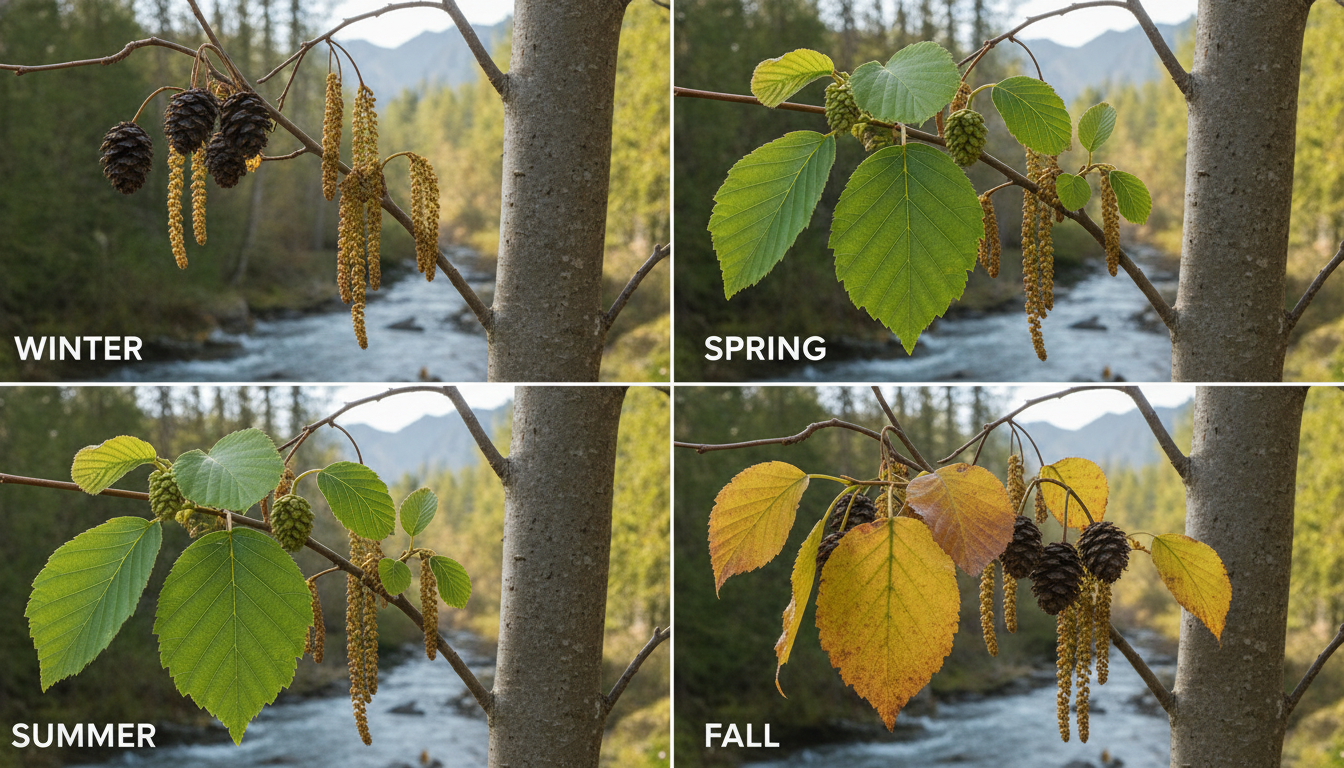
To identify an alder tree from photos, shoot the evidence in a fixed order and stop when the order breaks. The twig cones come first. Catkins, bark, leaves, and the wet ground around the trunk follow. A species name is last, and only if you are in the right region for red alder, speckled alder, or white alder. This page is that workflow. It does not replace the character-by-character species guide, and it does not replace the one-minute yes-or-no checklist. It tells you which frame to take this month, which frame to retake, and which result you are allowed to trust.
Read Alder Tree ID when you want the checklist on one screen. Read How to Identify an Alder Tree when the genus is already settled and you are separating species. Stay here when the problem is the photo itself.
The sequence, every season
Use the same five steps in January or July. What changes is which step is easy.
- Twig: Fill the frame with a branch that still holds small woody strobiles. Include two or three cones so a single dried bud is not doing all the work.
- Catkins: If male catkins are present, photograph them on the same branch as the old cones. Elongated spring catkins and short winter spikes are both useful.
- Bark: Chest-height, in focus, large enough to see whether the surface peels. Mossy bark needs a wiped patch or a younger stem.
- Leaf: One leaf, flat, teeth visible, with the twig attachment if you can show it is alternate. Skip this step in winter without apology.
- Place: One step back. Stream, swamp, ditch, or floodplain should be obvious. If it is not obvious, do not narrate a habitat you did not photograph.
Then name the plant only as far as those frames support. Cones plus non-peeling bark in a wet place: alder, genus Alnus. Add region and growth form before you say red, speckled, or white. Missing cones: do not identify an alder tree yet. Go get the twig.
What each frame is allowed to prove
| Frame | Proves | Does not prove |
|---|---|---|
| Woody strobiles on the twig | You are in alder territory, not a birch with only soft catkins | Which alder species |
| Hanging catkins alone | A catkin-bearing tree | Alder versus birch, hazel, or oak flowers at a glance |
| Bark that stays attached | Less likely to be a peeling birch | Alder by itself |
| Doubly toothed alternate leaf | Consistent with alder | Alder without the twig |
| Wet ground | The right neighborhood | Anything, if the plant is a planted specimen on a dry lawn |
| Whole crown from across a creek | There is a tree | An identification |
That table is the whole method. People identify an alder tree incorrectly when they promote a weak frame, usually the crown or a single leaf, over the twig they did not take.
Winter workflow
Winter is the generous season. Leaves are down, so woody strobiles and bark are visible from the trail. Male catkins often sit on the twigs as short, firm spikes that have not elongated yet. Speckled alder thickets read as multi-stem shrubs with dotted bark once you are close.
Shoot the twig, then bark, then a wider frame of the wet edge. You can finish without a leaf. If cones are absent, do not talk yourself into alder because the place is swampy. Willow, birch, and red maple also stand in that water. Mark the spot and return when catkins stretch, or accept “unknown wetland tree.”
Snow glare blows out bark texture. Expose for the trunk, not the snow, or the peel-versus-smooth test disappears into white.
Spring workflow
Male catkins elongate and release pollen. This is when phones fill up with yellow hanging strands and every stream tree becomes “birch or something.” The corrective photo is last year’s woody cones still on the same shoot, often just behind the new catkins. Take that frame before you take the portrait of the catkins alone.
Female structures are smaller and easier to miss. You do not need them if old strobiles are already in the photo. If pollen is flying and you still cannot find a cone, treat the result as a catkin tree and use trees with catkins as the wider net rather than forcing alder.
Summer workflow
Leaves are the distraction. Alternate, simple, doubly toothed blades in a wet place are consistent with alder and also with several neighbors. Turn the branch over and look for darkened strobiles from the previous year. They are often still attached and ignored because they are brown on brown bark.
If you cannot find them, summer is a “suspect alder” season. Say that in your notes. Come back in the dormant season, or identify an alder tree only to the level “possible Alnus, cones not seen.” An app that insists on a species from a July leaf deserves the same caution. Pair the leaf with bark using the characters in birch identification so a peeling trunk can remove alder from the list in one extra photo.
Fall workflow
Leaves yellow and drop while cones remain. The useful habit is to pick up a twig, not a leaf from the mud. Fallen leaves lose their arrangement, and arrangement is part of the leaf step. Attached cones on a twig you are holding are still the first frame.
Wet bark in fall is dark and the lenticels on speckled alder can vanish into the moisture. Wipe a small patch with a sleeve and reshoot. A shiny wet trunk photograph is not a bark character.
From genus to species without skipping
Once the sequence says alder, use form and map, not hope.
- Red alder: Often a real tree, single trunk, Pacific coastal rivers and wet disturbed slopes. Mottled gray bark. Leaves may curl slightly under at the edge.
- Speckled alder: Often a multi-stem shrub in northern and northeastern wetlands. Pale dots on the bark are the field mark once you are close.
- White alder: Streamside tree of California and the interior West, outside the main coastal red alder belt. Young bark can look pale. Leaves tend toward a diamond outline.
If your photo set was taken in a city park outside those patterns, planted European alder is common and the honest label is still alder. The species paragraphs, ecology, and nitrogen story are written out in the species guide. The checklist version is Alder Tree ID. Neither page can repair a missing cone photo.
Confidence, written in plain language
High: cones in focus, bark does not peel, wet site in the frame. You may identify an alder tree to genus. Add species only with the range match above.
Medium: leaves and wet site, cones distant or few. Say probable alder and reshoot the twig.
Low: crown only, or catkins only, or a leaf on a picnic table with no twig. Do not identify an alder tree from that set. What Type of Tree Is This? is the better next step when you are still at the start of the process.
Tree Identifier follows the same evidence. Give it the cone frame before the landscape frame. A genus result with a clear strobile is a completed workflow. A species result from a blurry crown is a draft.
Keep the set together. A notes app folder named with the date and the nearest stream is enough. When you return in another season, you are comparing new frames to the same plant, not starting over from a crown you half remember. That is how a summer “possible alder” becomes a winter identification without mixing up the birch twenty yards downstream.
Frequently asked questions
What photo identifies an alder tree fastest?
A close twig photo that shows small woody cone-like strobiles still attached. Catkins, bark, and a toothed leaf support it. A whole-tree snapshot usually does not.
Can I identify an alder tree in summer from leaves only?
You can suspect alder from alternate, doubly toothed leaves in a wet place, but confidence stays limited until a twig shows old cones or you return for catkins.
What should I photograph in winter?
Persistent woody strobiles, any short male catkin spikes, and bark. Winter is often the easiest season because leaves are not hiding the cones.
How do I keep birch out of the result?
Add a bark photo. Peeling or shredding sheets point toward birch. Bark that stays attached, plus woody cones, points toward alder.
When is a species name justified?
After the genus is secure, and only if form and region match red alder, speckled alder, or white alder. Otherwise report Alnus.
Which guide should I read next?
Use the field checklist for the yes-or-no genus decision, and the red, speckled, and white alder guide once you are ready to separate species.
Try Tree Identifier — free on iPhone
Start with a twig photo of the woody cones, then add bark and a leaf.
Download on the App Store