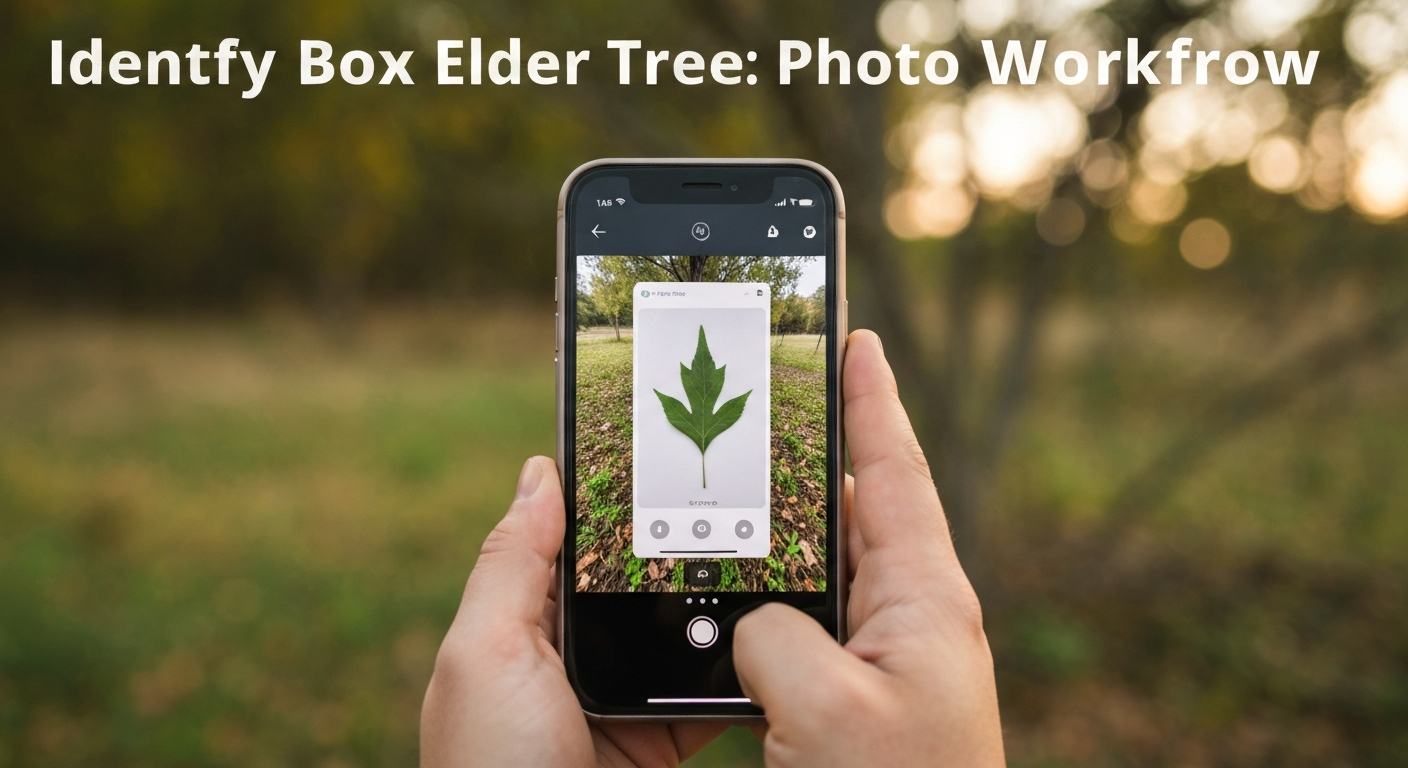
TL;DR: To identify box elder tree with a phone, shoot an opposite node, a full compound leaf (or winter bud tip), and paired maple samaras when available. Run the opposite-compound test first, then split ash using fruit type. Feed clean single-organ frames into Tree Identifier when leaflets look intermediate or winter evidence is thin.
🔴 Workflow mantra: opposite? → compound? → paired helicopters? If all three are yes, you have box elder (Acer negundo). If fruit is a single paddle, rethink ash.
Why a workflow beats random googling
People who search identify box elder tree often already suspect maple-or-ash confusion. A fixed photo sequence removes that confusion faster than scrolling lookalike galleries. This longtail how-to is a field checklist you can run in five minutes — complementary to species overviews and winter-focused companion pieces on the same tree.
Box elder is a true maple with compound leaves. That sentence is the destination; the workflow is how you prove it with camera evidence.
Step 1 — Capture a stand-back for context
Before zooming into leaflets, take one photo of the whole tree or major trunk flare. Note:
- Irregular, often multi-stemmed form
- Softwood breakage and leaners after storms
- Moist yard edges, ditches, or floodplain proximity
Context photos rarely ID the species alone, but they keep you honest if you later mix shots from two neighboring trees — a common app failure mode covered generally in Identify Trees From Photo Guide.
Step 2 — The opposite arrangement test
Walk to a living shoot tip you can photograph without climbing.
- Look at the newest leaves or buds.
- Ask: do they sit in pairs across from each other?
- Photograph the node so both partners appear in one frame.
Opposite arrangements limit candidates to maples, ashes, dogwoods, and a few less common groups. Alternate arrangements (oak, elm, birch, walnut) stop the box elder hypothesis immediately.
Mark the photo with a mental tag: OPPOSITE = YES/NO. Do not skip this even if leaflets “look like maple.” Arrangement beats vibe.
Step 3 — The compound leaf test
Once opposite is confirmed:
- Pick one complete leaf from petiole base to tip leaflet.
- Count leaflets — typically three to seven on box elder.
- Check for coarse teeth or lobing on the terminal leaflet.
- Lay the leaf on a notebook and photograph top-down.
Simple opposite leaves (dogwood, sugar maple) diverge here. Compound opposite leaves keep you in ash vs box elder space. Photo craft for foliage is expanded in Best Photo for Tree ID and Tree Foliage Identification Guide.
If young shoots show only three leaflets, add an extra stem photo to prove opposite arrangement — poison ivy is alternate and can mimic the leaf count alone.
Step 4 — Samara decision fork
Search the canopy and ground for fruit.
- Paired winged seeds in a V/U: maple samaras → identify box elder tree is nearly done.
- Single paddle wing per seed: ash pattern → switch to ash ID.
- No fruit: lean on leaflet shape, bark, and apps; wait for fall if possible.
Female and male trees differ — not every individual fruits. Male trees still show opposite compound leaves. Fruit is proof when present, not a mandatory ticket.
Ash specifics live in Ash Tree Identification. Maple family context is in Maple Tree Identification.
Step 5 — Optional supporting checks
When leaflets look intermediate:
- Leaflet outline: box elder tip leaflet often lobed or irregular; ash leaflets more uniformly oval.
- Bark: mature ash diamond furrows vs softer pale box elder furrows.
- Insects: red-and-black box elder bugs near seed trees in fall — supporting only.
- Odor: crushed box elder leaves can smell slightly foul; not always decisive.
Do not invent certainty from bugs alone, but do include them in notes when massing is obvious.
Step 6 — Winter path (no leaves)
Replace Step 3 with:
- Twig tip with opposite buds in focus.
- Mid-trunk bark texture.
- Any hanging or fallen paired samaras.
- Form shot of multi-stemmable trunks.
Winter bark techniques in Identify Trees by Bark and Tree Bark Identification App Guide help when seed evidence is missing.
Step 7 — When Tree Identifier (and other apps) help
Apps shine after you have clean organ photos — not before.
Best moments for an app:
- Leaflet shape sits between textbook ash and textbook box elder.
- You only have winter buds today and need a shortlist.
- You are teaching kids and want fast feedback loops (see also Teaching Kids Tree Identification).
Weak moments for an app:
- Distant canopy silhouettes
- Two species overlapping in one frame
- Heavy motion blur
Tree Identifier works offline once models are on device — useful on creek walks. After the suggestion appears, still verify opposite + compound + fruit yourself. Apps accelerate; they do not replace the arrangement test.
For broader tool shopping context, compare approaches later in buyer guides on the site rather than mixing brand rankings into this how-to.
Putting it together — a sample field script
Walk up to the tree. Say aloud: “Opposite?” Snap the node. “Compound?” Snap the leaf. “Helicopter pairs?” Search fruit. If yes/yes/yes — identify box elder tree is complete. If yes/yes/no — check ash fruit or wait a season. If yes/no — other opposite-leaved trees. If no — leave maple–ash group entirely.
That script takes less time than reading a full key page and produces photos you can recheck indoors.
Common mistakes in the photo workflow
- Photographing leaflets without showing the petiole base — leaflet count becomes unclear.
- Assuming three leaflets = poison ivy without checking arrangement.
- Submitting a photo of seeds on the lawn far from the tree you meant.
- Stopping after “looks like a maple” while holding a compound leaf — simple maples differ.
- Cropping so tightly that the opposite partner leaf disappears — the app then sees a lonely leaflet.
Related species articles such as Box Elder Identification add morphology depth once this workflow tags the tree.
Practice circuit for beginners
Spend one afternoon visiting three sites: a wet ditch, a suburban fence line, and a park floodplain edge. At each stop, run the opposite-compound-samara script and save the four-photo set in an album labeled by date. Compare results indoors. After five successful identify box elder tree sessions, ash confusion drops sharply because your muscle memory for paired helicopters improves.
Teaching others? Hand them the phone only after they verbalize opposite vs alternate. Verbalizing prevents the most common three-leaflet panic. For family-friendly frameworks beyond this species, browse Teaching Kids Tree Identification and backyard frequency notes in common backyard trees.
Keep expectations realistic: cultivar plantings and storm-damaged crowns mess with form cues, but they rarely break the opposite-compound logic. Soft broken limbs may look “trashy,” yet the bud pairs remain orderly under the mess. Revisit the same tagged tree in October for samaras and again in February for bare twigs — one individual teaches three seasons.
Why this how-to stays distinct from species guides
Species guides catalog leaflets, bark grades, and insect natural history. This how-to forces sequence and evidence photos. Use both: run the workflow outside, then read deeper morphology when you want winter buds or bug ecology. The longtail phrase identify box elder tree maps to action — snap, test, confirm — more than to encyclopedia browsing.
If spelling variants send you to one-word boxelder articles, the botanical endpoint is identical: Acer negundo. Keep your photo album labeled with whichever spelling you searched so you can find the session later. Consistency in your notes matters more than which marketplace spelling Google preferred that morning.
When Emerald Ash Borer has emptied a block of true ashes, leftover opposite-compound survivors are often box elder. Running this workflow prevents mourning the wrong genus and guides smarter planting replacements next season.
Frequently asked questions
What is the fastest way to identify box elder tree?
Confirm buds or leaves are opposite, confirm the leaf is compound with three to seven leaflets, then look for paired maple samaras. That three-part workflow identifies box elder tree (Acer negundo) for most North American yards and floodplains. Photograph each step for app confirmation.
Which phone photos should I take?
Take (1) a full compound leaf, (2) a close-up of the opposite node, (3) samaras if present, and (4) a stand-back of the tree form. In winter replace the leaf with a twig tip showing opposite buds. Sharp focus beats artistic blur.
How do I run the opposite compound leaves test?
Find a living twig tip. Check whether leaves or buds sit in pairs across the stem (opposite). Then check whether each leaf is made of separate leaflets (compound). Opposite + compound narrows to ash, box elder, and a few rarer shrubs — fruit or leaflet shape finishes the split.
When do apps help most?
Apps help when leaflets look intermediate between ash and box elder, when you only have winter twigs, or when you want a quick triage before learning keys. Apps struggle with distant canopy blurs and mixed photos of two trees in one frame. Feed single-organ close-ups.
How do samaras prove box elder?
Box elder produces paired winged maple seeds with wings in a V or U. Ash produces single wing samaras. Finding paired helicopters on an opposite-compound tree basically completes identify box elder tree.
Can I ID box elder without leaves?
Yes — opposite buds, softer twigs, pale furrowed bark, and any remaining paired samaras work in winter. Box elder bugs on nearby walls add support. Apps can accept bud and bark sets with lower confidence than summer leaves.
Is box elder the same as boxelder?
Yes. Two-word and one-word spellings refer to Acer negundo. Search habits differ; species characters do not.
Try Tree Identifier — free on iPhone
Photograph opposite leaves, nodes, or samaras and confirm box elder in seconds.
Download on the App Store