TL;DR: Ground cherry identification points to Physalis — a low herbaceous plant with papery husks, not a tree. For cherry tree identification, focus on wild black cherry (Prunus serotina): alternate lanceolate finely toothed leaves, bark with horizontal lenticels that becomes dark and scaly with age, drooping white flower racemes, and dark fruit. Ornamental cherries share the genus but show denser, often pinker bloom. Photograph leaf and bark, then confirm with Tree Identifier. Deep dive: Prunus serotina field guide.
🍒 Name trap: “Ground cherry” ≠ cherry tree. Physalis grows as a garden or wild herb with husked berries. Woody cherry identification means genus Prunus — black cherry, chokecherry, pin cherry, and planted flowering cherries.
Ground cherry vs cherry tree — clear the keyword first
People search ground cherry identification when they find a plant with cherry-sounding fruit — and search engines often mix herb and tree results. Botanically:
- Ground cherry (Physalis): Herbaceous annual or perennial in the nightshade family (Solanaceae). Soft stems, not woody trunks. Fruit sits inside a papery lantern-like husk. Related to tomatillo. Height is usually under a few feet.
- Cherry tree (Prunus): Woody tree or large shrub. True bark, persistent woody twigs, simple alternate leaves, flowers with five petals, stone-fruit (drupe) cherries.
If your plant has a husk and dies back to the ground in winter, stop — that is Physalis ground cherry identification territory, not this tree guide. If it has a trunk, horizontal bark marks, and canopy leaves, continue below for wild black cherry tree identification and related cherries.
Cherry tree family and the species you will meet
True cherries belong to the rose family (Rosaceae), genus Prunus, which also includes plums, peaches, and almonds. For North American wild cherry tree id, the main players are:
- Black cherry (Prunus serotina): The tall forest and fencerow cherry — primary focus of black cherry tree identification in the East and Midwest.
- Chokecherry (Prunus virginiana): Often shrubby, northern and western; dense flower clusters; astringent fruit.
- Pin / fire cherry (Prunus pensylvanica): Early-successional, smaller leaves, reddish bark.
- Ornamental flowering cherries: Yoshino, Kwanzan, and dozens of cultivars planted for spring color.
Cherry identification at genus level is often enough for hikers; species level rewards bark and flower structure study. Terms like lenticel, raceme, and serrate are covered in the Tree Anatomy Glossary.
Black cherry leaf identification
Black cherry leaf identification is one of the most reliable summer characters:
- Arrangement: Simple, alternate — one leaf per node.
- Shape: Lanceolate to narrowly ovate, typically 2 to 5 inches long, longer than wide, with a tapered tip.
- Margin: Finely serrated — small sharp teeth along the edge.
- Surface: Glossy dark green above; paler below.
- Vein axil hairs: Under magnification, brownish or whitish hair tufts often sit in the angles where secondary veins meet the midrib on the underside — a classic P. serotina tip.
- Scent: Crushed fresh leaves or broken twigs may smell like almond, cherry cough syrup, or bitter almond from cyanogenic compounds.
Photograph one full leaf flat against a notebook and one underside midrib close-up if you can. For general leaf method, see Identify Trees by Leaf and Best Photo for Tree ID.
Compare carefully with chokecherry: chokecherry leaves are often broader and more oval; black cherry is usually more elongated. Pin cherry leaves tend to be smaller and narrower on younger trees in disturbed sites.
Bark and horizontal lenticels
Bark is the year-round signature for wild black cherry tree identification:
Young trunks and branches: Smooth reddish-brown to gray-brown skin marked with horizontal lenticels — pale, elongated breathing pores that look like short dashes or dashes wrapped around the stem. Many people remember them as “potato chip” or “band-aid” marks on young cherry bark.
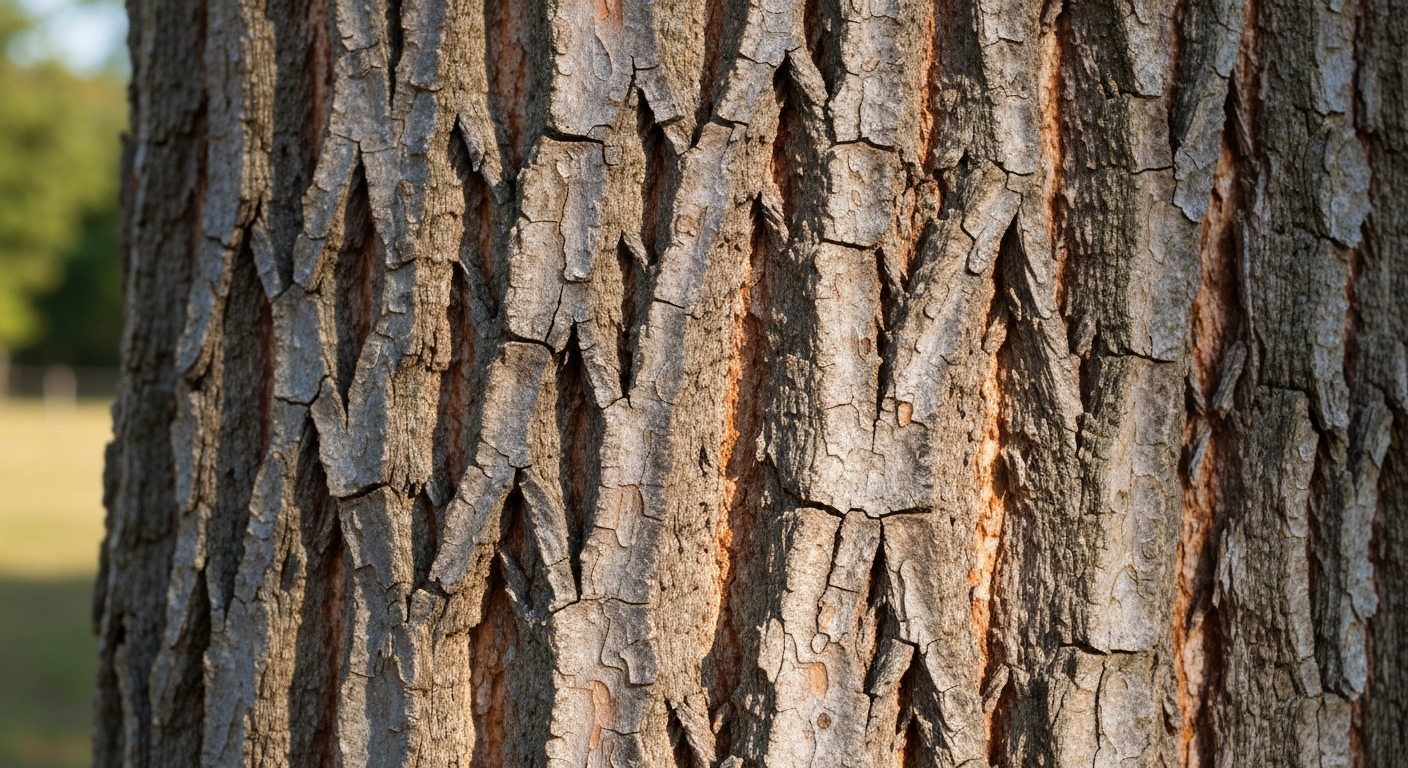
Mature trunks: Outer bark breaks into small irregular plates or scales, dark gray to nearly black. The textured look is distinctive in eastern forests once you have seen it a few times. Lenticels may still show on remaining smooth patches and on upper branches.
Not birch: Birch peels in papery horizontal sheets; black cherry does not peel like paper. Not oak: oak furrows are deep vertical ridges, not dark chip-scales with a lenticel history.
Winter wild cherry tree identification leans heavily on this bark pattern plus bud and twig scent. Photograph both a young branch and the main trunk when possible.
Flowers — white racemes in late spring
Black cherry flowers are white, five-petaled, and arranged in elongated drooping racemes — bottle-brush sprays that hang below the foliage in late spring. This is different from the dense rounded clouds of many ornamental cherries and from Bradford pear’s compact umbels.
Flower timing helps cherry identification: racemes appear after leaves have started expanding. If you are sorting white spring bloomers, use the photo-first workflow in identify tree with white flowers — raceme shape plus alternate leaves points strongly to wild cherry.
Ornamental cherries may be single or double-flowered, white to deep pink, often in denser clusters along twigs rather than long dangling racemes. Kwanzan doubles look almost peony-like; Yoshino is the classic soft-pink street tree cloud.
Fruit — dark cherries on red pedicels
Wild black cherry fruit ripens in summer from red to dark purple or nearly black. Individual cherries are small (often under half an inch), hanging on reddish stalks. Birds feast on them; seedlings appear under fence lines and powerlines.
Fruit pulp of ripe black cherries is used in jellies and traditional recipes; the pit is a stone like other Prunus fruits and should not be crushed and eaten. Leaves and wilted foliage are toxic to livestock — another reason accurate black cherry tree identification matters on farms.
Do not confuse hanging Prunus cherries with ground cherry husks on a soft-stemmed plant in a garden bed. Completely different plants, similar English name.
Wild black cherry tree identification in the landscape
Prunus serotina can become a large canopy tree — 50 to 80 feet in good sites — with a somewhat irregular crown. It colonizes old fields, forest edges, and roadsides across eastern North America, west into parts of the Great Plains, with related varieties farther south and in the Southwest mountains.
Wood is valued for furniture; the species is both a timber tree and a common “weed” tree in young woods. For a character-by-character species page, use our dedicated how to identify Prunus serotina guide — this article is the broader cherry tree context, including ornamentals and the ground-cherry name trap.
Habitat cue: if you are deep in a swamp with white drooping berries on a sumac-like plant, that is not cherry — reassess for poison sumac. Cherries prefer upland woods and edges more often than standing water.
Chokecherry and pin cherry — quick contrasts
Chokecherry (Prunus virginiana): Frequently a large shrub or small tree. Flower clusters are denser; fruit is very astringent raw (“choke”). More common in northern and western regions. Leaves often broader than black cherry.
Pin cherry (Prunus pensylvanica): Pioneer species after fire or clearcuts. Bark more reddish; leaves narrower; fruit small and red. Rarely becomes the massive dark-barked canopy tree that mature black cherry does.
When apps return “cherry” without a species, these contrasts plus range and habit usually finish wild cherry tree identification.
Ornamental flowering cherry identification
Landscape cherries are selected for bloom, not timber. Clues:
- Planted in yards, parks, and streets in rows or as specimens.
- Flower color often pink; doubles common.
- Fruit may be sparse or absent on sterile cultivars.
- Bark still often shows horizontal lenticels — useful cherry identification even when bloom is over.
Do not force every pink spring tree into black cherry. Yoshino and related hybrids are not the same ecology as forest P. serotina. Crabapple and hawthorn are frequent lookalikes in bloom week — crabapple fruit are small apples; hawthorn has thorns and often lobed leaves. See crabapple identification and hawthorn identification.
Lookalikes that are not cherries
Serviceberry / juneberry (Amelanchier): Early white flowers, edible berries, multi-stem habit — rose family but not Prunus. Leaves and fruit differ; see juneberry identification.
Bradford pear: Dense white bloom, alternate leaves, often foul scent — not a cherry. Fruit are small hard pears.
Buckthorn and other invasives: May have dark fruit but different leaf margins and bark. Always check lenticels and leaf teeth before calling cherry.
For backyard shortlists, common backyard trees in the US and What type of tree is this? help frame the search.
Step-by-step cherry identification from photos
- Confirm it is woody — rule out Physalis ground cherry.
- Shoot a full leaf (margin and tip clear) for black cherry leaf identification.
- Shoot bark showing horizontal lenticels or mature dark scales.
- If blooming, capture raceme vs dense ornamental cluster shape.
- If fruiting, note color, size, and stalk color.
- Run the set through Tree Identifier and compare to Prunus serotina marks.
This sequence is the practical path for cherry identification whether you arrived from a “ground cherry” search or a forest hike.
Using Tree Identifier for cherries
Tree Identifier recognizes black cherry and many ornamental cherries when leaf and bark cues are sharp. Flower-only photos of pink doubles may return cultivar-level guesses; adding a leaf photo stabilizes wild cherry tree id.
Best combo: glossy serrated leaf + lenticel bark from the same stem system. Avoid only photographing distant white bloom. More on photo choice: best photo for tree ID. Broader app tips: app to identify trees.
Cherry tree identification rewards patience — once you lock the lenticel-and-lanceolate-leaf pattern, black cherry becomes one of the easiest canopy trees to name in eastern woods.
Frequently asked questions
Is ground cherry a tree?
No. Ground cherry identification refers to Physalis species — herbaceous plants in the nightshade family with papery husks around small fruits. They are not woody trees. If you are looking at a tree with cherry-like leaves, bark lenticels, or hanging fruit, you want wild black cherry tree identification or ornamental cherry ID, not Physalis ground cherry.
How do you identify a black cherry tree?
Black cherry tree identification uses lanceolate finely serrated leaves, mature bark that becomes dark and scaly with earlier horizontal lenticels still visible on younger wood, white flowers in drooping racemes, and dark purple-black fruit on reddish stalks. Broken twigs often smell like almond or bitter almond. Prunus serotina is the common wild black cherry of eastern North America.
What does black cherry bark look like?
Young black cherry bark is smooth and reddish-brown with prominent horizontal lenticels — pale elongated marks wrapping the trunk. Mature bark breaks into small dark plates or chips, nearly black, sometimes compared to burnt cornflakes. Lenticel pattern on younger branches remains one of the best wild cherry tree identification characters year-round.
How do you do black cherry leaf identification?
Black cherry leaf identification focuses on simple alternate leaves 2 to 5 inches long, lanceolate to narrowly ovate, with fine sharp teeth and a long-pointed tip. Upper surface is glossy dark green; underside is paler, often with tiny hair tufts in midrib vein axils. Crushed leaves may smell almond-like. Compare to chokecherry, which often has broader leaves and different habitat.
What is the difference between wild cherry and ornamental cherry?
Wild black cherry (Prunus serotina) is a forest and fencerow tree with drooping flower racemes and small dark fruit. Ornamental cherries (Yoshino, Kwanzan, and many cultivars) are planted for showy spring bloom — denser flower clusters, often pink, and typically smaller landscape stature. Bark lenticels appear in both groups. Cherry identification to species needs flower form, fruit, and leaf details together.
Are wild black cherries edible?
Ripe black cherry fruit pulp is edible and used in jams and wines, but seeds, leaves, and wilted foliage contain cyanogenic compounds and should not be eaten. Livestock poisoning from wilted cherry leaves is a known risk. Positive wild black cherry tree identification comes before any foraging — and never confuse Physalis ground cherry husks with Prunus fruit.
Can tree ID apps identify cherry trees?
Yes when photos show leaves with serrated margins, bark with horizontal lenticels, or flower racemes clearly. Apps may return Prunus genus or Prunus serotina specifically. For best wild cherry tree id results, submit leaf plus bark from the same tree. Tree Identifier handles black cherry well across its eastern range.
Try Tree Identifier — free on iPhone
Photograph cherry leaves or bark with lenticels and get a species match in seconds.
Download on the App Store