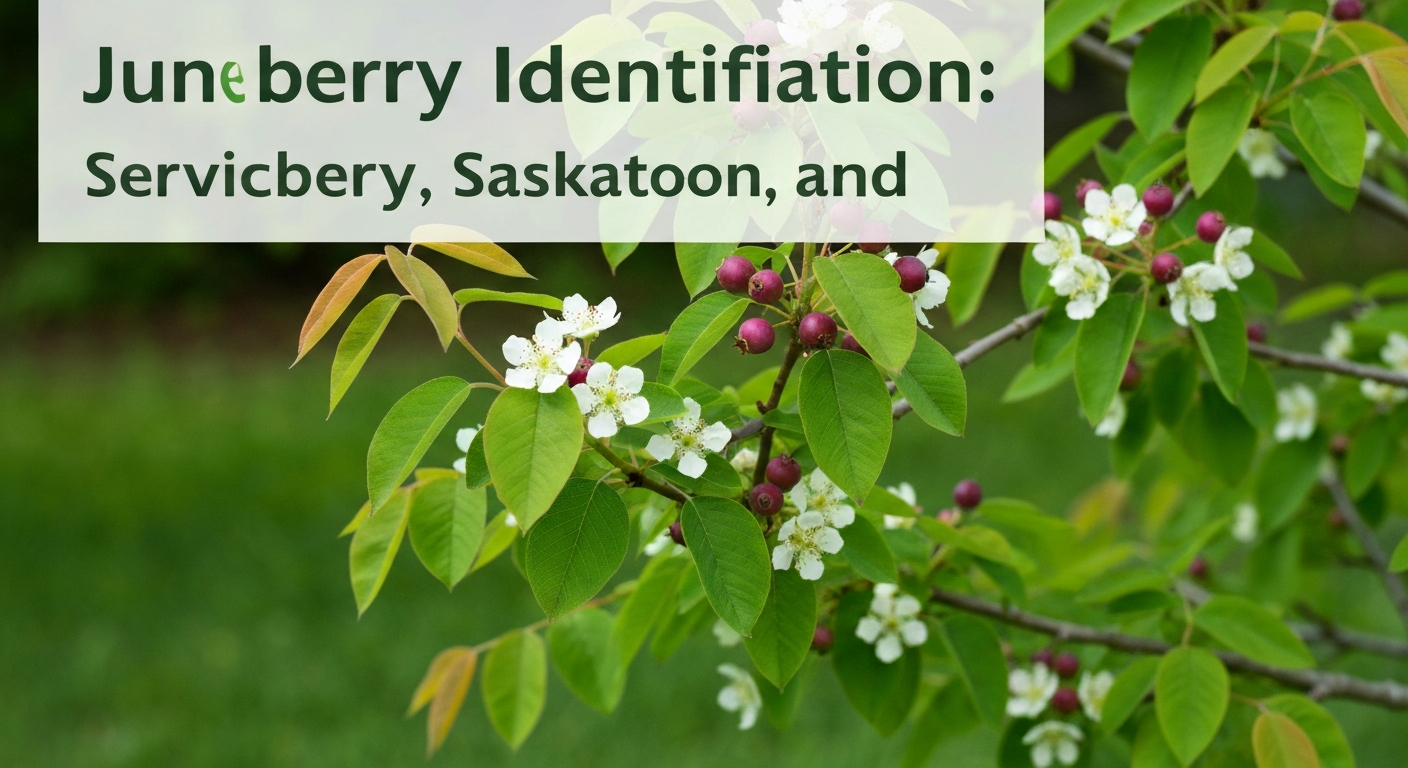
TL;DR: Juneberry identification means recognizing Amelanchier — also called serviceberry, shadbush, or saskatoon. Look for a multi-stem shrub or small tree with alternate simple finely toothed leaves, early white five-petaled spring flowers, and edible berries that ripen red to purple in early summer (often June). It lacks hawthorn thorns and is taller and more tree-like than blueberry shrubs. Photograph flowers or fruit plus a leaf, then confirm with Tree Identifier.
🫐 Juneberry ≠ blueberry shrub. Same berry-blue color when ripe can fool beginners, but juneberry (Amelanchier) has open rose-family blossoms and woody multi-stem tree form; blueberry (Vaccinium) has urn-shaped flowers and usually stays much lower.
What juneberry is — genus Amelanchier
Juneberry belongs to the rose family (Rosaceae), genus Amelanchier. Across North America the same plants wear different common names:
- Juneberry — emphasizes early-summer ripening.
- Serviceberry / sarvis — traditional eastern names (sometimes linked to spring “service” season lore).
- Shadbush / shadblow — blooms when shad fish run in eastern rivers.
- Saskatoon — especially Amelanchier alnifolia on the northern plains and in prairie provinces, prized for larger fruit.
Species boundaries inside Amelanchier are famously messy — hybrids and overlapping forms are common. For field juneberry identification, genus-level recognition is the practical goal: white early flowers, finely toothed alternate leaves, edible pomes, multi-stem habit.
Eastern woodland species include downy serviceberry (A. arborea), Canadian serviceberry (A. canadensis), and Allegheny serviceberry (A. laevis). Western and prairie plantings often mean saskatoon. Landscapers plant cultivars for spring bloom and fall color regardless of exact Latin label.
Growth form — shrub that wants to be a tree
Juneberry typically grows as a multi-stemmed large shrub or small tree, often 10 to 25 feet tall, sometimes taller in favorable sites. Stems rise in a clump from the base rather than a single massive oak-like trunk. Young bark is smooth and gray; older stems may show slight fissuring but remain relatively smooth compared with deeply furrowed oaks.
This form matters for juneberry identification in yards and forest edges: if the plant is a low knee-high blueberry patch, rethink. If it is a graceful multi-stem specimen with early white foam in April or May, stay with Amelanchier.
Habitat spans woodland edges, streambanks, rocky slopes, and prairie thickets depending on species. Many tolerate partial shade; fruiting is heavier in sun. For backyard context among other small trees, see common backyard trees in the US.
Leaves — alternate, simple, finely toothed
Leaf characters for juneberry identification:
- Arrangement: Alternate — one leaf per node.
- Type: Simple (not compound).
- Shape: Oval, elliptic, or slightly oblong, usually 1 to 3 inches long.
- Margin: Finely serrated — small neat teeth, not deep hawthorn lobes.
- Young leaves: May emerge bronze, reddish, or softly hairy (downy serviceberry); Allegheny serviceberry leaves are often smoother and bronzy when expanding.
Photograph a mature mid-season leaf flat so teeth are visible. Compare with cherry: black cherry leaves are usually longer and more lanceolate with a glossier look and different bark. Cherry details: cherry tree identification and Prunus serotina.
Leaf vocabulary — serrate, alternate, simple — is defined in the Tree Anatomy Glossary. General leaf method: Identify Trees by Leaf.
Flowers — early white spring show
Juneberry flowers are among the earliest woody white blooms in many regions. Each flower has five narrow white petals, often slightly strap-like, in clusters along the twigs. Bloom frequently starts before leaves are fully expanded or just as they open — a cloud of white on still-bare stems is a classic shadbush look.
This timing helps separate juneberry from later crabapple and hawthorn peaks, though overlap exists by latitude. Flower structure is open and rose-like, not the urn-shaped bells of blueberries and not the four large bracts of flowering dogwood.
If you are sorting white bloomers street by street, use the decision workflow in identify tree with white flowers — early bloom + multi-stem + finely toothed unlobed leaves points strongly to juneberry.
Photograph one open flower cluster filling the frame. Petal shape and early phenology are as important as “white.”
Fruit — edible berries that ripen early
After flowering, juneberry produces small pome fruits (apple relatives) that ripen from red to deep purple or blue-purple, often in June — hence the name. Individual fruits are typically ¼ to ½ inch, soft when ripe, with a crown of dried flower remnants at the tip like a tiny apple.
Ripe juneberries are edible and sweet, with a mild blueberry-like flavor and a hint of almond from the seeds. They make excellent pies, muffins, jams, and fresh snacks. Wildlife — especially birds — strip bushes quickly, so foragers watch color daily.
Foraging note: Positive juneberry identification first. Eat only ripe soft fruit. Immature hard red berries are not the goal. Avoid any plant with thorns you have not ruled out as hawthorn.
Juneberry vs blueberry
This is the most common edible-fruit confusion:
- Blueberry (Vaccinium): Heath family. Usually low to medium shrubs. Flowers urn- or bell-shaped, nodding. Leaves often smaller; many species evergreen or half-evergreen in the South. Fruit is a true berry with many tiny seeds.
- Juneberry (Amelanchier): Rose family. Multi-stem shrub or small tree. Flowers open with five flat petals. Fruit is a pome with a few larger seeds. Stature often much taller.
Side-by-side in fruit, color can match. Side-by-side in flower or in winter silhouette, they rarely do. If your “blueberry bush” is 15 feet tall with smooth gray stems and had white starry flowers in early spring, run juneberry identification — you likely have serviceberry.
Juneberry vs hawthorn
Hawthorn (Crataegus) also offers white spring flowers and reddish fruit in the rose family. Splits:
- Thorns: Hawthorn usually has stout sharp thorns; juneberry does not.
- Leaves: Hawthorn often lobed; juneberry finely toothed but unlobed.
- Fruit: Hawthorn haws are firmer with a stony core; juneberry pomes are softer when ripe and more snackable.
- Habit: Both can be multi-stem, but thorn presence is decisive in the hand.
Full hawthorn marks: hawthorn tree identification. Crabapple is another white-flower lookalike with small apples — usually thornless ornamentals; see crabapple identification.
Juneberry vs cherry and redbud
Wild cherry: Longer lanceolate leaves, horizontal bark lenticels, drooping flower racemes, and stone-fruit cherries rather than soft multi-seeded pomes. Cherry bark becomes dark and scaly; juneberry stays smoother gray longer.
Redbud: Magenta-pink pea flowers on stems before leaves — not white juneberry sprays. Leaves are heart-shaped with smooth margins. See redbud identification if bloom color is pink-purple, not white.
These contrasts keep juneberry identification clean during the crowded spring bloom calendar.
Seasonal calendar for ID
- Early spring: White flower clusters on multi-stem shrubs — peak juneberry visibility.
- Late spring: Expanding finely toothed leaves; petals drop.
- Early summer: Fruit colors up — best edible confirmation.
- Fall: Many species show orange to red foliage; fruit usually gone to birds.
- Winter: Smooth gray stems, pointed buds, multi-stem silhouette — harder but possible with practice.
Photograph in the season you have. Flower + leaf is ideal; fruit + leaf is ideal for foragers. Tips: Best Photo for Tree ID.
Regional notes — east, prairie, and west
In the East, woodland edges and yards host several overlapping Amelanchier species; gardeners often say “serviceberry” regardless. On the northern plains and in western Canada, saskatoon orchards and wild patches of A. alnifolia are cultural staples — larger fruit, prairie habitat. Mountain West canyons hold additional serviceberry forms.
Exact species keys use petal length, leaf hair, and ovary characters that are hard without a hand lens. For most users of Tree Identifier, confirming Amelanchier (juneberry / serviceberry / saskatoon) is the win.
Using Tree Identifier for juneberry
Tree Identifier matches juneberry well from sharp flower clusters or fruiting stems with leaves visible. Multi-stem habit in a whole-plant photo helps the model separate low blueberries from taller Amelanchier.
Best photo set:
- One flower cluster or one ripe fruit cluster.
- One leaf showing fine teeth and alternate attachment.
- Optional: base of the plant showing multiple stems.
If results hover between hawthorn and serviceberry, add a clear shot of a branch node — thorns vs no thorns. More app guidance: app to identify trees. If you only know “some small tree with berries,” start from What type of tree is this?.
Juneberry identification rewards early-season walks: once you connect the white spring foam to the June fruit on the same multi-stem shrub, Amelanchier becomes an easy friend in yards and wild edges alike.
Frequently asked questions
How do you identify a juneberry?
Juneberry identification focuses on Amelanchier shrubs or small trees with alternate simple leaves that are finely toothed, clusters of white five-petaled flowers in early spring (often before or as leaves expand), and edible berries that ripen red to purple-blue in early summer. Growth is frequently multi-stemmed. Smooth gray bark on young stems and lack of hawthorn-style thorns help separate juneberry from lookalikes.
Is juneberry the same as serviceberry and saskatoon?
Yes — juneberry, serviceberry, shadbush, and saskatoon are common names for Amelanchier species. Saskatoon usually refers to Amelanchier alnifolia of the northern plains and western Canada, grown for larger berries. Eastern serviceberries include Amelanchier arborea, A. canadensis, and A. laevis. Juneberry identification at genus level is enough for most foraging and landscaping purposes.
What do juneberry leaves look like?
Juneberry leaves are simple and alternate, oval to elliptic, typically 1 to 3 inches long, with fine sharp teeth along the margin. Young leaves may be bronze or hairy depending on species. Tips are pointed to rounded; bases are rounded to slightly heart-shaped. Unlike blueberry, juneberry is a taller woody Amelanchier with tree-like stems, not a low Ericaceous shrub with urn-shaped flowers.
How do you tell juneberry from blueberry?
Blueberries (Vaccinium) are usually lower shrubs with urn- or bell-shaped flowers and smaller leaves; juneberry (Amelanchier) has open five-petaled white rose-family flowers, larger stature (often 10 to 25 feet), and pomes that look like tiny apples more than classic blueberries. Juneberry bark is smooth gray on young stems; blueberry stems are thinner and twiggier. Fruit of both can be blue-purple, so use flowers and plant size for juneberry identification.
How do you tell juneberry from hawthorn?
Both can have white spring flowers and reddish fruit. Hawthorn has stout sharp thorns and often lobed leaves; juneberry lacks long thorns and has unlobed finely toothed leaves. Hawthorn fruit are haws with a stony core; juneberry fruit are softer edible pomes. See hawthorn tree identification for the thorny rose-family contrast.
Are juneberries edible?
Yes. Ripe juneberries (serviceberries, saskatoons) are edible fresh or in pies, jams, and muffins — sweet with an almond-like seed note. Birds compete heavily for ripe fruit. Always confirm juneberry identification before eating; do not confuse with toxic lookalikes. Harvest fully ripe dark purple fruit, not hard red immature berries.
Can tree ID apps identify juneberry?
Yes when photos show early white flower clusters, finely toothed alternate leaves, or fruiting stems on a multi-stem shrub or small tree. Apps may return Amelanchier genus or a regional species. Tree Identifier works well for serviceberry and saskatoon when leaf and flower or fruit are both clear.
Try Tree Identifier — free on iPhone
Photograph juneberry flowers, leaves, or berries and get a species match in seconds.
Download on the App Store