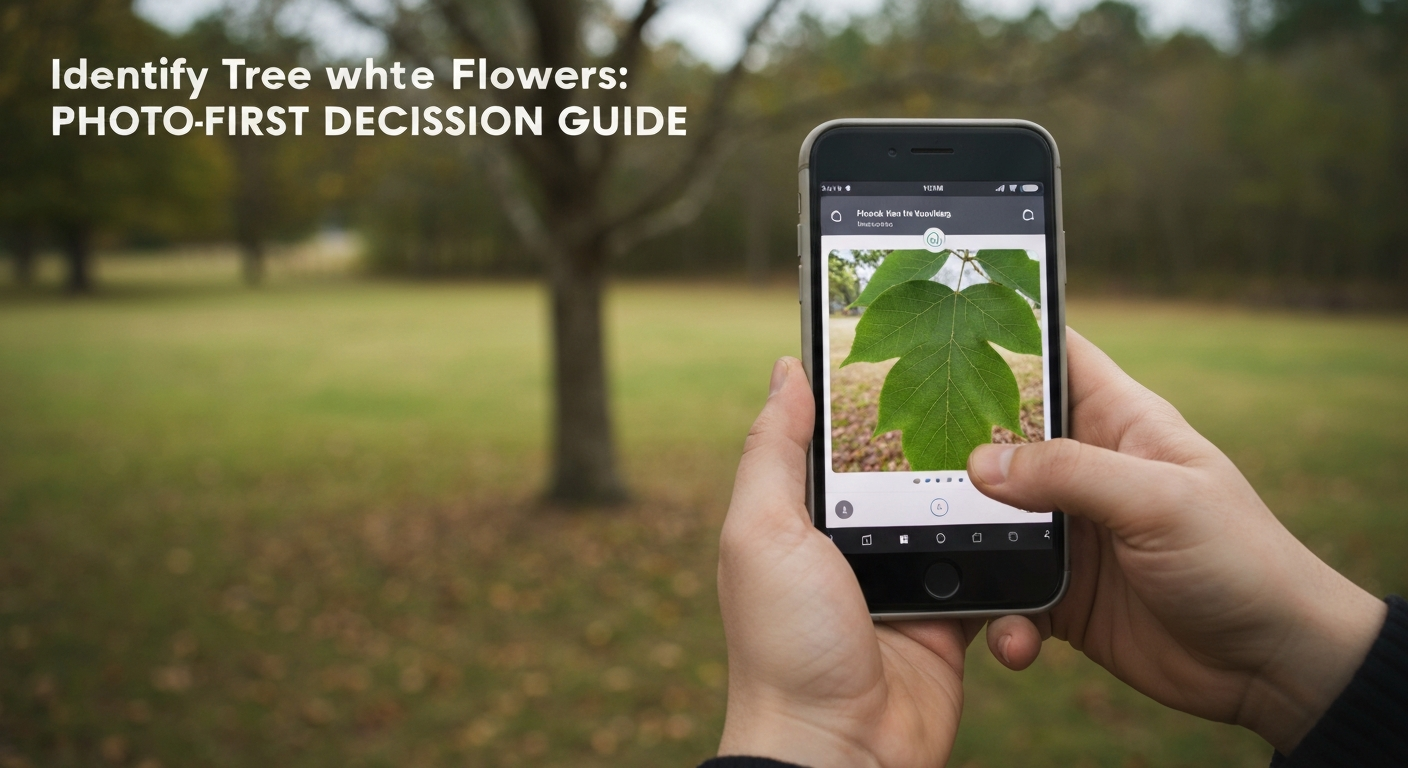
TL;DR: To identify a tree with white flowers from photos, work in three steps: (1) capture flower cluster structure — flat four-bract “petals” (dogwood), dense five-petaled cloud (Bradford pear), drooping racemes (cherry), or rounded rose-family clusters (crabapple, hawthorn); (2) check whether leaves are opposite or alternate on the twig; (3) confirm with bark, thorns, and fruit. Common spring suspects are dogwood, Bradford pear, cherry, crabapple, hawthorn, and catalpa. Photograph close, then confirm with the Tree Identifier app.
🌸 White color alone will not identify a tree with white flowers. Petal/bract count, cluster shape, and opposite vs alternate leaves separate lookalikes in under a minute when your photos show those details.
Why a decision workflow beats a species list
Searching “identify tree with white flowers” usually means one tree in your yard or along a sidewalk — not a catalog of every white-blooming species in North America. Species lists are useful later for browsing; in the field you need a photo-first workflow that narrows candidates fast.
This guide is that workflow. It is deliberately different from a flowering-trees white-flowers catalog: you will decide how the flowers are built, how the leaves attach, and what bark or thorns add — then match one of the common suspects. If you want leaf basics first, see Identify Trees by Leaf. For what to photograph, see Best Photo for Tree ID.
Spring bloom season piles white trees into the same week in many towns. Bradford pears and cherries can both look like foam from a distance. Dogwood and crabapple both look elegant up close. The decision tree below keeps you from guessing by scent or “it looks pretty.”
Step 1 — Photograph the flower cluster correctly
Before you name anything, get one usable flower photo. Fill the frame with a single cluster or a few open blossoms. Avoid silhouettes against bright sky. Side light in morning or late afternoon shows petal edges and bracts better than noon glare.
Ask these questions while looking at the screen:
- Are the “petals” really four large flat bracts? If yes, and the true tiny flowers sit in the center, you are in flowering dogwood territory (Cornus florida and relatives).
- Are there five small petals on each flower, packed into a dense white cloud? Think Callery / Bradford pear (Pyrus calleryana) or other ornamental pears.
- Do white flowers hang in long drooping racemes like a bottle brush? Think black cherry or other wild cherries (Prunus).
- Are flowers in rounded clusters on short stalks, rose-family style, sometimes with pink flush? Think crabapple or hawthorn.
- Are flowers large, tubular or orchid-like, with purple and yellow markings inside? Think catalpa — often later than peak cherry week.
If the photo only shows a white blob from across the street, walk closer or use optical zoom. App and human ID both fail on distant bloom clouds. Terms like raceme, umbel, and bract are defined in the Tree Anatomy Glossary.
Step 2 — Opposite vs alternate leaves
Leaf arrangement is the highest-value second photo when you identify a tree with white flowers. Look at a growing tip where leaves attach:
- Opposite: Two leaves leave the twig at the same node, mirrored left and right. Dogwood and catalpa are opposite. Maples are opposite too, but most maples do not produce showy white spring flower displays like these.
- Alternate: One leaf per node, staggered along the twig. Cherry, crabapple, hawthorn, Bradford pear, and serviceberry are alternate.
If leaves are not out yet, look for leaf scars or buds at nodes — opposite buds still mirror each other. Photograph a 6-inch twig section so arrangement is obvious. This single cue eliminates half the common white-flower suspects instantly.
Opposite + white flowers: Start with dogwood (flat four-bract “flowers”) or catalpa (large marked blossoms, huge heart-shaped leaves, long bean-like pods later).
Alternate + white flowers: Stay in the rose family and pears — cherry, crabapple, hawthorn, Bradford pear — and use flower shape, thorns, and fruit to finish.
Step 3 — Bark, thorns, and habit
Bark and thorns confirm what flowers and leaves suggest:
- Flowering dogwood: Mature bark often breaks into small square blocks — “alligator” or checkerboard bark. Small tree, layered horizontal branching.
- Bradford / Callery pear: Gray bark, often narrow upright crown that becomes broader with age; branches may have short thorns on wilder Callery types; flowers often smell unpleasant.
- Cherry (wild black cherry): Young bark smooth with horizontal lenticels; older bark dark and scaly. See Prunus serotina identification.
- Crabapple: Small ornamental tree, often multi-trunk or dense crown; fruit small apples persist; usually no stout hawthorn-style thorns. See Crabapple tree identification.
- Hawthorn: Stout sharp thorns, often lobed leaves, small red haws later. See Hawthorn tree identification.
- Catalpa: Coarse bark, very large opposite heart-shaped leaves, cigar-like seed pods hanging after bloom.
Habit helps from a distance: dogwood is usually understory-scale; Bradford pear is a street-tree silhouette; catalpa looks oversized and tropical in leaf size.
Common suspect A — Flowering dogwood
Flowering dogwood is the classic “white flower” tree of eastern yards and woodlands. What look like four white petals are modified leaves called bracts; the true flowers are the small yellowish cluster in the center. Leaves are opposite, simple, and often show arcuate veins curving toward the tip.
Photo checklist: One bract cluster from the side so the center is visible. One opposite leaf pair. Bark blocks if the tree is mature.
Confusion risk: Kousa dogwood (Cornus kousa) has pointed bracts and blooms later, often after leaves are fully expanded; fruit becomes a pink raspberry-like ball. Native flowering dogwood blooms with or just as leaves expand and has rounded bract tips with a notch.
If opposite leaves plus four large white bracts are clear, you have almost certainly identified your tree with white flowers as a dogwood — not a pear or cherry.
Common suspect B — Bradford / Callery pear
Bradford pear (a Callery pear cultivar) transformed suburban spring: entire streets turn white almost overnight. Flowers are five-petaled, densely packed, and often smell fishy or unpleasant up close. Leaves are alternate, glossy, and somewhat rounded with fine teeth; fall color can be deep maroon.
Photo checklist: Close flower showing five petals. Alternate leaf on the same shoot. Whole-tree silhouette if possible.
Why it fools people: From the road it looks like a giant dogwood or cherry. Opposite-leaf check kills the dogwood idea immediately. Drooping cherry racemes are longer and looser than pear’s compact umbels. Many municipalities now discourage planting Callery pear because it escapes and forms thorny thickets.
When neighbors ask how to identify a tree with white flowers on the median strip, Bradford pear is often the answer in the eastern and midwestern US.
Common suspect C — Cherry (wild and ornamental)
Cherries in genus Prunus produce white (sometimes pink) flowers. Wild black cherry hangs flowers in elongated racemes; ornamental Yoshino and other flowering cherries may present denser clusters and pink tones. Leaves are alternate, typically lanceolate with fine teeth. Bark often shows horizontal lenticels — pale dashes across young trunks.
Photo checklist: Raceme or cluster shape. Leaf margin and tip. Bark with lenticels.
Scratch a twig carefully: many cherries release a faint almond or cyanide scent. That cue supports cherry identification but is not required if photos are strong. For a deep species guide to wild black cherry, use how to identify Prunus serotina. For a broader cherry-tree workflow including the “ground cherry” search confusion, see cherry tree identification.
Common suspect D — Crabapple
Crabapples are planted for spring show: white to pink blossoms, then small persistent fruit. Leaves are alternate, simple, often oval with teeth; some cultivars have lobed leaves that confuse beginners with hawthorn. True crabapples usually lack the long stout thorns of wild hawthorn.
Photo checklist: Flower cluster and any pink blush. Leaf shape. Small apple-like fruit if present from last season.
Crabapple vs hawthorn is the frequent backyard puzzle. Thorns plus deeply lobed leaves push you to hawthorn; thornless ornamental form with leftover mini-apples pushes you to crabapple. Details live in the crabapple identification guide.
Common suspect E — Hawthorn
Hawthorn (Crataegus) blooms white in late spring in clusters. Leaves are alternate and often lobed like tiny oak leaves. Branches carry sharp thorns. Fall fruit are small red or orange haws.
Photo checklist: Thorny twig with a leaf. Flower cluster. Haws if available.
If you are trying to identify a tree with white flowers and you jab your hand on a thorn, do not skip that clue — photograph the thorn. Hawthorn hedgerows and yard specimens are common across North America and Europe. Full field marks: hawthorn tree identification.
Common suspect F — Catalpa
Northern and southern catalpa produce large, showy white flowers with purple and yellow throat markings — more orchid than rose. Bloom often comes after peak cherry and pear week. Leaves are opposite (sometimes whorled in threes), very large, and heart-shaped. Later, long slender pods hang like green beans or cigars.
Photo checklist: Single flower showing interior markings. One giant leaf with petiole attachment. Pods if present.
Catalpa is rarely confused with dogwood once leaf size is visible — catalpa leaves can be dinner-plate scale. It is confused with “mystery white flowers” when people only photograph the bloom high in the canopy without a leaf for scale.
Quick decision table
Use this order when you identify a tree with white flowers on site:
- Opposite leaves + four large bracts → flowering dogwood (check Kousa if bracts pointed and bloom late).
- Opposite huge heart leaves + marked tubular flowers → catalpa.
- Alternate + dense five-petaled foul-scented cloud → Bradford / Callery pear.
- Alternate + drooping racemes + lenticel bark → cherry.
- Alternate + thorns + lobed leaves → hawthorn.
- Alternate + ornamental form + small apples → crabapple.
Still stuck? Serviceberry / juneberry also has early white flowers and edible berries — multi-stem shrub or small tree with alternate simple leaves. See juneberry identification. For broader backyard context, browse common backyard trees in the US and What type of tree is this?.
Photo set that apps (and experts) need
A reliable identify-tree-with-white-flowers photo set is three frames:
- Flower: Cluster filling most of the frame, petals/bracts sharp.
- Leaf / twig: Arrangement (opposite vs alternate) unmistakable.
- Bark or thorn: Trunk texture or a thorny node.
Optional fourth: whole tree for habit. Submit the close-ups first to Tree Identifier — the app is built for leaf and flower detail, not distant white haze. The same principles apply year-round when you follow app guidance for tree ID.
Do not rely on bloom color names from nursery tags alone; cultivars rename pink as white and white as blush. Structure wins.
Seasonal timing tips
Note the calendar when you shoot. Early serviceberry and some cherries can bloom before leaves are full. Dogwood and Bradford pear often peak with leaves expanding. Catalpa frequently lags. A late June white flower with giant opposite leaves is almost never a spring dogwood leftover — check catalpa.
After petals drop, you can still identify the tree with white flowers by leftover fruit, pods, or leaf arrangement. Pear and crabapple fruit, cherry drupes, hawthorn haws, dogwood berry clusters, and catalpa pods continue the story into summer and fall.
Using Tree Identifier during bloom week
Tree Identifier is most accurate when flower structure and leaf arrangement appear in separate clear photos. During peak white bloom week, take 20 extra seconds to frame one cluster properly — that beats three rushed whole-tree shots.
If results return multiple rose-family options, add a thorn photo or a fruit photo from the same plant. Cherry vs crabapple vs hawthorn is exactly where a second image resolves the tie.
This workflow — cluster, arrangement, bark/thorns — is how you identify a tree with white flowers consistently, whether you are walking a suburban street of Bradford pears or a woodland edge of dogwood and black cherry.
Frequently asked questions
How do you identify a tree with white flowers?
Identify a tree with white flowers by photographing the flower cluster close-up, one leaf showing arrangement on the twig, and bark on the trunk. First decide cluster type — flat umbel (dogwood), dense cloud (Bradford pear), drooping raceme (cherry), or upright clusters (crabapple, hawthorn). Then check opposite vs alternate leaves. Finally use bark, thorns, and fruit to confirm. Tree Identifier can match from a sharp blossom and leaf photo.
What trees have white flowers in spring?
Common backyard and roadside trees with white spring flowers include flowering dogwood, Bradford Callery pear, ornamental and wild cherry, crabapple, hawthorn, catalpa (late spring to early summer), serviceberry (juneberry), and some magnolias. Region and bloom timing matter — dogwood and cherry peak earlier than catalpa. Use leaf arrangement and flower structure, not color alone, to identify a tree with white flowers.
How do you tell dogwood from Bradford pear?
Dogwood flowers sit in flat clusters with four large white bracts that look like petals; leaves are opposite. Bradford pear blooms as a dense white cloud of five-petaled flowers on alternate leaves, often with an unpleasant scent, and has a narrow upright crown that later spreads. Dogwood bark on mature trees becomes blocky like alligator hide; Callery pear bark is gray and more ordinary. Opposite leaves alone rule out Bradford pear.
Do white flowering trees have opposite or alternate leaves?
Both. Dogwood and catalpa have opposite leaves — two leaves per node. Cherry, crabapple, hawthorn, Bradford pear, and most serviceberries have alternate leaves — one leaf per node zigzagging along the twig. Leaf arrangement is the fastest split when you identify a tree with white flowers after bloom fades or when flower photos are ambiguous.
What white flower tree has thorns?
Hawthorn is the classic white-flowered tree with stout sharp thorns on the branches. Some wild plum and crabapple relatives may have short spurs, but hawthorn thorns are usually longer and more obvious. If your white blossom tree has lobed leaves plus thorns, start with hawthorn identification rather than cherry or dogwood.
When do white flowering trees bloom?
Timing varies by species and region. Dogwood, cherry, crabapple, and Bradford pear typically bloom in mid to late spring. Catalpa often blooms later — late spring into early summer — with large orchid-like white flowers marked with purple and yellow. Serviceberry can bloom very early, sometimes before leaves fully expand. Note the month and whether leaves are already out when you photograph.
Can a tree ID app identify white flowering trees?
Yes, when photos show flower structure clearly plus at least one leaf or bark shot. Apps struggle with distant whole-tree bloom clouds that hide petal shape. Photograph one cluster filling the frame, then a leaf showing opposite or alternate arrangement. Tree Identifier works well for dogwood, pear, cherry, crabapple, hawthorn, and catalpa when those cues are visible.
Try Tree Identifier — free on iPhone
Photograph white flower clusters and leaves and get a species match in seconds.
Download on the App Store