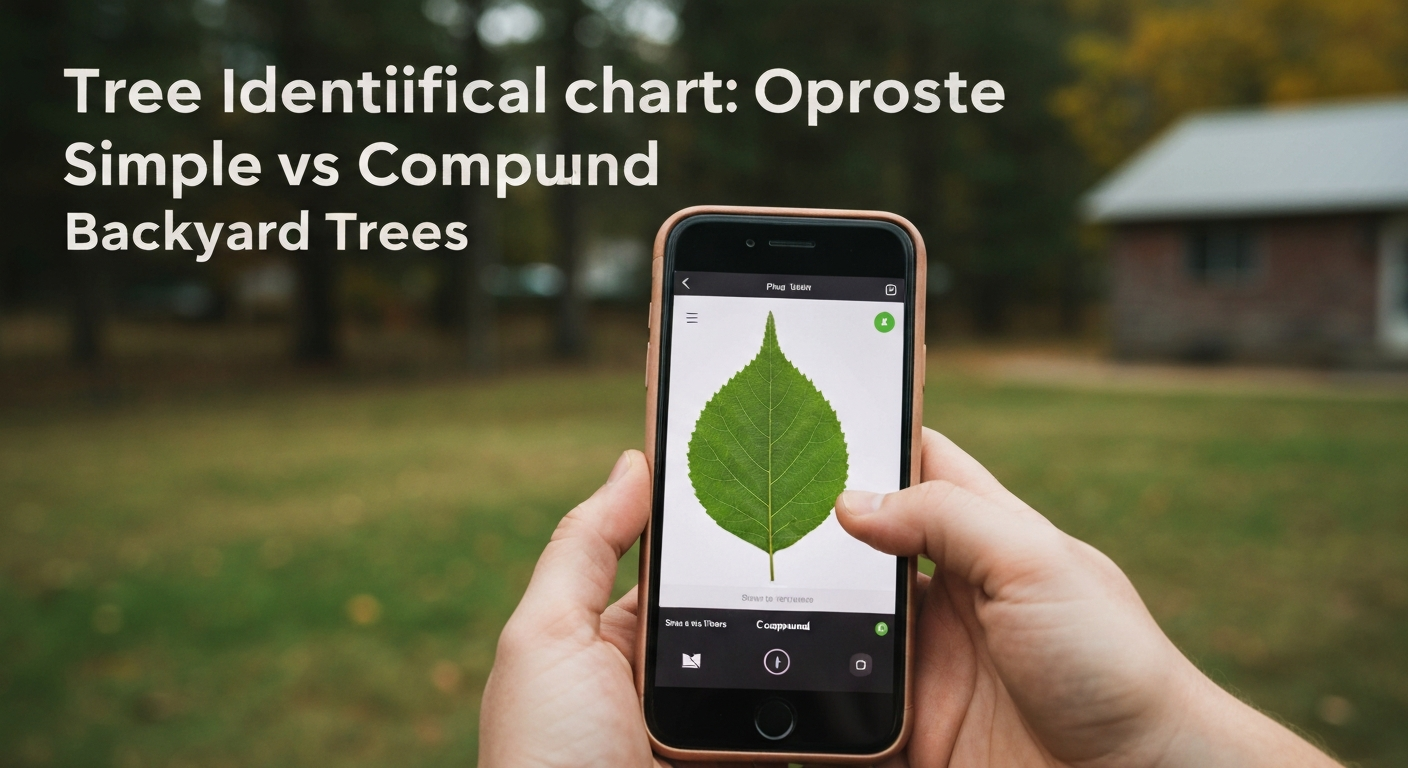
TL;DR: Use this tree identification chart in three moves: (1) opposite vs alternate leaves, (2) simple vs compound blades, (3) lobed vs toothed vs entire margins. Match the trait combo to the backyard species tables below, then confirm with bark or fruit and the Tree Identifier app. Chart lookups are fast; species names still need a second clue.
📊 Bookmark this tree identification chart rule: opposite + lobed ≈ maple; alternate + lobed ≈ oak; alternate + compound ≈ hickory/walnut/locust; opposite + compound ≈ ash/buckeye.
How to use this tree identification chart
A tree identification chart is a reference grid, not a novel. Read left to right: arrangement first, structure second, margin third. Stop when only a few backyard candidates remain. If you want the full method narrative, open the companion tree identification guide. If you want a yes/no flowchart instead of tables, use the tree id chart.
Photograph the twig with two nodes visible before you guess — arrangement errors cause most chart misreads. Definitions of petiole, sinus, and rachis live in the tree anatomy glossary.
Chart 1: Leaf arrangement
| Arrangement | What you see | Common backyard examples |
|---|---|---|
| Opposite | Two leaves at each node, mirrored | Red maple, sugar maple, Norway maple, ash, flowering dogwood, Ohio buckeye |
| Alternate | One leaf per node, staggered | White oak, red oak, birch, elm, cherry, sweetgum, hickory, black walnut, redbud |
| Whorled | Three or more leaves at one node | Northern catalpa, southern catalpa (rare on most lots) |
Memory aid for beginners: MAD Cap Horse — Maple, Ash, Dogwood, Caprifoliaceae shrubs, Horse chestnut/buckeye — the classic opposite groups. Nearly everything else is alternate.
Chart 2: Simple vs compound
| Structure | Definition | Backyard examples |
|---|---|---|
| Simple | One continuous blade per petiole | Oak, maple, birch, elm, cherry, beech, sweetgum, sycamore, redbud, magnolia |
| Pinnately compound | Leaflets in a row on a rachis | Black walnut, shagbark hickory, white ash, honey locust, tree-of-heaven |
| Palmately compound | Leaflets radiate from one point | Ohio buckeye, horse chestnut |
Compound-leaf tips for this tree identification chart: count leaflets on a typical mid-crown leaf, not a damaged stub. Ash leaflets are opposite on an opposite-leaved tree; hickory leaflets are alternate on an alternate-leaved tree — both are pinnate, so arrangement still matters.
Chart 3: Margin — lobed, toothed, or entire
| Margin type | Look for | Backyard examples |
|---|---|---|
| Lobed | Deep or shallow indentations (sinuses) | Oaks, maples, sweetgum (star lobes), sycamore, tulip tree |
| Toothed / serrate | Sawlike edge teeth | Birch, elm, cherry, American chestnut (rare), many hickory leaflets |
| Entire (smooth) | No teeth, no lobes | Redbud (mature), southern magnolia, some dogwoods, live oak (often entire lobes shallow) |
| Doubly serrate | Teeth on teeth | Ironwood, hornbeam, some birches |
Margin is the third filter. Two lobed trees that share yard space — red maple and white oak — separate instantly once arrangement sits on the chart: opposite maple vs alternate oak. Full photo walkthroughs live in identify trees by leaf and tree foliage identification.
Master backyard tree identification chart
Combine the three charts into one lookup table of common US yard trees. This is the heart of the tree identification chart page — skim until traits match, then verify.
| Tree | Arrangement | Structure | Margin / shape | Quick confirm |
|---|---|---|---|---|
| Red maple | Opposite | Simple | 3–5 lobes, V sinuses | Paired samaras; red petioles common |
| Sugar maple | Opposite | Simple | 5 lobes, U sinuses | Smooth gray bark when young; classic maple leaf |
| Norway maple | Opposite | Simple | Broad lobes, milky sap in petiole | Wide street-tree crown; tough urban survivor |
| White oak | Alternate | Simple | Rounded lobes | Acorns; light gray platy bark |
| Northern red oak | Alternate | Simple | Pointed bristle-tipped lobes | Acorns; ski-trail bark ridges |
| Sweetgum | Alternate | Simple | 5 pointed star lobes | Spiky gum balls on ground |
| American sycamore | Alternate | Simple | Broad maple-like lobes | Mottled white/cream peeling bark |
| River birch | Alternate | Simple | Doubly serrate, diamond/ovate | Peeling cinnamon-salmon bark |
| American elm | Alternate | Simple | Doubly serrate, unequal leaf base | Vase-shaped crown when mature |
| Black cherry | Alternate | Simple | Finely serrate, lance tip | Burnt-cornflake bark plates; small black fruit |
| Eastern redbud | Alternate | Simple | Heart-shaped, entire | Magenta spring flowers on bark |
| White ash | Opposite | Pinnate compound | 5–9 leaflets, toothed | Single samaras in clusters; diamond bark |
| Black walnut | Alternate | Pinnate compound | 15–23 leaflets | Round husked nuts; chambered pith |
| Shagbark hickory | Alternate | Pinnate compound | Usually 5 leaflets | Dramatically shaggy bark plates |
| Honey locust | Alternate | Once/twice pinnate | Tiny leaflets | Long twisted pods; often thornless cultivars |
| Ohio buckeye | Opposite | Palmate compound | 5 leaflets | Buckeye nuts in prickly husks |
| Eastern white pine | — | Needles in fascicles | 5 soft needles per bundle | Long slender cones; soft flexible needles |
| Eastern redcedar | — | Scale-like foliage | Tiny overlapping scales | Blue berry-like cones; columnar form |
That roster covers a large share of suburban mystery trees. Expand context with common backyard trees in the US, and drill species pages such as oak and maple when the chart points there.
Combo shortcuts (print-friendly)
- Opposite + simple + lobed → Maple group
- Opposite + compound + pinnate → Ash
- Opposite + compound + palmate → Buckeye / horse chestnut
- Alternate + simple + lobed + rounded lobes → White oak group
- Alternate + simple + lobed + bristled tips → Red oak group
- Alternate + simple + star lobes → Sweetgum
- Alternate + compound + many leaflets + round husks → Black walnut
- Alternate + compound + ~5 leaflets + shaggy bark → Shagbark hickory
- Alternate + simple + heart + magenta flowers → Eastern redbud
Bark and fruit columns to add mentally
Leaf charts fail silently on cultivars and hybrids. Always add one bark or fruit check from this mini-list:
- Peeling white/cream mottling → Sycamore
- Salmon peeling curls → River birch
- Spiky spheres → Sweetgum
- Acorns → Oak
- Paired helicopters → Maple
- Single winged seeds → Ash
Bark photography tips: identify trees by bark. Framing tips: best photo for tree ID.
When the chart disagrees with your gut
Trust traits over reputation. Homeowners often insist a Norway maple is “the oak by the driveway” because the leaf looks lobed from twenty feet away. Run the tree identification chart cold: opposite? Yes → maple path. Milky sap in the petiole? Norway maple. Apps will agree when the leaf photo shows opposite nodes.
Conversely, Callery pear leaves look generic toothed-oval; flowers and inedible hard fruits finish the ID better than leaf charts alone.
Teaching kids with chart language
Charts teach vocabulary faster than dense essays. Give kids three cards — Opposite, Alternate, Compound — and a scavenger checklist of five yard trees. Their job is to place each tree on the correct row of the master table. Reward correct arrangement first; species name second. Adults can confirm with Tree Identifier.
Chart vs app vs full guide
Use this tree identification chart to reduce candidates to two or three. Use the method essay in the tree identification guide when you are still learning sequence. Use a quick-start workflow in the tree id guide when you only have five minutes on a hike. Use an app to identify trees to name the finalist from photos.
No single tool replaces all others. Charts excel at teaching and triage; apps excel at speed; field methods excel at preventing confident wrong answers.
Frequently asked questions
What is a tree identification chart used for?
A tree identification chart organizes visible traits — leaf arrangement, simple vs compound structure, and margin type — so you can match a mystery tree to a short list of common species. It is a reference tool, not a full field narrative. Use the chart in the yard or trail, then confirm with bark, fruit, and a photo app.
How do I read opposite vs alternate on a chart?
Opposite means two leaves meet at the same node on opposite sides of the twig — maple, ash, dogwood, buckeye. Alternate means one leaf per node, staggered along the twig — oak, birch, elm, cherry, hickory, walnut. Start every tree identification chart lookup with arrangement; it cuts candidates roughly in half.
What is the difference between simple and compound leaves?
A simple leaf has one blade on one petiole. A compound leaf has multiple leaflets on one rachis before a single attachment to the twig. Oaks and maples are simple; hickories, walnuts, ashes, and locusts are compound. Never count each leaflet tip as a separate leaf when using a tree identification chart.
Which common US backyard trees are opposite-leaved?
Red maple, sugar maple, Norway maple, white ash (and other ashes), flowering dogwood, and Ohio buckeye are the opposite-leaved trees beginners meet most often. If leaves are opposite and lobed, think maple. If opposite and compound, think ash or buckeye.
Which backyard trees have lobed leaves?
Oaks, maples, sweetgum, sycamore, and tulip tree (tulip poplar) commonly show lobed leaves in US yards. Use arrangement and bark from this tree identification chart to separate them: maple opposite; oak alternate; sweetgum star-shaped lobes; sycamore mottled bark.
Can a chart replace a tree ID app?
No. Charts narrow options quickly; apps name species from photos. The best workflow is chart traits first, then Tree Identifier confirmation, then bark or fruit sanity check. Charts excel when cellular signal is weak or when teaching kids trait language.
How is this different from a tree id chart?
This tree identification chart emphasizes trait tables and a backyard species roster. A tree id chart is usually organized as a decision flowchart — trait A leads to genus B. Use both: backyard tables here, flowchart decisions in the companion tree id chart post.
Try Tree Identifier — free on iPhone
Use the chart to shortlist traits, then photograph the leaf and get a species match in seconds.
Download on the App Store