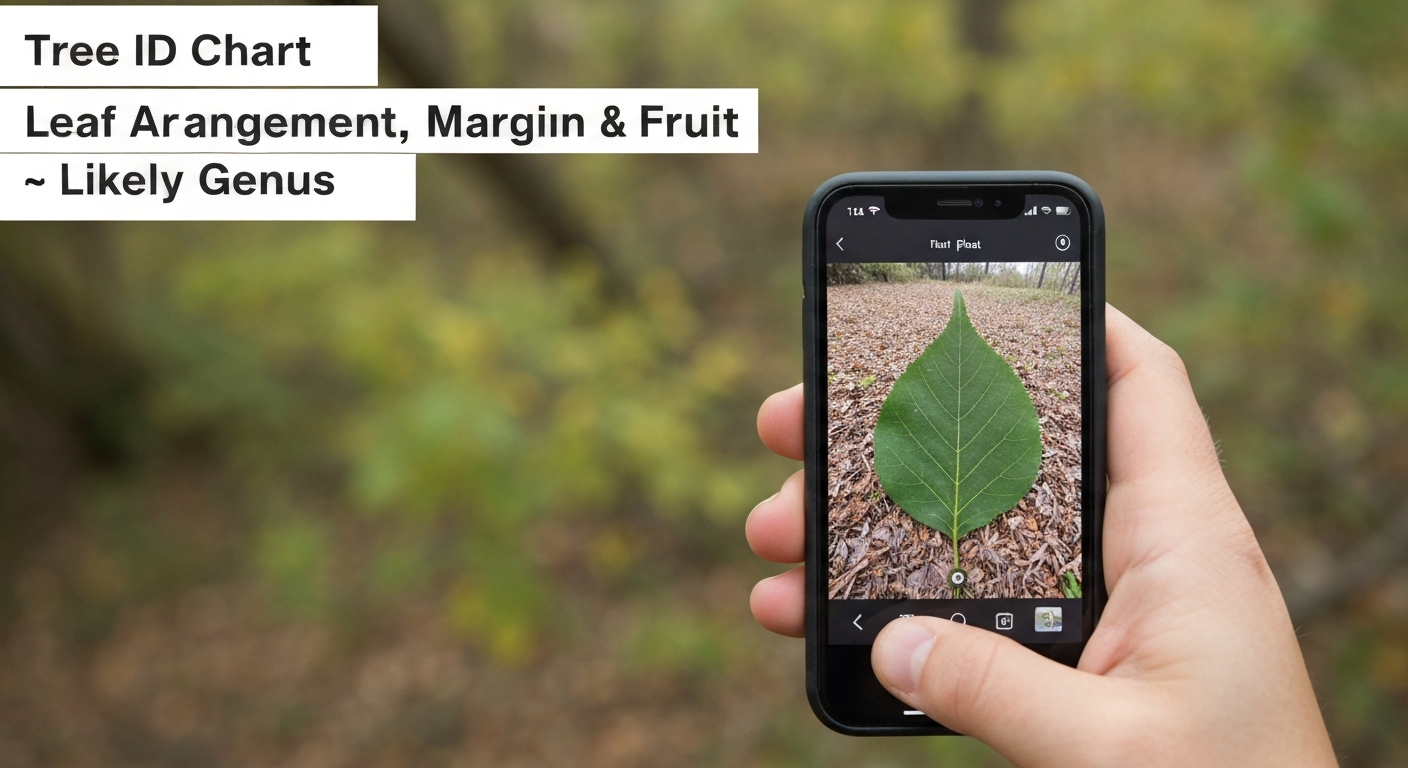
TL;DR: This tree id chart works like a flowchart. Ask three questions in order: (1) opposite or alternate? (2) lobed, toothed, or entire — and simple or compound? (3) what fruit is present? Follow the matching row to a likely genus (maple, oak, walnut, ash…). Confirm with bark and the Tree Identifier app. For backyard name tables instead of decisions, use the tree identification chart.
🔀 Decision rule: arrangement → structure/margin → fruit → genus. If any step fails, stop and re-photograph the twig. Bad arrangement data breaks every tree id chart path.
How to walk this tree id chart
Read only the branch that matches what you see. Do not scan every row like a phone book — that is what the other chart is for. This tree id chart is logic, not inventory.
Need vocabulary? Open the tree anatomy glossary. Need photo framing? See best photo for tree ID. Need the speed checklist? Use the tree id guide.
Decision gate A — leaf arrangement
| If you see… | Then go to… |
|---|---|
| Two leaves per node (opposite) | Gate B1 — Opposite paths |
| One leaf per node (alternate) | Gate B2 — Alternate paths |
| Three+ leaves at a node (whorled) | Likely Catalpa (Catalpa) — confirm giant heart leaves + long pods |
| Needles or scale foliage (evergreen) | Gate E — Evergreen block |
Decision gate B1 — opposite leaves
| Structure + margin | Fruit (if present) | Likely genus | Common name |
|---|---|---|---|
| Simple + lobed | Paired samaras (helicopters) | Acer | Maple |
| Simple + lobed | None yet | Acer (primary) | Maple — verify bark |
| Simple + entire/wavy, not lobed | Fleshy red or purple fruit clusters | Cornus | Dogwood |
| Pinnately compound (leaflets in a row) | Single winged samaras in clusters | Fraxinus | Ash |
| Pinnately compound | None | Fraxinus vs boxelder maple | Check if end leaflet looks maple-like (boxelder) |
| Palmately compound (leaflets from one point) | Buckeye nut in husk | Aesculus | Buckeye / horse chestnut |
Opposite + lobed is the cleanest tree id chart win: almost always maple. Drill species later via maple identification.
Decision gate B2 — alternate leaves
| Structure + margin | Fruit (if present) | Likely genus | Common name |
|---|---|---|---|
| Simple + lobed, rounded lobe tips | Acorn | Quercus (white oak group) | White oaks |
| Simple + lobed, bristle tips | Acorn | Quercus (red oak group) | Red oaks |
| Simple + 5 pointed star lobes | Spiky gum ball | Liquidambar | Sweetgum |
| Simple + broad maple-like lobes | Round buttonball cluster | Platanus | Sycamore / planetree |
| Simple + 4 lobes with flat notch tip | Cone-like aggregate | Liriodendron | Tulip tree |
| Simple + toothed, unequal leaf base | Wafer samaras / none | Ulmus | Elm |
| Simple + toothed, diamond/ovate | Catkins / tiny seeds | Betula | Birch (check peeling bark) |
| Simple + finely toothed lance leaf | Small fleshy cherries | Prunus | Cherry / plum |
| Simple + heart-shaped, entire | Short flat pods; magenta flowers on bark | Cercis | Redbud |
| Simple + giant heart, often whorled | Long bean pods | Catalpa | Catalpa |
| Pinnately compound, many leaflets | Round husked nut | Juglans | Walnut |
| Pinnately compound, usually 5–9 leaflets | Husked nut, often 4-valved | Carya | Hickory |
| Once/twice compound, tiny leaflets | Long twisted pods | Gleditsia | Honey locust |
| Pinnately compound, glandular leaflet bases | Twisted samaras | Ailanthus | Tree-of-heaven (invasive) |
Alternate + lobed + acorn → oak genus every time. Species polish: how to identify oak. Leaf photo practice: identify trees by leaf.
Decision gate C — fruit-first shortcuts
When fruit is obvious, jump the tree id chart:
| Fruit type | Go to genus | Still verify |
|---|---|---|
| Acorn | Quercus | Leaf lobes white vs red group |
| Paired helicopter samaras | Acer | Opposite leaves |
| Single winged samaras in bunches | Fraxinus | Opposite compound leaves |
| Round green/black husked nut | Juglans / Carya | Leaflet count + bark |
| Spiky sphere | Liquidambar | Star leaves |
| Long slender bean pods | Catalpa | Giant hearts |
| Short flat pealike pods + magenta flowers on wood | Cercis | Heart leaves |
| Woody cone | Conifer genera | Gate E needle traits |
Decision gate E — evergreen block
| Foliage | Extra clue | Likely path |
|---|---|---|
| Needles in bundles of 2–5 | Woody hanging cones | Pinus — pine |
| Single needles on woody pegs, 4-sided | Pendant cones | Picea — spruce |
| Flat single needles, soft | Upright cones (fir) or small pendant (hemlock) | Abies / Tsuga |
| Scale-like sprays | Blue berry-like cones | Juniperus — redcedar/juniper |
| Scale-like sprays, flattened | Small elongated cones | Thuja — arborvitae |
Worked flowchart examples
Example 1: Opposite → simple lobed → paired samaras → Acer (maple). Species: use petiole color, sinus shape, bark. App confirms red maple.
Example 2: Alternate → simple lobed → bristle tips → acorn → Quercus red oak group. App + ski-trail bark → northern red oak.
Example 3: Alternate → pinnate compound → many leaflets → round husk → Juglans → black walnut.
Example 4: Alternate → heart entire → short pods + magenta on bark → Cercis → eastern redbud.
These four paths cover a huge fraction of phone photos. For foliage nuance, see tree foliage identification; for bark falsification tests, see bark guide.
When the tree id chart dead-ends
- Cultivars with odd leaves → photograph fruit and bark; trust app + landscape context.
- Hybrid oaks → stop at genus Quercus; species may stay uncertain.
- Winter without fruit → buds + bark gate, then app.
- App disagrees with chart → re-check opposite/alternate; do not invent intermediate genera.
For “someone sent me a blurry photo” triage, use what type of tree is this.
Chart + app feedback loop
Ideal loop for this tree id chart:
- Walk the flowchart to a genus.
- Submit leaf photo to Tree Identifier.
- Confirm the scientific name’s genus matches your path.
- If not, re-examine arrangement or compound structure — user error beats model error more often at this stage.
App shopping notes: app to identify trees. Backyard examples that populate many chart exits: common backyard trees.
Printable mental summary
- Opposite + lobed → maple
- Opposite + compound → ash or buckeye
- Alternate + lobed + acorn → oak
- Alternate + star lobes + gum ball → sweetgum
- Alternate + compound + husked nut → walnut/hickory
- Whorled + giant heart + long pod → catalpa
- Needles in bundles → pine
That is the entire tree id chart in pocket form. The tables above exist for edge cases and teaching.
Combine with the full method essay when you outgrow flowcharts: tree identification guide.
Teaching with the flowchart
A tree id chart is ideal for group hikes and classroom outdoor labs. Assign one student to call arrangement, one to call margin, and one to call fruit. The group must agree before advancing a gate. Disagreements almost always trace to someone counting leaflets as separate leaves or misreading a compound ash as alternate — fixing the observation fixes the path.
Laminate Gate A and the fruit shortcuts for rainy trail days when phones stay in dry bags. Run apps later at the cars. The chart’s job is not to replace technology; it is to keep your eyes honest so technology confirms the right branch of the tree of possibilities.
After ten successful flowchart runs, most beginners internalize the pocket summary without the tables. That transfer of skill — from reading a tree id chart to seeing genus shape in the wild — is the reason decision charts beat random photo guessing.
Frequently asked questions
How do I use a tree id chart?
Start at the top question — opposite or alternate leaves? — then follow the row that matches margin (lobed, toothed, entire) and finally fruit type if present. Each path ends at a likely genus such as Acer, Quercus, or Juglans. Confirm with a photo app and one bark check. This tree id chart is a decision tool, not a species encyclopedia.
How is a tree id chart different from a tree identification chart?
A tree identification chart emphasizes comparison tables and a backyard species roster. A tree id chart emphasizes flowchart decisions — if trait A and trait B, then genus C. Use the backyard roster when you want names of common lawn trees; use this tree id chart when you want the branching logic that gets you to genus.
What if my tree has no fruit?
Stop after arrangement and margin — the chart still narrows to a short genus list. Photograph bark and use an app for the final step. Many maples and oaks are identifiable to genus from leaf alone; species may need fruit or regional keys.
Does this tree id chart cover evergreens?
Yes in a separate decision block: needles in bundles → pine; single needles on pegs → spruce; flat single needles → fir/hemlock path; scale foliage → cedar/juniper path. Deciduous tables remain the bulk of the chart because most phone IDs start with broadleaf trees.
Can beginners use a flowchart without knowing genus names?
Yes — follow the path to the common name column (maple, oak, walnut) and treat the Latin genus as optional. Later, learning Acer and Quercus helps you read field guides and apps that list scientific names.
What fruit types appear in this tree id chart?
Acorns, paired samaras, single samaras, husked nuts, cones, long pods, short flat pods, fleshy berries or drupes, and spiky gum balls. Fruit is the strongest species-level clue once genus is known.
Should I still use an app after the chart?
Yes. Charts propose a genus; apps propose a species from photos. Run Tree Identifier with a leaf photo, then verify that the result sits in the genus your tree id chart predicted. Disagreement means re-check arrangement or photograph fruit.
Try Tree Identifier — free on iPhone
Walk the flowchart to a genus, then photograph the leaf for a species-level match in seconds.
Download on the App Store